<YOUR NAME HERE> — HTBAA Fall 2026
About me
Contact info
Homework, Labs, and Projects
See the nav bar on the left to look through my work for How To Biomanufacture Almost Anything (Fall 2026)!
See the nav bar on the left to look through my work for How To Biomanufacture Almost Anything (Fall 2026)!
I want to produce recombinant keratin-based proteins as programmable building blocks for high-performance ultrafine fibers.
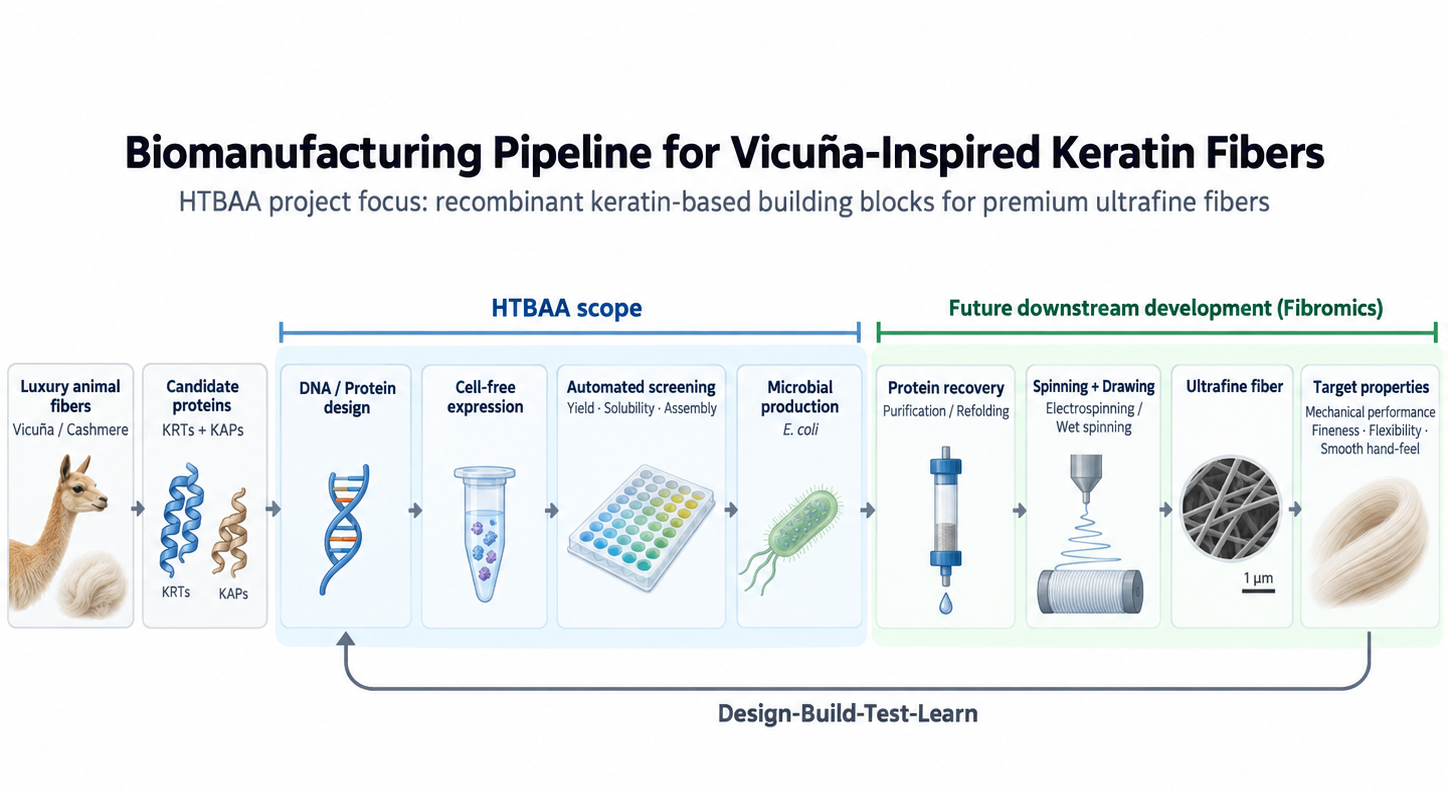
I am particularly interested in keratins and keratin-associated proteins (KAPs) found in, or inspired by, luxury animal fibers such as vicuña and cashmere. Proteomic studies have identified keratins such as K33a, K81/K83 and K86, as well as several KAPs, in South American camelid fibers.
My long-term goal is not to directly replicate vicuña or cashmere fibers, but to reproduce desirable properties such as mechanical performance, fineness, flexibility and smooth hand-feel by controlling both protein composition and downstream fiber architecture.
An engineered microbial expression system, particularly Escherichia coli, could serve as the main production chassis for recombinant keratins.
Recombinant hair keratins have already been successfully expressed in E. coli, although challenges such as insolubility and inclusion-body formation may require downstream solubilization and refolding.
During early development, cell-free protein synthesis could provide a rapid platform to screen different keratin sequences, Type I/Type II combinations, and engineered variants before selecting candidates for microbial production.
Automation could enable parallel screening of protein sequences and expression conditions using cell-free systems, liquid handling and standardized assays.
Protein yield, solubility, aggregation and assembly behavior could be evaluated across multiple candidates. This would help identify proteins with the best manufacturability before scaling their production.
In the future, this could become a Design-Build-Test-Learn workflow in which experimental data guide the selection or redesign of keratin-based proteins specifically for fiber fabrication.
After selecting suitable recombinant proteins, production would transition from microscale cell-free screening to microbial fermentation, followed by efficient protein recovery, purification and, when necessary, refolding.
The downstream manufacturing process would then formulate these proteins for spinning. Electrospinning and, eventually, wet spinning followed by drawing, molecular alignment and crosslinking could be used to control fiber diameter, internal organization and surface properties.
The long-term objective is therefore to connect:
protein design → biomanufacturing → fiber processing → performance
to manufacture ultrafine fibers whose mechanical and sensory properties approach those of premium natural fibers such as vicuña.