Week 1 HW: Final Project Ideas
A Modular Bacterial Nanocellulose Bio-skin Tattoo for Physiological-Strain Monitoring
HTBAA Homework 1
1 Concept
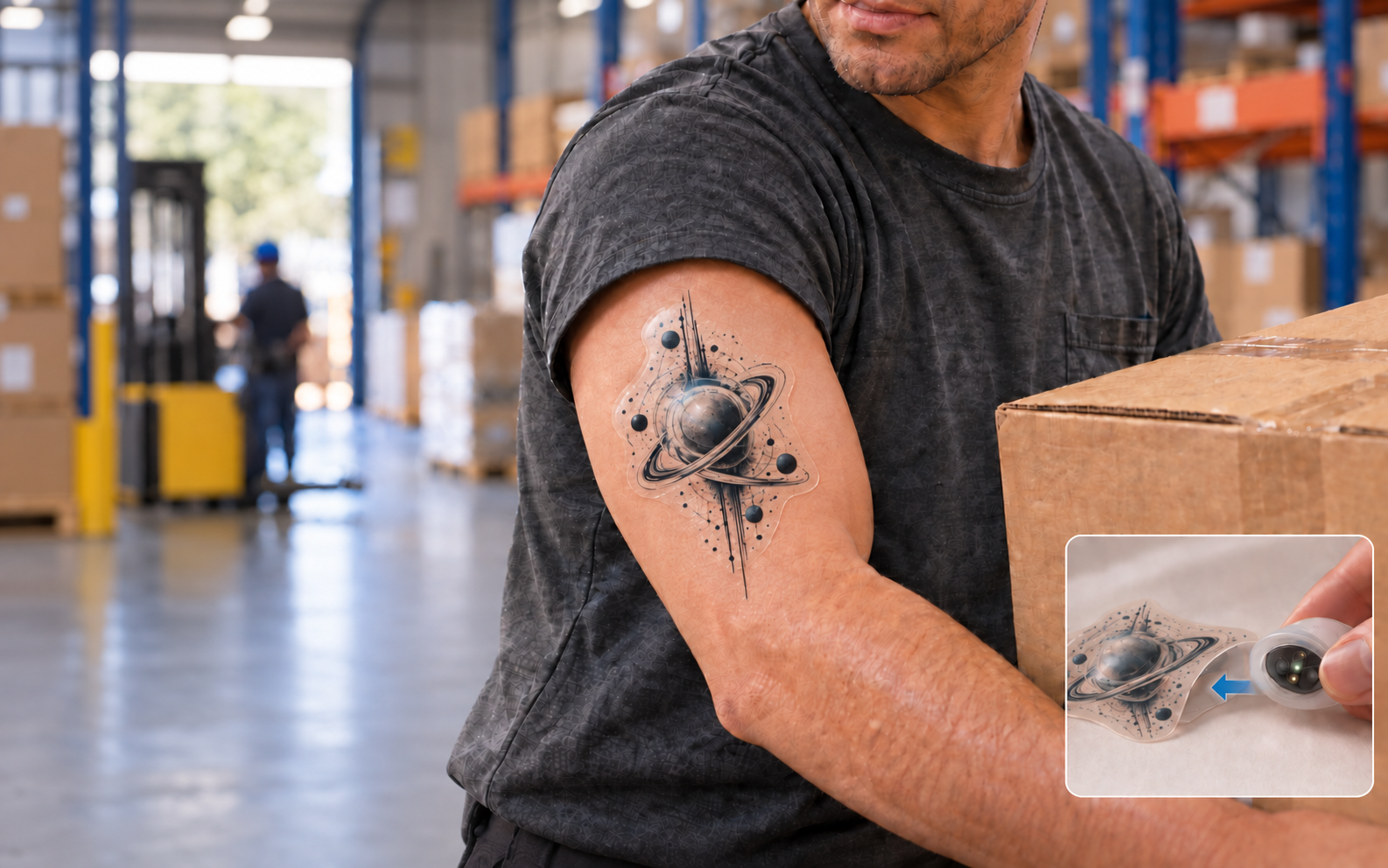
I want to make a soft patch for people who lift and move heavy objects at work. It would be worn on the upper arm and would combine two kinds of measurements in one circular design. A small reusable electronic core in the center would use light to measure heart rate and pulse shape. A replaceable ring around it would collect sweat and measure sweat rate, sodium level, and skin temperature. The Bio-skin would be designed to last for three work shifts, while the core would be removed and charged after each 8–12 hour shift. The patch would help a worker notice patterns related to heat, hydration, and physical effort, and provide timely reminders when signs of increasing strain appear.
The part touching the skin would be called the Bio-skin. It would be made partly from a soft sheet of cellulose grown by bacteria. The Bio-skin could carry printed artwork, so it could look more like a temporary tattoo or personal accessory than a medical device. My goal is to combine a useful workplace wearable with self-expression.
The whole device would be modular. Later versions could use other removable cores, such as a movement sensor or a sensor that measures muscle activity.
2 What I Want to Biomanufacture and Why
Warehouse, construction, factory, and delivery workers may repeat the same lifting tasks for many hours. Their bodies also respond differently to heat and heavy work. Many wearable devices look technical or medical. I am interested in whether a modular wearable can reduce unnecessary replacement, feel more personal, and still provide useful information.
The design is inspired by Swatch. The electronic core would stay the same, but the outer Bio-skin could change in color, pattern, and artwork. In the future, artists could create different collections. The worker would be the person wearing the patch, while an employer or safety team might buy the system. This means privacy and consent would be important. A worker should know what is being measured and who can see the data. The system should support personal awareness and workplace safety, not hidden productivity monitoring or unsupported medical diagnosis. It also have potential to be a fashion item.
3 Main Parts of the Patch
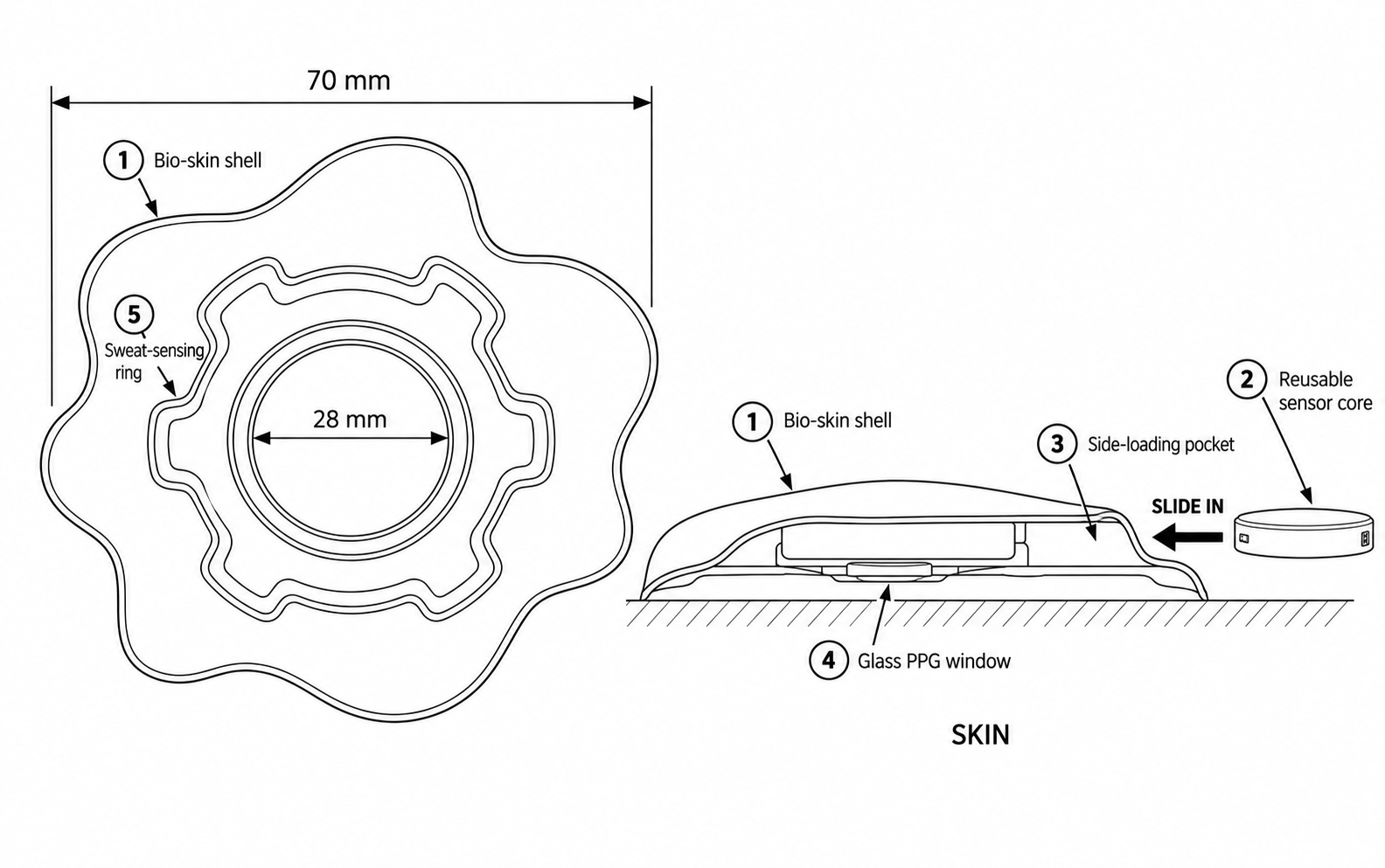
I want to biomanufacture the replaceable skin-facing part of a modular wearable. The Bio-skin would be about 70 millimeters in diameter and worn on the outside of the upper arm. It would contain:
- a soft bacterial-nanocellulose base;
- a patterned medical-grade adhesive border in the first version;
- direct sweat inlets and ring-shaped fluid channels;
- printed sensors for sweat rate and sodium;
- a surface that allows skin-temperature measurement;
- a central optical opening and mechanical pocket for a 25–30 millimeter electronic core;
- an artist-designed outer graphic.
The fluid channels are very small paths that guide fresh sweat from the skin to the sensors.
| Part | Use cycle | Purpose | |
|---|---|---|---|
| Central electronic core | Reusable | PPG light sensor, small computer, Bluetooth, and rechargeable battery. It is removed and charged after each work shift. | |
| Bio-skin | Material and art layer | Three shifts | Soft bacterial-nanocellulose base, artist-designed graphic, central optical opening, opaque fluid-resistant barrier, and a pocket for the 25–30 millimeter core. |
| Bio-skin | Sweat-sensing ring | Three shifts | Direct sweat inlets, ring-shaped small channels, printed sensors for sweat rate and sodium, and contact for skin-temperature measurement. |
| Bio-skin | Adhesive edge | Three shifts | A patterned medical-grade adhesive border that holds the complete Bio-skin against the skin. |
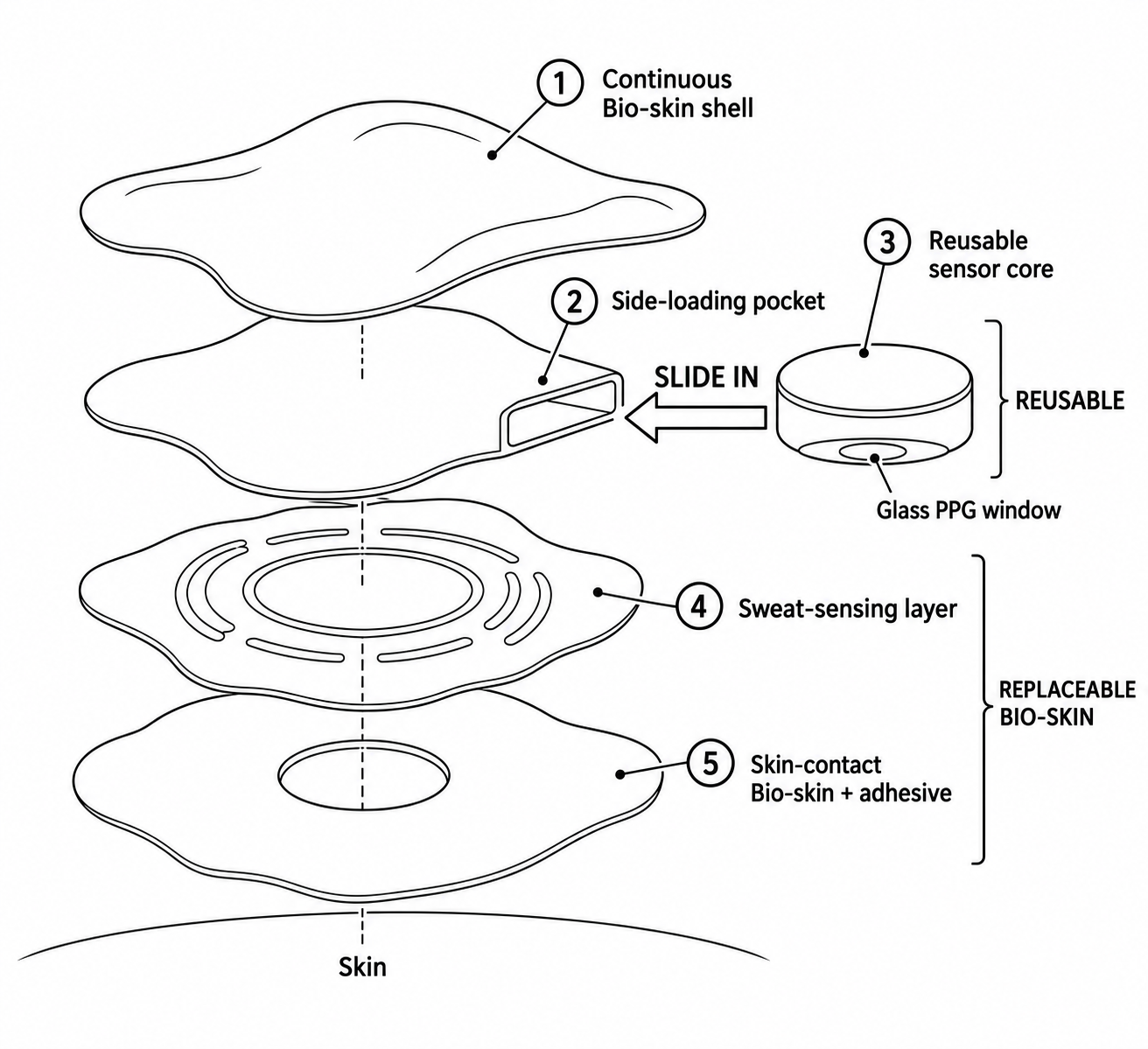
The three Bio-skin rows describe parts of one replaceable patch, not three separate products. The base, sweat-sensing ring, and adhesive edge would be assembled together, so the user could peel off and replace the complete Bio-skin at once. They can still use different materials: bacterial nanocellulose for the soft base and an existing medical-grade adhesive for the skin-contact border.
3.1 How the Electronic Core Connects
The patch has a circle within a circle design. The reusable sensor core is in the center. A fluid resistant ring around it keeps sweat away from the light path. The sweat sensing area forms the outer ring, and the adhesive sit around the outer edge. On the surface, it is the artwork.
PPG uses a small light and a light detector to observe changes in blood volume under the skin. So, the electronic core would sit above the Bio-skin, but its optical face would reach the skin through a direct opening or a tested transparent window. Studies suggest that the upper arm can be a useful place for PPG, although rapid full-body movement can still create errors [1].
The sweat sensors must also reach fresh sweat. A solid cellulose or gel layer placed between the skin and sensor could dilute sweat, hold sodium, mix old and new sweat, or slow the reading. The sweat inlets would therefore touch the skin directly and guide sweat through thin water-attracting channels. Research devices have used controlled channels and a replaceable sweat layer connected to reusable electronics [2,3].
For three-shift use, sweat cannot remain trapped in the sensing ring. A small channel could move sweat past the sensors toward a drainage or evaporation area so that newer sweat continues to arrive. Other sweat patches have used capillary force and evaporation for continuous flow [4]. This idea still needs to be tested with my material.
The core would work for one 8–12 hour shift and charge overnight. To save battery power, it could measure PPG during selected time windows, read the sweat sensors at intervals, and send data in groups. Lifting creates movement errors in PPG, so the core should also report when the signal is unreliable. A small movement sensor could help remove those periods from the results.
The first version would still use a conventional soft circuit board, silicon chips, LEDs, a light detector, Bluetooth, and a rechargeable battery. Its adhesive and conductive sensor inks would also be conventional materials. The biomanufactured material would provide the skin-contact surface, sweat collection and transport, a base for the printed sensors, and the artwork. It would not replace all of the electronics.
4 The Living System
In this project, the living producer would be bacteria from the genus Komagataeibacter. The culture would need water, sugar, other nutrients, oxygen, bacteria, and shallow trays or shaped molds. The bacteria make very small cellulose fibers. Near the air and liquid surface, the fibers join together and form a sheet called bacterial nanocellulose. Researchers have made sheets of 0.2 square meters or more and have also guided the material to grow with surface patterns [6,7].
The basic process would be:
- Put water, sugar, nutrients, and the bacteria into shallow trays.
- Allow the bacteria to grow the cellulose sheet for about five to seven days.
- Remove the sheet, wash and neutralize it, and sterilize it to remove bacteria and leftover culture liquid.
- Dry and condition the sheet so it is thin, soft, and stable.
- Add the sweat channels, printed sensors, artwork, adhesive edge, and pocket for the electronic core.
The bacteria would act as the factory, but the final patch would not contain living bacteria. This feels more realistic for a first version because a living patch would need food, water, containment, and safety controls while it is worn. The amount and quality of cellulose will depend on the food source, oxygen, tray shape, and growth time. Bacterial nanocellulose has already been explored as a thin base that carries body fluids toward flexible electrolyte sensors [8].
5 How Automation Could Help
For early experiments, I would use a small liquid-handling robot. It could prepare many small cultures while changing one condition at a time, such as the amount of sugar, pH, or growth time. A camera could record how quickly each sheet grows and whether it has holes, shrinkage, or uneven areas. I would then test thickness, strength, bending, water uptake, sweat movement, sodium recovery, and whether printed sensors stay attached. Automation would make the experiments more consistent and let me compare many recipes [11].
A production system would use different machines from the early experiments. The main steps could be:
- prepare the growth liquid, add the bacteria, and fill shallow trays;
- control temperature and check the trays while the sheets grow;
- harvest, wash, neutralize, sterilize, and dry the sheets;
- press or laminate the small fluid channels and cut the sweat and PPG openings;
- print the sensors, electrical paths, and artwork;
- test the liquid flow, electrical signals, optical opening, appearance, and batch number.
The electronic core would still use normal electronics manufacturing and automated testing for the PPG, battery, wireless connection, sensor contacts, and protection from sweat. Early automation would help me discover a good design. Production automation would help make the same design consistently.
6 Rough Scale Calculation
I will define a meaningful scale as enough patches for 1,000 workers for one year. I assume that each worker has 250 work shifts each year, one Bio-skin lasts three shifts, 10 percent extra finished patches are kept as reserve, and 85 percent of the pieces made pass quality control.
- Total worker shifts: 1,000 workers × 250 shifts = 250,000 worker-shifts per year
- Bio-skins before reserve: 250,000 ÷ 3 shifts per Bio-skin = about 83,333 Bio-skins
- Finished Bio-skins with 10 percent reserve: 83,333 × 1.10 = about 91,667, rounded to 92,000
- Pieces started before quality loss: 91,667 ÷ 0.85 = about 107,843, rounded to 108,000
- Reusable cores: 1,000 workers × 1.10 = 1,100 cores
A 70 millimeter patch has a radius of 3.5 centimeters. Its area is approximately 3.14 × 3.5 × 3.5, or 38.5 square centimeters.
- Annual growth area: 107,843 pieces × 38.5 square centimeters = about 415 square meters
- Culture liquid at 1 centimeter depth: 415 square meters × 0.01 meter = 4.15 cubic meters, or about 4,150 liters
- Dry cellulose estimate: 415 square meters × 50 grams per square meter = about 20.8 kilograms per year
- Weekly output: 107,843 ÷ 52 weeks = about 2,074 pieces per week
- Weekly growth surface: 2,074 × 38.5 square centimeters = about 8 square meters
If one shallow tray provides 0.1 square meter of growth surface, one weekly group would need about 80 trays. After the line is operating, 52 overlapping weekly production groups would make about 108,000 gross pieces in one year. The estimate of 50 grams of dry cellulose per square meter is only an early assumption. These calculations do not yet include all cutting waste, failed cultures, cleaning time, or the space between trays. They are mainly useful for understanding the rough size of the production system.
7 Estimated Time
One production batch might take:
- Five to seven days to grow the bacterial cellulose.
- About one day to wash and clean it.
- One to two days to dry and prepare the material.
- One to two days to add channels, sensors, artwork, adhesive, and quality checks.
The total time for one batch would be about eight to twelve days. Different batches could overlap, so a small factory could still finish one group each week.
7.1 Twelve Week Prototype
I estimate about twelve weeks for a basic bench demonstration:
- Weeks 1–2: compare culture recipes and growth conditions.
- Weeks 3–4: wash, dry, bend, and test liquid movement through the material.
- Weeks 5–6: make the central opening and ring-shaped fluid-channel samples.
- Weeks 7–8: add and test the sweat-rate and sodium sensors.
- Weeks 9–10: connect an existing PPG module to a removable core.
- Week 11: test the sweat system with artificial sweat and test PPG with a material that imitates skin.
- Week 12: combine the parts and review how the product could be manufactured.
This would be a bench prototype, not a clinically tested product. So, testing the patch on people would require a separate safety plan, informed consent, and the appropriate institutional approval.
7.2 Small Production Line
After the material and sensor design are fixed, I estimate another six to twelve months to build and test a repeatable small production system. Its long-term target would be about 92,000 Bio-skins that pass quality checks each year.
8 Technical Unknowns
8.1 Making and shaping the Bio-skin
I do not yet know how to grow bacterial nanocellulose with consistent thickness, softness, and strength, or how to shape it into the sweat channels, central opening, and side-loading pocket that my design needs. I need to learn how to culture Komagataeibacter and grow bacterial nanocellulose with consistent thickness, softness, and shape. How culture conditions affect the material and whether these structures should be grown directly, molded, cut, or added later? I would measure thickness, flexibility, shrinkage, strength, and liquid transport across multiple samples.
8.2 Combining the material, sensors, and electronic core
I do not yet know how to assemble the Bio-skin, sweat channels, printed sensors, adhesive, artwork, and electronic-core pocket into one working prototype. The layers must stay together without blocking sweat, disturbing the PPG light path, or allowing sweat to enter the electronics. I would first test each part separately and then measure leakage, sensor response, optical alignment, and pocket durability in an integrated prototype.
8.3 Reliable sensing and multi-shift wear
I do not know whether the patch can provide useful signals while a worker is lifting and sweating, or whether it can remain comfortable and attached for three work shifts. Sweat may become trapped or mixed with older sweat, bacterial nanocellulose may change the sodium reading, and movement may disturb the PPG signal. I would test the patch with artificial sweat, repeated arm movement, repeated core insertion, and extended wear before considering a human study.
9 AI Use Disclosure
I used OpenAI GPT5.6 Sol as a discussion and writing tool while developing this proposal. I began with the problem of workers becoming tired or hurt while lifting heavy objects and an idea for a Band-Aid-like product with a reusable core. I asked whether sweat sensing and PPG could be placed in the same patch. Through the discussion, I chose a circle-within-a-circle structure: a PPG sensor in the center and a sweat-sensing ring around it.
I also asked where the electronic core should sit and whether sweat could pass through a lower biological material layer. The discussion helped me understand that both sensing areas need a clear path to the skin. The PPG needs an optical opening, while the sweat ring needs direct collection openings and small channels. We then narrowed the first version to sweat rate, sodium, skin temperature, heart rate, and pulse waveform. We decided not to claim that sweat lactate alone can measure muscle fatigue, and not to promise blood pressure or medical-grade blood oxygen measurement.
We compared a living patch, a cell-free patch, and a non-living material grown by bacteria. I chose to use bacteria to manufacture the cellulose sheet, then wash the cells out before the patch is worn. We also discussed how often to replace the Bio-skin. I first considered replacing it after every work shift, but that seemed expensive. I changed the goal to one Bio-skin for three shifts, while removing and charging the electronic core each night.
Examples of prompt topics I used were:
- Can sweat sensing and PPG be combined in one structure, with PPG in the center and sweat sensing around it?
- Does the sweat sensor need to touch the skin directly, or can a biological material pass the sweat through?
- Should the skin material be living, cell-free, or grown by bacteria and then cleaned?
- How could the patch be worn for two or three days while the electronic core is charged each night?
- How many Bio-skins and electronic cores would be needed for 1,000 workers for one year?
- What could be automated during experiments and later during production?
10 References
- Moghaddam, M., et al. (2026). Impact of anatomical placement on the accuracy of wearable heart rate monitors during rest and various exercise intensities. Sensors, 26, 176. https://doi.org/10.3390/s26010176
- Spinelli, J. C., et al. (2025). Wearable microfluidic biosensors with haptic feedback for continuous monitoring of hydration biomarkers in workers. npj Digital Medicine, 8, 76. https://doi.org/10.1038/s41746-025-01466-9
- Nyein, H. Y. Y., et al. (2021). A wearable patch for continuous analysis of thermoregulatory sweat at rest. Nature Communications, 12, 1823. https://doi.org/10.1038/s41467-021-22109-z
- Fu, X., et al. (2024). Microfluidic sweat patch based on capillary force and evaporation pump for real-time continuous sweat analysis. Biomicrofluidics, 18, 034106. https://doi.org/10.1063/5.0208075
- Zhang, Y. H. P., Sun, J., & Ma, Y. (2017). Biomanufacturing: History and perspective. Journal of Industrial Microbiology and Biotechnology, 44, 773-784. https://doi.org/10.1007/s10295-016-1863-2
- Revin, V., et al. (2022). Bacterial cellulose and BC composites: Production and properties. Nanomaterials, 12, 192. https://doi.org/10.3390/nano12020192
- Brugnoli, M., et al. (2021). Assessing effectiveness of Komagataeibacter strains for producing surface-microstructured cellulose via guided assembly-based biolithography. Scientific Reports, 11, 19311. https://doi.org/10.1038/s41598-021-98705-2
- Bihar, E., et al. (2017). Electrolyte-sensing transistor decals enabled by ultrathin microbial nanocellulose. Scientific Reports, 7, 40867. https://doi.org/10.1038/srep40867
- Nguyen, P. Q., et al. (2021). Wearable materials with embedded synthetic biology sensors for biomolecule detection. Nature Biotechnology, 39, 1366-1374. https://doi.org/10.1038/s41587-021-00950-3
- Karim, A. S., & Jewett, M. C. (2021). Toward sustainable, cell-free biomanufacturing. Current Opinion in Biotechnology, 69, 136-144. https://doi.org/10.1016/j.copbio.2020.12.012
- Petzold, C. J., & Mukhopadhyay, A. (2025). From bench to biofactory: High-throughput technologies and automated workflows to accelerate biomanufacturing. Current Opinion in Biotechnology, 94, 103320. https://doi.org/10.1016/j.copbio.2025.103320
- Mölnlycke Health Care. (n.d.). Mepiform product information and directions for use.