Week 4 HW: Cell-Free Reaction Design
4. WEEK 4 ASSIGNMENT: CFPS REACTION DESIGN FOR SFGFP, PETASE, RETEPLASE Due: October 20, 2026
Copy and paste this section (section 4) into your website!
- coopetition.htgaa.org is intended to support you as you answer these questions.
- Download the Pydantic model and raw data files for the coopetition here.
Source: HTBAA Homework #3 & #4: Cell-Free Reaction Design. The course instructions are reproduced below, with my responses placed under their corresponding sections.
A. DESIGN A BATCH OF CELL-FREE REACTION COMPOSITIONS
When designing experiments, you’ll often want to compare several conditions that differ only slightly, such as one reagent at a few different concentrations, and batches let you submit those together. To make a batch, click “+ add mix” in the designer to copy your current composition into additional columns, change reagent(s) to a different concentration in each column, add an overall hypothesis plus a short rationale for each mix when submitting.
You should batch experimental conditions that are intended to be directly compared with each other. When we pick the final experimental conditions, we’ll try to include whole batches rather than splitting them up.
A batch is a JSON object with an overall experiment_hypothesis and a samples list. Each item in the list is a dictionary for one composition: a unique sample_id and reagent_list of reagent volumes in nL that sum to exactly 20,000, and metadata with that composition’s protein_target and comments.
For example, to specify a parameter sweep, you keep every sample identical except the reagent you’re varying, and adjust water to keep the total at 20,000 nL:
My goals and design choices
I manually submitted nine batches: three proteins × three ingredients to test × five concentrations = 45 submitted recipes. I do not have results for these recipes yet. The benefits below are what I hope to test, not improvements I have already achieved.
I want to find recipes that make useful protein at a reasonable cost. For sfGFP, I will use its green fluorescence to estimate how much protein was made. For PETase and Reteplase, I will look at how well the enzymes work. An enzyme test tells me about its activity; it does not directly tell me its weight. Using less of an ingredient is helpful only if the recipe still works well enough.
| Protein | Starting recipe | Three ingredients to test | What I hope to learn |
|---|---|---|---|
| sfGFP | sfGFP Ribose | Magnesium, spermidine, CMP | Can magnesium or spermidine help make more protein? Can less CMP still give a similar result? |
| PETase | PETase PEP | DsbC, CoA, GTP | Can I use less of these ingredients and keep the enzyme working, especially the costly DsbC? |
| Reteplase | Reteplase PEP | DsbC, GSH, HEPES | Can less DsbC save money? Can changing GSH or HEPES help the enzyme work better? |
Why I chose three ingredients per protein
At first, I wanted to test five ingredients for each protein. I discussed their prices with AI, including DsbC, CoA, NAD, pyruvate oxidase, and ingredients used to make RNA. I learned that the price of a stock bottle is only part of the cost. I also need to check how much of it a recipe uses and whether it is in that recipe at all. For example, the sfGFP Ribose recipe has no added DsbC, CoA, NAD, or pyruvate oxidase to reduce. PETase uses only a small amount of CoA, so reducing it would save much less money than reducing DsbC.
I chose three ingredients per protein to keep the first round manageable and give each experiment a clear question. Five ingredients at five concentrations for each protein would mean 75 recipes; my final plan has 45. This was my choice, not a course rule. I kept five concentrations for each ingredient so I could see whether increasing it helps, makes little difference, or makes the result worse.
Each batch includes the unchanged starting recipe for comparison. These repeated starting recipes mean there are 39 different recipes among my 45 entries. Some also match other students’ submissions. I kept useful comparisons rather than changing numbers just to make them different. The teaching team will decide which recipes are actually tested.
How I chose the concentrations
In each batch, I started with the course recipe and changed only one ingredient, then adjusted the water to keep the total at 20 µL, or 20,000 nL. The fixed additions are 2,000 nL base buffer, 5,000 nL lysate (the cell extract used to make protein), and 2,000 nL of the DNA for that protein. I left Salt optima on Default. Before testing the next ingredient, I put the previous one back to its starting amount.
The website uses volume steps of 25 nL. That is why some concentrations have several decimal places. The stock is the prepared ingredient solution that is added to the reaction; its concentration and the volume added determine the final concentration. The base buffer already supplies 2.6 mM magnesium and 30 mM HEPES, so those amounts are included in the totals shown below.
I also kept the three HW3 choices as points to compare: sfGFP magnesium at 8.85 mM, PETase DsbC at 3.75 µM, and Reteplase GSH at 1.125 mM. These are earlier ideas, not proven improvements.
My nine submitted batches
The tables run from Mix 1 to Mix 5. “Final concentration” is the amount in the complete reaction. “Stock added” is the volume of the prepared ingredient solution. The reference is the unchanged starting recipe. All other ingredient additions stay the same within each batch; only the tested ingredient and water change.
1. PETase — DsbC
Reference: petase_energy_pep. Submitted batch ID: qingyun_liu_2026-10-20_didgh0.
My question: Can I use less DsbC and keep PETase working?
Why I chose this ingredient: DsbC helps proteins take the right shape so they can work. It is also an expensive ingredient in this recipe. I want to find out whether PETase needs the full amount.
Why these five concentrations: I included none, one-quarter, half, three-quarters, and all of the usual amount. This lets me compare using less DsbC with the original 5 µM recipe. The 3.75 µM level is my HW3 choice.
Possible benefit: The main goal is to save money without losing too much activity. The website estimated $6.96 per reaction at 5 µM, $4.14 at 2.5 µM, and $1.32 with no added DsbC. Half the DsbC saves about 41% of the total cost because the other ingredients still cost money. We need experimental results to know whether the cheaper recipes work well enough.
| Mix | Final concentration (µM) | Stock added (nL) | Water (nL) | Why I included this mix |
|---|---|---|---|---|
| 1 | 0 | 0 | 2225 | No added DsbC: does PETase still work? |
| 2 | 1.25 | 250 | 1975 | One-quarter of the usual DsbC. |
| 3 | 2.5 | 500 | 1725 | Half the usual DsbC: test a larger saving. |
| 4 | 3.75 | 750 | 1475 | Three-quarters of the usual DsbC; my HW3 choice. |
| 5 — reference | 5 | 1000 | 1225 | Original recipe for comparison. |
2. PETase — CoA
Reference: petase_energy_pep. Submitted batch ID: qingyun_liu_2026-10-20_7rqj1t.
My question: Can I reduce CoA without making PETase work worse?
Why I chose this ingredient: CoA helps some chemical reactions in the cell extract. Its stock solution is expensive, but this recipe uses only 100 nL. I want to check whether that full amount is needed.
Why these five concentrations: I included none, one-quarter, half, three-quarters, and all of the usual 0.25 mM amount. Each step adds 25 nL of the 50 mM stock. DsbC stays at its original 5 µM in every mix.
Possible benefit: This might save a small amount of money. If reducing CoA makes the enzyme work much worse, the saving would not be useful.
| Mix | Final concentration (mM) | Stock added (nL) | Water (nL) | Why I included this mix |
|---|---|---|---|---|
| 1 | 0 | 0 | 1325 | No added CoA: is it needed? |
| 2 | 0.0625 | 25 | 1300 | One-quarter of the usual CoA. |
| 3 | 0.125 | 50 | 1275 | Half the usual CoA. |
| 4 | 0.1875 | 75 | 1250 | Three-quarters of the usual CoA. |
| 5 — reference | 0.25 | 100 | 1225 | Original recipe for comparison. |
3. PETase — GTP
Reference: petase_energy_pep. Submitted batch ID: qingyun_liu_2026-10-20_nytdjn.
My question: Can I lower GTP and still get similar PETase activity?
Why I chose this ingredient: GTP is used when the reaction makes RNA and protein. Too little may limit how much protein can be made. In this batch, I changed only GTP while keeping ATP, CTP, and UTP unchanged.
Why these five concentrations: I used five evenly spaced concentrations from 0.375 to the original 0.875 mM. Each step adds 25 nL of the 100 mM stock. I kept some GTP in every mix to first test smaller reductions.
Possible benefit: Using less GTP could save a little money if the enzyme still works well. DsbC remains the larger cost-saving opportunity.
| Mix | Final concentration (mM) | Stock added (nL) | Water (nL) | Why I included this mix |
|---|---|---|---|---|
| 1 | 0.375 | 75 | 1325 | Lowest GTP: does this reduce activity? |
| 2 | 0.5 | 100 | 1300 | A second low amount. |
| 3 | 0.625 | 125 | 1275 | A middle amount. |
| 4 | 0.75 | 150 | 1250 | A small reduction from the original. |
| 5 — reference | 0.875 | 175 | 1225 | Original recipe for comparison. |
4. sfGFP — Magnesium glutamate
Reference: sfgfp_energy_ribose. Submitted batch ID: qingyun_liu_2026-10-20_8f1mmr.
My question: Would a little less or more magnesium help the reaction make more sfGFP?
Why I chose this ingredient: Magnesium helps the reaction make protein. Too little or too much may give a worse result, so I want to compare several amounts close to the starting recipe.
Why these five concentrations: I chose two concentrations below and two above the original 8.225 mM. Each step changes the total by 0.625 mM, using 25 nL of the 500 mM stock. The 8.85 mM level is my HW3 choice.
Possible benefit: The main goal is to make more sfGFP for roughly the same cost. Magnesium itself is inexpensive, so using less of it is not a major way to save money.
| Mix | Final concentration (mM) | Stock added (nL) | Water (nL) | Why I included this mix |
|---|---|---|---|---|
| 1 | 6.975 | 175 | 225 | Lowest magnesium amount in this batch. |
| 2 | 7.6 | 200 | 200 | A little below the original amount. |
| 3 — reference | 8.225 | 225 | 175 | Original recipe for comparison. |
| 4 | 8.85 | 250 | 150 | A little above the original; my HW3 choice. |
| 5 | 9.475 | 275 | 125 | Highest amount: does more still help? |
5. sfGFP — Spermidine
Reference: sfgfp_energy_ribose. Submitted batch ID: qingyun_liu_2026-10-20_imyftm.
My question: Could adding a small amount of spermidine help make more sfGFP?
Why I chose this ingredient: Spermidine may help the parts of the cell extract that make protein. The starting sfGFP Ribose recipe has no added spermidine, so I can compare adding it with adding none.
Why these five concentrations: I started at zero and increased by 0.3125 mM each time, up to 1.25 mM. Each step adds 25 nL of the 250 mM stock. Magnesium stays at the original 8.225 mM.
Possible benefit: This might increase sfGFP output, but it also adds cost. The extra ingredient is useful only if the improvement is worth the extra money. More may not always be better.
| Mix | Final concentration (mM) | Stock added (nL) | Water (nL) | Why I included this mix |
|---|---|---|---|---|
| 1 — reference | 0 | 0 | 175 | Original recipe, with none added. |
| 2 | 0.3125 | 25 | 150 | Smallest added amount. |
| 3 | 0.625 | 50 | 125 | Does adding more help? |
| 4 | 0.9375 | 75 | 100 | Does the improvement continue or stop? |
| 5 | 1.25 | 100 | 75 | Highest amount: does it still help? |
6. sfGFP — CMP
Reference: sfgfp_energy_ribose. Submitted batch ID: qingyun_liu_2026-10-20_vtf8c7.
My question: Can I use less CMP and still make a similar amount of sfGFP?
Why I chose this ingredient: CMP is one of the ingredients this recipe uses to supply material for making RNA. It is already in the starting recipe, so I can test reducing it while keeping AMP, GMP, and UMP unchanged.
Why these five concentrations: I chose five concentrations from 1.125 to the original 2.125 mM, with equal steps of 0.25 mM. Each step adds 50 nL of the 100 mM stock. I kept some CMP in every mix. Magnesium stays at 8.225 mM, with no added spermidine.
Possible benefit: Less CMP might save a small amount of money, but it could also reduce how much protein is made. This experiment checks whether the original amount can be reduced; it does not tell me every chemical reason for a change in output.
| Mix | Final concentration (mM) | Stock added (nL) | Water (nL) | Why I included this mix |
|---|---|---|---|---|
| 1 | 1.125 | 225 | 375 | Lowest CMP: does protein output fall? |
| 2 | 1.375 | 275 | 325 | A second low amount. |
| 3 | 1.625 | 325 | 275 | A middle amount. |
| 4 | 1.875 | 375 | 225 | A small reduction from the original. |
| 5 — reference | 2.125 | 425 | 175 | Original recipe for comparison. |
7. Reteplase — DsbC
Reference: reteplase_standard. Submitted batch ID: qingyun_liu_2026-10-20_84z9c5.
My question: Can less DsbC save money, or could more DsbC help Reteplase work better?
Why I chose this ingredient: Reteplase needs several internal links, called disulfide bonds, to form the right shape. DsbC can help with this, but it is expensive. I want to test how much Reteplase needs rather than assume it needs the same amount as PETase.
Why these five concentrations: I included one-quarter, half, three-quarters, all, and one-and-a-quarter times the usual 5 µM amount. The lower levels test possible savings, and the higher level tests whether extra DsbC helps. GSH and GSSG stay at their original amounts.
Possible benefit: A lower amount might save money while keeping similar activity. A higher amount might improve activity enough to justify its cost. The website estimated $6.89 at 5 µM, $4.07 at 2.5 µM, and $8.30 at 6.25 µM. I need a clear activity reading above the test background before deciding which recipe works better.
| Mix | Final concentration (µM) | Stock added (nL) | Water (nL) | Why I included this mix |
|---|---|---|---|---|
| 1 | 1.25 | 250 | 1375 | One-quarter of the usual DsbC. |
| 2 | 2.5 | 500 | 1125 | Half the usual DsbC: test a larger saving. |
| 3 | 3.75 | 750 | 875 | Three-quarters of the usual DsbC. |
| 4 — reference | 5 | 1000 | 625 | Original recipe for comparison. |
| 5 | 6.25 | 1250 | 375 | More than the original: does activity improve? |
8. Reteplase — GSH
Reference: reteplase_standard. Submitted batch ID: qingyun_liu_2026-10-20_a48sgf.
My question: Could changing GSH help Reteplase form correctly and work better?
Why I chose this ingredient: GSH and GSSG help control the chemical conditions in which the protein forms its internal links. I changed only GSH. GSSG stays at 475 nL, or 4.0375 mM, and DsbC stays at 5 µM.
Why these five concentrations: I included half the usual amount, the original 1 mM, my HW3 choice of 1.125 mM, and two higher levels. The steps are uneven because I wanted to keep that HW3 point. Every added volume fits the 25 nL steps used by the website.
Possible benefit: The main goal is better enzyme activity, rather than a large cost saving. Although I only change GSH, its amount compared with GSSG changes too, because GSSG stays the same. The combined amount of GSH and GSSG also changes. Results will show whether these GSH levels help or hurt activity.
| Mix | Final concentration (mM) | Stock added (nL) | Water (nL) | Why I included this mix |
|---|---|---|---|---|
| 1 | 0.5 | 100 | 725 | Half the usual GSH. |
| 2 — reference | 1 | 200 | 625 | Original recipe for comparison. |
| 3 | 1.125 | 225 | 600 | A small increase; my HW3 choice. |
| 4 | 1.5 | 300 | 525 | A larger increase in GSH. |
| 5 | 2 | 400 | 425 | Twice the original GSH: does it help or hurt? |
9. Reteplase — HEPES
Reference: reteplase_standard. Submitted batch ID: qingyun_liu_2026-10-20_o5hc40.
My question: Could adding more HEPES help Reteplase work better?
Why I chose this ingredient: HEPES helps keep the reaction from becoming too acidic or too alkaline. The acidity may change while the reaction runs, so I want to test whether adding more HEPES helps. Activity readings alone cannot prove that a change came from better acidity control.
Why these five concentrations: I started at the original 57.5 mM and added four equal steps of 6.25 mM, ending at 82.5 mM. Each step uses 125 nL of the 1 M stock. The totals include 30 mM already supplied by the base buffer. All five recipes still fit in 20 µL.
Possible benefit: The main goal is better enzyme activity. Extra HEPES adds a small cost, and too much may make the result worse. Adding more HEPES does not mean choosing a higher starting pH; I use the same pH 7.5 stock throughout.
| Mix | Final concentration (mM) | Stock added (nL) | Water (nL) | Why I included this mix |
|---|---|---|---|---|
| 1 — reference | 57.5 | 550 | 625 | Original recipe for comparison. |
| 2 | 63.75 | 675 | 500 | A small increase in HEPES. |
| 3 | 70 | 800 | 375 | A middle amount. |
| 4 | 76.25 | 925 | 250 | Does the improvement continue or stop? |
| 5 | 82.5 | 1050 | 125 | Highest amount: is any improvement worth the extra cost? |
Submission record and JSON
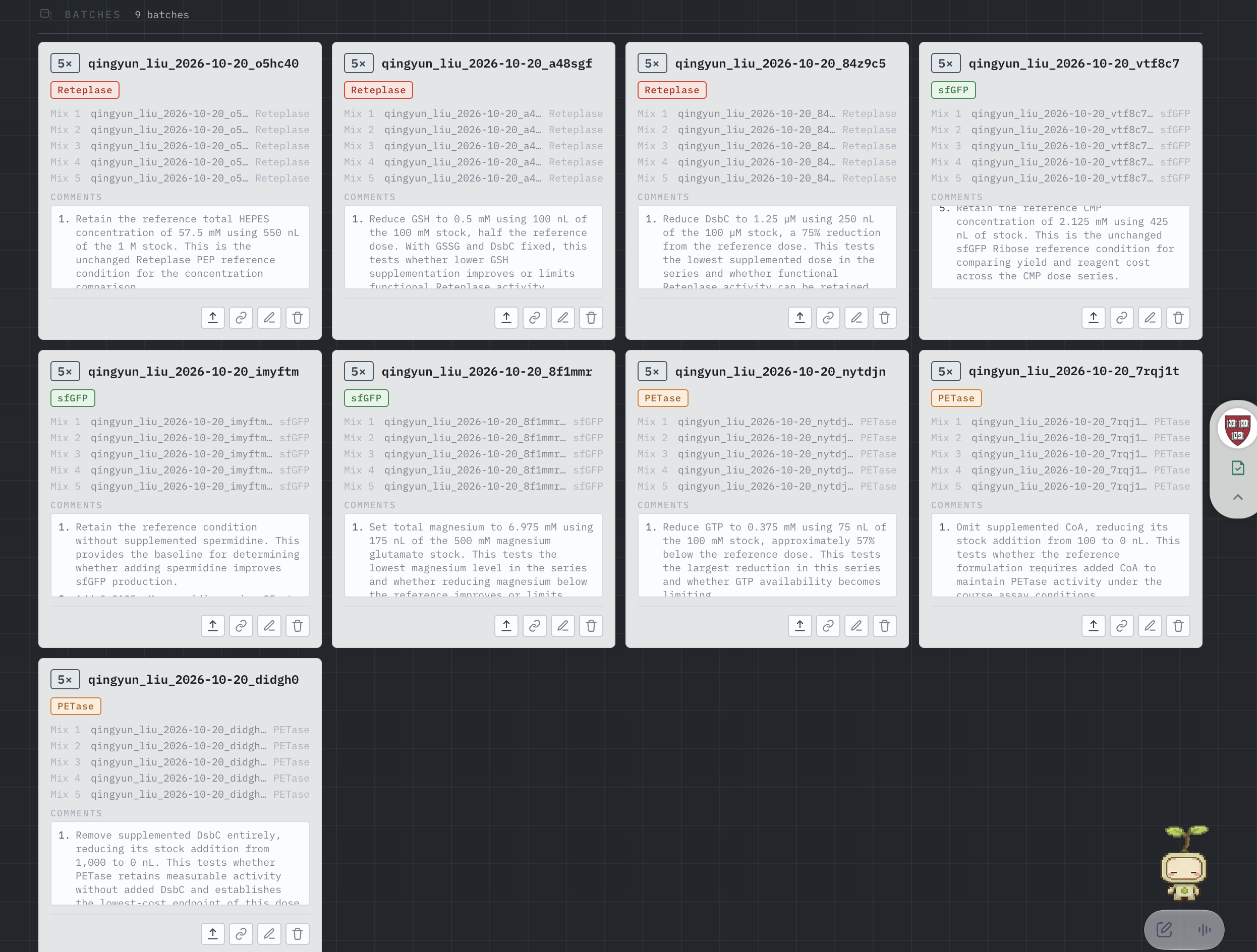
The screenshot shows nine saved batches, each with five mixes. Each batch has one overall question and a reason for each mix.
Download the nine batches as JSON. JSON is a file format for storing the recipes in a way software can read. I reconstructed this appendix from the course’s starting recipes and my submitted concentration tables; it is not a direct download of the website’s saved records. It lists the ingredient volumes in nL, the protein target, and a comment for each recipe.
I checked all 45 recipes with the course’s Pydantic tool, which checks whether the recipe data follow the required format. I also checked that the volumes are nonnegative, follow 25 nL steps, use the correct DNA, and add up to 20,000 nL. Passing these checks does not tell me how much protein the recipe will make or how well it will work.
How I will judge whether a change helps
I will compare each recipe with its unchanged reference. For sfGFP, I will look at how much protein is made for the money spent. For PETase and Reteplase, I will look at how much enzyme activity I get for the money spent. I will use repeated measurements to check whether a difference is consistent.
For example, imagine a recipe costs half as much and keeps nearly all of the original activity. That would be useful. But if it costs half as much and loses almost all activity, it would not be a good saving. This is an example, not an experimental result. The website prices estimate reagent costs; they do not include every cost of running and measuring an experiment.
B. RESEARCH TEAM DISCUSSION, DATA ANALYSIS, METASCIENCE
1. Research Team Discussion
- Research Team Discussion: We’d like a few HTBAA members to share their approach to experimental design during the recitation meeting on Thursday (5-6:30 PM ET) with the Adamala, Borkowski, and Styczynski labs. If you are willing to share a short 2–3 minute synopsis (no slides required), please sign up by Thursday (Oct 15).
Note: ideas at any stage are encouraged: a single hypothesis, an experimental batch you’re planning, broader topics you are investigating, or computational methods you are trying. The goal is to facilitate a rich discussion with these leading cell-free research labs and to welcome them to our community!
Even if you do not wish to sign up to share publicly, please document on your homework page the current status of your CFPS optimization ideas!
My response — current status and questions
My current status is nine batches submitted, with no experimental outcomes yet available for these submissions. The strongest direct economic question is the DsbC dose for PETase and Reteplase. The sfGFP magnesium and spermidine batches explore output, while the Reteplase GSH and HEPES batches explore conditions that may affect functional activity. CoA, GTP, and CMP are smaller supplement-sensitivity questions.
From the class notes, my main lesson is to connect formulation design to the complete measurement process. Echo prepares the variable reagent additions, DNA and lysate addition initiate the reaction, and the protein-specific assay determines what can actually be inferred. sfGFP fluorescence, PETase substrate turnover, and Reteplase AMC release are different measurements; I should not describe them all as direct protein concentration measurements. Calibration standards, blanks, and positive and negative controls are essential parts of an interpretable comparison.
For a short research-team discussion, I would present three questions:
- Cost versus folding: What is the minimum DsbC dose that retains useful PETase or Reteplase activity? A dose that works for one protein should not automatically be transferred to the other.
- Recipe versus process: Should the magnesium response be screened in the final plate and incubation format, given the large ranking changes in the sfGFP reference report?
- Expression versus assay: How will the team keep PETase readings in their linear range and establish a usable Reteplase signal above background before ranking my conditions?
2. Data Analysis
- Data Analysis: Familiarize yourself with the autonomous-cfps repository. Experimental results are stored in autonomous_cfps/data/reference_set and data analysis files are in the reference_results folder. Review the sfGFP_control_20260722-39-L_96w_report.pdf. What does it show about how the same 20 µL sfGFP reaction performs in a 384-well plate versus a 96-well deep-well plate? Can you suggest what might explain some of the differences (for example: oxygen access, evaporation).
My response
I read the assigned sfGFP report. It compares 80 recipes in two experimental setups: a 384-well plate and 96-well deep-well plates. A well is a small compartment that holds one reaction. These are the course’s reference experiments, not results from my own submitted recipes.
What did the report show?
The deep-well setup produced a higher measured sfGFP concentration overall. The table shows the median, meaning the middle result when the measurements are put in order.
| Setup | Middle sfGFP concentration |
|---|---|
| 384-well plate | 0.36 g/L |
| 96-well deep-well setup | 2.71 g/L |
The deep-well setup also gave more consistent results when the same recipe was repeated. However, the best recipes changed: none of the top ten recipes in one setup appeared in the top ten in the other. This tells me that a recipe that works well in one setup may not work equally well in another (report pp. 1 and 8).
Why might the results be different?
Oxygen: The shape of the wells and how the liquid moves can affect how much oxygen reaches the reaction. Oxygen can help some energy-producing reactions and is also needed for sfGFP to develop its green fluorescence. This could affect the result, but the report does not prove that oxygen caused the difference.
Evaporation: If water evaporates, the remaining liquid becomes more concentrated. A higher reading in g/L could therefore partly reflect less water, rather than more protein being made. Water loss also changes the concentrations of salts and other ingredients, which may affect the reaction.
Other changes: The assignment mentions the same 20 µL reaction, but the report lists 40 µL in the deep-well setup and 20 µL in the 384-well setup. The buffer preparation and measurement steps also differed. We therefore cannot say that the plate type alone caused the higher result (report p. 2).
What does this mean for my experiments?
I should compare my recipes using the same plate setup, reaction volume, and measurement method. To investigate the difference between plate setups, I would keep these other conditions matched and check how much water is lost. My magnesium series is a way to look for a useful concentration under the conditions actually used; I should not assume that a reported best recipe will work best everywhere.
3. Metascience
- Metascience: With hundreds of proposed reactions and a limited number of experimental wells during round 1 of the coopetition, deciding which experiments to run is itself a scientific question. A shared rubric, a set of criteria we score every proposal against, can make that choice transparent and fair. Propose one rubric criterion you think we should use to decide which experiments make it onto the plate, and explain in a sentence or two why it matters. Examples include novelty relative to what’s already been tested, the strength of the hypothesis, or the expected information gain.
My response — experiment-selection criterion
Criterion: expected decision-relevant information gained per experimental well. I would prioritize a controlled batch that can resolve a specific uncertainty and change the next experimental decision, even if some of its conditions are expected to perform worse than the reference. This makes limited wells useful for learning rather than selecting only optimistic yield predictions.
One simple way to score this criterion before seeing results is:
| Score | Evidence in the proposal |
|---|---|
| 0 | No clear question or interpretable comparison |
| 1 | A question is stated, but the comparison lacks a useful reference, range, or decision rule |
| 2 | A controlled comparison with a reference and a plausible decision that follows from the result |
| 3 | A controlled batch that resolves an important uncertainty not already answered by comparable executed data, with an explicit next decision |
For example, the PETase DsbC series can tell us whether a costly supplement can be reduced, while the Reteplase GSH series can tell us whether to explore lower or higher supplementation. Duplicate community proposals should be grouped during selection; multiple people proposing the same recipe is not additional experimental information. A duplicate reference may still be necessary as an execution control. I would favor complete, interpretable dose series and let the teaching team allocate shared reference wells, controls, and replicates appropriately. A useful negative result can score well because it narrows the next search.
C. AGENTIC CONTRIBUTION (OPTIONAL)
coopetition.htgaa.org has been updated to allow for AI agents to programmatically create and submit CFPS compositions based on your guidance. Visit the Agent tab to generate an agent token which can be used for interacting with the website.
Your AI agent can design and submit reagent compositions (singly or in batches), edit, reorder or delete your contributions, star and comment on other compositions, suggest, upvote and comment on community reagents, add, edit and upvote papers in the literature list, and read the approved reagent list.
(optional) try making a CFPS design using your agent and document the experience on your webpage!
4. Use of AI
You are encouraged to use AI and online tools for this assignment to assist your reagent composition development process. As you will present your work during recitation, you must be able to explain and justify the reasoning behind your design.
If you use AI, ensure that you cite the AI client and your prompts used.
AI Disclosure
I used OpenAI Codex (GPT-6.1 Sol, High reasoning effort) to discuss which ingredients were worth changing, what concentration levels to test, and how those changes might affect protein production, enzyme activity, and cost. AI helped me compare options and explain the reasons for my choices. I made the final design choices and entered and submitted the recipes myself.
Sources and resources
- Course assignment: HTBAA Homework #3 & #4, Section 4 and Use of AI, accessed October 20, 2026.
- Course-provided model and raw-data download. I reviewed the teacher-supplied
autonomous-cfps.zip;reference_results/README.mddescribes the reference runs and cost-estimate convention. - Assigned sfGFP reference report, especially pp. 1–3 and 6–9. Numbers in B2 are reported results, not measurements of my own submissions.
- Teacher-provided
reference_results/PETase_control_20260722-39-L_96w/PETase_control_20260722-39-L_96w_report.pdf, pp. 1–2. - Teacher-provided
reference_results/reteplase_control_20260730-DSB/reteplase_control_20260730-DSB_report.pdf, p. 1. - CFPS Reaction Designer and course discussion channel.
- Class notes supplied for this assignment: automation workflow, protein-specific assays, calibration, and controls.
- Xiangtao Shi — Week 4, used as a documentation-structure reference.