Hi everyone,I’m Rachel. I worked in the biotech industry for the past two years and am here to learn more about the details of biomanufacturing ! 😊
Contact info
Homework, Labs, and Projects
See the nav bar on the left to look through my work for How To
Biomanufacture Almost Anything (Fall 2026)!
Subsections of <Rachel Lee> — HTBAA Fall 2026
Week 1 HW: Final Project Ideas
What you would like to biomanufacture and why ?
I’d like to make animal-free polydeoxyribonucleotide (PDRN) produced by microbial fermentation rather than extracted from salmon or trout milt.
PDRN was originally used in medicine to heal wounds, burns and diabetic ulcers. More recently, it has become a trendy skincare ingredient. The polymer is now known for its ability to promote skin regeneration and repair, and it is used as an injectable ‘skin booster’ in aesthetic dermatology.
The main problem with traditional PDRN is that it comes from salmonid gonads, which ties supply to fish harvests and to the availability and quality of aquaculture byproducts. This creates several issues: allergenic residual fish protein, incompatibility with vegan, halal and kosher requirements, and a supply ceiling if demand keeps growing. Although many skincare products on the market claim to contain PDRN, they actually contain phyto-PDRN, which is sourced from lab-grown wild ginseng or even roses. The main challenge with phyto-PDRN is that it does not match the molecular structure of salmon DNA fragments. I would like to bridge the gap between true clinical efficacy and full vegan compliance through precision fermentation. I am also personally a big fan of skincare, and I hope everyone can have the opportunity to use these products without worrying about allergens or animal-derived ingredients.
What living system would you use ?
I would use E. coli, because it is one of the most widely used bacteria in industry and research. Many companies already use it to produce large quantities of DNA for vaccines and therapies, as well as alternative proteins, so there is a large body of work I can draw on.
I would first design a plasmid carrying a chosen DNA sequence and transform it into E. coli cells. The bacteria would be cultured in a fermenter with glucose as the carbon source, along with other nutrients such as ammonium salts, phosphates, magnesium and trace metals. The fermentation would run aerobically at 37 °C under controlled pH, with glucose fed at a controlled rate to avoid the accumulation of acetic acid. The fermentation would be stopped once a target biomass was reached, measured by OD600 or dry cell weight (DCW). The broth would then be harvested by centrifugation and the cells lysed. Purification would follow: first the removal of larger unwanted molecules, then anion exchange and hydrophobic interaction chromatography to isolate the plasmid DNA and wash away cellular impurities. Finally, nuclease digestion and tangential flow filtration (TFF) would yield a purified solution of short DNA fragments suitable for use as PDRN. The specific approach to nuclease digestion is still being worked out, since the reaction is relatively difficult to control. The process assumes that the bacteria can replicate the designed plasmid faithfully and that byproducts can be removed to achieve high purity.
How would you use automation ?
Before establishing a protocol, there would be many variables to test such as strain, temperature, feed rate, harvest time and growth time in order to find the conditions that work best. I would use design of experiments (DoE) to set up a range of experimental conditions in 96-well plates. When running the experiments, I would use a liquid handler to collect time-point samples, especially when more than 100 samples need to be taken. Doing that by hand with a pipette would take a very long time and would introduce errors. A liquid handler would also ensure that sampling is consistent.
How much would you need to make, and how long would it take?
This calculation is based on aesthetic use in skincare. Using the Medicube PDRN Pink Peptide Serum as a baseline, each unit contains 300 mg of PDRN, or 1% (10,000 ppm) of the formulation. 1According to Medicube’s official website, there are 29 products in their PDRN line.2 APR Corp, Medicube’s parent company, reports that 50 million units of the PDRN line have been sold.3
PDRN per unit: 300 mg
Units per year: 50 million ÷ 29 ≈ 1.7 million
Total PDRN needed per year: 1.7 million × 300 mg ≈ 517 kg
Assuming an overall downstream yield of 70%:
517 kg ÷ 0.7 ≈ 739 kg/year rounded to a target of 750 kg/year.
Assuming a crude fermentation titre of 1 g/L 4 and 50% product recovery:
Batches at 2,000 L working volume: 1,500,000 L ÷ 2,000 L = 750 batches/year
What don’t you know yet?
Much of this is based on assumptions. From my experience working with other bacteria, purifying a target product is extremely difficult, and the actual process parameters remain a significant unknown. The typical doubling time for E. coli is 30 minutes in rich medium 5, but without knowing the final process conditions I cannot yet estimate how long each batch would take. A great deal of small-scale experimentation would be needed to confirm that the process works before scaling up.
Another unknown is whether the DNA can be cut to the right size consistently during nuclease digestion, since this is a relatively complex process. Because PDRN is applied to the human body, I also do not know whether bacterially produced DNA would perform in the same way as salmon-derived PDRN — whether it would actually help to rejuvenate skin, or have no effect at all.
References
Anthropic. (2026). Claude (Opus 5)
Chae, D., Oh, S.-W., Choi, Y.-S., Kang, D.-J., Park, C.-W., Lee, J., & Seo, W.-S. (2025). First report on microbial-derived polydeoxyribonucleotide: A sustainable and enhanced alternative to salmon-based polydeoxyribonucleotide. Current Issues in Molecular Biology, 47(1), 41. https://doi.org/10.3390/cimb47010041
Appendix (AI prompts)
Suggest ideas for products I could biomanufacture, across medicine, materials, food, energy, art, design, or architecture.
What about PDRN?
Is all PDRN in cosmetics derived from animals?
Are there skincare materials still made from animals or plants rather than microbes?
What are the limitations of this paper on microbial PDRN?
My product is DNA, so there’s no protein that “makes” it — the cell’s own replication
machinery does. The plasmid therefore carries two different things:
A protein: M.SssI, a CpG DNA methyltransferase.1 It adds a methyl group to the
cytosine in every CG pair.
Why: vertebrate DNA is CpG-methylated, bacterial DNA isn’t, and unmethylated CpG is
read by the immune receptor TLR9 as a danger signal.23 This was the biggest risk
identified in HW1. Methylating the DNA as it’s made makes it look vertebrate-like.
The enzyme is a process aid — it gets thrown away during purification.
The product: an AT-rich array of defined-length DNA units. A non-coding part whose
sequence is the deliverable.
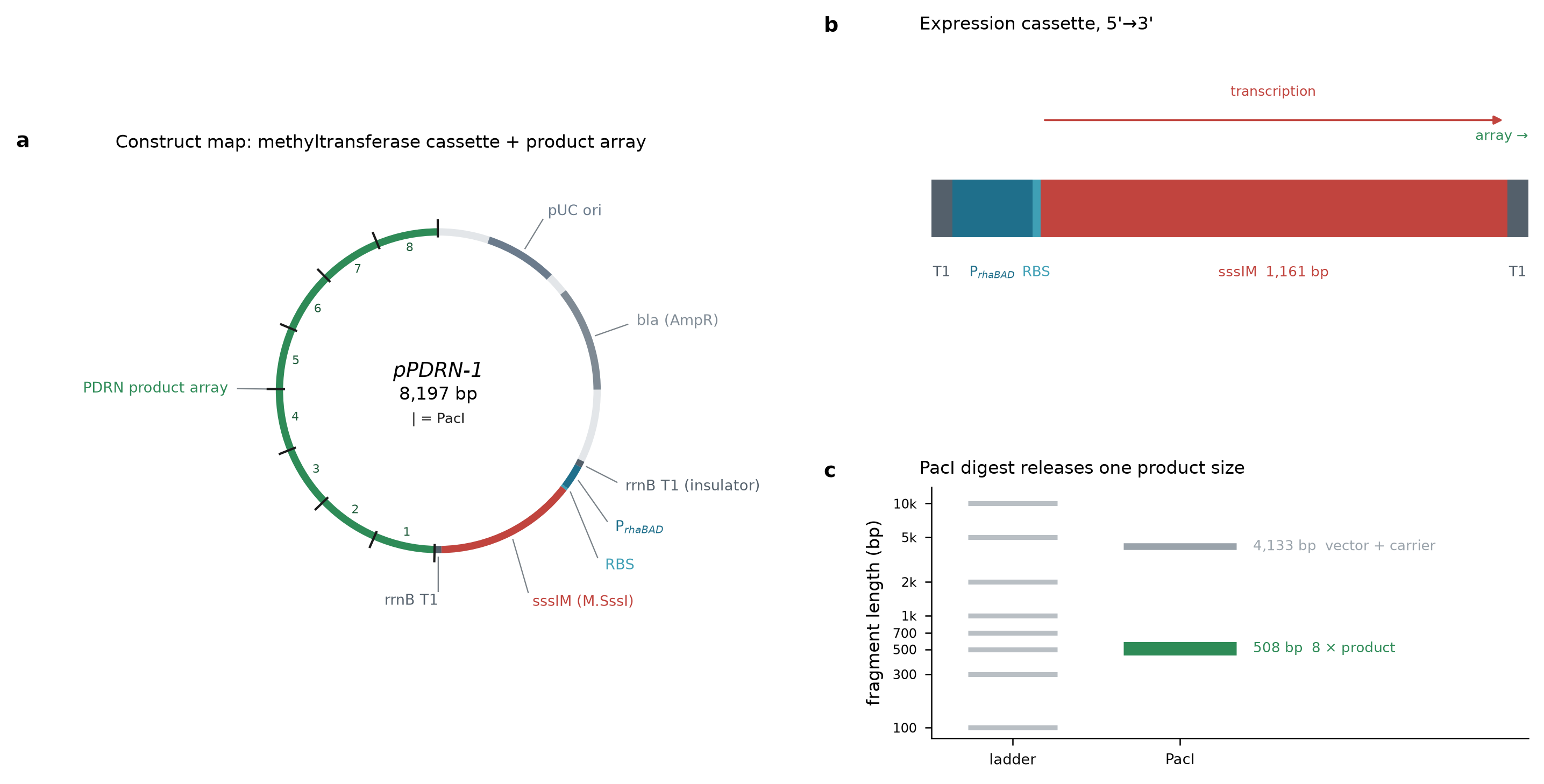
Neat detail: the plasmid is both the vector and the product — 49.6% of its mass is product.
Sequence: UniProt P15840 (386 aa)1; native gene GenBank X17195.14. My
coding sequence is a redesigned version of that gene. The product array is designed from
scratch.
Findings
Spiroplasma uses genetic code table 4, where TGA = tryptophan, not “stop.” The native
gene has 5 tryptophan codons and 4 are TGA (codons 43, 83, 165, 203). In E. coli,
translation stops at codon 43 → 42-amino-acid fragment, no enzyme.
So codon optimization isn’t about boosting yield here — it’s the only reason the gene makes
protein at all.
(Check: Renbaum et al. did report expressing this in E. coli,4 probably via inefficient
TGA read-through. Worth skimming their methods.)
Host:E. coli K-12 (from HW1 — DNA is ~3.1% of dry weight, giving ~2.5 g/L vs ~0.12
g/L for the Lactobacillus process in the precedent paper5). Three new requirements:
mcrBC⁻ (mandatory) — E. coli destroys DNA containing 5-methylcytosine,6 so a cell
methylating its own genome would attack its own chromosome. Most cloning strains (DH5α,
DH10B) already lack it.
dcm⁻ — removes native methylation so the only methylation is the kind I added.
endA⁻ — stops the product being degraded during lysis.
Location: cytoplasm. No signal peptide, no tag. The enzyme has to reach DNA, which is in
the cytoplasm — secreting it would separate it from its substrate. No tag because the enzyme
is discarded, not purified.
Terminators — block read-through from the backbone into my cassette, and stop transcription
before the array (the array shouldn’t be transcribed; it’s a substrate, not a gene).
PrhaBAD instead of T7 — M.SssI is toxic when overexpressed, so I want a promoter I can
dial down. The rhamnose system was built for tunable expression of toxic proteins.10 It
also fits HW1’s two-phase fermentation: grow uninduced, then induce at the end.
RBS — characterized strong ribosome binding site, so initiation is predictable.8
Spacer — puts the RBS 7 nt from the ATG (optimal is 5–9).
CDS — the methyltransferase, recoded for E. coli (see Part 4).
pUC19 — high-copy origin (~500–700 copies/cell) means more product per cell; bla for
selection.9
Designing the product array
Six rules, all enforced by code:
AT-rich (~30% GC) — more adenine per gram, which matters if the mechanism is
adenosine-receptor signalling. Got 67.3% AT vs ~56–59% for salmon DNA and 49.2% for
the E. coli genome. So my product is more adenine-rich than the salmon material.
500 bp units, each flanked by PacI (TTAATTAA).
No PacI inside units — so it only cuts where I want.
Units are all different sequences, not identical copies (see below).
No run of the same base longer than 4 — a DNA-synthesis constraint.
Biologically inert — screened out promoter-like and ribosome-binding motifs; longest
accidental reading frame is ≤24 codons, so nothing encodes a peptide.
Two constraints that only show up when parts interact
(these are the interesting bits)
The cut site has to survive my own enzyme. M.SssI methylates the C in every CG, and
methylation blocks most restriction enzymes. PacI has no CG in it, so it stays
cuttable. This rules out the usual rare-cutters — NotI, AscI, FseI and AsiSI all contain CG.
Identical repeats would collapse. Tandem repeats recombine and get deleted. So each
unit is a different sequence with the same length and composition. Longest exact stretch
shared by any two units is 11–12 bp, under the ~20–25 bp minimum RecA needs to
recombine.11 Uniform in length, not repetitive in sequence — so I don’t need a ΔrecA
strain.
Part 3 — Assembled construct
Order of parts, start to finish:
backbone → stop sign → on switch → start signal → spacer → gene → stop sign →
[cut site + segment] × 8 → cut site
Why this order: the stop sign before the on-switch blocks stray signals from the backbone.
The stop sign after the gene means the cell stops reading before it reaches the product
segments — which is what I want, because the product is just DNA sitting there. Reading it
would waste the cell’s energy for no benefit.
Checks I ran on the sequence
Gene length is 1,161 bp — divisible by 3, as a gene must be ✓
Begins with ATG (start) and ends with TAA (stop) ✓
No accidental stop codons in the middle ✓
The protein it codes for matches the database entry exactly, all 386 amino acids ✓
9 cut sites, which is correct for 8 segments ✓
Whole plasmid: 8,197 bp
What happens when you cut it
I simulated the cut. It produces:
8 pieces of 508 bp each — all exactly the same size. This is the product.
1 piece of 4,133 bp — the leftover backbone, which gets discarded.
(508 rather than 500 because each piece keeps a few letters of the cut site on its ends.)
This is the whole point of the design. In HW1 I couldn’t work out how to control the
fragment size — I was planning to break the DNA up mechanically, which gives a messy range of
sizes. Cutting with an enzyme at designed positions gives one exact size every time.
Honest trade-off: HW1 showed that harvesting the bacteria’s own chromosomal DNA gives
about 2.5 g/L, while a plasmid-based route gives only 0.24–0.8 g/L. So this design buys
uniform size at the cost of yield. The saving grace is that the methylation gene is useful in
both routes, so this one plasmid works either way.
Part 4 — Optimize and quality-check
Codon optimization
Built the reference from real data rather than a generic table: all 4,318 E. coli MG1655
coding sequences,7 then 77 highly expressed genes (ribosomal proteins, translation
factors, chaperones) as a codon-adaptation-index reference set, following Sharp & Li.12
Optimized by simulated annealing against explicit constraints.
Native
Recoded
GC
28.0%
47.0%
CAI
0.225
0.854
Rare codons
97
0
TGA read as stop
4
0
Identity to native
—
72.8%
Why codon usage matters — three reasons:
Genetic-code mismatch (the decisive one) — the 4 TGA codons truncate the protein at
codon 43. No promoter fixes this.
tRNA supply — 97 of 386 codons are rare in E. coli; rare codons stall ribosomes,
lowering yield and giving truncated protein.
Synthesizability — 28% GC with long A/T runs is hard to synthesize; the native gene
dips below 10% GC near position 830.
Constraints applied: removed PacI (critical — an internal site would chop the CDS during
product release), plus EcoRI, HindIII, NdeI, XhoI, BamHI and Golden Gate sites; GC held
40–62% per 50 bp window; no base run > 4. Zero violations.
Conclusion: it is the right gene (top two hits are the native gene and its source
genome), but my version is novel at the DNA level — 72.8% identity over 99.6% coverage.
Protein is 386/386 identical while ~1 nucleotide in 4 changed. That’s exactly what codon
optimization looks like. Everything below the top two is background noise.
I will need to submit the BLAST search to NCBI to verify the accuracy — it’s designed from AI assistant
Safety screen
What it checks: compares each region against databases of sequences of concern — select
agents, toxins, regulated pathogens, virulence factors — usually under the International Gene
Synthesis Consortium Harmonized Screening Protocol,14 which synthesis companies run on
orders. Scans DNA and all translation frames.
Part 5 — From design to build
How I’d build it: order synthetic DNA in three pieces, join by Gibson assembly.15
Fragment
Length
Difficulty
Route
Backbone
2,641 bp
trivial
PCR from existing pUC19
Cassette
1,484 bp
routine (47% GC)
one synthetic fragment
Product array
4,072 bp
hard (32.7% GC, 8 similar units)
8 separate ~508 bp fragments
Why Gibson, not restriction cloning: Gibson joins fragments by overlapping ends and needs
no restriction sites. That matters because PrhaBAD contains an internal EcoRI site and
the finished plasmid has two — so classical cloning would cut inside my own promoter. Bonus:
because the 8 units are all different, each junction is unique, so they assemble in a defined
order. Identical repeats would scramble.
Not a chip-synthesized oligo pool16 — pools are economical for many different
constructs; I want one construct with a hard repetitive region, which is where pools struggle
most.
What synthesis constrains — two hard features, both designed against:
Repetitive array — repeats cause template switching in synthesis, mispriming in PCR,
and recombination in the host.17Mitigated: units share no exact stretch over
11–12 bp.
AT-rich (32.7% GC) — weak base pairing, and long A/T runs are where insertions and
deletions concentrate. Mitigated: no base run over 4, every 100 bp window 24–40% GC, no
10 bp inverted repeats.
Error correction changes the approach: a 4 kb repetitive AT-rich fragment probably won’t
come back perfect. Ordering 8 short fragments turns one low-probability synthesis into eight
high-probability ones, and a failed unit gets re-ordered alone. Verify with long-read
sequencing (Nanopore/PacBio), not Sanger — only long reads span the repeats and can confirm
unit count and order.
Prototype vs scale:
Prototype
Manufacturing (750 kg/yr)
DNA made by
synthesis company + Gibson, ~2–3 weeks
not synthesized — replicated by the cells
Cost
~$0.07–0.10/bp, a few hundred dollars
glucose + salts (HW1: media ≈ 4% of ~$8/g)
Selection
bla / ampicillin
antibiotic-free — no residue in a skin product
Amount
micrograms
~1,000 kg/yr
Core idea:synthesis is how you build the design once; biology is how you manufacture
it. At $0.07/bp a single gram of synthetic DNA would cost more than the annual media bill.
Part 6 — What I don’t know yet
1. Will methylation be complete, and will the cells survive it?
Partial methylation may leave enough unmethylated CpG to trigger TLR9, breaking the main
quality claim. Full methylation may be lethal. There may be no induction level that
satisfies both — the most serious failure mode.
How to find out: rhamnose dose series in parallel micro-bioreactors; measure %
5-methylcytosine by LC-MS/MS, plus growth rate and DNA yield → a methylation-vs-yield curve.
Run a TLR9 reporter assay on the product vs salmon PDRN in the same experiment.
Fallback: methylate in vitro after purification instead.
2. Is 508 bp the right size — does size even matter?
The conventional PDRN spec is 50–1500 bp, the salmon comparator was 200–800 bp, and the
precedent paper’s microbial material was under 100 bp yet performed better.5 So nothing
supports a target size, or the premise that tight control is worth the yield penalty.
How to find out: build 150, 500 and 1000 bp unit variants → three uniform products
differing only in length; dose–response in the precedent paper’s assays with an
adenosine-receptor antagonist as control. If size doesn’t matter, the array route is
unnecessary and HW1’s genomic-DNA route wins — so this is a go/no-go.
3. Will the array survive fermentation?
The ~20–25 bp recombination threshold11 is a generalization, not a guarantee, and there
are 500–700 plasmid copies per cell. A partly collapsed array still gives correctly sized
product, just less of it — so it shows up as slow titre decline and is easy to miss.
How to find out: serial passage to 40–60 generations, long-read sequencing to count units
per plasmid, PacI digest + capillary electrophoresis for product-to-carrier ratio. If it
declines: fewer units, more divergence, lower-copy origin, or fall back to ΔrecA.
Appendix (AI Prompts)
Anthropic. (2026). Claude Science (Opus 5)
Pasted my HW1 submission on animal-free PDRN and asked for review and expansion.
“Follow up on homework 2, I am required to design the DNA, these are the following
questions I need to answer. Include relevant sources to back up your statements.
How figures were made
Figure 1 (construct map, cassette schematic, digest) — feature coordinates come from
the assembled sequence; the fragment sizes in the gel panel come from a simulated PacI
digest run with Biopython’s restriction module.
Sources
UniProt P15840 — orphan methyltransferase M.SssI, Spiroplasma monobiae strain
ATCC 33825 / MQ-1; 386 aa, 44.3 kDa, EC 2.1.1.37. Annotated as acting “completely and
exclusively on CG residues in DNA.” ↩︎↩︎
Krieg AM et al. (1995) CpG motifs in bacterial DNA trigger direct B-cell activation.
Nature374:546–549. ↩︎
Hemmi H et al. (2000) A Toll-like receptor recognizes bacterial DNA. Nature408:740–745. (TLR9.) ↩︎
GenBank X17195.1 (protein CAA35058.1) — Spiroplasma sp. M-SssI gene for CpG DNA
methylase, CDS 103..1263. Confirmed to translate to exactly the P15840 protein, but
only under NCBI translation table 4. Primary reference: Renbaum P, Abrahamove D,
Fainsod A, Wilson GG, Rottem S, Razin A (1990) Cloning, characterization, and expression
in Escherichia coli of the gene coding for the CpG DNA methylase from Spiroplasma sp.
strain MQ1 (M.SssI). Nucleic Acids Research18(5):1145–1152. PMID 2181400. ↩︎↩︎
Chae D, Oh S-W, Choi Y-S, Kang D-J, Park C-W, Lee J, Seo W-S (2025) First report on
microbial-derived polydeoxyribonucleotide: a sustainable and enhanced alternative to
salmon-based polydeoxyribonucleotide. Current Issues in Molecular Biology47(1):41.
doi:10.3390/cimb47010041. Full text reviewed — L. rhamnosus, genomic DNA, fragments
<100 bp vs 200–800 bp for salmon. ↩︎↩︎
Raleigh EA, Wilson G (1986) Escherichia coli K-12 restricts DNA containing
5-methylcytosine. PNAS83:9070–9074. (The McrBC constraint.) ↩︎
NCBI NC_000913.3 — Escherichia coli K-12 MG1655 reference genome. PrhaBAD from
the rhaS–rhaB intergenic region (4,097,536–4,097,735, minus strand); rrnB T1
terminator located by hairpin-core search and verified at position 4,171,772; all 4,318
coding sequences used for the codon-usage reference set. ↩︎↩︎↩︎↩︎
iGEM Parts Registry, part BBa_B0034 (ribosome binding site). ↩︎↩︎
GenBank L09137.2 — cloning vector pUC19, 2,686 bp. The bla gene located by
open-reading-frame search at 1,625–2,486 (minus strand), 286 aa, beginning
MSIQHFRVALIPFFAAFCLPVFA — not taken from a vector map. ↩︎↩︎
Giacalone MJ et al. (2006) Toxic protein expression in Escherichia coli using a
rhamnose-based tightly regulated and tunable promoter system. BioTechniques40:355–364. ↩︎
Shen P, Huang HV (1986) Homologous recombination in Escherichia coli: dependence on
substrate length and homology. Genetics112:441–457. (Source of the ~20–25 bp
minimum efficient processing segment.) ↩︎↩︎
Sharp PM, Li W-H (1987) The codon adaptation index — a measure of directional
synonymous codon usage bias, and its potential applications. Nucleic Acids Research15:1281–1295. ↩︎
NCBI blastn, recoded CDS vs the nt database, request ID BNJECKKN014, 22 hits.
Results in blast_optCDS_hits.csv. ↩︎
International Gene Synthesis Consortium, Harmonized Screening Protocol. ↩︎
Gibson DG et al. (2009) Enzymatic assembly of DNA molecules up to several hundred
kilobases. Nature Methods6:343–345. ↩︎
Tian J et al. (2004) Accurate multiplex gene synthesis from programmable DNA
microchips. Nature432:1050–1054. ↩︎
Kosuri S, Church GM (2014) Large-scale de novo DNA synthesis: technologies and
applications. Nature Methods11:499–507. ↩︎