Week 1 HW: Za'atar One — Biomanufacturing Carvacrol
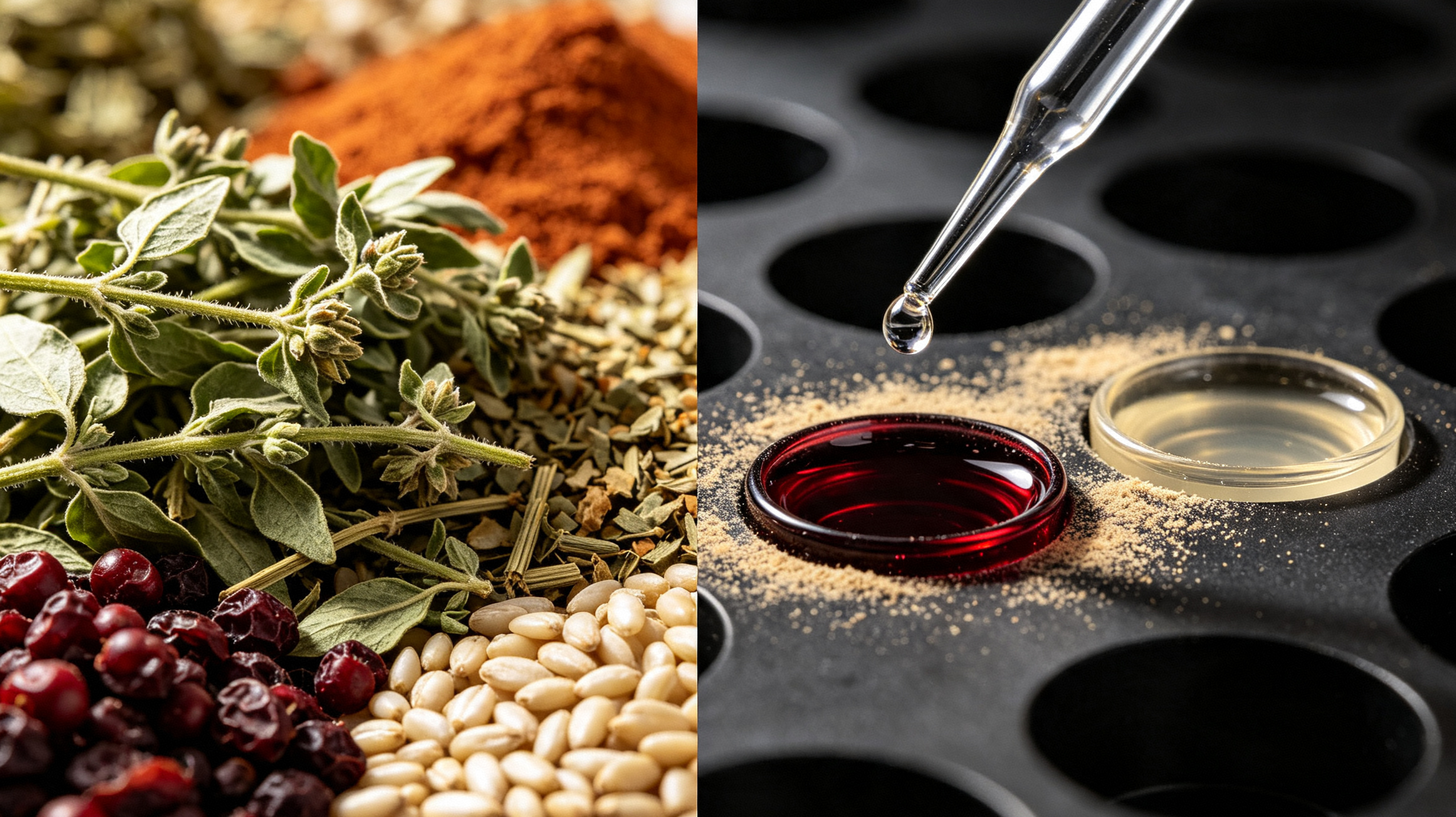
Za’atar One
زعتر — choosing which isomer the za’atar pathway makes.
Thymol and carvacrol are the same molecule with the hydroxyl in a different place. One cytochrome P450 decides which. Nobody has learned to tell it what to do and perhaps Origanum syriacum, the za’atar of the Levant, already has the answer.
1. What I want to biomanufacture, and why
Carvacrol - made selectively, not as a mixture.
Carvacrol (C₁₀H₁₄O, CAS 499-75-2) is the phenolic monoterpene that gives Origanum syriacum (AKA za’atar) its smell, its bite and its antimicrobial activity. Its regioisomer thymol has the same formula and the same biosynthetic route, differing only in where the hydroxyl sits relative to the isopropyl group.
Carvacrol has previously been produced in microbes, back in 2025, in Yarrowia lipolytica. I want to make try to poduce one of the isomers, e.g. carvacrol rather than thymol, since there has never been a report controlling the ratio.
Why it matters to me. Za’atar in Lebanon is a spice we eat mainly at breakfast. Origanum syriacum is part of the Levantine heritage, and it can represent us lebanses more than any other plant product from our country, including the cedar on our flag. Wild za’atar is under harvest pressure across the Levant, and the commercial molecule that bears its chemistry has nothing to do with the plant.
Why it matters industrially. Carvacrol is a veterinary antibiotic replacement. Antibiotic growth promoters are banned in the EU and US and since 2020 in China, and phytogenic feed additives filled the gap, standardised on carvacrol and thymol as marker compounds. An additive tested against the antibiotic avilamycin in Cobb 500 broilers was formulated at 10% carvacrol + 10% cinnamaldehyde, dosed at 100 g per tonne of feed (PMID 40342754). And the biggest painful fact is that carvacrol sold today is petrochemical, made from p-cymene by sulfonation and alkali fusion.
Who it is for: feed formulators needing standardised, traceable, natural-label carvacrol without depending on wild-harvested oregano — and anyone who needs to steer a plant P450’s regiochemistry.
What is known, and what is left
| Question | Status | |
|---|---|---|
| How does the plant make these molecules? | Solved, 2021 | GPP → γ-terpinene → P450 oxidation → a short-chain dehydrogenase resolves the unstable intermediate to the phenol. Three enzymes, and the SDR is required (PMID 34930840). |
| Can a microbe make them? | Yes, once, 2025 | Y. lipolytica + TvTPS2, TvCYP71D507, TvSDR1 → 61.31 mg/L in a 5-L bioreactor — thymol and carvacrol combined (PMID 41024186). |
| Can a microbe make only carvacrol? | Open | Never demonstrated in any host. |
Row three is my project.
2. What living system I would use
Two stages, because the enzyme used and the product are different problems.
Stage A — the system that makes the catalyst. E. coli cell-free lysate on a digital-microfluidic cartridge for screening; E. coli or Y. lipolytica to scale up whichever constructs win.
- In: synthetic linear DNA per variant, lysate, energy mix, and — for the P450 — heme, NADPH, O₂ and a cytochrome P450 reductase partner.
- Out: soluble full-length enzyme, reported by a split-GFP tag that only fluoresces on full-length soluble protein.
Stage B(i) — whole-cell fermentation, the manufacturing platform. Y. lipolytica, following the published route.
- In: glucose (or a glycerol/lipid feed, exploiting Yarrowia’s oleaginous metabolism), minerals, O₂.
- Process: glucose → acetyl-CoA → mevalonate → GPP. TvTPS2 cyclises GPP to γ-terpinene, releasing pyrophosphate. TvCYP71D507 hydroxylates it at C-3 (→ thymol) or C-6 (→ carvacrol), consuming NADPH and O₂, giving an unstable cyclohexadienol. TvSDR1 oxidises that to a dienone, which aromatises spontaneously to the phenol.
- Out: carvacrol + thymol (a mixture — see §5), plus p-cymene, a dead-end byproduct formed when the dienol dehydrates before the SDR reaches it.
3. How I would use automation
Primary — programmable digital microfluidics with cell-free expression. Synthetic DNA with no cloning, with a split-GFP soluble-yield readout and overnight scale-up of hits to µg–mg. Its membrane-protein workflow adds cofactor and redox screening, which matters because CYP71D needs a reductase partner and NADPH.
Secondary — Opentrons liquid handling for the assays. Terpene synthases release pyrophosphate, detectable colorimetrically (PMID 29438678, 24681801). The selectivity assay needs each sample split into a pH 9 well and a pH 12 well with a shared incubation clock — exactly what a liquid handler removes variance from.
4. How much, and how long
How much. Carvacrol’s largest market by volume is poultry feed additives, so I scale to one year of Lebanon’s broiler flock: 130,000 t meat × 1.6 kg feed/kg meat × 10 g carvacrol/t feed = 2.1 t/yr (dose from PMID 40342754; meat figure from a 2008 review, so pre-crisis and dated). Small enough that this is a specialty problem about consistency and traceability, not tonnage.
How long. At the published 61.31 mg/L a 200 m³ fermenter makes 12.3 kg per 7-day batch, so 2.1 t is 170 batches — 3.3 years in one vessel, or ~10 months in four running in parallel. At the ~200 mg/L target it is 52 batches: one year, one vessel — which is why 3.3× is the number worth engineering for.
And the prototyping platform is a different machine on a different clock. The cartridge answers which isomer across 192 conditions in ~24 h, while the microreactor at the only measured immobilised-P450 turnover (20.3 fmol/min, PMID 30073515) makes 1.6 µg per reactor-year — twelve orders of magnitude short of manufacturing. It produces a number; only the fermenter produces tonnes.
5. What I don’t know yet
Q1 — Does the P450 sequence set the isomer ratio, or does the expression environment? Known: C-3 → thymol, C-6 → carvacrol, and D180/D181 track the carvacrol chemotype — but the isoforms leak the other product, the deciding residues are unstated, and D507 changed regiochemistry between yeast and tobacco (PMID 34930840). Measure: carvacrol:thymol across D179 / D180 / D181 / D507 / an I363F revert, by the two-pH gold assay — 550 nm, carvacrol at pH 9, thymol by difference (PMID 29968089). Gate: NADPH also reduces Au(III), so the extract matrix must validate first.
Q2 — Does the physical distance between the P450 and the SDR control the p-cymene byproduct?
The intermediate dehydrates to p-cymene unless the SDR intercepts it, and the authors hypothesise the ratio depends on interenzyme distance — untestable in a cell (PMID 34930840).
Measure: phenol (A550, pH 12) ÷ γ-terpinene made (PPi) across CYP–SDR fusions of varied linker length. p-Cymene has no hydroxyl, so a phenol assay is blind to it by construction.
Q3 — What does NADPH cost once the enzymes leave the cell? In a cell regeneration is free; in a reactor the P450 consumes it stoichiometrically, and the 2025 authors blame their own plateau on cofactor supply. Unverified: if the SDR runs oxidatively, part of the demand may balance internally. Measure: moles NADPH per mole carvacrol, then a regeneration module (PMID 39908731) — precedent being a cell-free plant monoterpene cascade on orthogonal regeneration (PMID 35355836).
Why both platforms coexist: monoterpenes poison the host that makes them — 1.052 g/L of 1,8-cineole but only 0.605 g/L limonene on product toxicity (PMID 36397160), and phenolic monoterpenes are worse. In an immobilised system that constraint is not mitigated, it is absent.
6. The plan
| Leg | What | Deliverable | Risk |
|---|---|---|---|
| 1. Expression map | 24 × 8 on the cartridge: TvTPS2, CYP71D variants, TvSDR1, boundary variants, reductase ratios | A soluble-expression map for a three-enzyme phenolic-monoterpene pathway — the authors’ own named future work | Low |
| 2. Selectivity map | Two-pH gold-nanoparticle assay across the CYP71D panel; HPLC on top hits | An experimental regioselectivity map, plus the first test of the residue the PNAS authors flagged and did not mutate | Medium |
| 3. Proximity | CYP–SDR fusions with varied linkers, then co-immobilisation; phenol:p-cymene vs free enzyme | A direct test of the interenzyme-distance hypothesis, which cannot be done in a cell | High |
Timeline, with two hard gates. Weeks 1–2 design and freeze the 24-construct panel; week 3 order synthesis — slipping either gate by two weeks costs the activity work. Weeks 4–5 Opentrons method development including the matrix-blank ladder that decides whether the colorimetric screen is viable at all. Week 6 cartridge run. Week 7 scale up and purify. Week 8 NADPH-coupled turnover. Weeks 9–10 selectivity screen, HPLC confirmation, fusion constructs. Weeks 11–12 write-up.
AI use disclosure
Clients: Claude Science (Anthropic), model Claude Opus 5, session of 22 September 2026, for the literature retrieval, calculations and drafting. Pippit AI for the cover banner, from a prompt written in that session describing dried Levantine oregano beside a microplate holding one wine-red and one colourless well.
Form of this disclosure. The session was iterative and my individual messages were short, because each rested on reading I had already done outside the conversation. Quoting them verbatim would hide that prior research and make one-line follow-ups look like the whole specification. So what follows is the consolidated brief — the instructions actually in force.
The redirections that were mine. I raised that a Boston company already produces an earlier candidate molecule, forcing the commercial-precedent check; rejected two candidate targets after seeing the evidence, which is how the search reached za’atar; asked why both isomers are co-produced, which prompted retrieving the PNAS full text and yielded the C-3/C-6 mechanism and the p-cymene problem; and pointed out that GC-MS is outside this course’s scope, supplying the colorimetric reference myself — which is why the primary screen is now a plate reader. I did factcheck and modify all the texts that were AI-generated.
The image generation prompt was the following:
References
- (2021) The biosynthesis of thymol, carvacrol, and thymohydroquinone in Lamiaceae proceeds via cytochrome P450s and a short-chain dehydrogenase. PNAS. PMID 34930840. — the pathway, and the C-3/C-6 regiospecificity this project turns on
- (2025) Engineering Yarrowia lipolytica for co-production of the phenolic monoterpenes thymol and carvacrol. Microbial Cell Factories. PMID 41024186. — the only microbial production of these compounds, and the source of the 61.31 mg/L baseline
- (2018) Extraction-free colorimetric determination of thymol and carvacrol isomers in essential oils by pH-dependent formation of gold nanoparticles. Microchimica Acta. PMID 29968089. — the two-pH plate assay that replaces GC-MS.
- (2018) Digital microfluidic immobilized cytochrome P450 reactors with integrated inkjet-printed microheaters for droplet-based drug metabolism research. Anal Bioanal Chem. PMID 30073515. — immobilised cytochrome P450 in digital microfluidics, and the source of the 20.3 fmol/min turnover used in §4
- (2026) Membrane composition influences expression yield of plant cytochrome P450s in E. coli lysate. ACS Synth Biol. PMID 42081616. — evidence that the membrane is a pipettable variable in cell-free expression
- Karim, A. S. & Jewett, M. C. (2021) Toward sustainable, cell-free biomanufacturing. Curr Opin Biotechnol 69, 136–144. doi:10.1016/j.copbio.2020.12.012 — course reading
- Petzold, C. J. & Mukhopadhyay, A. (2025) From bench to biofactory: high-throughput technologies and automated workflows to accelerate biomanufacturing. Curr Opin Biotechnol 94, 103320. doi:10.1016/j.copbio.2025.103320 — course reading