R. Odim — HTBAA Fall 2026
About me
Contact info
Homework, Labs, and Projects
See the nav bar on the left to look through my work for How To Biomanufacture Almost Anything (Fall 2026)!
See the nav bar on the left to look through my work for How To Biomanufacture Almost Anything (Fall 2026)!
Tuesday September 22, by 2:30p ET
ready for comments
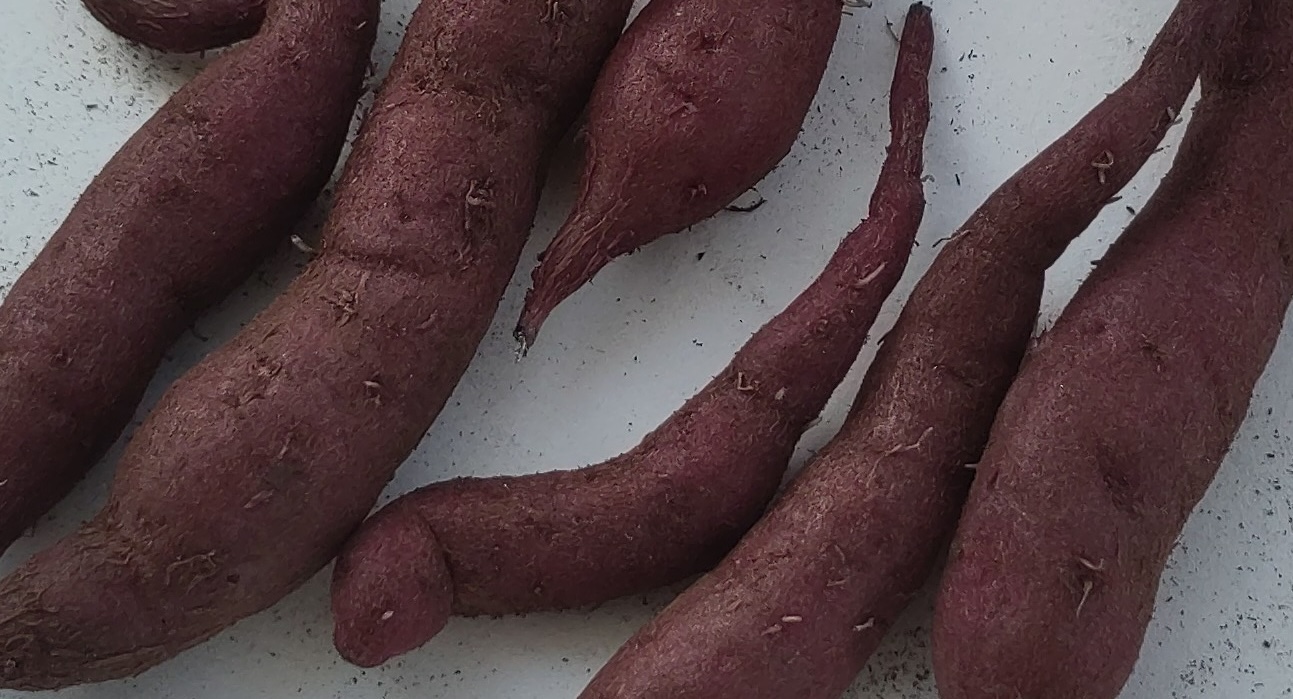
I would like to biomanufacture a drum head that is made from sweet potato culls rather than animal skin. My grandmother grew up on a farm in rural North Carolina, in a state where sweet potatoes are abundant, and a county where the environmental justice movement was born. My grandfather is from Nigeria, and I’ve experimented with various forms of west African drum and dance since I was a kid. Professionally, I currently work on projects related to the biocircular economy, and I’m interested in bringing these pieces of my identity together for this project.
I think there are some interesting directions to go from there as well, artistic angles like making the drum head reactionary to sound or touch, or that records music, or more market-based ideas like other similarly specced materials.
I want to engineer a microbial system that takes in sweet potato culls, breaks it down into sugars (either through an engineered bacterium that secretes amylase or with external enzymes) and then produces cellulose in a membrane form (e.g. using Komagataeibacter, also listed as Acetobacter or Gluconacetobacter).
Sources (prompted Claude for previous successful examples of creating similar materials through a similar process)
For the testing of sugar breakdown, high-throughput droplet liquid dispensers can help test many different concentrations. Automated assembly can help test multiple different versions of the amylase, and then I can automate screening for how well it breaks down.
Automating measurement of the physical properties of the membrane and optimization of the fermentation process would help with the latter half.
North Carolina produces roughly 13M cwt (590,000 tonnes) of sweetpotatoes, including 3% culls and another 20% lost during curing and storage. That means 18k - 130k tonnes/year of potential material.
Assuming 14% of weight is starch, and can produce 1.0 g/g of glucose (90% of 1.11 theoretical yield), and 0.2 g/g of bacterial cellulose (conservative estimate), that means 500 - 3,640 tonnes cellulose/year.
Translating that into a membrane of 0.15 m2 at 0.5mm thickness, ( / 0.5kg/m2) brings us to 1M - 7.3M m2 or between 6.7M to 49M drums. This is orders of magnitude larger than the global drum market, which is where the additional ideas mentioned in #1 add some interest. For now, I’ll assume a starting amount of 1,000 drums.
Sources (prompted Claude for sweet potato production, composition, and conversion yields, as well as calculations I later verified)
Assuming ~10 days per batch of ~4 m2 of tray, it can do 36 runs per year, making 1,000 drums. To do it more quickly it would need a larger tray area.
Manufacturing would require a different type of automation at scale, with lines of trays and automated processing.
Sources (prompted Claude for fermentation timeline source and calculations I later verified)
The biggest technical unknowns and assumptions include the items below. They will likely require additional research as well as some direct testing to answer.
Other Relevant Sources Acoustic and dielectric properties of nanocellulose Deep dive bio-cellulose diaphragms Warren County Ag Census 2022
Due: Tuesday September 29, by 2:30p ET (delayed due to Asimov access) Discussion Monday, October 5
This construct can be found in repository: odim-project in asimov.
Start from the project you proposed in Homework #1 and pin down exactly what your cells need to make. Answer in your write-up:
The first step in the process is engineering an amylolytic industrial yeast strain expressing α-amylase and glucoamylase genes. This HW will focus on that step, which is what will generate the sugars needed for fermentation into bacterial cellulose.
Reference (researched using Claude):
Reference (researched using Claude):
The cited paper uses industrial diploid Saccharomyces cerevisiae, but I’m doing this in a lab version of S. cerevisiae.
Secreted enzymes
This construct is built from the below parts.
For the promoters, I used the same promoters cited in the paper above, but paired them with an enzyme arbitrarily:
These were the genes I could find to represent α-amylase & glucoamylase, and both had translation folded within them:
Similarly, I used the same terminators as the cited paper. I also checked them against standardized parts for S. cerevisiae:
Reference (researched using Claude):

pRS425 plasmid TEF1 R. emersonii α-amylase CYC1 TDH3 glucoamylase ADH1
Sequence Alignment: I found two different enzymes I thought were α-amylase and compared their sequences, which led me to understand they were actually different despite being labeled the same. I instead decided to import my own from https://www.ncbi.nlm.nih.gov/nuccore/KT246498.1. BLAST came back with the specific parts I started with for both enzymes.
Codon Optimizer: Glucoamylase is already codon optimized, so I tried α-amylase. It updated to use TTG, GCT, AGA, GGT, TCT, CCA like the glucoamylase strain.
Biosecurity Sequence Scanner: No flagged sequences were detected in the biosecurity scanner for security-relevant, controlled, or regulated sequences.
For the purposes of lab/testing, I would order α-amylase and glucoamylase as separate fragments to aid in synthesis. Because it combines two enzymes/functions it is a longer sequence to synthesize, and can benefit from this approach (Gibson et al. 2009).
I’d want to ensure the set up can produce the amount of glucose needed outside the cell. Ordering these fragments can help derisk the process, before synthesizing a version that can be scaled up with appropriate error correction (Kosuri et al. 2010, Tian et al. 2004).
As in Homework #1, close by naming the edges of your design. Identify the 2–3 biggest unknowns or risks in your construct. For example: Will the promoter give the right expression level? Will the protein fold and be active in this host? Will it be secreted? Is codon optimization enough, or do you need to tune it empirically?
For each, state how you would find out: the measurement, experiment, or design variant you would try next. A good answer here shows you know which decisions are still bets.
I chose promoter/terminator pairs for each enzyme arbitrarily, but in the cited paper they use both with each. I would want to see the impact of this selection, test the otherway around, and maybe even test 2 pairs of each enzyme with each set of promoter/terminators. I would measure glucose production.
I don’t know what the actual amount of glucose will be produced and how the design might increase that/ensure it is produced outside of the cell. As mentioned in the last section, my first step would be to order the enzymes and try to produce enough glucose, then attempt to synthesize a matching amount, before setting up the system to scale.
Goal: using the collective intelligence of the HTBAA community and accessible AI systems, design novel CFPS reaction compositions for each of the three target proteins: sfGFP, PETase, and Reteplase to reduce the cost per gram of functional protein. Each design should be compatible with the experimental framework described above and should reflect the distinct expression and folding requirements of that protein. You can learn more about the details of the coopetition here.
Magnesium glutamate is necessary, and some of it is diverted in the experiments where NTPs, PEP, and phosphate buffers are present. In reactions where fewer phosphates are present, this is decreased to the necessary level given the amount that will be diverted. It is also more sensitive than potassium glutamate, going from concentration of 20mM to 24mM caused the yield to change 27% (and 10% in the other direction) in the PANOx-SP system, vs lower than 10% for K-glutamate. For the Cytomim system, a 2mM change in mM of Mg glutamate had a larger impact than a 70mM change in K glutamate on the upside, and a 2mM decrease in Mg glutamate was roughly equivalent to a 30mM decrease in K glutamate. (Table II Jewett & Swartz 2004)
PEP+NTP is the Jewett & Swartz approach. Translation burns ATP and GTP fast and PEP enables regeneration of ATP. This however causes accumulation of inorganic phosphate, which inhibits the reaction at about 30mM.
Ribose+NMP is Olsen’s approach that aims to solve this inefficiency. It consumes glucose and ribose to get glycolysis, with ribose also serving as the needed sugar. RNA polymerase can’t use monophosphates and in this case phosphate is consumed by lysate kinases so it doesn’t accumulate. It is a bit more circular in that the byproduct of the energy usage is used for something productive. Finally, this lower cost approach shows more sensitivity to pH..
PANOx-SP (Jewett & Swartz 2004) and 1793122_35 (Smith 2026) had distinct approaches, mainly because the latter was trying to bring the overall cost down for the reaction. The original PANOx-SP reaction was optimizing for yield without considering cost at all. 1793122_35 kept the decreased Mg glutamate (8.8mM) that the Cytomim system started and other experiments continued, with increased K glutamate (273.2mM). It also however removed both Mg and K acetates. pH was balanced through HPES-KOH (67.5mM) and K phosphates (7.5mM di and mono). It used sodium pyruvate (9.1mM), glucose (8.3mM), and ribose (40.0mM) instead of PEP for energy, a more circular and self sustaining energy source. It also swapped ATP/CTP/GTP/UTP for AMP/CMP/GMP/UMP and increased amino acids (4.8mM).
sfGFP PETase Reteplase
As a HTBAA research team, we will have the opportunity to suggest new reagents to add to the cell-free reagent inventory. Contribute (or upvote) at least one reagent to the “Community Reagents” section of the website and provide a short rationale. Include in your homework documentation how you decided on that specific reagent and provide links to any relevant research.
Visit the cfps-coopetition forum page to ensure you will be able to take part in the discussion. Bonus: send a note in the channel about a CFPS optimization idea that you have! If you would like clarification on aspects of the project, please message in this dedicated channel.
Build T7 compatible plasmids for cell-free expression using the amino acid coding sequences below:
sfGFP MSKGEELFTGVVPILVELDGDVNGHKFSVRGEGEGDATIGKLTLKFICTTGKLPVPWPTLVTTLTYGVQCFSRYPDHMKRHDFFKSAMPEGYVQERTISFKDDGKYKTRAVVKFEGDTLVNRIELKGTDFKEDGNILGHKLEYNFNSHNVYITADKQKNGIKANFTVRHNVEDGSVQLADHYQQNTPIGDGPVLLPDNHYLSTQTVLSKDPNEKGTRDHMVLHEYVNAAGITWSHPQFEK
PETase MEKKIWSHPQFEKGGSGENLYFQSGGASPAGGGANPYERGPNPTDALLEASSGPFSVSEENVSRLSASGFGGGTIYYPRENNTYGAVAISPGYTGTEASIAWLGERIASHGFVVITIDTITTLDQPDSRAEQLNAALNHMINRASSTVRSRIDSSRLAVMGHSMGGGGTLRLASQRPDLKAAIPLTPWHLNKNWSSVTVPTLIIGADLDTIAPVATHAKPFYNSLPSSISKAYLELDGATHFAPNIPNKIIGKYSVAWLKRFVDNDTRYTQFLCPGPRDGLFGEVEEYRSTCPFGGSGVSGWRLFKKIS
Reteplase MEKKIWSHPQFEKGGSGENLYFQSGGASPAGGGNSDCYFGNGSAYRGTHSLTESGASCLPWNSMILIGKVYTAQNPSAQALGLGKHNYCRNPDGDAKPWCHVLKNRRLTWEYCDVPSCSTCGLRQYSQPQFRIKGGLFADIASHPWQAAIFAKHRRSPGERFLCGGILISSCWILSAAHCFQERFPPHHLTVILGRTYRVVPGEEEQKFEVEKYIVHKEFDDDTYDNDIALLQLKSDSSRCAQESSVVRTVCLPPADLQLPDWTECELSGYGKHEALSPFYSERLKEAHVRLYPSSRCTSQHLLNRTVTDNMLCAGDTRSGGPQANLHDACQGDSGGPLVCLNDGRMTLVGIISWGLGCGQKDVPGVYTKVTNYLDWIRDNMRPGGSGVSGWRLFKKIS
Bonus question: design a T7 helper plasmid that you could add to the cell-free reaction to improve the yield of functional reteplase (general chaperones, disulfide-bond machinery, etc).
I also did multiple iterations of trying to answer each question on my own and asking Claude to explain when I was misunderstanding something.
Finally, once I understood the system a bit better, I prompted Claude to come up with a few compositions given a focus on trying to manage pH in the lowest cost systems to get some ideas of which direction to go.
Folder with pdfs: https://drive.google.com/drive/folders/1mWn6ncwFQg61ZbjsJU2XYCL8q5wGNJ3x?usp=sharing