Week 1 HW: Final Project Ideas
HTBAA Homework #1
Tuesday September 22, by 2:30p ET
ready for comments
(1) What you would like to biomanufacture and why?
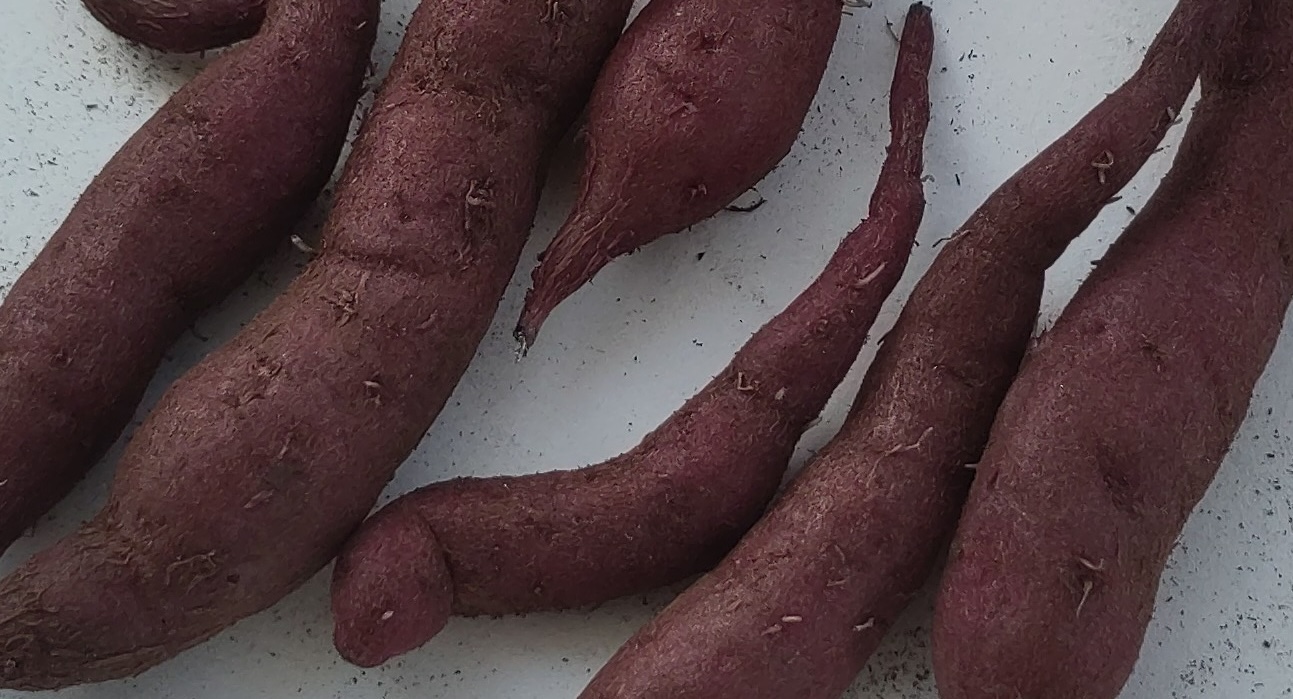
I would like to biomanufacture a drum head that is made from sweet potato culls rather than animal skin. My grandmother grew up on a farm in rural North Carolina, in a state where sweet potatoes are abundant, and a county where the environmental justice movement was born. My grandfather is from Nigeria, and I’ve experimented with various forms of west African drum and dance since I was a kid. Professionally, I currently work on projects related to the biocircular economy, and I’m interested in bringing these pieces of my identity together for this project.
I think there are some interesting directions to go from there as well, artistic angles like making the drum head reactionary to sound or touch, or that records music, or more market-based ideas like other similarly specced materials.
(2) What living system would you use?
I want to engineer a microbial system that takes in sweet potato culls, breaks it down into sugars (either through an engineered bacterium that secretes amylase or with external enzymes) and then produces cellulose in a membrane form (e.g. using Komagataeibacter, also listed as Acetobacter or Gluconacetobacter).
Sources (prompted Claude for previous successful examples of creating similar materials through a similar process)
- Malai (India) — celullose from coconut water waste
- Bacterial Cellulose Production from agricultural Residues by two Komagataeibacter sp. Strains
- Low-cost and highly efficient production of bacterial cellulose from sweet potato residues: Optimization, characterization, and application
- Structural Properties of Bacterial Cellulose Film Obtained on a Substrate Containing Sweet Potato Waste
(3) How would you use automation?
For the testing of sugar breakdown, high-throughput droplet liquid dispensers can help test many different concentrations. Automated assembly can help test multiple different versions of the amylase, and then I can automate screening for how well it breaks down.
Automating measurement of the physical properties of the membrane and optimization of the fermentation process would help with the latter half.
(4) How much would you need to make, and how long would it take?
(a) How much?
North Carolina produces roughly 13M cwt (590,000 tonnes) of sweetpotatoes, including 3% culls and another 20% lost during curing and storage. That means 18k - 130k tonnes/year of potential material.
Assuming 14% of weight is starch, and can produce 1.0 g/g of glucose (90% of 1.11 theoretical yield), and 0.2 g/g of bacterial cellulose (conservative estimate), that means 500 - 3,640 tonnes cellulose/year.
Translating that into a membrane of 0.15 m2 at 0.5mm thickness, ( / 0.5kg/m2) brings us to 1M - 7.3M m2 or between 6.7M to 49M drums. This is orders of magnitude larger than the global drum market, which is where the additional ideas mentioned in #1 add some interest. For now, I’ll assume a starting amount of 1,000 drums.
Sources (prompted Claude for sweet potato production, composition, and conversion yields, as well as calculations I later verified)
- 13M cwt sweetpotato produced in 2024
- 3% culls and another 20% lost during curing and storage
- 14% starch
- 0.39 g/g of bacterial cellulose yield example
- In 2024, 86,500 acres of sweetpotatoes were harvested
- The average acre yields 16,800 pounds of sweetpotatoes
(b) How long?
Assuming ~10 days per batch of ~4 m2 of tray, it can do 36 runs per year, making 1,000 drums. To do it more quickly it would need a larger tray area.
Manufacturing would require a different type of automation at scale, with lines of trays and automated processing.
Sources (prompted Claude for fermentation timeline source and calculations I later verified)
(5) What don’t you know yet?
The biggest technical unknowns and assumptions include the items below. They will likely require additional research as well as some direct testing to answer.
- Whether it makes sense to create one bacterium that does both functions (break down sugars and produce cellulose)
- Will the bacterium be able to produce cellulose with the right properties: tunable pitch, strikeable, stiffness, thickness, feel, ability to wrap around edge?
- Will the cellulose be stable in typical environments (e.g. humidity)?
Other Relevant Sources Acoustic and dielectric properties of nanocellulose Deep dive bio-cellulose diaphragms Warren County Ag Census 2022