Week 1 HW: Final Project Ideas
Background
I am an industrial product design engineer, and my MSc thesis followed a material-driven design approach, instead of starting from a predefined product, I started by growing mycelium composites myself and letting their behaviour guide the design decisions. I grew Pleurotus mycelium on sawdust, straw, sunflower seed husks, paper and cotton, and other textiles. Also tried to give a nw life to spent mushroom blocks donated by a small artisanal mushroom farm in Budapest. Most of my characterisation was exploratory, I also struggled with contaminaton a lot.
Below I describe two alternative concepts that translate the thesis into a biomanufacturing process. Concept A stays close to what I have actually tested; Concept B is more speculative and extends the idea to textile waste. I have not yet decided which one to develop further, and feedback on that choice would be very welcome.
Concept A: A Mushroom Farm that Harvests Twice
- What I want to biomanufacture
Mushroom farms produce roughly five kilograms of spent substrate for every kilogram of fresh mushrooms, and most of it ends up as a low-value soil amendment. My idea is to fill the substrate into moulds shaped like the final product from the very beginning. The same block first produces edible oyster mushrooms and then, once it is exhausted, is dried into a finished mycelium composite part. One bioprocess yields two product streams: food and material.
The products I have in mind are compostable protective packaging (in my thesis, a gift box that holds six hand-painted Hungarian Easter eggs) and temporary building elements, such as exhibition walls, pavilion blocks or acoustic panels, that can be composted after use.
- Why this idea: evidence from my thesis
Two observations led me here. First, the spent blocks from the farm turned out to be a better raw material than fresh substrate: they were already densely colonised, much more resistant to mould contamination, and easier to handle. Second, when I crumbled these blocks and remixed them with a small amount of wheat bran or flour (not sterilised), the mycelium reactivated and formed a new shape, including a soft, leather-like skin on the surface. Reshaping after harvest works, but it costs an extra processing step. Growing the block in its final shape from the start would remove that step.
I also learned that process control matters a lot. My early samples failed because I calculated the 65 % moisture target on a dry basis instead of a wet basis (the correct amount is about 186 g of water per 100 g of dry substrate), and my final prototype was lost to mould because the substrate was over-watered. Both mistakes point towards automated, weight-based dosing.
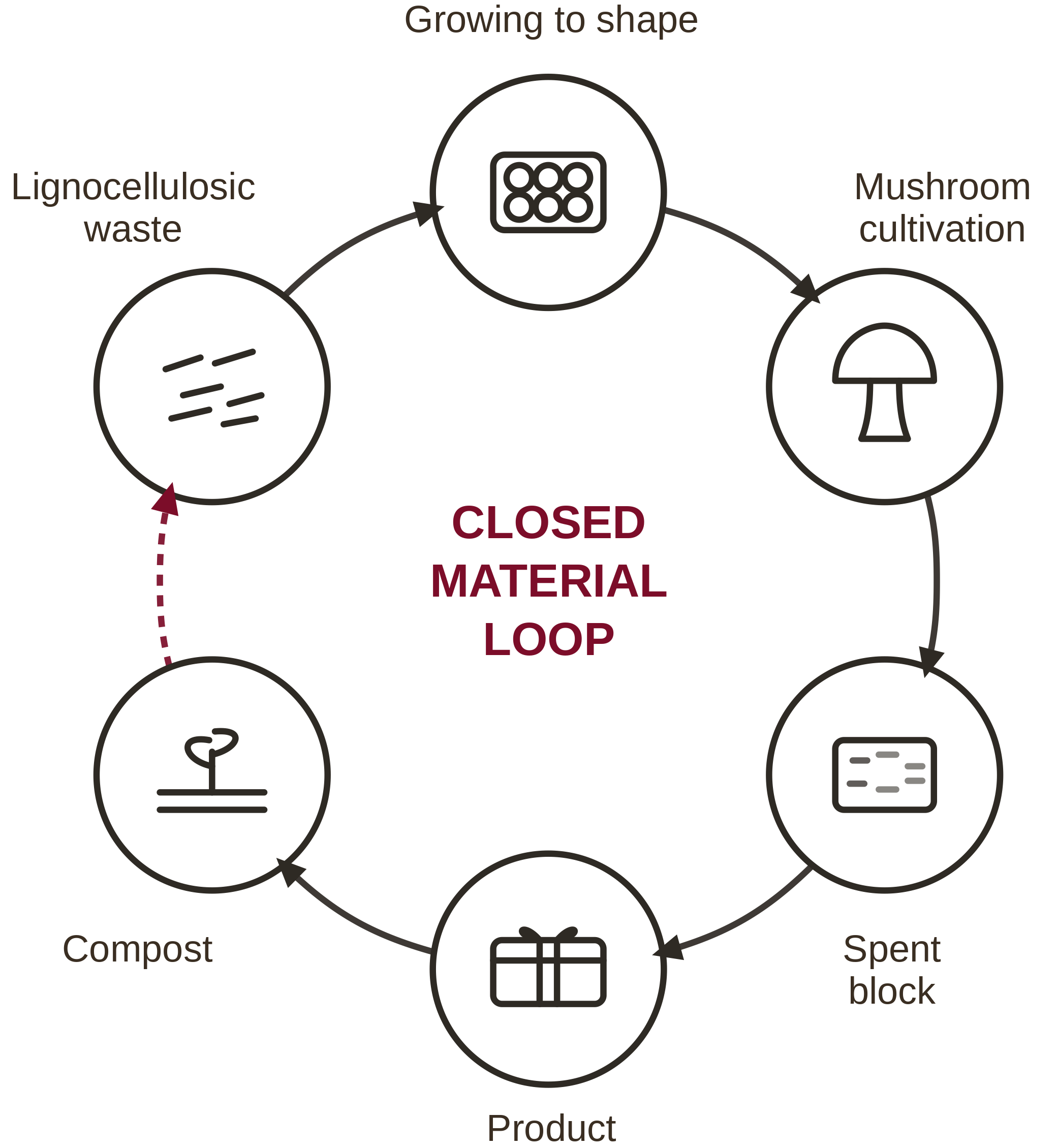
Figure 1. Closed material loop: food and material production linked in one cycle (Created with Claude AI).
- Biological system
Organism: oyster mushroom species (Pleurotus spp.), which are white-rot fungi that degrade lignocellulose, are edible and well documented. I would start with Pleurotus djamor (pink oyster), which grows fastest at around 24–28 °C and therefore needs less cooling and tolerates warm summers.
Feedstock: hardwood sawdust and/or straw supplemented with wheat bran, adjusted to 65 % moisture on a wet basis.
Outputs: fruiting bodies (food) and a porous mycelium–lignocellulose composite (material), in which the hyphal network acts as the binder
- Manufacturing workflow
Automated substrate preparation Sawdust, straw and bran are dosed gravimetrically; water is added under load-cell control to reach 65 % wet-basis moisture; the mix is homogenised and then pasteurised or sterilised.
Automated inoculation and mould filling Grain spawn is dosed by weight and mixed in, and the substrate is filled into reusable, heat-resistant moulds (stainless steel or glass) whose inner geometry is the product. The moulds have small perforations at defined positions, such as above the future egg cavities, so fruiting happens where surface disruption is either removed later or hidden.
Incubation
Fruiting Blocks moved to a fruiting room with high humidity, fresh-air exchange and light cues. Cameras observe every block from above.
AI vision and robotic harvesting A vision model decides when each cluster is ready and triggers a robotic arm to harvest it (more detail in section 5).
Block retirement The same vision system recognises when a block is exhausted and will not produce another worthwhile flush, and when it is contaminated. Exhausted blocks are sent to the material line; contaminated blocks are sent to composting.
Post-processing Optional surface reactivation (a thin top-dressing of bran or flour to regrow a dense skin), then drying: first inside the mould at 70–80 °C, which made demoulding easy in my experiments, then out of the mould. Drying at around 40 °C only makes the fungus dormant; about 80 °C or higher is needed to inactivate it. Other optional postprocessing.
Quality control Mass, dimensions and visual colonisation for every part; compression tests and water uptake on samples from each batch. -Sale Compostable protective packaging or temporary construction elements that are composted at the end of their use.
- The AI vision component
I see two separate tasks for the vision system. The first is harvest timing: oyster mushrooms should be picked before the cap margins flatten and curl upwards and before heavy spore release. This affects quality. The second is block state classification, based on the history of each block: the number of flushes so far, the yield per flush, shrinkage, discolouration, weak or irregular primordia, and green patches that suggest Trichoderma contamination. The practical output is a single decision: keep fruiting, retire to material, or discard.
Automated mushroom harvesting has been researched for decades, mainly for button mushrooms. Oyster mushrooms grow in irregular, overlapping clusters, which I expect to be harder for both detection and gripping. I do not yet know how much labelled image data this would need or whether one camera angle per block is enough.
- What is new here
The mould is shared between food production and material production, and the fungus does the shaping. The mushroom farm becomes a materials factory without a separate growing infrastructure. For food-safety reasons, the fruiting unit and the material-processing unit would be kept in separate buildings on the same site.
Open questions and risks Food versus material trade-off. Every flush consumes substrate that also forms the body of the composite. How will this affect mechanical properties? I have not measured this yet; compression testing on a universal testing machine is one of my next steps. Geometry. Do perforations reliably control where fruiting bodies form, and does fruiting distort the part? Economics. The cost of durable moulds and robotics compared with manual work will not be profitable at the scale of a small farm.
Biosafety
The organism is a native, edible, non-genetically-modified species that is already grown commercially. Heat treatment at about 80 °C or higher stops fungal activity in the finished product. The main occupational risk is spore exposure in the fruiting room, which harvesting before sporulation also helps to reduce.
- Calculations A meaningful annual output for one small farm supplying a regional e-commerce or glassware brand is on the order of 10,000 pieces: about 3 tonnes of dry feedstock and 450 kg of spawn, giving 2 tonnes of finished packaging and, as the first harvest from the same blocks, roughly 1.8 tonnes of fresh mushrooms.
Concept B: Mycelium on Textile Waste
- What I want to biomanufacture
Non-load-bearing thermal and acoustic insulation boards grown from shredded textile waste. The fungus colonises the textile fibres inside panel-shaped moulds and binds them into a rigid, lightweight board without synthetic binders.
The motivation is the scale of the textile waste problem. Since January 2025, EU member states have been required to collect textile waste separately, and in Hungary the collection network is growing quickly. Separating textiles only helps if there is somewhere for them to go. Polyester–cotton blends are the most common and also the hardest to recycle, because the fibres are difficult to separate mechanically or chemically. My secondary school training was in garment construction, and many of my colleagues at the Institute of Product Design come from textile engineering, so this concept connects my own background with theirs. I recently co-authored a review in the Hungarian journal Magyar Textiltechnika on how the role of fungi in the polymer and textile industries is being reinterpreted, from enemy to resource.
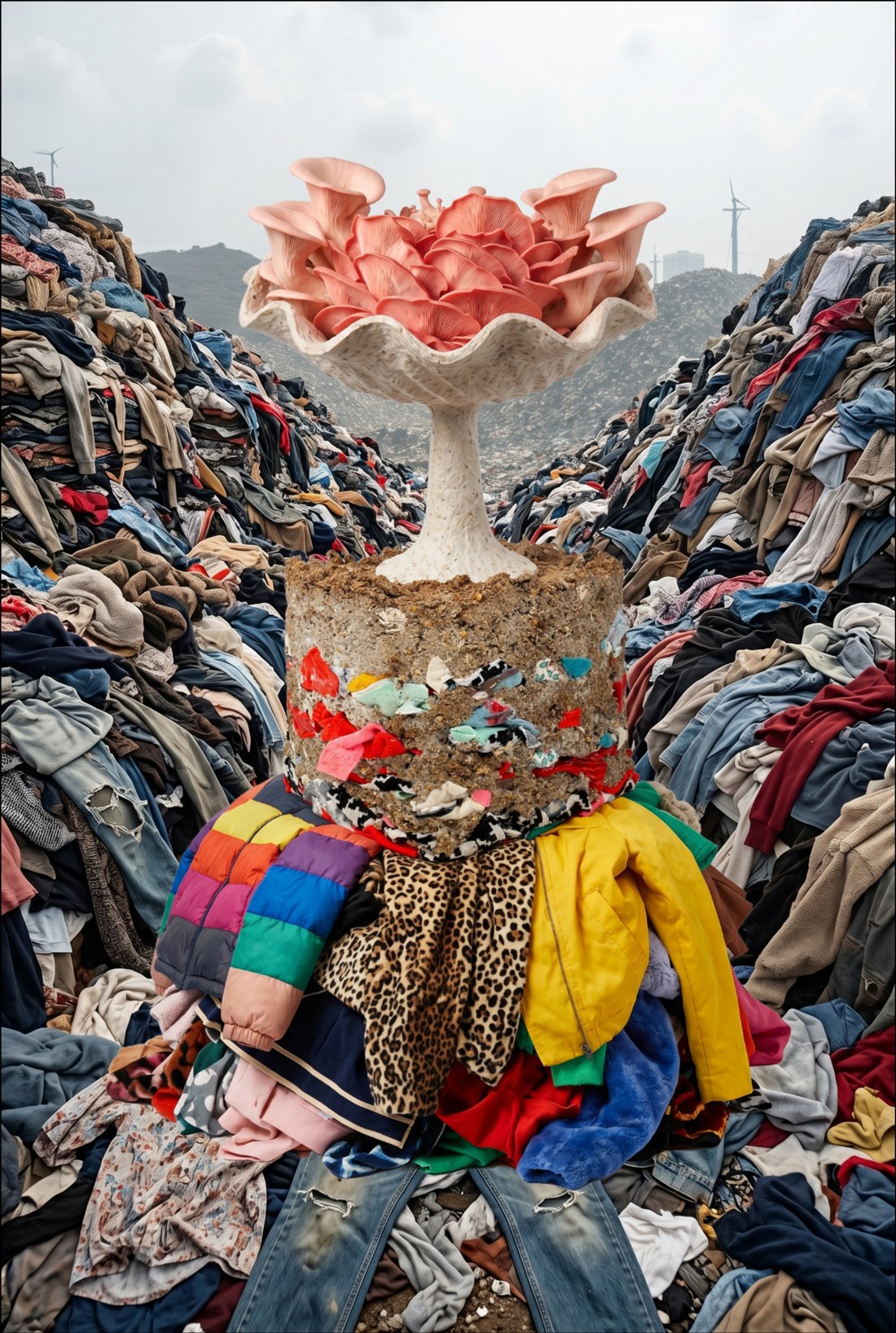 Figure 2. Concept illustration: oyster mushrooms fruiting from a mycelium block grown on textile waste (photomontage created with Adobe Firefly).
- Biological system and species selection
Primary binder: Pleurotus ostreatus, a white-rot fungus that degrades cellulose efficiently, colonises textile residues and is safe and easy to handle. Trametes versicolor and Ganoderma species are alternatives worth screening, since they are also white-rot fungi with strong oxidative enzyme systems.
The synthetic fraction: this is where I want to be careful. Some fungi have been shown to degrade polyester and polyurethane. However, polyethylene terephthalate (PET), is highly resistant, and I have not found evidence that a binder species degrades it at a useful rate. My assumption is that in a composite the hyphae wrap around synthetic fibres and hold them mechanically rather than digesting them. Two roles, binding and degrading.
- Manufacturing workflow
Automated shredding: Shredders and fibre openers reduce the textiles to a defined fibre or particle length. Particle size matters: in my thesis, larger pieces were poorly bound by the mycelium. Substrate formulation: Textile fibres are dosed together with a nutrient supplement such as wheat bran, and water is added to 65 % wet-basis moisture before mixing and pasteurisation. Automated inoculation and moulding: Spawn is dosed by weight, and the mix is filled into panel moulds with filter-covered lids for gas exchange. Solid-state fermentation: Colonisation in the shape of the board under controlled temperature, humidity and CO₂, optionally followed by a short second growth phase after demoulding to form a continuous skin. Inactivation and densification: Drying, hot-pressing to adjust density and stiffness. Quality control: Density, thermal conductivity, compressive strength, water uptake and reaction to fire… Product: Insulation boards for interior partitions and acoustic panels.
- Open questions and risks
End of life: If the board contains polyester, it is not compostable, and I should not claim that it is. Chemical load: Dyes, finishes and flame retardants in waste textiles may inhibit fungal growth or leach into the product and later into soil. Variability: Mixed waste varies from batch to batch, so sorting and blending will largely determine how consistent the board properties are. Fire and moisture: Not easy to charecterize beause of the mixed and possibly not consistent substrate.
- Calculations
One square metre panel would be about 12 kg of finished material, which needs roughly 15 kg of dry shredded textile and 0.9–2 kg of spawn depending on the inoculation rate. An average Hungarian family house has about 150 m² of external wall, so insulating one house takes 1.8 tonnes of panel, 2.3 tonnes of dry textile waste and 130–320 kg of spawn.