Week 1 HW: Final Project Ideas
Biosensor for measuring coffee quality
My proposal is an optical biosensor to qualify coffee quality by detecting caffeic acid and 5-CQA, using a hydrogel immobilization matrix.
Coffee is among the most important agricultural commodities grown in tropical regions. Consumers are increasingly interested in coffee quality, so demand for high quality and specialty coffee is growing. Phenolic acids, such as caffeic acid and chlorogenic acids, directly determine coffee cup quality and play an important role in coffee flavor. [1]
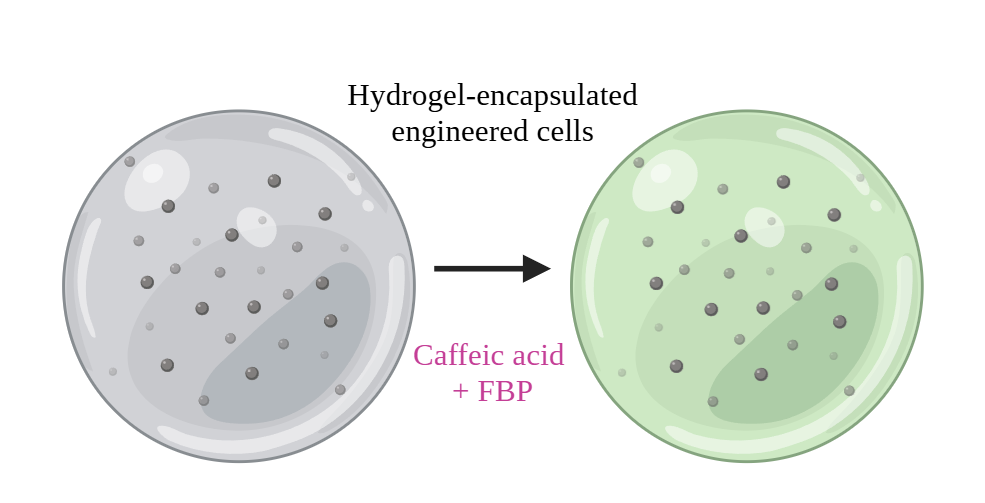
The hydrogel has porous junctions, excellent biocompatibility, and controllable physicochemical properties. This provides an environment that allows target molecules to diffuse through the matrix while maintaining the bacteria in place, improving the device’s portability. [2]
This work presents a caffeic acid and 5-CQA sensor based on the Fungal Bioluminescent Pathway (FBP), using Komagataella phaffii cells to express the FBP enzymes. The target diffuses through the hydrogel and activates the FBP pathway, resulting in light emission.
How would you use automation?
I would combine the hydrogel system with a microfluidic platform to automate sample handling and optical measurements. The system could control the introduction of the sample into the microfluidic chamber, regulate the flow and incubation time. An optical measurement step could then monitor the signal produced by the immobilized bacteria. Automation improves reproducibility by controlling parameters, while reducing manual handling. In the longer term, the platform could be used to test multiple samples and optimize the sensing parameters.
How much would you need to make, and how long would it take?
For an initial pilot-scale production, I would aim to manufacture approximately 1,000 biosensor units, each containing about 100 µL of bacteria-loaded hydrogel. This would require approximately 100 mL of hydrogel, including about 1 g of sodium alginate for a 1% w/v formulation. The main time requirement would be bacterial culture, which I estimate would take around 24 hours. Hydrogel preparation and sensor assembly could then be automated using a liquid-handling robot, requiring approximately 2–3 additional hours. Therefore, producing 1,000 sensing units would take approximately 26–27 hours, or about 1.5 days.
What don’t you know yet?
The main technical uncertainties are the stability and sensing performance of the immobilized Komagataella phaffii cells over time. I also need to determine how hydrogel composition affects biomarker diffusion and optical signal intensity. Finally, the scalability of the process needs to be validated.
References
[1] Torrez, V., Benavides-Frias, C., Jacobi, J., & Speranza, C. I. (2023). Ecological quality as a coffee quality enhancer. A review. Agronomy For Sustainable Development, 43(1), 19. https://doi.org/10.1007/s13593-023-00874-z
[2]Yang, S., Sarkar, S., Xie, X., Li, D., & Chen, J. (2023). Application of Optical Hydrogels in Environmental Sensing. Energy & Environment Materials, 7(3). https://doi.org/10.1002/eem2.12646