Week 2 HW: DNA Design
Part 1
The idea is to detect caffeic acid by expressing the Fungal Bioluminescent Pathway FBP enzymes (hispidin synthase HispS, hispidin-3-hydroxylase H3H, luciferase, and caffeylpyruvate hydrolase CPH). Together, they convert caffeic acid into fungal luciferin. [1]
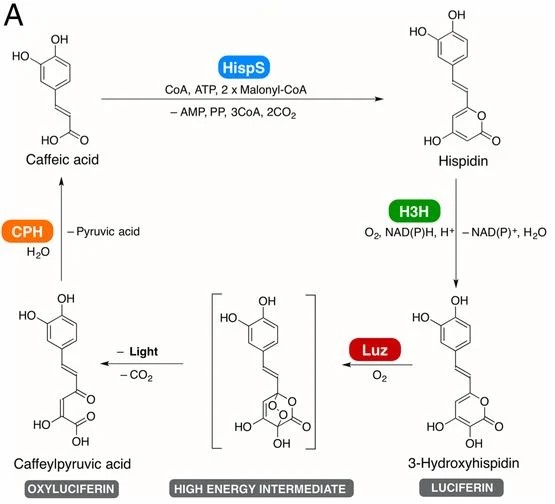
Figure 1. Proposed pathway of fungal luciferin biosynthesis and recycling. Caffeic acid is converted to hispidin by HispS and hydroxylated by H3H, yielding 3-hydroxyhispidin (fungal luciferin) [1]
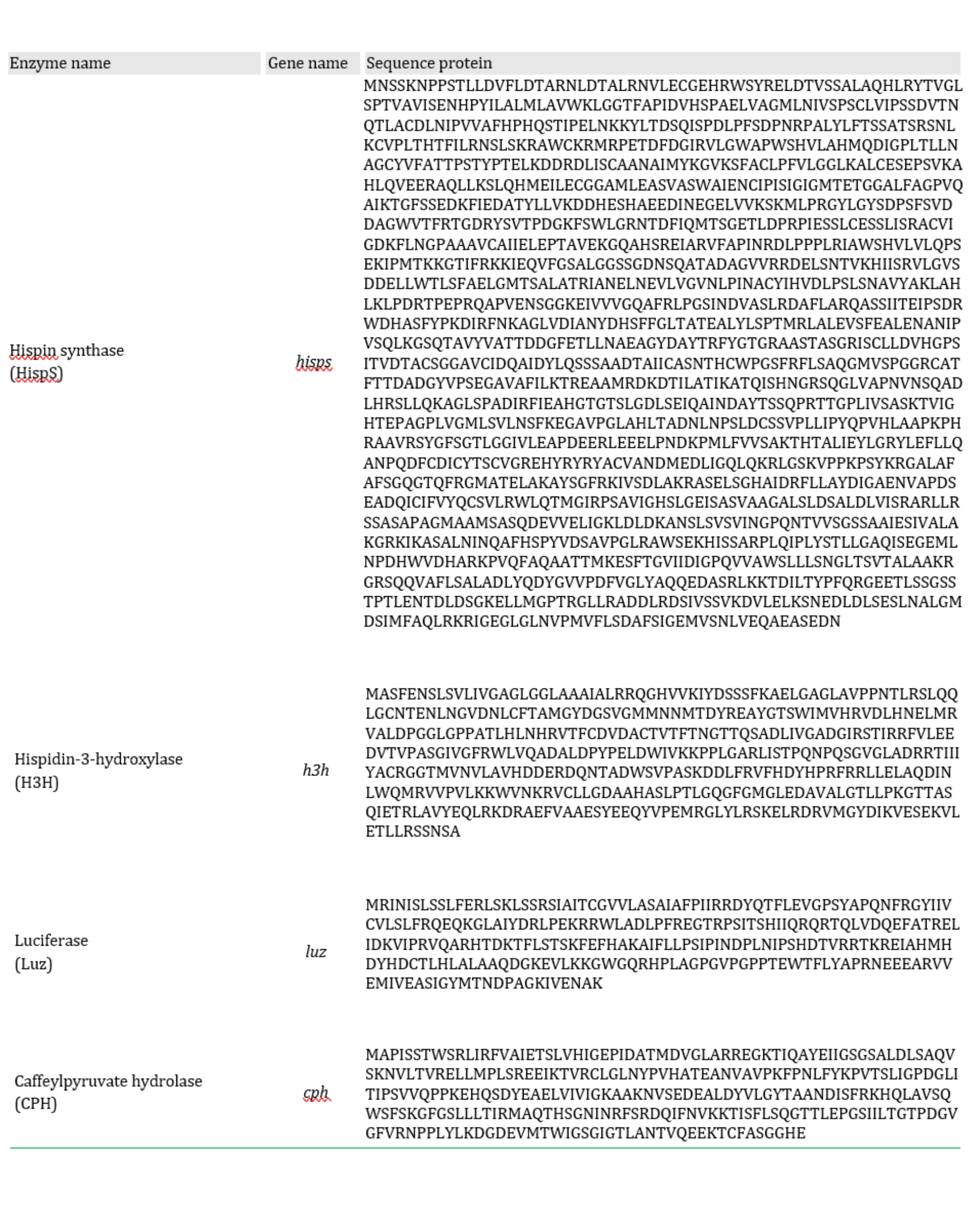
The sequence of enzymes that compose the FBP is described in the following table:
The chassis is Komagataella phaffii cells.
The FBP enzymes should be expressed in the cytoplasm.
References
[1] Kotlobay, A. A., Sarkisyan, K. S., Mokrushina, Y. A., Marcet-Houben, M., Serebrovskaya, E. O., Markina, N. M., Somermeyer, L. G., Gorokhovatsky, A. Y., Vvedensky, A., Purtov, K. V., Petushkov, V. N., Rodionova, N. S., Chepurnyh, T. V., Fakhranurova, L. I., Guglya, E. B., Ziganshin, R., Tsarkova, A. S., Kaskova, Z. M., Shender, V., . . . Yampolsky, I. V. (2018). Genetically encodable bioluminescent system from fungi. Proceedings Of The National Academy Of Sciences, 115(50), 12728-12732. https://doi.org/10.1073/pnas.1803615115
[2] Zamuner, C. K., Gomes, T. M. V., Bastos, E. L., Palkina, K. A., Yampolsky, I. V., Bechara, E. J. H., & Stevani, C. V. (2026). A Fungal Bioluminescent Pathway (FBP)-Based Yeast Biosensor for Caffeic Acid Quantification in Food and Beverages. ACS Sensors, 11(7), 5621-5634. https://doi.org/10.1021/acssensors.6c00051