Week 3 HW: cell free systems
- Objective
The objective of this assignment was to design novel cell-free protein synthesis (CFPS) reaction compositions for three target proteins — sfGFP, PETase, and Reteplase — with the goal of reducing the cost per gram of functional protein.
CFPS uses cell lysate containing the machinery required for transcription and translation, combined with DNA, amino acids, nucleotides, energy sources, salts, cofactors, and other components. Since individual reaction components can be adjusted independently, CFPS provides a flexible platform for optimizing protein production and cost.
The three proteins were selected because they represent increasing levels of folding difficulty: sfGFP has no disulfide bonds, PETase has one disulfide bond, and Reteplase has nine disulfide bonds.
A. COMPARE CELL-FREE REACTION COMPOSITIONS (20 minutes)
Why does the concentration of potassium glutamate and magnesium glutamate differ between compositions? Which is more sensitive?
Potassium glutamate (K-Glu) and magnesium glutamate (Mg-Glu) both contribute to the ionic environment required for efficient transcription and translation. However, they do not play identical roles. K-Glu primarily helps establish the overall ionic strength of the reaction, while Mg²⁺ has a more sensitive role in processes involving nucleic acids, ribosomes, and ATP/NTP interactions. Therefore, the concentrations of K-Glu and Mg-Glu differ between optimized formulations because the two ions affect the CFPS system differently. Mg-Glu is generally the more sensitive parameter, meaning relatively small changes in Mg²⁺ concentration can significantly affect reaction performance.
Explain how a PEP+NTP reaction formulation is different from a Ribose+NMP reaction formulation.
A PEP + NTP formulation uses phosphoenolpyruvate (PEP) as an energy-regeneration substrate and nucleotide triphosphates (ATP, CTP, GTP and UTP) as the building blocks for transcription. A Ribose + NMP formulation instead uses ribose together with less expensive nucleotide monophosphates (AMP, CMP, GMP and UMP). The major difference is therefore both how energy is regenerated and how nucleotides are supplied. The Ribose + NMP approach is particularly interesting for cost optimization because NTPs such as CTP, GTP and UTP are relatively expensive. Prior work has shown that partial replacement of NTPs with cheaper NMPs can reduce CFPS cost.
Choose two cell-free reaction compositions from the literature, compare and contrast the choice of reagents and the concentration of reagents.
or this comparison, I considered the PANOx-SP formulation and the later cost-optimized formulation described in the assignment. The PANOx-SP approach uses a conventional energy-regeneration system based around PEP and NTPs, whereas newer cost-optimized approaches investigate ways of reducing expensive reagents while maintaining protein production. Important cost-optimization strategies include:
- Improving pH buffering
- Partially replacing NTPs with NMPs
- Using small amounts of spermidine
- Reducing unnecessary expensive cofactors where possible
Part B — Designing New CFPS Compositions
The CFPS reaction has a fixed total volume of 20 µL. The fixed components are:
- Lysate: 5,000 nL
- DNA: 2,000 nL
- Base buffer: 2,000 nL This leaves 11,000 nL for variable reagents, with unused volume filled with nuclease-free water. Reagent volumes must be specified in 25 nL increments
3.1 sfGFP Design
Design goal
sfGFP is the least challenging of the three proteins because it does not require disulfide-bond formation. Its fluorescence provides a direct measurement of correctly folded functional protein.
I therefore focused primarily on cost reduction while maintaining a stable reducing CFPS environment.
| Reagent | Reference | My design | Rationale |
|---|---|---|---|
| K-Glu | 280 mM | 300 mM | Explore a moderate ionic-strength adjustment |
| Mg-Glu | 8.22 mM | 7.6 mM | Explore a slightly lower Mg²⁺ concentration |
| Amino acids | 2 mM | 2 mM | Maintained baseline |
| HEPES | 57.5 mM | 57.5 mM | Maintained pH buffering |
| PEP | 30 mM | 30 mM | Maintained energy regeneration |
| ATP | 1.25 mM | 1.25 mM | Maintained |
| CTP | 0.875 mM | 0.75 mM | Reduce expensive NTP usage |
| GTP | 0.875 mM | 0.75 mM | Reduce expensive NTP usage |
| UTP | 0.875 mM | 0.75 mM | Reduce expensive NTP usage |
| Spermidine | — | 1.88 mM | Explore cost/yield optimization |
The major cost-oriented change was reducing CTP, GTP and UTP while introducing a small amount of spermidine. This follows the general cost-optimization strategy described in the assignment, where partial NTP replacement and spermidine were associated with reduced cost per gram.

3.2 PETase Design
PETase is more challenging than sfGFP because TfCut2 contains one disulfide bond and must form the correct structure to be enzymatically active Because PETase remains compatible with reducing CFPS conditions, I retained the basic PEP-based formulation and focused on reducing the cost of nucleotide components.
| Reagent | Reference | My design | Rationale |
|---|---|---|---|
| K-Glu | 200 mM | 200 mM | Maintained |
| Mg-Glu | 10.1 mM | 10.1 mM | Maintained |
| NH4-Glu | 10 mM | 10 mM | Maintained |
| Amino acids | 2 mM | 2 mM | Maintained |
| HEPES | 57.5 mM | 57.5 mM | Maintained |
| PEP | 30 mM | 30 mM | Maintained |
| ATP | 1.25 mM | 1.25 mM | Maintained |
| CTP | 0.875 mM | 0.75 mM | Reduce NTP cost |
| GTP | 0.875 mM | 0.75 mM | Reduce NTP cost |
| UTP | 0.875 mM | 0.75 mM | Reduce NTP cost |
| Spermidine | — | 1.88 mM | Explore optimization |
deliberately made fewer changes to PETase than to sfGFP because the protein has an additional folding requirement. The intention was to explore cost reduction without substantially changing the established reaction environment.
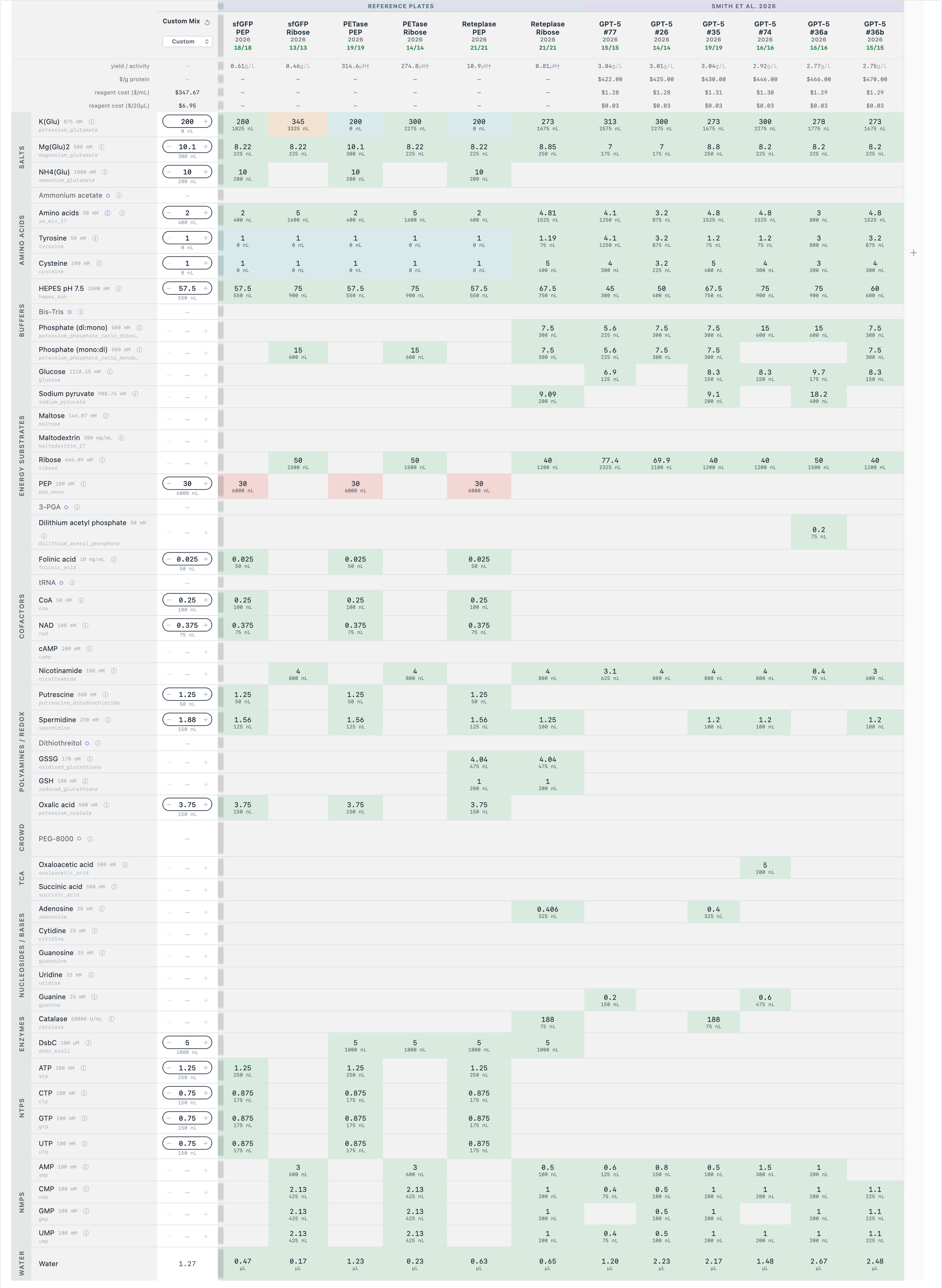
3.3 Reteplase Design
Reteplase presented the greatest design challenge because it contains nine disulfide bonds, all of which must form correctly for the protein to become functional. Unlike sfGFP and PETase, Reteplase therefore requires an oxidizing CFPS formulation. The assignment specifically describes the use of a modified lysate, GSSG/GSH redox buffering, DsbC, and a Δgor lysate. For this reason, I preserved the key disulfide-folding components rather than removing them purely for cost reduction.
| Reagent | Reference | My design | Rationale |
|---|---|---|---|
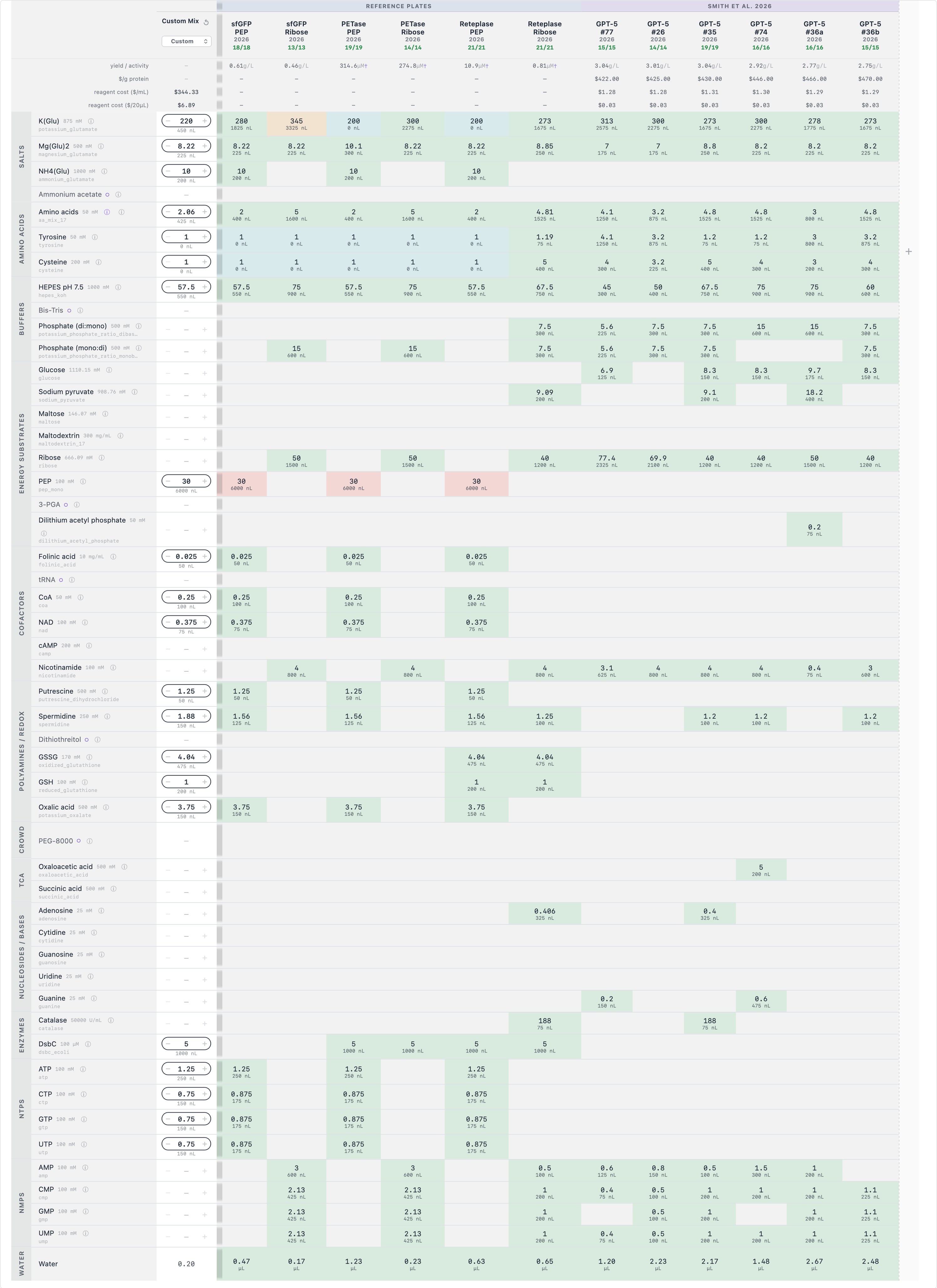
| K-Glu | 200 mM | 220 mM | Explore ionic environment |
| Mg-Glu | 8.22 mM | 8.22 mM | Maintained |
| NH4-Glu | 10 mM | 10 mM | Maintained |
| Amino acids | 2 mM | 2.06 mM | Small adjustment within designer constraints |
| HEPES | 57.5 mM | 57.5 mM | Maintained |
| PEP | 30 mM | 30 mM | Maintained |
| ATP | 1.25 mM | 1.25 mM | Maintained |
| CTP | 0.875 mM | 0.75 mM | Reduce NTP cost |
| GTP | 0.875 mM | 0.75 mM | Reduce NTP cost |
| UTP | 0.875 mM | 0.75 mM | Reduce NTP cost |
| GSSG | 4.04 mM | 4.04 mM | Preserved redox environment |
| GSH | 1 mM | 1 mM | Preserved redox environment |
| DsbC | 5 mM | 5 mM | Preserved folding assistance |
| Spermidine | — | 1.88 mM | Explore optimization |
4. Community Reagent — FkpA
For the Community Reagents section, I selected FkpA. FkpA is an E. coli chaperone with peptidyl-prolyl isomerase activity that can assist protein folding. I selected it because Reteplase has nine disulfide bonds and therefore represents the most demanding folding problem among the three targets. The reasoning was to add a reagent that addresses functional protein folding, rather than simply increasing protein expression. FkpA is particularly interesting because it can complement DsbC, which is already present in the Reteplase formulation. The assignment identifies DsbC as a folding helper that rearranges incorrectly paired disulfide bonds Research supporting the choice Groff et al. demonstrated that FkpA and DsbC can act as positive effectors of difficult disulfide-containing protein folding and assembly. Reference: Groff, M. et al. (2014). Engineering toward a bacterial “endoplasmic reticulum” for the rapid expression of immunoglobulin proteins.
. Design Strategy Across all three proteins, my overall strategy was:
- Start from the closest reference formulation →
- Identify expensive or potentially adjustable reagents →
- Make small changes rather than changing the entire formulation →
- Preserve protein-specific folding requirements →
- Prioritize functional protein rather than total protein expression. This was particularly important for Reteplase. Since activity depends on correct formation of its nine disulfide bonds, simply increasing total expression would not necessarily improve functional yield. The assignment similarly emphasizes that different target proteins can require different reaction conditions.
6. AI-Assisted Design
prompts:
- “Explain the difference between potassium glutamate and magnesium glutamate in CFPS.”
- “Explain the difference between PEP + NTP and Ribose + NMP formulations.”
- “Help me design a cost-conscious CFPS formulation for sfGFP using the reference formulation.”
- “Help me reason about which reagents should be preserved for Reteplase and why.”
- “Explain why DsbC, GSSG and GSH are important for Reteplase.”
- “Help me evaluate FkpA as a potential community reagent for improving Reteplase folding.”