Week 1 HW: Final Project Ideas

The cover image depicts the 3D molecular structure of the engineered plant defensin RsAFP2.
(1) What you would like to biomanufacture and why?
A leave-on topical hydrogel containing a re-engineered RsAFP2 plant defensin peptide to fight cutaneous fungal infections and restore skin microbiome balance.
In the following diagram I present a quick overview of the rationale for the project followed by a more detailed description:
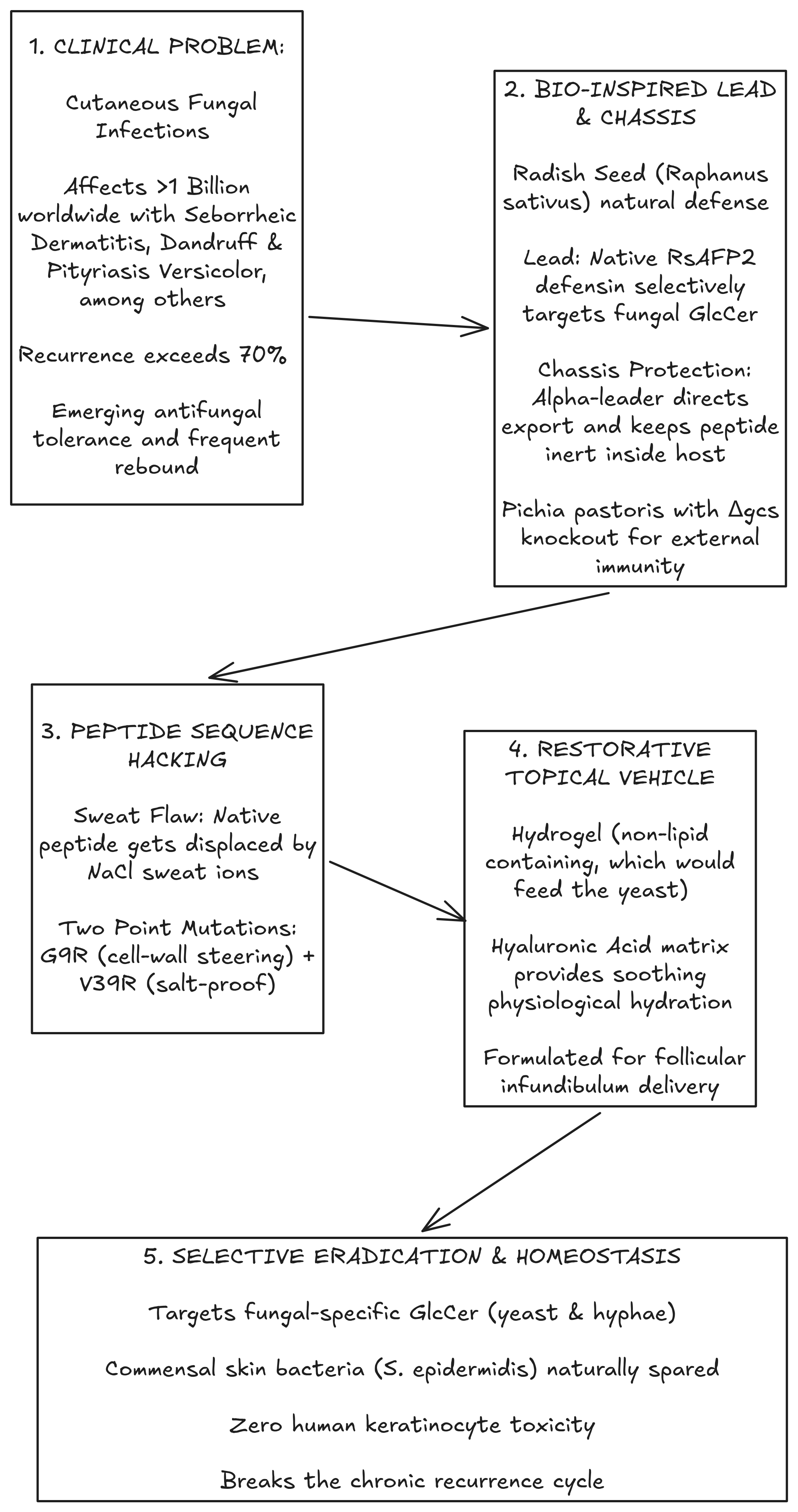
The idea for this project started with a condition that I see myself affected by and made me come up with the question: what would be a viable alternative to the current treatment methods that isn’t harsh on the skin and helps it reestablish balance instead of just fighting the infection?
This led me through an interesting journey of discovery about the skin, its interactions with the microbiome and what a safe biopharmaceutical intervention could look like.
I went on doing a literature review encompassing the etiology of these conditions and alternative biopharmaceutical approaches that could benefit from a biomanufacturing implementation.
Through this literature review I found out about a peptide, a plant defensin first isolated in 1992 from the common garden radish (Raphanus sativus L., family Brassicaceae), aiming for agricultural purposes, the RsAFP2 (Terras et al., 1992).
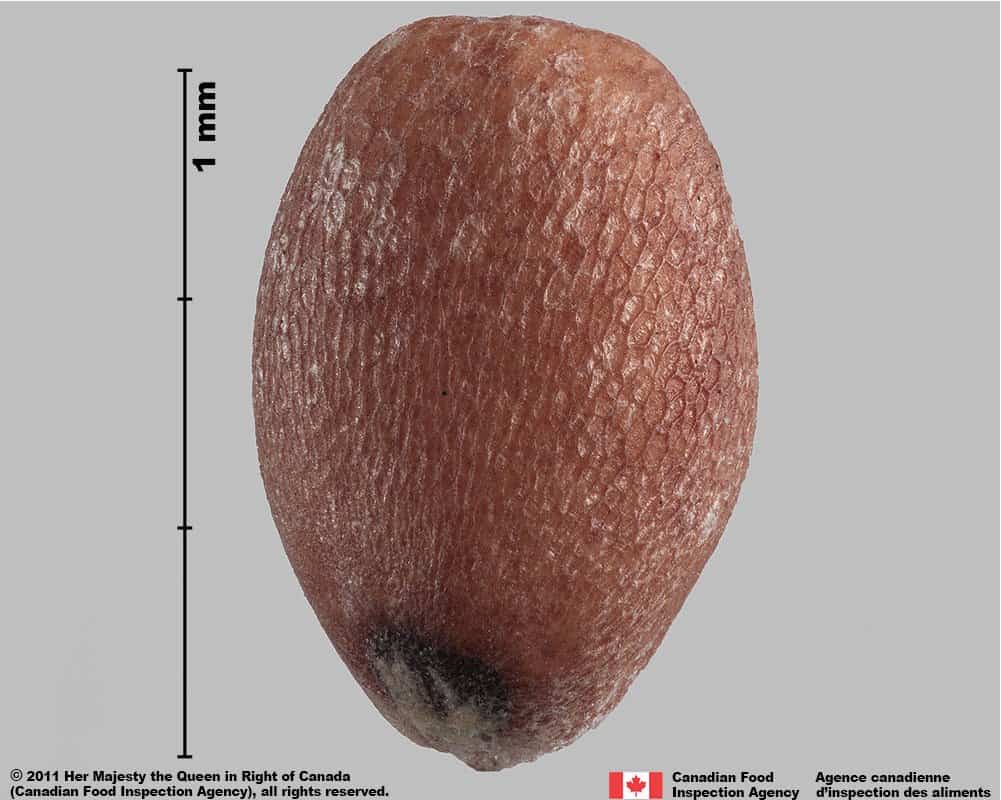 Figure: Seed of the common garden radish (Raphanus sativus L.), the natural source from which the antifungal defensin RsAFP2 was first isolated. I love the idea of leveraging a molecule from a plant seed to create a re-engineered human therapeutic.
My initial idea is about developing a hydrogel containing a re-engineered version of this plant defensin that reduces the yeast overgrowth in the skin, while not disrupting the beneficial microflora and has no detrimental effects on the skin. In the future, other components like urea and/or probiotics could be added to the final product, so that it leads to a more thorough skin health rebalance.
Virtually all human fungal pathogens including Malassezia, Candida, and dermatophytes (ringworm) depend on the exact same cell-membrane receptor: fungal glucosylceramide (GlcCer). Because this specific branched lipid is completely absent in human cells and beneficial bacteria, our engineered defensin acts as a selective fungal therapeutic with zero mammalian toxicity (Thevissen et al., 2004).
For optimal results, we would be tailoring the wild-type peptide specifically for the human cutaneous environment, applying two point mutations documented in the literature (G9R/V39R; Pandey et al., 2020): basically we are hacking the wild-type peptide to optimize for skin conditions, making it more salt-tolerant and electrostatically targeted.
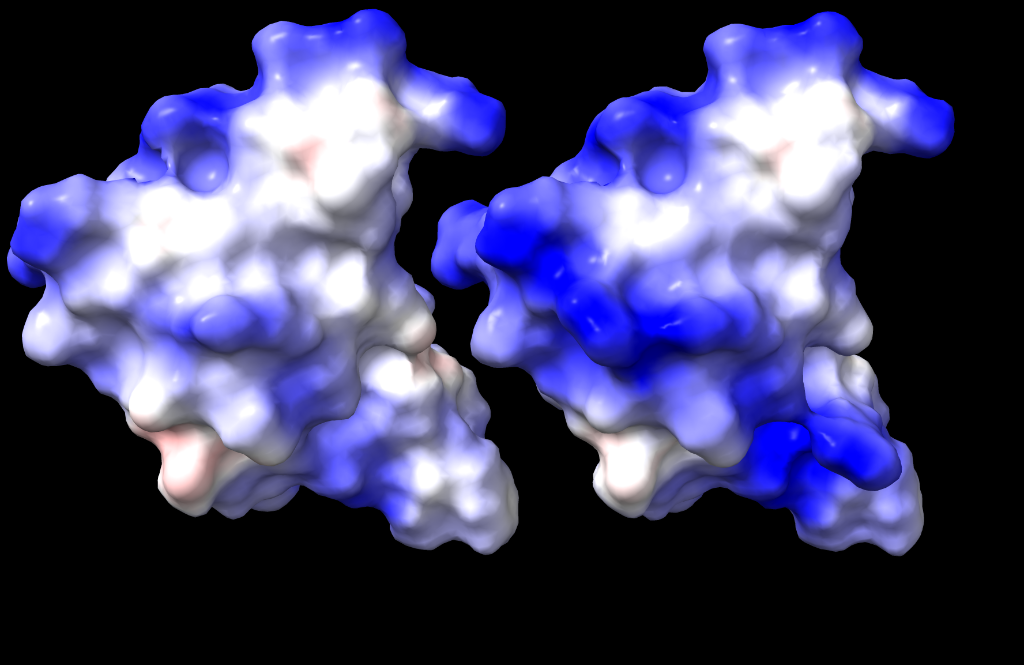 Figure: Electrostatic surface potential comparison between wild-type RsAFP2 (left) and our engineered G9R/V39R double mutant (right). The expanded deep-blue surface indicates an increased positive electrostatic charge, enhancing attraction toward negatively charged fungal membranes and preventing ionic deactivation by sweat (rendered using UCSF ChimeraX).
This is also an exercise in how an individual can leverage scientific research to solve a personal problem and eventually work together with others that share the same interest: a different way of developing health solutions that is not dependent on a company’s initiative. Obviously this also poses questions about safety and regulation, which I find will become more and more important as biotechnological experiments become accessible outside regulated institutions.
Safety
Different studies have characterized RsAFP2 as safe for human cells:
Tavares et al. (2008):
Specifically tested RsAFP2 against human cells using an automated Lactate Dehydrogenase (LDH) release assay. RsAFP2 caused zero LDH leakage, completely inert toward mammalian cells.Terras et al. (1992) and Thevissen et al. (2004):
Demonstrated 0% hemolytic activity against human red blood cells even at concentrations >500 μg/mL.
Future directions
adding extra components that help the skin recover and avoid recurrence (e.g. urea, probiotics);
after the engineered peptide proves effective for our use case (skin dysbiosis), we could develop different delivery systems for using in the scalp or against vaginal candidiasis, where it’s also very important not to disrupt the beneficial bacterial flora;
chromogenic feedback, transforming the product into a theragnostic that gives the user an immediate reading of the treatment’s effectiveness;
grafting an Arg-Arg-Arg-Trp (RRRW) motif into the defensin’s flexible β2–β3 loop (γ-core). In plant defensin studies, this cationic-hydrophobic patch accelerates fungal membrane permeabilization by over 300% (Sagaram et al., 2011). This would have to be screened for production viability and safety, as described in the automation section;
eventual translation to internal use, producing an antifungal that has no hepatotoxicity, in contrast to current drugs in the market.
(2) What living system would you use?
Host chassis: Methylotrophic yeast Komagataella phaffii (Pichia pastoris)
We need an eukaryotic chassis for specific folding that wouldn’t be possible in a bacterial one and we don’t need any mammalian cell specific machinery, hence this choice.
Because wild-type Pichia pastoris is a fungus whose plasma membrane contains glucosylceramide, expressing an antifungal defensin in a wild-type fungal host would result in autotoxicity. For this reason, manufacturing requires a two-stage engineering sequence:
Host Immunization: we disrupt the Pichia glucosylceramide synthase gene (GCS, locus PAS_chr4_0775) using a transient, marker-free CRISPR/Cas9 plasmid. The resulting Δgcs Pichia pastoris mutant produces no glucosylceramide and is completely immune to defensin-mediated lysis (confirmed by Thevissen et al., 2004).
API Expression Vector Integration: the immune Δgcs host is transformed with the linearized expression vector pPICZαA-RsAFP2[G9R/V39R] for stable single-crossover integration into the chromosomal AOX1 locus.
(3) How would you use automation?
This is an area that I hope to improve as the course proceeds and I get more familiar with the available automation methods and their possible uses.
Through an AI guided exploration where I provided the AI with the course content and available automation systems along with the project details, it suggested some uses, from which I selected what seems to me a sensible use for automation during the biomanufacturing process which I describe below (the text has been manually edited by me).
Example using the Opentrons OT-2 for testing formulation phase-behavior and solubility:
RsAFP2 (our peptide) has a +7 positive charge. Hyaluronic acid (the hydrogel polymer) is an anionic polyglycosaminoglycan covered in negative carboxylic acid groups (-COO⁻).
At certain pH and salt levels, strongly positive peptides and strongly negative polymers can bind together and form cloudy precipitates or “clumps” (polyelectrolyte complexation).
The automated screen: we would be using the Opentrons robot to run a combinatorial 96-well grid:
- pH gradient: 4.0, 4.5, 4.8, 5.2, 5.5, 6.0, 6.5
- Salt gradient: 0, 25, 50, 100, 150 mM NaCl
- Polymer: 0.5%, 1.0%, 1.5% Hyaluronic acid
We would then measure absorbance at 405 nm to find the exact formulation window where the gel remains 100% crystal-clear and the peptide is free to diffuse and kill yeast.
Another possible use
I also find this use for automation really interesting: as mentioned in the “future directions” section, there is another peptide modification (γ-core RRRW grafting) that could be used to improve the antifungal activity but that has never been tested for use in humans (as far as I could find). An automated safety pipeline could be implemented that verifies if it doesn’t compromise host safety:
- Opentrons OT-2 automated 96-well HaCaT human keratinocyte cytotoxicity screen (CellTiter-Glo viability and LDH release assays).
This would establish a developability gate to confirm if the high selectivity of RsAFP2 for fungal glucosylceramide is preserved with zero mammalian membrane permeabilization.
(4) How much would you need to make, and how long would it take?
I used AI to come up with the estimations and calculations below, using the articles mentioned in the bibliography as references (“Clinical scale and dosing standards” and “Living system and Biomanufacturing automation” sections). I will iterate on them as I become more familiar with the methods. All the text was manually edited by me but I must clarify that I am not familiar with all the processes that are mentioned.
(a) How much?
For a 4-week clinical treatment course for 10,000 patients (10,000×50 mL tubes of 0.1% topical hydrogel): (Borda and Wikramanayake, 2015; Long and Finlay, 1991):
Calculations
Mass of pure RsAFP2[G9R/V39R] active peptide needed per tube:
Mass per tube = 50 mL × 1.0 mg/mL = 50 mg = 0.050 grams of pure RsAFP2
Total active product needed for 10,000 patients:
Total Active Peptide Required = 10,000 patients × 0.050 g/patient = 500 grams (0.50 kg)
(b) How long?
The overall workflow divides into two distinct automated phases: initial prototyping and the 500-gram production campaign:
Prototyping Automation vs. Production Automation
Prototyping phase (2–3 weeks, upfront R&D): High-throughput micro-scale screening using the Opentrons OT-2 to screen colonies, optimize media in 96-well plates, and test formulation compatibility (μL to mL scale; Asin-Garcia et al., 2025).
Production phase (3 weeks, manufacturing campaign): Pilot-scale manufacturing of the 500 g using a SCADA-controlled 500 L Bioreactor with automated Process Analytical Technology (PAT; Cereghino and Cregg, 2000; Petzold and Mukhopadhyay, 2025): closed-loop DO-stat methanol feeding, mass-flow gas blending, and automated Tangential Flow Filtration (TFF).
Bioreactor volume and time calculation
Target pure peptide: 500 g
Expected fermentation titer: 1.5 g/L in Pichia pastoris broth
Downstream recovery: ~70% (yielding ~1.0 g/L pure peptide)
Total broth required: 500 g ÷ 1.0 g/L = 500 L broth
To produce 500 L with adequate headroom for aeration and foaming, we run two 250 L batches in a 500 L pilot vessel (working at 50% capacity).
Manufacturing Timeline
Batch strategy: Run two consecutive 250 L batches in a 500 L pilot vessel
Cycle time per batch (8 days): Seed train (2d) + Glycerol biomass phase (1d) + Methanol induction (3.5d) + Harvest/CIP (1.5d)
Downstream purification and packaging: 5 days
Production manufacturing duration = (2×8 days) + 5 days = 21 days (≈3 weeks)
(Total initial campaign duration including upfront prototyping: ≈5–6 weeks)
5. What don’t you know yet?
The fact that we are dealing with a biopharmaceutical project means that we would need a lot of careful testing to validate the action (some of it could probably be done through automation, as clarified above) and safety. The ultimate validation would be testing it on human skin and measure its effect on infected skin: I am not familiar with the process but that’s something I will explore in the meanwhile.
Being pretty much a beginner when it comes to biomanufacturing, I can’t still define exactly what is the best way to implement the fabrication process of such a product. Hopefully as the course advances, things will become more clear. For this proposal I am using some ideas retrieved through AI (always using reliable sources as references) and these should be considered “temporary”.
I also need to dive deeper on how to calculate and establish the right posology and treatment guidelines.
AI use:
I’ve been experimenting with an AI assisted research environment, using Google Antigravity 2.0 with the Gemini Flash 3.8 model. The agent is connected to external scientific literature sources (using the Consensus MCP server as well as other sources through web-search) so that I can more easily find relevant articles related to the project.
I have been having good results with finding relevant literature but the AI is still quite naïve with some of its statements and overly optimistic about some of the ideas I present to it. For this reason, I use it to gather information (which really speeds up the process) and as a brainstorming companion, while always checking the sources as the ultimate source of truth.
For the proposal, I prompted the AI with my original “problem” and asked it to find possible solutions that could be implemented through biomanufacturing. I then went on asking for details about specific parts of the project, gathering relevant articles that I accessed directly and keep as a reference locally for me and for the AI agent itself.
All the information is then kept in the form of a local “wiki” that I access as an Obsidian vault.
AI was also used to generate the clean citation list.
I still prefer to write the final text myself, and that’s what I did for this proposal.
Bibliography
Foundational Plant Defensin and Biology:
- Terras, F. R., Schoofs, H. M., De Bolle, M. F., Van Leuven, F., Rees, S. B., Vanderleyden, J., Cammue, B. P., and Broekaert, W. F. (1992). Analysis of two novel classes of plant antifungal proteins from radish (Raphanus sativus L.) seeds. Journal of Biological Chemistry, 267(22), 15301–15309. DOI: 10.1016/s0021-9258(19)49534-3
- Thevissen, K., Warnecke, D. C., François, I. E., Leipelt, M., Heinz, E., Ott, C., Zähringer, U., Thomma, B. P., Ferket, K. K., and Cammue, B. P. (2004). Defensins from insects and plants interact with fungal glucosylceramides: Pichia pastoris Δgcs mutants are highly resistant to defensin-mediated permeabilization. Journal of Biological Chemistry, 279(6), 3900–3905. DOI: 10.1074/jbc.M311165200
- Tavares, P. M., Thevissen, K., Cammue, B. P., François, I. E., Barreto-Bergter, E., Taborda, C. P., Marques, A. F., Rodrigues, M. L., and Nimrichter, L. (2008). In vitro activity of the antifungal plant defensin RsAFP2 against Candida isolates and its in vivo efficacy in prophylactic murine models of candidiasis. Antimicrobial Agents and Chemotherapy, 52(12), 4522–4525. DOI: 10.1128/AAC.00448-08
- Pandey, B., Tyagi, C., Prajapati, G. K., Mishra, A. K., Hashem, A., Alqarawi, A. A., and Abd_Allah, E. F. (2020). Analysis of mutations of defensin protein using accelerated molecular dynamics simulations. PLoS ONE, 15(11), e0241679. DOI: 10.1371/journal.pone.0241679
- Sagaram, U. S., Pandurangi, R., Kaur, J., Smith, T. J., and Shah, D. M. (2011). Structure-activity determinants in antifungal plant defensins MsDef1 and MtDef4 with different modes of action against Fusarium graminearum. PLoS ONE, 6(4), e18550. DOI: 10.1371/journal.pone.0018550
Clinical Scale and Dosing Standards:
- Borda, L. J., and Wikramanayake, T. C. (2015). Seborrheic dermatitis and dandruff: a comprehensive review. Journal of Clinical and Investigative Dermatology, 3(2), 10. DOI: 10.13188/2373-1044.1000019 | PMCID: PMC4852869
- Long, C. C., and Finlay, A. Y. (1991). The finger-tip unit—a new practical measure. Clinical and Experimental Dermatology, 16(6), 444–447. DOI: 10.1111/j.1365-2230.1991.tb01232.x
Living System and Biomanufacturing Automation:
- Cereghino, J. L., and Cregg, J. M. (2000). Heterologous protein expression in the methylotrophic yeast Pichia pastoris. FEMS Microbiology Reviews, 24(1), 45–66. DOI: 10.1111/j.1574-6976.2000.tb00532.x
- Petzold, C. J., and Mukhopadhyay, A. (2025). From bench to biofactory: high-throughput technologies and automated workflows to accelerate biomanufacturing. Current Opinion in Biotechnology, 94, 103320. DOI: 10.1016/j.copbio.2025.103320
- Asin-Garcia, E., Fawcett, Z., Batianis, C., et al. (2025). A snapshot of biomanufacturing and the need for enabling research infrastructure. Trends in Biotechnology, 43(5), 1000–1014. DOI: 10.1016/j.tibtech.2024.10.014