Week 2 HW: DNA Design
Part 0: Set up in Kernel
ruben_goncalves/goncalves-antifungal_peptide
Part 1: Define your expression target
What molecule are you expressing? I’m expressing an engineered plant peptide: the RsAFP2[G9R/V39R].
What is the sequence?
The amino acid sequence for the wild-type defensin Rs-AFP2 from Raphanus sativus was obtained from UniProtKB (Accession: P30230, Entry: DEF1_RAPSA; https://www.uniprot.org/uniprotkb/P30230/entry):
MAKFASIIVLLFVALVVFAAFEEPTMVEAQKLCQRPSGTWSGVCGNNNACKNQCIRLEKARHGSCNYVFPAHKCICYFPC
In the UniProt Feature viewer the first 29 AAs are identified as a plant signal sequence, which we need to remove as later we are adding the yeast signal peptide:
QKLCQRPSGTWSGVCGNNNACKNQCIRLEKARHGSCNYVFPAHKCICYFPC
Final sequence with the two specific point mutations: Gly9Arg (G9R) and Val39Arg (V39R) based on De Samblanx et al. (1997) and Pandey et al. (2020):
QKLCQRPSRTWSGVCGNNNACKNQCIRLEKARHGSCNYRFPAHKCICYFPC
What host or chassis? Pichia pastoris.
Where does the product need to go? It needs to be secreted (extracellular). The peptide is targeted co-translationally into the endoplasmic reticulum lumen using the S. cerevisiae αα-mating factor pre-pro leader peptide.
Part 2: Design your genetic parts
For defining the parts that need to be included in the plasmid, apart from the peptide sequence, the “pPICZ A” Pichia pastoris vector was used as a reference (retrieved from https://www.snapgene.com/plasmids/yeast_plasmids/pPICZ_A ).
_A_reference_map.png) Figure: Reference plasmid map of pPICZα A (3,593 bp; Invitrogen/SnapGene).
Figure: Reference plasmid map of pPICZα A (3,593 bp; Invitrogen/SnapGene).
Each of the necessary components was individually created as a part in Kernel. The sequence for each of the parts was extracted from the .dna file retrieved from the address above.
The sequence for the RsAFP2 plant peptide was retrived from the European Nucleotide Archive (https://www.ebi.ac.uk/ena/browser/api/embl/U18556.1?lineLimit=1000). Several edits had to be done to achieve the DNA coding sequence for the mature 51-amino-acid engineered defensin:
- removal of the DNA bases (1–41): plant’s 5’ UTR;
- removal of the DNA bases (42–128): plant’s native signal peptide;
- removal of the DNA bases (285–457): plant’s 3’ UTR and poly(A) tail;
- engineered point mutations (G9R and V39R).
Parts created in Kernel:
AOX1 promoter
Type: promoter
Ultra-strong, methanol-inducible eukaryotic promoter from Pichia pastoris (Invitrogen pPICZαA) driving high-titer defensin expression upon glycerol depletion, harboring a unique SacI linearization site (bp 208) for Campbell chromosomal integration.
Sequence (939 bp):GATCTAACATCCAAAGACGAAAGGTTGAATGAAACCTTTTTGCCATCCGACATCCACAGGTCCATTCTCACACATAAGTGCCAAACGCAACAGGAGGGGATACACTAGCAGCAGACCGTTGCAAACGCAGGACCTCCACTCCTCTTCTCCTCAACACCCACTTTTGCCATCGAAAAACCAGCCCAGTTATTGGGCTTGATTGGAGCTCGCTCATTCCAATTCCTTCTATTAGGCTACTAACACCATGACTTTATTAGCCTGTCTATCCTGGCCCCCCTGGCGAGGTTCATGTTTGTTTATTTCCGAATGCAACAAGCTCCGCATTACACCCGAACATCACTCCAGATGAGGGCTTTCTGAGTGTGGGGTCAAATAGTTTCATGTTCCCCAAATGGCCCAAAACTGACAGTTTAAACGCTGTCTTGGAACCTAATATGACAAAAGCGTGATCTCATCCAAGATGAACTAAGTTTGGTTCGTTGAAATGCTAACGGCCAGTTGGTCAAAAAGAAACTTCCAAAAGTCGGCATACCGTTTGTCTTGTTTGGTATTGATTGACGAATGCTCAAAAATAATCTCATTAATGCTTAGCGCAGTCTCTCTATCGCTTCTGAACCCCGGTGCACCTGTGCCGAAACGCAAATGGGGAAACACCCGCTTTTTGGATGATTATGCATTGTCTCCACATTGTATGCTTCCAAGATTCTGGTGGGAATACTGCTGATAGCCTAACGTTCATGATCAAAATTTAACTGTTCTAACCCCTACTTGACAGCAATATATAAACAGAAGGAAGCTGCCCTGTCTTAAACCTTTTTTTTTATCATCATTATTAGCTTACTTTCATAATTGCGACTGGTTCCAATTGACAAGCTTTTGATTTTAACGACTTTTAACGACAACTTGAGAAGATCAAAAAACAACTAATTATTCGAAACG
α-factor secretion signal
Type: peptide-cds (+start, -stop)
Bipartite pre-pro secretion leader from Saccharomyces cerevisiae MFα1 (Invitrogen pPICZαA) directing the nascent peptide co-translationally into the oxidizing ER lumen for 4-disulfide bond formation, terminating in a dibasic Lys-Arg motif for scarless Golgi Kex2 endoprotease cleavage.
Sequence (267 bp):ATGAGATTTCCTTCAATTTTTACTGCTGTTTTATTCGCAGCATCCTCCGCATTAGCTGCTCCAGTCAACACTACAACAGAAGATGAAACGGCACAAATTCCGGCTGAAGCTGTCATCGGTTACTCAGATTTAGAAGGGGATTTCGATGTTGCTGTTTTGCCATTTTCCAACAGCACAAATAACGGGTTATTGTTTATAAATACTACTATTGCCAGCATTGCTGCTAAAGAAGAAGGGGTATCTCTCGAGAAAAGAGAGGCTGAAGCT
RsAFP2_G9R_V39R_optimized
Type: peptide-cds (-start, +stop)
De novo engineered plant defensin coding sequence (based on UniProt P30230 / PDB 2N2R) harboring G9R and V39R substitutions, codon-harmonized for Saccharomyces cerevisiae as the closest organism to Pichia pastoris available and terminated with tandem TAA stop codons.
Sequence (156 bp):CAAAAATTGTGTCAAAGACCATCTAGAACTTGGTCTGGTGTTTGTGGTAATAATAATGCTTGTAAAAATCAATGTATTAGATTGGAAAAAGCTAGACATGGTTCTTGTAATTATAGATTTCCAGCTCATAAATGTATTTGTTATTTTCCATGTTAA
AOX1 terminator
Type: terminator
Native Pichia pastoris AOX1 transcription terminator and polyadenylation signal (Invitrogen pPICZαA) ensuring high mRNA transcript stability, efficient 3’ cleavage, and prevention of transcriptional read-through into downstream units.
Sequence (247 bp):TCAAGAGGATGTCAGAATGCCATTTGCCTGAGAGATGCAGGCTTCATTTTTGATACTTTTTTATTTGTAACCTATATAGTATAGGATTTTTTTTGTCATTTTGTTTCTTCTCGTACGAGCTTGCTCCTGATCAGCCTATCTCGCAGCTGATGAATATCTTGTGGTAGGGGTTTGGGAAAATCATTCGAGTTTGATGTTTTTCTTGGTATTTCCCACTCCTCTTCAGAGTACAGAAGATTAAGTGAGA
TEF1 promoter
Type: promoter
Robust, constitutive RNA Polymerase II promoter from Saccharomyces cerevisiae Translation Elongation Factor 1 (Invitrogen pPICZαA) driving continuous expression of the Zeocin resistance marker in yeast without requiring chemical inducers.
Sequence (387 bp):AATGTTTCTACTCCTTTTTTACTCTTCCAGATTTTCTCGGACTCCGCGCATCGCCGTACCACTTCAAAACACCCAAGCACAGCATACTAAATTTTCCCTCTTTCTTCCTCTAGGGTGTCGTTAATTACCCGTACTAAAGGTTTGGAAAAGAAAAAAGAGACCGCCTCGTTTCTTTTTCTTCGTCGAAAAAGGCAATAAAAATTTTTATCACGTTTCTTTTTCTTGAAATTTTTTTTTTTAGTTTTTTTCTCTTTCAGTGACCTCCATTGATATTTAAGTTAATAAACGGTCTTCAATTTCTCAAGTTTCAGTTTCATTTTTCTTGTTCTATTACAACTTTTTTTACTTCTTGTTCATTAGAAAGAAAGCATAGCAATCTAATCTAAG
EM7 promoter
Type: promoter
Minimal synthetic prokaryotic promoter (Invitrogen pPICZαA) providing constitutive σ70-driven expression of the BleoR resistance gene in Escherichia coli during plasmid propagation, functioning in an orthogonal tandem arrangement with the upstream TEF1 promoter.
Sequence (48 bp):
GTTGACAATTAATCATCGGCATAGTATATCGGCATAGTATAATACGAC
BleoR
Type: cds (+start, +stop)
Dominant antibiotic resistance gene from Streptoalloteichus hindustanus (sh ble, Invitrogen pPICZαA) encoding a 13.7 kDa acidic protein that stoichiometrically binds and neutralizes Zeocin in a 1:1 complex, conferring chemical selection in both bacteria and yeast.
Sequence (375 bp):ATGGCCAAGTTGACCAGTGCCGTTCCGGTGCTCACCGCGCGCGACGTCGCCGGAGCGGTCGAGTTCTGGACCGACCGGCTCGGGTTCTCCCGGGACTTCGTGGAGGACGACTTCGCCGGTGTGGTCCGGGACGACGTGACCCTGTTCATCAGCGCGGTCCAGGACCAGGTGGTGCCGGACAACACCCTGGCCTGGGTGTGGGTGCGCGGCCTGGACGAGCTGTACGCCGAGTGGTCGGAGGTCGTGTCCACGAACTTCCGGGACGCCTCCGGGCCGGCCATGACCGAGATCGGCGAGCAGCCGTGGGGGCGGGAGTTCGCCCTGCGCGACCCGGCCGGCAACTGCGTGCACTTCGTGGCCGAGGAGCAGGACTGA
CYC1 terminator
Type: terminator
Native Saccharomyces cerevisiae Cytochrome c-1 transcription terminator and polyadenylation signal (Invitrogen pPICZαA) directing 3’ transcript processing of the BleoR mRNA in yeast, insulating the adjacent bacterial origin of replication.
Sequence (248 bp):TCATGTAATTAGTTATGTCACGCTTACATTCACGCCCTCCCCCCACATCCGCTCTAACCGAAAAGGAAGGAGTTAGACAACCTGAAGTCTAGGTCCCTATTTATTTTTTTATAGTTATGTTAGTATTAAGAACGTTATTTATATTTCAAATTTTTCTTTTTTTTCTGTACAGACGCGTGTACGCATGTAACATTATACTGAAAACCTTGCTTGAGAAGGTTTTGGGACGCTCGAAGGCTTTAATTTGC
ori
Type: origin-of-replication
High-copy prokaryotic replicon derived from plasmid pUC19/ColE1 (Invitrogen pPICZαA) recruiting E. coli DNA Polymerase III on the reverse strand to maintain 500–700 plasmid copies per cell for rapid, high-yield cloning and miniprep harvesting.
Sequence (589 bp):TTTCCATAGGCTCCGCCCCCCTGACGAGCATCACAAAAATCGACGCTCAAGTCAGAGGTGGCGAAACCCGACAGGACTATAAAGATACCAGGCGTTTCCCCCTGGAAGCTCCCTCGTGCGCTCTCCTGTTCCGACCCTGCCGCTTACCGGATACCTGTCCGCCTTTCTCCCTTCGGGAAGCGTGGCGCTTTCTCAATGCTCACGCTGTAGGTATCTCAGTTCGGTGTAGGTCGTTCGCTCCAAGCTGGGCTGTGTGCACGAACCCCCCGTTCAGCCCGACCGCTGCGCCTTATCCGGTAACTATCGTCTTGAGTCCAACCCGGTAAGACACGACTTATCGCCACTGGCAGCAGCCACTGGTAACAGGATTAGCAGAGCGAGGTATGTAGGCGGTGCTACAGAGTTCTTGAAGTGGTGGCCTAACTACGGCTACACTAGAAGGACAGTATTTGGTATCTGCGCTCTGCTGAAGCCAGTTACCTTCGGAAAAAGAGTTGGTAGCTCTTGATCCGGCAAACAAACCACCGCTGGTAGCGGTGGTTTTTTTGTTTGCAAGCAGCAGATTACGCGCAGAAAAAAAGGATCTCAA
Part 3: Assemble your construct
(Descriptions are AI generated from reference material)
1. Linear Expression Cassette (RsAFP2_G9R_V39R_Cassette)
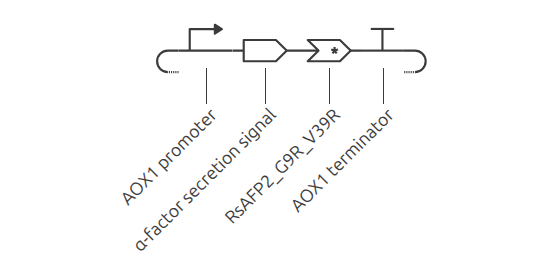
Description (1,609 bp):
Minimal eukaryotic expression cassette driving secretion of the defensin in Pichia pastoris. It joins the inducible AOX1 promoter, the α-factor secretion signal, the mature RsAFP2[G9R/V39R] coding sequence, and the AOX1 terminator into a single in-frame 423 bp open reading frame (141 AA) with zero frameshifts and an ochre stop codon (TAA).
2. Complete Circular Shuttle Plasmid (pPICZalpha_RsAFP2_G9R_V39R)
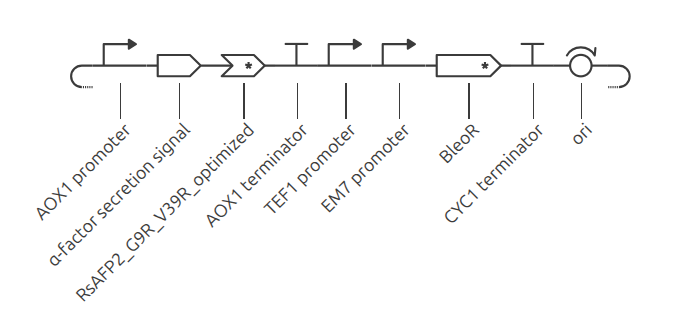
Description (3,256 bp):
Complete recombinant shuttle vector embedding the 1,609 bp expression cassette within the pPICZαA backbone. It provides the pUC origin for high-copy cloning in E. coli and the dual TEF1/EM7 promoter driving Zeocin resistance (BleoR), harboring a unique SacI site at bp 208 for linearization and chromosomal integration into Pichia pastoris.
Part 4
Codon-optimization:
The peptide sequence was codon-optimized using the Kernel optimization tool for Saccharomyces cerevisiae as this was the the closest organism to Pichia pastoris available.
Initial sequence:
CAGAAGTTGTGTCAGAGGCCAAGTAGAACATGGTCAGGAGTCTGTGGAAATAATAACGCATGCAAGAATCAGTGCATTCGACTTGAGAAAGCACGACATGGGTCTTGCAACTATAGATTCCCAGCTCACAAGTGTATCTGTTATTTCCCTTGTTAAOptimized sequence:
CAAAAATTGTGTCAAAGACCATCTAGAACTTGGTCTGGTGTTTGTGGTAATAATAATGCTTGTAAAAATCAATGTATTAGATTGGAAAAAGCTAGACATGGTTCTTGTAATTATAGATTTCCAGCTCATAAATGTATTTGTTATTTTCCATGTTAA
What changed?
- length stayed the same;
- GC content: from 42.9% to 29.5%. Shifted to AT-rich yeast preference;
- 30 of 52 codons swapped (57.7%).
Why does codon usage matter for expression in this organism? (validated AI generated text)
Although the genetic code is redundant, organisms exhibit strong species-specific codon bias that mirrors the intracellular abundance of their matching tRNA pools. Expressing native plant (Raphanus sativus) cDNA directly in yeast frequently leads to ribosome stalling, translational pausing, and mRNA degradation due to the scarcity of tRNAs for plant-preferred codons. Codon optimization resolves this by systematically substituting rare codons with high-frequency synonymous yeast codons (favoring AT-rich triplets like CAA, AAA, and TCT), which accelerates translation elongation and maximizes recombinant peptide yield without altering the final amino acid sequence. Saccharomyces cerevisiae was selected as the optimization host in Kernel because its tRNA availability and codon preferences closely mirror those of Pichia pastoris.
BLAST:
(I asked AI for the steps required for the analysis)
Used https://blast.ncbi.nlm.nih.gov/Blast.cgi protein-protein BLAST with the settings:
Database: Non-redundant protein sequences (nr)
Algorithm: blastp (protein-protein BLAST)
Inserted the engineered peptide aminoacid sequence:QKLCQRPSRTWSGVCGNNNACKNQCIRLEKARHGSCNYRFPAHKCICYFPC
Results:
While being a novel engineered variant, as expected, the CDS is similar to existing proteins, as just two point mutations were made to the original radish plant defensin. The closest match is exactly the “defensin-like protein 2 [Raphanus sativus]” with 96.08%.
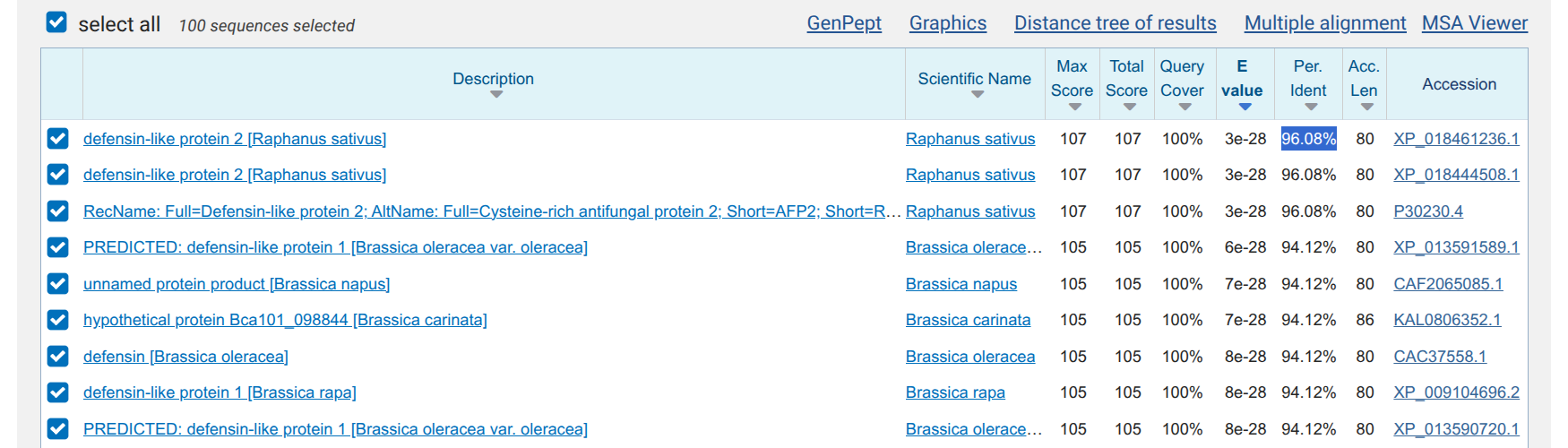 Figure: NCBI blastp results showing defensin-like protein 2 (Raphanus sativus) as the top match (96.08% identity).
Biosecurity sequence scanner:
The scanner evaluates genetic sequences against international regulatory databases for:
- Controlled Pathogens: Regulated viral, bacterial, and eukaryotic pathogens (including US/international Select Agents).
- Dual-Use Toxins: High-consequence protein toxins and virulence factors (e.g., ricin, botulinum, diphtheria toxin).
- Pandemic Hazards: Sequences of concern that present severe biological safety or biosecurity risks prior to commercial DNA synthesis.
The engineered peptide sequence shows no flags when run throught the biosecurity scanner:
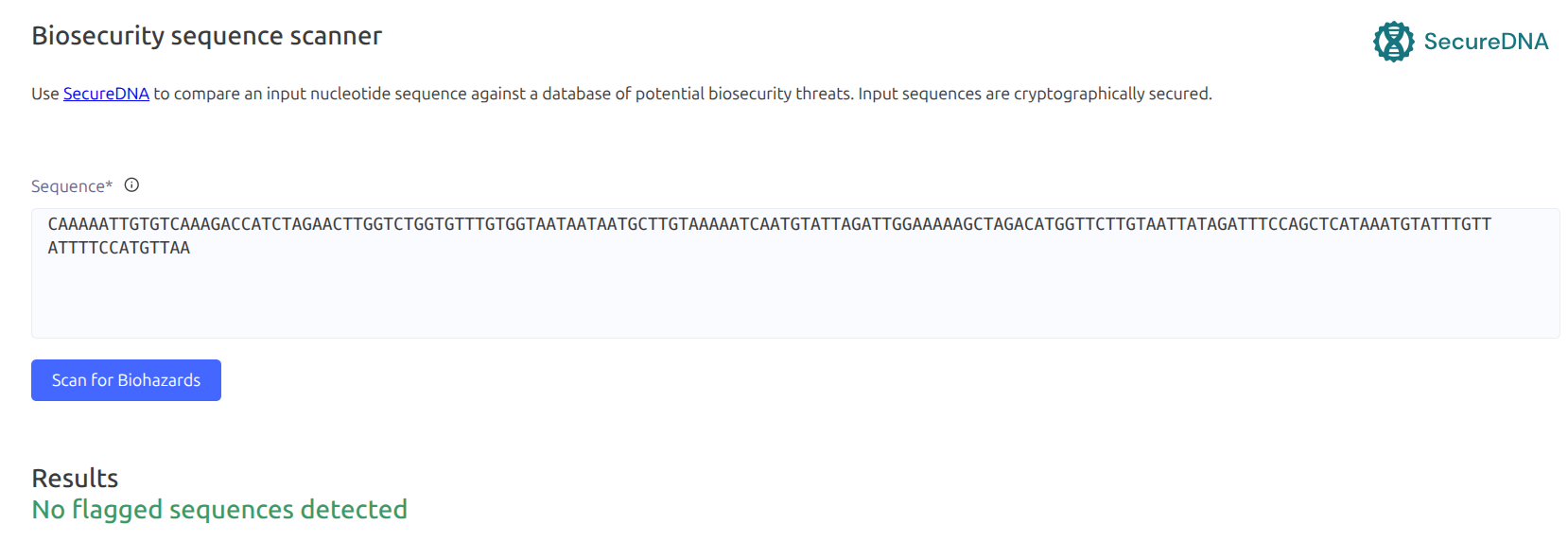
Part 5: From design to build
(this part of the text was AI generated against the reference literature and its still under review)
How would you build it?
- Strategy: I would order only the 156 bp coding sequence as a double-stranded synthetic gene fragment (e.g., IDT gBlock or Twist fragment) and insert it into a commercial, linearized pPICZαA vector using Gibson Assembly (Gibson et al., 2009).
- Why this choice:
- Synthesizing the entire ~3.6 kb plasmid from scratch makes no economic or practical sense: the vector backbone is an inexpensive commodity, and only the 156 bp defensin payload is novel.
- Gibson assembly joins overlapping DNA ends in a simple 1-hour isothermal reaction (using a 5’ exonuclease, DNA polymerase, and DNA ligase). By designing ~30 bp overlaps matching the vector ends, the fragment inserts seamlessly right after the secretion signal without leaving unwanted restriction scars.
What does synthesis constrain?
- Chemical synthesis error rates: Oligo synthesis has an inherent error rate per base that accumulates with length. For a short ~200 bp fragment (including terminal overlaps), direct synthesis is fast and cheap, and simple colony picking followed by Sanger sequencing is sufficient to verify an error-free clone.
- Error correction (MutS): If assembling longer multikilobase genes or using crude oligo pools, enzymatic error correction using the mismatch-binding protein MutS (Carr et al., 2004) would be employed to remove error-containing molecules (reducing error rates by >15-fold).
- Manufacturability check:
- Our codon-optimized sequence passed all vendor complexity checks: 29.5% GC content, no extreme GC/AT patches, no repetitive hairpins, and no homopolymers longer than 4 bp.
- All internal cut sites for key cloning enzymes (EcoRI, NotI, XhoI) and the SacI linearization site were domesticated.
Prototype vs. scale
- Prototyping (Benchtop Testing): To test the idea, we only need to build 1–2 constructs (e.g., wild-type vs. G9R/V39R) using individually synthesized gene fragments assembled by Gibson and amplified in E. coli minipreps.
- Production Scale: In biomanufacturing, DNA is not the final product. The sequence-verified plasmid is integrated once into the Pichia chromosome to establish a clonal Master Cell Bank (MCB). Subsequent manufacturing scales entirely through yeast fermentation, not repeated DNA synthesis.
- High-throughput variant libraries: Chip-synthesized oligo pools (Tian et al., 2004; Kosuri et al., 2010; Kong et al., 2007) would only be needed if we were scaling the design search to screen hundreds of defensin mutants in parallel.
Part 6: What don’t you know yet?
(this part of the text was AI generated against the reference literature and its still under review)
Here are the 3 biggest biological unknowns and bets in the construct, and how to test them:
1. Titer & Biomanufacturing Yield
- The Risk: In HW1, our manufacturing plan aims for ~1 g/L of pure peptide from a 500 L bioreactor. However, published yields for plant defensins secreted by Pichia in shake flasks are typically much lower (10–65 mg/L; Almeida et al., 2001; Cabral et al., 2003). Reaching gram-per-liter titers is possible, but requires substantial clone screening and bioprocess tuning.
- How to find out: Screen multiple transformed Pichia colonies for gene copy number and quantify secreted peptide by RP-HPLC. Then run a benchtop fed-batch fermentation to compare the methanol-induced AOX1 promoter against a constitutive GAP promoter.
2. N-Terminal Secretion Processing (Ste13 Inefficiency)
- The Risk: Secretion relies on yeast proteases to remove the α-factor leader. While Kex2 cleaves efficiently at -Lys-Arg-, the secondary enzyme Ste13 (which trims the Glu-Ala repeats) is notoriously inefficient during high expression (Cabral et al., 2003). Incomplete trimming leaves extra amino acids on the N-terminus (+400 Da for EAEA), which can disrupt folding or increase cation sensitivity.
- How to find out: Analyze the culture supernatant with intact-mass LC-MS to verify whether the peptide has the exact mature mass or carries extra residues.
- Next design variant: If trimming is incomplete, remove the EAEA spacer so Kex2 cleaves directly before the mature defensin sequence.
3. Activity of the Double Mutant in Sweat Salinity
- The Risk: The G9R and V39R mutations were originally identified in plant defense against crop fungi (Fusarium) (De Samblanx et al., 1997) and modeled computationally (Pandey et al., 2020). However, the combined double mutant has not yet been experimentally tested against human skin pathogens (Candida albicans and Malassezia) under cutaneous salt concentrations (20–100 mM NaCl).
- How to find out: Run a broth microdilution assay (CLSI standard for Candida, and lipid-supplemented media for Malassezia) measuring Minimum Inhibitory Concentration (MIC) across a titration of NaCl (0 to 100 mM) plus Ca²⁺/Mg²⁺.
AI
AI (Gemini 3.8 Flash) was used for general guidance and text generation where indicated, using peer-reviewed articles and curated databases as reference. It was also used to retrieve, verify, and format the bibliographic citations.
Bibliography
Plant Defensin Biology, Mutagenesis & Target Interaction:
- Terras, F. R., Schoofs, H. M., De Bolle, M. F., Van Leuven, F., Rees, S. B., Vanderleyden, J., Cammue, B. P., and Broekaert, W. F. (1992). Analysis of two novel classes of plant antifungal proteins from radish (Raphanus sativus L.) seeds. Journal of Biological Chemistry, 267(22), 15301–15309. DOI: 10.1016/S0021-9258(19)49534-3
- De Samblanx, G. W., Goderis, I. J., Thevissen, K., Raemaekers, R., Fant, F., Borremans, F., Acland, D. P., and Broekaert, W. F. (1997). Mutational analysis of a plant defensin from radish (Raphanus sativus L.) reveals two adjacent sites important for antifungal activity. Journal of Biological Chemistry, 272(2), 1171–1179. DOI: 10.1074/jbc.272.2.1171
- Thevissen, K., Warnecke, D. C., François, I. E., Leipelt, M., Heinz, E., Ott, C., Zähringer, U., Thomma, B. P., Ferket, K. K., and Cammue, B. P. (2004). Defensins from insects and plants interact with fungal glucosylceramides: Pichia pastoris Δgcs mutants are highly resistant to defensin-mediated permeabilization. Journal of Biological Chemistry, 279(6), 3900–3905. DOI: 10.1074/jbc.M311165200
- Pandey, B., Tyagi, C., Prajapati, G. K., Mishra, A. K., Hashem, A., Alqarawi, A. A., and Abd_Allah, E. F. (2020). Analysis of mutations of defensin protein using accelerated molecular dynamics simulations. PLoS ONE, 15(11), e0241679. DOI: 10.1371/journal.pone.0241679
Recombinant Expression & Protease Processing in Pichia pastoris:
- Almeida, M. S., Cabral, K. M., Zingali, R. B., and Kurtenbach, E. (2001). cDNA cloning and heterologous expression of functional cysteine-rich antifungal protein Psd1 in the yeast Pichia pastoris. Archives of Biochemistry and Biophysics, 395(2), 199–207. DOI: 10.1006/abbi.2001.2564
- Cabral, K. M., Almeida, M. S., Valente, A. P., Almeida, F. C., and Kurtenbach, E. (2003). Production of the active antifungal Pisum sativum defensin 1 (Psd1) in Pichia pastoris: overcoming the inefficiency of the STE13 protease. Protein Expression and Purification, 31(1), 115–122. DOI: 10.1016/s1046-5928(03)00136-0
Assigned Course Readings:
- Gibson, D. G., Young, L., Chuang, R. Y., Venter, J. C., Hutchison, C. A. 3rd, and Smith, H. O. (2009). Enzymatic assembly of DNA molecules up to several hundred kilobases. Nature Methods, 6(5), 343–345. DOI: 10.1038/nmeth.1318
- Carr, P. A., Park, J. S., Lee, Y. J., Yu, T., Zhang, S., and Jacobson, J. M. (2004). Protein-mediated error correction for de novo DNA synthesis. Nucleic Acids Research, 32(20), e162. DOI: 10.1093/nar/gnh160
- Kosuri, S., Eroshenko, N., Leproust, E. M., Super, M., Way, J., Li, J. B., and Church, G. M. (2010). Scalable gene synthesis by selective amplification of DNA pools from high-fidelity microchips. Nature Biotechnology, 28(12), 1295–1299. DOI: 10.1038/nbt.1716
- Tian, J., Gong, H., Sheng, N., Zhou, X., Gulari, E., Gao, X., and Church, G. (2004). Accurate multiplex gene synthesis from programmable DNA microchips. Nature, 432(7020), 1050–1054. DOI: 10.1038/nature03151
- Kong, D. S., Carr, P. A., Chen, L., Zhang, S., and Jacobson, J. M. (2007). Parallel gene synthesis in a microfluidic device. Nucleic Acids Research, 35(8), e61. DOI: 10.1093/nar/gkm121