Week 1 HW: Final Project Ideas
(1) What I Would Like to Biomanufacture and Why
I am interested in engineering microbial proteins, particularly proteins or enzymes produced by bacteria that could eventually be useful for human applications. My interest comes from a previous project in which I obtained promising results from computational protein engineering. That experience motivated me to explore the potential of microbial proteins more deeply and to understand how their properties could be improved through protein and sequence engineering. In particular, I am interested in modifying microbial proteins so that they can have improved characteristics for potential biomedical or biotechnological applications.
The target product I would like to develop is an engineered microbial protein or enzyme with properties that make it more suitable for use in humans. One possible strategy I am interested in is protein humanization, in which selected regions of a microbial protein are modified to reduce the likelihood of recognition by the human immune system while attempting to preserve or improve the protein’s functional activity. The long-term goal would be to develop a microbial protein that retains its useful biological function while having characteristics that make it more compatible with potential human applications.
I find this project interesting because microorganisms contain a large and relatively underexplored diversity of proteins with potentially useful functions. Rather than focusing only on naturally occurring proteins, I am interested in using computational and experimental approaches to explore how these proteins can be engineered. In the future, such proteins could potentially be developed into useful enzymes, therapeutic proteins, or other biotechnology products. At this stage, however, I would consider the project primarily as an early-stage research and engineering effort rather than assuming that the engineered protein would already be safe or suitable for human use.
(2) What Living System Would I Use?
I would use bacteria as the primary living-system chassis for producing the engineered protein. Bacteria are attractive because many species can be cultured relatively easily, have well-established genetic engineering methods, and can be modified using plasmid-based expression systems. A bacterial chassis could therefore provide a relatively accessible platform for testing different protein sequences and evaluating how sequence modifications affect protein expression and function.
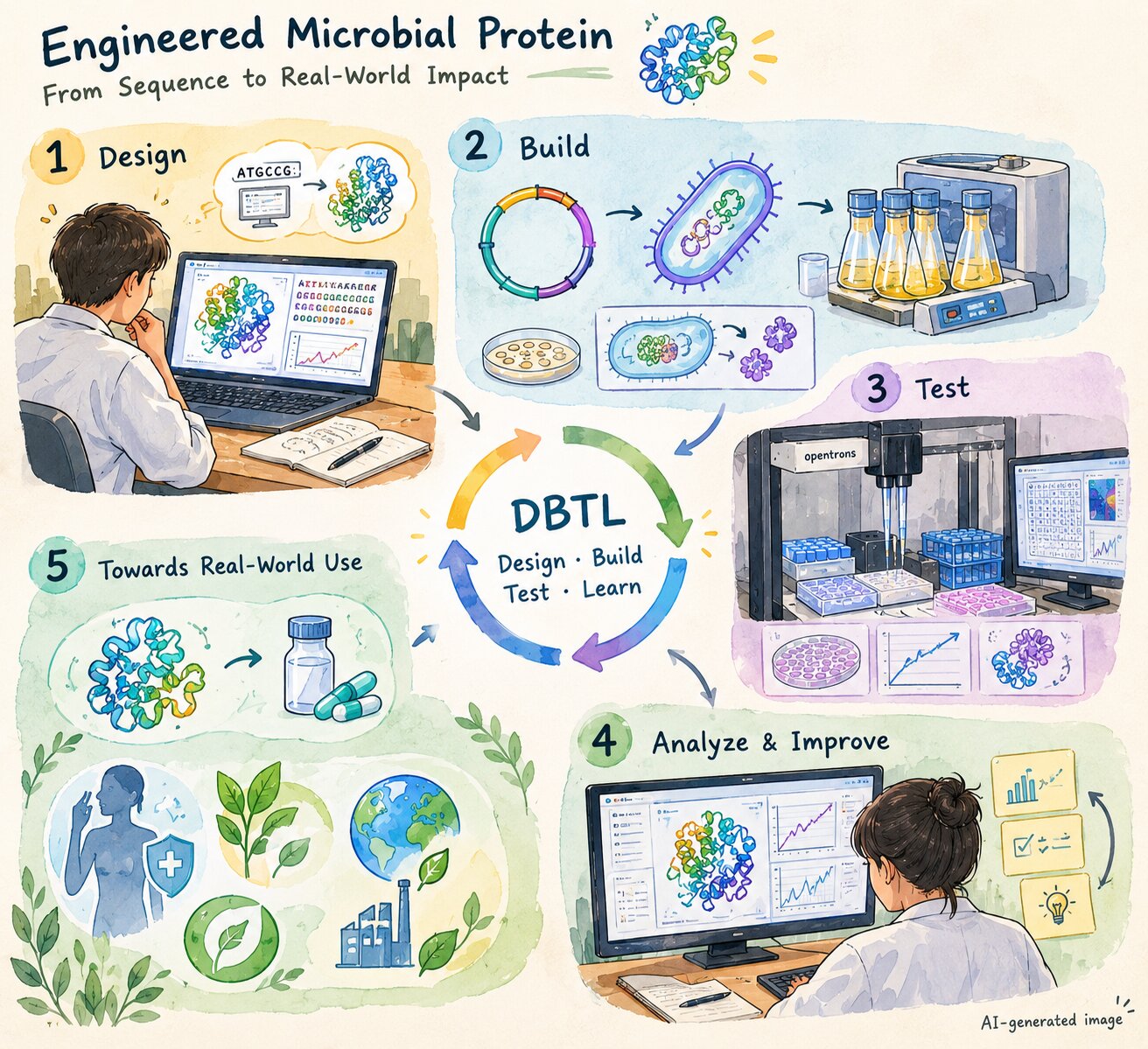
At a high level, the workflow would begin with a bacterial strain containing a plasmid encoding the engineered protein. The bacterial cells would be cultured under appropriate conditions so that they produce the target protein. Depending on the characteristics and intended application of the protein, the protein could either remain intracellular or be engineered for secretion into the culture medium. The resulting protein would then be collected and evaluated using appropriate analytical methods to determine whether the desired properties have been achieved. For a humanization strategy, the initial protein sequence could be analyzed computationally to identify regions that may contribute to immune recognition or other undesirable properties. Selected residues or regions could then be modified while attempting to preserve the structure and biological activity of the protein. Different engineered variants could be expressed in bacteria and compared based on expression level, stability, structural characteristics, and biological activity.
It is important to note that reducing potential immune recognition does not automatically mean that a protein will be safe for humans or free from side effects. Therefore, humanization would be considered one part of the engineering strategy, followed by appropriate in vitro and, if justified by future evidence, in vivo evaluation.
(3) How Would I Use Automation?
At this stage, I am more focused on understanding the potential of microbial proteins and generating reliable experimental data, so I have not yet selected a specific automation platform. However, I think automation could become extremely valuable for bacterial culturing, sample preparation, screening, and data collection.
For example, a desktop liquid-handling robot such as an Opentrons system could be used during the prototyping stage to automate repetitive liquid-handling tasks. It could help prepare bacterial cultures, distribute samples into plates, perform serial dilutions, prepare reagents, and organize samples for downstream screening. Automation would be particularly useful if I needed to compare a large number of engineered protein variants. Screening is another area where automation could significantly improve the workflow. Protein engineering may generate many different variants, and manually culturing and screening each variant would become increasingly difficult as the number of samples increases. An automated workflow could standardize sample handling, reduce repetitive manual work, and improve the consistency and traceability of the experiments.
In the longer term, automation could also be integrated with a larger-scale microbial cultivation and screening platform. The automated system could help connect the design, production, screening, and analysis stages into a more systematic workflow. This would allow experimental results to be used to identify promising protein variants and guide subsequent rounds of protein engineering.
(4) How Much Would I Need to Make, and How Long Would It Take?
(a) How Much?
At the current stage, I would define the initial manufacturing scale as a research-scale production rather than production for direct human use. Since this project would begin with engineered protein variants that still require extensive characterization, my initial goal would be to produce enough protein to evaluate expression, stability, structure, and biological activity.
I would not initially define the target quantity based on human treatment because the engineered protein would still be an experimental candidate and its safety, efficacy, pharmacokinetics, and immunogenicity would not yet be established. A more appropriate progression would be research-scale production → in vitro characterization → animal studies, where scientifically and ethically justified → further development toward potential human applications.
(b) How Long?
At present, I cannot provide a reliable manufacturing time because I do not yet know the expression yield, growth characteristics of the bacterial chassis, purification recovery, or the number of variants that would ultimately need to be tested. These parameters would have to be experimentally determined. My current approach would be to use the course to establish the workflow and generate realistic production parameters rather than assuming a fixed manufacturing time before these parameters are experimentally measured.
(5) What Don't I Know Yet?
I still need to learn more about molecular dynamics, gene expression, and the relationship between protein sequence, structure, and function. These areas are important because successful protein engineering requires more than simply changing a sequence. I need to understand how sequence modifications affect protein folding, stability, interactions, expression, and ultimately biological activity.
Second, I need to determine which bioinformatics and computational tools are most appropriate for this type of project. One of my main goals in this course is to become proficient in using bioinformatics software for protein engineering, sequence analysis, structural analysis, and data interpretation. I also want to improve my ability to analyze and interpret experimental data objectively so that I can distinguish genuine biological effects from experimental variation or analytical bias.