Week 1 HW: Final Project Ideas
Biomanufacturing Proposal
1. What I would like to biomanufacture and why
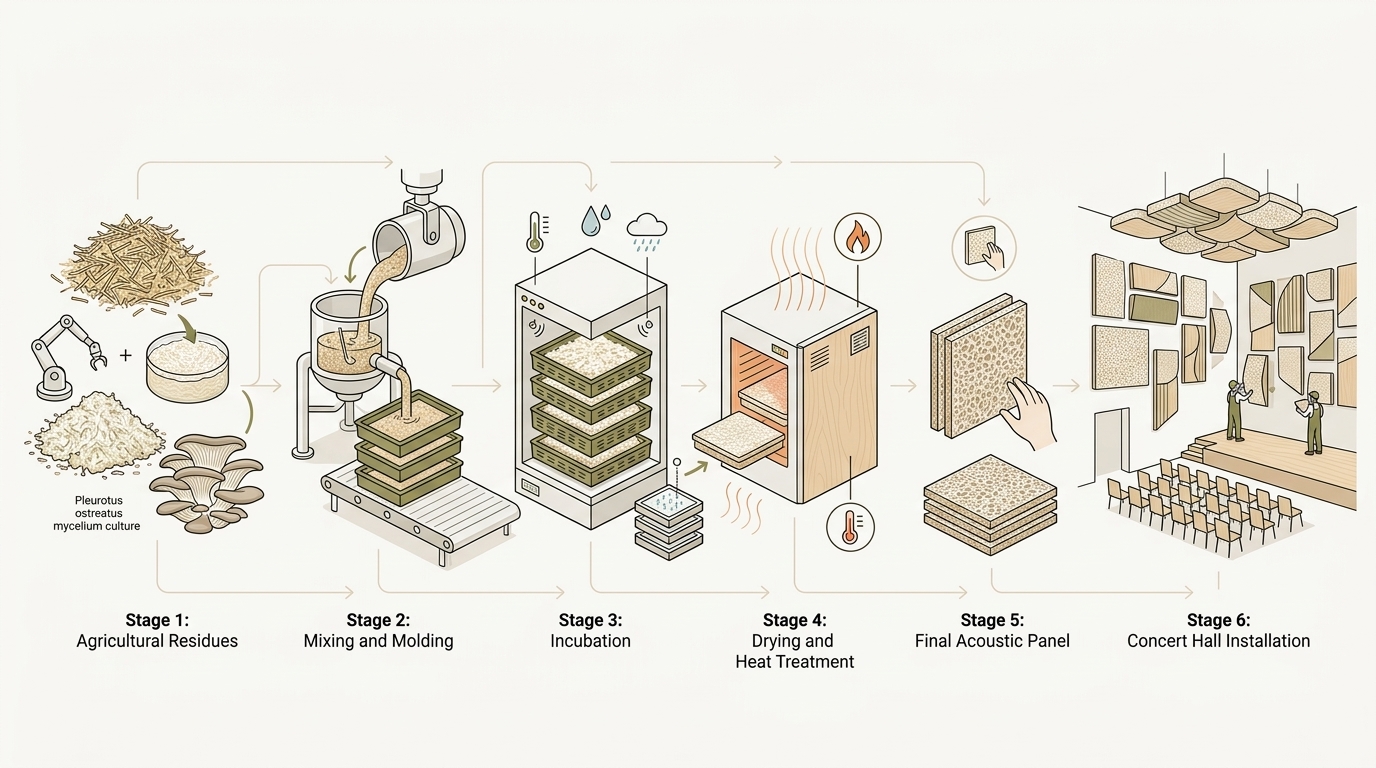
I want to biomanufacture custom-grown mycelium acoustic panels for concert halls, studios, and public buildings. The target product is a lightweight, shaped, sound-absorbing panel made from agricultural waste bound by fungal mycelium. The panel can be grown into custom geometries such as diffusers, clouds, and wall tiles, and then heat-treated to stop fungal growth.
I am interested in this because construction materials are often energy-intensive, petrochemical-based, or non-biodegradable. Mycelium composites can use agricultural byproducts, grow at room temperature, store carbon in the material, and be composted at end of life. For a concert hall, acoustic performance is critical; custom shapes can be grown rather than machined. The product is for architects, acoustic designers, and building occupants. It connects biology, design, and sustainability in a way that I find interesting and important.
2. What living system would I use?
Chassis: white-rot fungus such as Pleurotus ostreatus (oyster mushroom) mycelium. It is a eukaryotic filamentous fungus that grows on lignocellulosic waste.
Inputs:
- Agricultural waste substrate: hemp hurd, straw, sawdust, or corn stover.
- Fungal spawn (mycelium on grain or sawdust).
- Water.
- Optional natural binders or fire retardants such as clay or borax, if needed.
Process:
- Pasteurize or sterilize the substrate.
- Mix substrate with spawn and water.
- Fill molds or trays shaped like the desired panel.
- Incubate at about 25–30 °C for 2–4 weeks; fungal hyphae colonize and bind the substrate.
- Remove from mold, dry, and heat-treat at about 70–80 °C to kill the fungus and prevent spores.
- Finish or cut for acoustic mounting.
Output: a solid, porous, mycelium-bound composite panel.
Assumptions: the fungus is non-pathogenic, growth is contained, and the final material can meet fire and acoustic codes after testing.
3. How would I use automation?
I would combine the living system with automated environmental control and robotic handling, plus a desktop liquid-handling robot such as an Opentrons for R&D.
- R&D automation: Use an Opentrons or a programmable microfluidics platform to screen substrate formulations, spawn ratios, nutrient supplements, and fungal strains in 24- or 96-well or small tray formats. This would automate inoculation, sampling, and measurement of growth rate, density, and contamination.
- Manufacturing automation: Use automated mixing and filling stations, a robotic gantry or conveyor to move trays into climate-controlled incubation rooms, and sensors for temperature, humidity, CO₂, and moisture. Robotic harvesting and drying lines would reduce labor and contamination.
- Why: mycelium growth is slow and sensitive to environment. Automation can maintain reproducible conditions, run many parallel batches, and optimize formulations faster than manual trials.
4. How much would I need to make, and how long would it take?
(a) How much?
Scale: acoustic treatment for one medium concert hall.
Assumptions:
- Acoustic panel area needed: 1,000 m² (walls, ceiling clouds, diffusers).
- Panel thickness: 0.05 m (5 cm).
- Mycelium composite density: 200 kg/m³. This is an assumption based on typical low-density mycelium composites, which often range around 100–300 kg/m³. Verify with literature before final submission.
Calculation:
- Volume = 1,000 m² × 0.05 m = 50 m³.
- Mass = 50 m³ × 200 kg/m³ = 10,000 kg = 10 metric tons of finished panels.
Substrate and spawn:
- Assume finished panel is about 90% substrate and 10% fungal biomass/binder by dry mass. So dry substrate ≈ 9,000 kg.
- Spawn rate: 10% w/w of dry substrate = 900 kg spawn.
- Water: substrate is mixed at about 65% moisture. Wet mass ≈ 9,000 / (1 - 0.65) ≈ 25,700 kg wet mixture. So about 26 tons of wet material to fill molds.
So the meaningful scale is roughly 10 tons of finished panels, requiring about 9 tons dry substrate, 0.9 ton spawn, and 26 tons wet mixture.
(b) How long?
Assumptions:
- Each panel is 1 m² × 0.05 m and weighs about 10 kg. Need 1,000 panels.
- Incubation/colonization time: 21 days (3 weeks).
- Preparation, filling, harvest, drying, finishing: 7 days.
- Facility has 200 tray slots in parallel (small pilot factory).
If 200 panels grow in parallel:
- Batches = 1,000 / 200 = 5 batches.
- Time = 5 batches × 3 weeks = 15 weeks of incubation.
- Add 1 week preparation/finishing = about 16 weeks.
- With 1,000 parallel trays, time would be about 3 weeks incubation + 1 week = about 4 weeks.
Automation throughput:
- Opentrons for R&D: can screen about 96 formulations per run, several runs per week.
- Manufacturing: an automated filling line can fill about 200 trays/day; a robotic gantry can move trays continuously. The bottleneck is biological growth time, not liquid handling.
- At scale, a factory with 1,000+ trays and automated climate control could produce about 10 tons per month.
5. What don’t I know yet?
- Material performance: Will mycelium panels meet acoustic absorption coefficients, fire safety, moisture resistance, and mechanical strength required for a concert hall? I would need to measure impedance tube absorption, flame spread, and compressive strength.
- Contamination and reproducibility: How stable is P. ostreatus growth at 10-ton scale? I would need to test contamination rates, sterilization/pasteurization methods, and batch-to-batch variability.
- Scale-up economics: What is the actual yield, drying energy, labor, and cost per m² compared with conventional acoustic panels? I would need a pilot production run and techno-economic analysis.
References
- Asin-Garcia, E., et al. (2025). A snapshot of biomanufacturing and the need for enabling research infrastructure. Trends in Biotechnology, 43(5), 1000–1014.
- Petzold, C. J., & Mukhopadhyay, A. (2025). From bench to biofactory: High-throughput technologies and automated workflows to accelerate biomanufacturing. Current Opinion in Biotechnology, 94, 103320.
- Yap, W. S., Choudhury, D., & Suntornnond, R. (2023). Towards biomanufacturing of cultured meat. Trends in Biotechnology, 41(3), 292–294. Used as general biomanufacturing context.
- Additional assumptions from general mycelium composite literature; verify density and acoustic values before final submission.