Week 1 HW: Final Project Ideas

Photo by atwena Goodman on Unsplash
Homework 1: An elephant-memory-inspired neuroprotective biologic for dementia
What do I want to make, and why?
Elephants show exceptional long-term social and spatial memory. That’s worth investigating for people affected by Alzheimer’s disease and other dementias, which are devastating for both patients and the families who watch a loved one disappear in front of them. Roughly 55 million people currently live with dementia worldwide, a number projected to almost double to 78 million by 2030 and reach 139 million by 2050 as the world’s population ages, with the majority of cases already occurring in low- and middle-income countries (Alzheimer’s Disease International, 2015).
There is no single “elephant memory chemical” — and it also isn’t simply that elephants have an unusually large hippocampus. The actual MRI and histology study of the African elephant hippocampus (Patzke et al., 2013) found the opposite of the popular claim: the elephant hippocampus is “not unduly enlarged, nor specifically unusual in its internal morphology,” and at 10.84 cm³ is only slightly larger than the human hippocampus (10.23 cm³) despite the elephant’s much larger overall brain. What is distinctive is structural, not size-based: the dentate gyrus has extra sublayers not seen in other mammals, and — critically for this idea — doublecortin staining confirmed ongoing adult neurogenesis in the elephant hippocampus, the continued birth of new neurons into adulthood.
So the target here isn’t “elephant memory juice”, and it isn’t literally “a bigger hippocampus” either. It’s a recombinant peptide that stabilises or mimics the activity of known long-term-memory-maintenance molecules — most plausibly one based on protein kinase M-zeta (PKMζ), shown by Serrano et al. (2008) to be specifically required for maintaining, not just forming, spatial and other long-term memories, and its scaffolding partner KIBRA. Neither is elephant-specific; the elephant’s confirmed adult hippocampal neurogenesis is the loose thread that motivates looking at memory-maintenance and neurogenesis pathways at all, not proof that PKMζ/KIBRA are what makes elephants special.
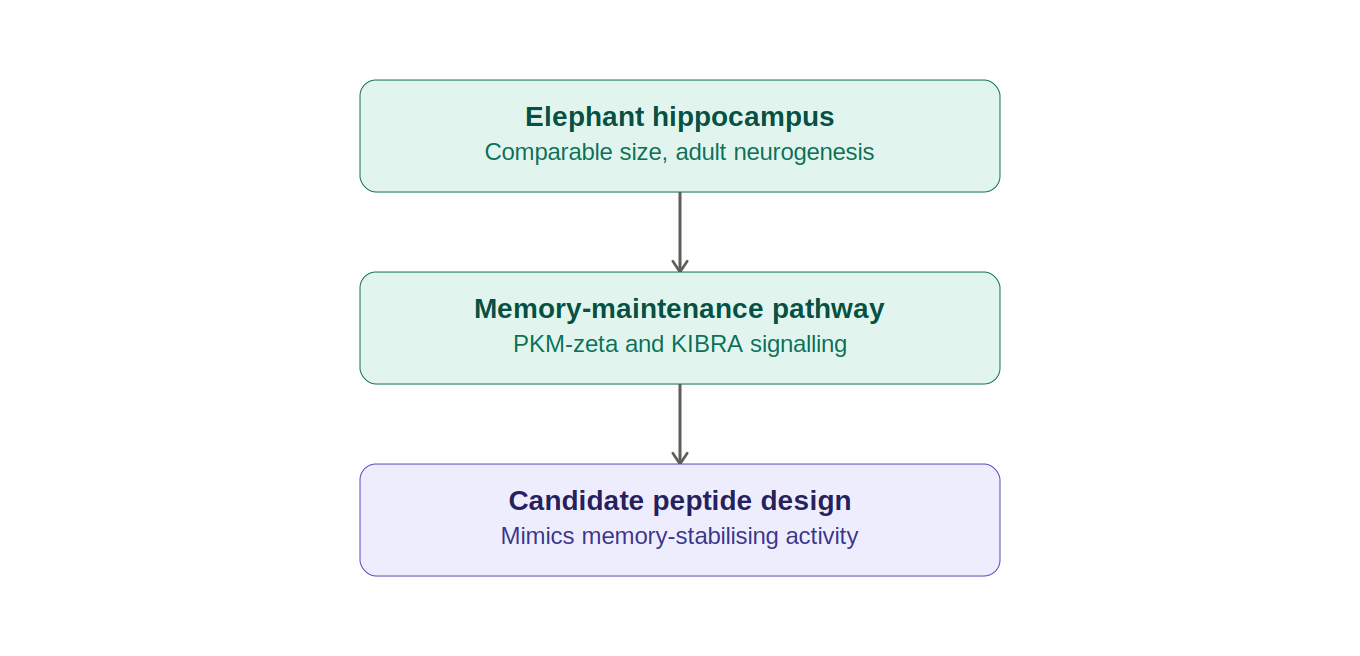
Diagram 1: From elephant biology to a drug candidate — elephant hippocampus → memory-maintenance pathway (PKMζ/KIBRA) → candidate peptide design.
What living system would I use?
Cell-free protein synthesis (CFPS) — cell lysate loaded with the target gene, ribosomes, and an energy mix — is ideal for rapidly iterating on peptide variants and fits directly with a cell-free biomanufacturing unit. Scale-up would then move to mammalian (CHO) cell culture, since the peptide needs correct folding and post-translational modification to work as a CNS-active biologic. This isn’t a novel category of product to manufacture — recombinant protein drugs made via genetically modified mammalian cell culture (erythropoietin, insulin, growth hormone) are precisely what Zhang, Sun and Ma (2017) call “Biomanufacturing 3.0,” the still-dominant paradigm for protein-drug production since the 1980s. My peptide would sit in that same established category; the open question is the specific target (PKMζ/KIBRA), not the manufacturing platform.
Worth being explicit about what “living system” means here: this is not extraction. I’m not proposing to harvest anything from an actual elephant — that wouldn’t scale and isn’t what biomanufacturing means. The living system (CFPS lysate, then CHO cells) is engineered to produce the peptide itself, the same way erythropoietin or insulin are made today: by giving a cell the gene and letting its own biology manufacture the product, not by extracting a pre-existing substance from a donor organism.
A creative addition on delivery. The single biggest scientific risk in this idea (see “what don’t I know yet,” below) is getting the peptide into the brain at all, since most peptides don’t cross the blood–brain barrier (BBB). Rather than leave that as a pure unknown, I’d propose intranasal delivery as the administration route: spraying the peptide into the nose lets it travel along the olfactory and trigeminal nerves directly into the brain, physically bypassing the BBB rather than trying to cross it. This isn’t a hand-wave — intranasal insulin has already been trialled for memory improvement in Alzheimer’s patients, and a 2025 study specifically delivered a short catalytic peptide (JAL-TA9) nose-to-brain for Alzheimer’s treatment in rats and mice (Hanson and Frey, 2008; Hatakawa et al., 2025). It’s still unproven for this specific peptide, but it converts “we don’t know how this would ever reach the brain” into “here is a plausible, precedented route to test” — which is a stronger place to leave an open question than a dead end.
How would I use automation?
CFPS screening on a Cloud Lab or desktop liquid handler — testing many peptide variants in parallel, reading out activity/stability — to find the best-performing construct. Production then scales up in a stirred-tank bioreactor. This mirrors what Petzold and Mukhopadhyay (2025) describe as the central role of automation in current biomanufacturing R&D: cloud labs and biofoundries “reshaping the landscape of biomanufacturing research by introducing unprecedented levels of automation, reproducibility, and accessibility,” allowing continuous, round-the-clock experimentation without a scientist physically present, and directly enabling the throughput that the design–build–test–learn (DBTL) cycle needs to search a large space of peptide variants efficiently.
Concretely, this is the same workflow the course itself is about to run in Week 4’s first lab: each student gets assigned a set of wells on a 384-well plate, designs their own CFPS reaction, and the plate is executed by the automation system at MIT or at Ginkgo Bioworks (whose autonomous lab system, Nebula, was highlighted in lecture as already running cell-free protein synthesis reactions at scale). My peptide-screening step is that exact setup with a different readout: instead of optimising for the brightness of a fluorescent reporter protein (this course’s Lab 1 exercise), each well would run a variant of the PKMζ/KIBRA-based peptide and be screened with a binding- or stability-activity assay instead of a fluorescence readout — same plate-based automation, different signal.
What automation can’t do here. Screening and manufacturing are automatable; getting a drug approved is not. Automation genuinely covers the CFPS variant-screening stage and the bioreactor production stage once a construct is chosen. It does not cover, and cannot cover, the preclinical safety testing, human clinical trials, or regulatory review that sit between those two stages — those require human patients, ethics oversight, and years of monitoring by definition, not more robots. That gap is the subject of the next section.
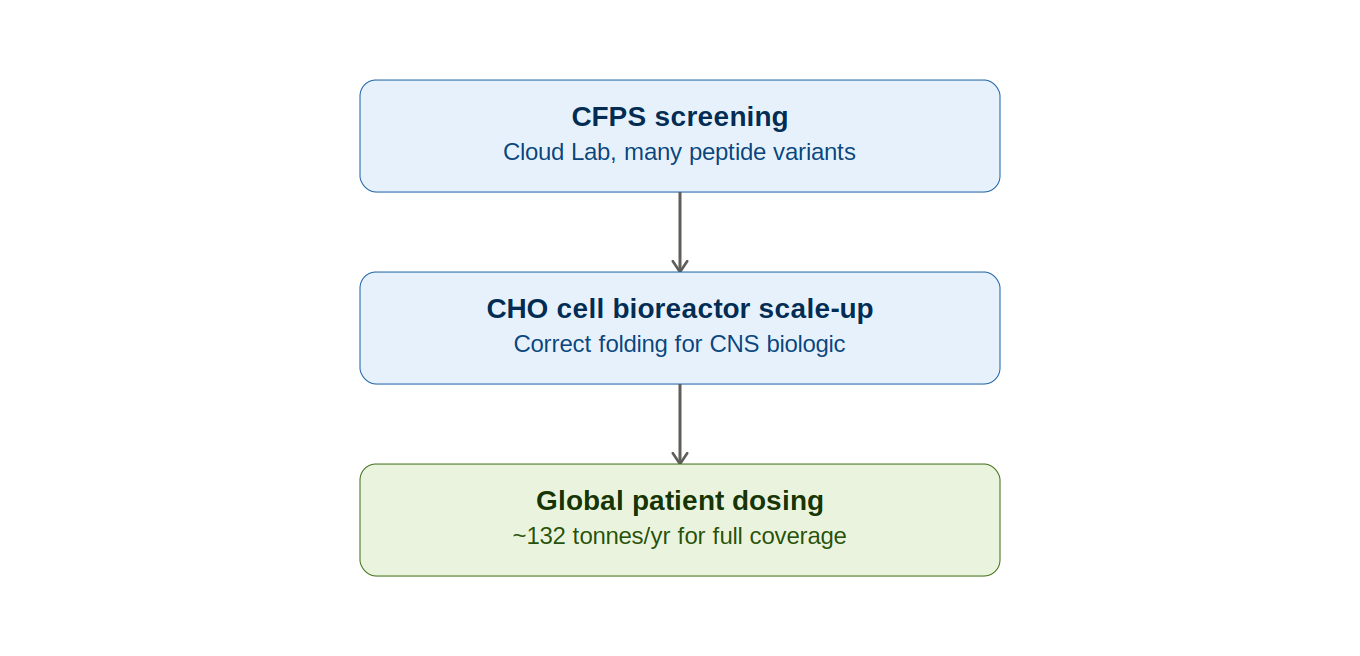
Diagram 2: Biomanufacturing and scale-up pipeline — CFPS screening (Cloud Lab) → CHO cell bioreactor scale-up → global patient dosing.
How much would I need to make, and how long would it take?
How much? Biologics for neurological conditions are typically dosed monthly at roughly 100–250 mg. Assuming 200 mg/dose × 12 doses/year = 2.4 g/patient/yr:
- A 1% initial global rollout (550,000 of the ~55 million people with dementia worldwide) needs 550,000 × 2.4 g ≈ 1.32 tonnes/yr.
- Full global coverage would need 55,000,000 × 2.4 g ≈ 132 tonnes/yr.
How long? Typical CFPS yields are around 1 g/L per batch (Karim and Jewett, 2021). At that titre, 132 tonnes/yr requires roughly 132 million litres of reaction volume per year — clearly beyond CFPS alone, so screening stays in CFPS while production moves to bioreactors. But the jump from lab-scale to an industrial bioreactor is, by the field’s own account, the hard part of biomanufacturing, not a detail to wave past: Asin-Garcia et al. (2025) quote Paul Freemont (Global Alliance of Biofoundries, Imperial College London) that “the big technology barrier [to commercialisation] is how you move from a laboratory-based strain that produces a product towards a 3000 L bioreactor producing the same product at high titre… that’s always been the challenge in industrial biotechnology.” Asin-Garcia et al. also describe this gap as a “Valley of Death” that many promising biomanufacturing projects don’t survive, because few organisations have access to pilot-scale plants to test the transition. Existing published biomanufacturing infrastructure (e.g. VTT, Finland) currently tops out around 1,200 L capability — well short of even a single tonne/yr at CFPS-equivalent titres, let alone the 132 tonnes/yr full-coverage figure above. So this idea’s real bottleneck isn’t chemistry, it’s exactly the scale-up gap the literature itself flags as unsolved industry-wide.
What it would take to get there at all — cost and timeline before “how much/how long” even applies. The 132 tonnes/yr figure above answers “how much would I need to manufacture,” but it assumes an approved, working drug already exists — it says nothing about getting there. That’s a separate, much larger number. Using the widely cited Tufts Center for the Study of Drug Development estimate (DiMasi, Grabowski and Hansen, 2016), taking one biologic from discovery to approval costs on the order of $1–2.6 billion and takes 10–15 years (more recent analyses, e.g. RAND, 2025, put the median lower at roughly $700 million, but multi-hundred-million-to-billion-dollar costs and decade-plus timelines are consistent across every estimate I found). None of that cost or time is automatable: it is preclinical safety testing, Phase 1–3 human trials, and regulatory review, not manufacturing throughput. So the honest shape of this project is: years 1–2 automatable CFPS/Cloud Lab screening (relatively cheap, fast), years 2–12+ non-automatable clinical development (expensive, slow, and not guaranteed to succeed at all), then — only after approval — the 132 tonnes/yr industrial bioreactor scale-up this section opened with. Cost per dose would very likely fall over time as production scales (the standard economics of fixed R&D cost amortised over more units), but the initial capital and time commitment is genuinely on the order of a billion dollars and a decade, not a Cloud Lab afternoon.
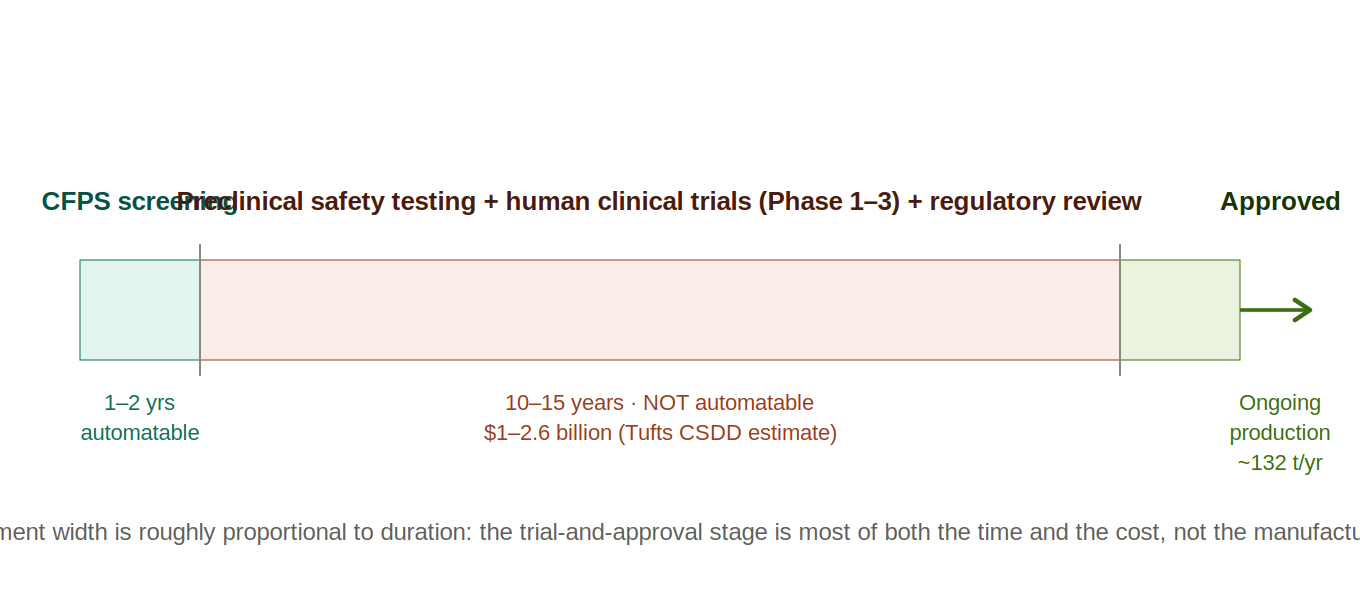
Diagram 3: Development timeline and cost — CFPS screening (1–2 yrs, automatable) vs. preclinical/clinical trials (10–15 yrs, not automatable, $1–2.6 billion — the true bottleneck) vs. approved production (ongoing, ~132 tonnes/yr).
A real-world price comparison, and why it matters. Leqembi (lecanemab), an FDA-approved Alzheimer’s antibody made in CHO cells — the same manufacturing category this idea sits in — launched in January 2023 at $26,500 per patient per year (Stanton, 2023). If my peptide followed similar pricing logic once approved, it would be unaffordable for most of the roughly 55 million people who need it, given that (per the Alzheimer’s Disease International figures cited above) the majority of dementia cases are already in low- and middle-income countries. A biologic that only the wealthiest patients can access doesn’t actually solve the problem this idea sets out to address — that tension between “can be manufactured at global scale” and “can be afforded at global scale” is a real gap in this proposal, not a footnote.
On elephant genetic material specifically — availability, not extraction, and no harm to elephants. As written above, this idea doesn’t actually use any elephant-derived gene at all — PKMζ and KIBRA are proteins studied in rodents (Serrano et al., 2008), not sequenced from an elephant. But it’s worth answering directly, since the question matters for the idea’s honesty: if a future version of this project wanted the actual elephant version of a memory-related gene, would that require extracting anything from a living or dead elephant, and would elephants be harmed? No, on both counts. The African elephant (Loxodonta africana) genome has been fully sequenced and publicly available since 2009 (the Broad Institute’s loxAfr3 assembly), with a newer, higher-quality chromosome-level assembly released in 2023 (NCBI GenBank accession GCA_030020305.1) — both freely searchable through NCBI and Ensembl by anyone, including a student, at no cost. Getting an elephant gene sequence today means looking it up in a public database and ordering a synthetic copy of that DNA sequence from a commercial gene-synthesis company (a routine, few-days-to-weeks service), then cloning it into the CFPS/CHO system already described above — not touching an elephant at all. The original blood or tissue samples used to build that reference genome were collected once, years ago, under standard veterinary sampling protocols (not lethal, not ongoing); every subsequent use of the sequence — including this one — is purely digital and synthetic. So the honest answer is: the elephant genome is already available, no extraction is needed for this project, and no elephant would be harmed by it.
What don’t I know yet?
- Blood–brain barrier crossing. Whether a PKMζ/KIBRA-based peptide can actually reach the brain — intranasal delivery (above) is a plausible, precedented route to test, but it’s unproven for this specific peptide and would need to be validated experimentally, not assumed.
- Human efficacy. Whether the peptide is neuroprotective or pro-memory in humans at all — all direct evidence for PKMζ/KIBRA’s role in memory maintenance comes from rodent models.
- Yield at scale. Realistic CFPS/bioreactor yield for this specific construct hasn’t been benchmarked, and — per Asin-Garcia et al. (2025) above — the lab-to-3,000 L-bioreactor transition is an unsolved, field-wide bottleneck, not something I can assume away.
- Affordability at the scale that matters. Even a perfectly manufacturable, safe, effective peptide doesn’t solve global dementia if it’s priced like existing biologics ($26,500/yr for Leqembi) while most patients needing it are in low- and middle-income countries. I don’t yet know what pricing or production model (tiered pricing, generic licensing after patent expiry, regional manufacturing) would actually close that gap, and it’s a real open problem, not a detail I can wave past with a bigger bioreactor.
References
Alzheimer’s Disease International (2015) World Alzheimer Report 2015: The Global Impact of Dementia — An Analysis of Prevalence, Incidence, Cost and Trends. London: Alzheimer’s Disease International. Available at: https://www.alzint.org/u/WorldAlzheimerReport2015-sheet.pdf
Asin-Garcia, E., Fawcett, J.D., Batianis, C. and Martins dos Santos, V.A.P. (2025) ‘A snapshot of biomanufacturing and the need for enabling research infrastructure’, Trends in Biotechnology, 43(5), pp. 1000–1014. Available at: https://doi.org/10.1016/j.tibtech.2024.10.014
DiMasi, J.A., Grabowski, H.G. and Hansen, R.W. (2016) ‘Innovation in the pharmaceutical industry: new estimates of R&D costs’, Journal of Health Economics, 47, pp. 20–33. (Tufts CSDD analysis, widely cited as the source of the ~$2.6 billion / 10–15 year biologic development estimate used above.)
Hanson, L.R. and Frey, W.H. (2008) ‘Intranasal delivery bypasses the blood-brain barrier to target therapeutic agents to the central nervous system and treat neurodegenerative disease’, BMC Neuroscience, 9(Suppl 3), S5. Available at: https://doi.org/10.1186/1471-2202-9-S3-S5
Hatakawa, Y., Tanaka, A., Furubayashi, T., Katsumi, H., Nakamura, R., Konishi, M., Akizawa, T. and Sakane, T. (2025) ‘Efficient nose-to-brain delivery of nine residues peptide (JAL-TA9) exhibiting hydrolytic activity against amyloid-β’, European Journal of Pharmaceutics and Biopharmaceutics, 208, article 114661. Available at: https://doi.org/10.1016/j.ejpb.2025.114661
Karim, A.S. and Jewett, M.C. (2021) ‘Toward sustainable, cell-free biomanufacturing’, Current Opinion in Biotechnology, 69, pp. 136–144. Available at: https://doi.org/10.1016/j.copbio.2020.12.012
National Center for Biotechnology Information (2023) Loxodonta africana genome assembly mLoxAfr1.hap1, GenBank accession GCA_030020305.1. Available at: https://www.ncbi.nlm.nih.gov/datasets/genome/GCA_030020305.1/ (cited for the public availability of the African elephant reference genome; the original loxAfr3 assembly was released by the Broad Institute in 2009.)
Patzke, N. et al. (2013) ‘Organization and chemical neuroanatomy of the African elephant (Loxodonta africana) hippocampus’, Brain Structure and Function. Available at: https://doi.org/10.1007/s00429-013-0587-6 (full author list not confirmed from the accessible abstract — verify before formal submission.)
Petzold, C.J. and Mukhopadhyay, A. (2025) ‘From bench to biofactory: high-throughput technologies and automated workflows to accelerate biomanufacturing’, Current Opinion in Biotechnology, 94, article 103320. Available at: https://doi.org/10.1016/j.copbio.2025.103320
Serrano, P., Friedman, E.L., Kenney, J., Taubenfeld, S.M., Zimmerman, J.M., Hanna, J., Alberini, C., Kelley, A.E., Maren, S., Rudy, J.W., Yin, J.C.P., Sacktor, T.C. and Fenton, A.A. (2008) ‘PKMζ maintains spatial, instrumental, and classically conditioned long-term memories’, PLoS Biology, 6(12), pp. 2698–2706. Available at: https://doi.org/10.1371/journal.pbio.0060318
Stanton, D. (2023) ‘Eisai and Biogen: FDA approve Alzheimer’s mAb lecanemab’, BioProcess International, 9 January. Available at: https://bioprocessintl.com/regulations/eisai-and-biogen-fda-approve-alzheimer-s-mab-lecanemab (cited for the $26,500/yr Leqembi launch price used above.)
Zhang, Y.-H.P., Sun, J. and Ma, Y. (2017) ‘Biomanufacturing: history and perspective’, Journal of Industrial Microbiology & Biotechnology, 44, pp. 773–784. Available at: https://doi.org/10.1007/s10295-016-1863-2
AI use disclosure
AI client: Claude (Anthropic), used via the Claude.ai chat interface with web search and this project’s uploaded course-reading PDFs.
Prompts used (in sequence, condensed from a longer conversation):
- An initial request to develop seven-plus biomimicry-inspired biomanufacturing ideas (animal/plant “superpowers” — elephant memory, tortoise longevity, cactus water retention, ant strength, drought-resistant food, spider silk, electric eel/firefly energy) against the assignment’s four questions, in table/comparison format, with real, verifiable Harvard-style citations only — explicitly instructed not to hallucinate sources.
- A request to add an eighth idea, inspired by the Qur’anic account of Prophet Yusuf’s shirt restoring Ya’qub’s eyesight, and to research whether the “sweat/urea” hypothesis behind it has any real scientific backing.
- A request to reframe all scale calculations from South Africa-specific to global/worldwide figures.
- “I am going with the elephant/Alzheimer’s/dementia for my submission. Can it be improved with diagrams or anything else that will enhance its appeal?” — resulting in the two accompanying schematic diagrams and this standalone write-up.
- “Does it make use of the course readings or anything else that substantiates its claim?” — resulting in a check of all seven assigned readings against this specific idea, and integration of real quoted content from three that apply (Zhang, Sun and Ma, 2017; Petzold and Mukhopadhyay, 2025; Asin-Garcia et al., 2025), with the three that don’t apply (Averesch et al., 2023; Yap et al., 2023; Ye et al., 2023) explicitly named and excluded rather than cited for padding.
- “Does it take note of everything mentioned in the recitation that pertains to this submission?” — resulting in the addition of the Week 4 Lab 1 / 384-well-plate / Ginkgo Bioworks Nebula detail to the automation section, and this fuller prompt disclosure.
- Uploaded a human-vs-elephant brain comparison image from safari-center.com and asked whether it’s backed by the course readings, and for images to insert since I can’t generate or find them myself — resulting in a correction (the actual Patzke et al., 2013 study found the elephant hippocampus is not unusually large, contradicting the popular “big brain” graphic), two new citations added (Patzke et al., 2013; Serrano et al., 2008), a regenerated diagram with accurate text, and image-sourcing guidance.
- Asked whether biomanufacturing means only extracting from plants/animals, whether there’s room for creativity in the idea, what’s been overlooked, whether the process can really be fully automated, and to show assumptions/calculations for cost and timeline — resulting in: an explicit clarification that biomanufacturing means engineering a living system to produce the target, not extraction; a proposed intranasal delivery route (Hanson and Frey, 2008) addressing the blood-brain-barrier unknown; an honest split between what automation can and can’t cover; a new cost/timeline estimate for drug development separate from production scale-up (DiMasi, Grabowski and Hansen, 2016); a real-world price comparator (Leqembi, $26,500/yr); and a new affordability/equity unknown.
- “Are these shown [the diagrams]? Please… include the diagrams/simulations discussed. Is there anything else not included that should be included?” — resulting in the two earlier diagrams and a new third diagram (a development timeline/cost chart visualizing the automation-limits and cost/timeline sections) being generated as actual saved SVG and PNG files rather than just chat widgets, and referenced by filename at the correct points in this document.
- “Please verify the references and facts stated herein, especially the Petzold citations, and cite inline as well, Harvard style. Also, what would it take to get elephant enzymes at current dates and times—is it available or would it need to be extracted, and would elephants be harmed?” — resulting in: direct verification of the Petzold and Mukhopadhyay (2025) citation against the published ScienceDirect page (confirmed word-for-word accurate); two citation gaps found and fixed (DiMasi, Grabowski and Hansen, 2016 wasn’t named inline near the $2.6B figure; the JAL-TA9 paper was mentioned in text but missing a full reference entry, now added as Hatakawa et al., 2025); and a new paragraph confirming the African elephant genome is publicly available (no extraction needed, no harm to elephants), with a citation for the reference genome assembly.
I reviewed every AI-sourced claim and citation myself before submitting and can explain each one in the homework-review chair.