Week 3 Cell Free
HTBAA Week 3 — Designing a Cell-Free Reaction Composition
Section 3 (A–C) report — for submission on the homework website (version 2, 13 October 2026)
Targets: sfGFP · PETase (TfCut2) · Reteplase Objective: lowest specific cost — $ per gram (sfGFP) or $ per unit of activity (PETase, Reteplase)
Reading notes. All costs use the coopetition price list. Items marked [VERIFY] are not yet confirmed and are listed in Section 11. The three designs are hypotheses with stated tests, not predicted winners. Companion files: the workbook
HTBAA_HW3_CFPS_Costing.xlsx(every figure below is a live formula there) and the CFPS Design Toolkit web page (Section 8), which recomputes these designs and checks them against this report.
0. Summary
| Protein | Starting recipe (known formulation) | What I change | Total cost | Hypothesis |
|---|---|---|---|---|
| sfGFP | Smith et al. composition 1793122_35 (“GPT-5 #35”) | GMP 1.0 mM → guanine 0.2 mM; spermidine 1.2 → 1.5 mM | $1,290.93 /L ($0.0258 per 20 µL reaction) | A cheaper nucleotide source at equal titer; a polyamine at its reported optimum may raise titer |
| PETase | Designer plate “PETase Ribose” | DsbC 5 → 0.125 µM (one variable) | $8,374.33 /L ($0.1675 per reaction) | TfCut2 has one disulfide bond and tolerates reducing conditions, so 5 µM DsbC is unlikely to pay for itself |
| Reteplase | Designer plate “Reteplase PEP” | DsbC 5 → 1 µM (one variable) | $59,877.49 /L ($1.1976 per reaction) | Nine disulfide bonds need DsbC, but 1 µM may keep enough activity at one-fifth of the DsbC cost |
| Community reagent | — | Upvote Bis-Tris (pH buffer) | — | pH control is a shared bottleneck across all three proteins |
Three findings drive every decision:
- For sfGFP, titer — not reagent tweaks — sets the cost. Lysate, DNA and base buffer cost about $1,215 per litre before any reagent is added.
- For the two enzymes, purified DsbC dominates. At 5 µM it costs $281,600 per litre, about 99% of the reference plates.
- The best energy system depends on the protein and on the DsbC level. Ribose+NMP is far cheaper for sfGFP; PEP+NTP wins for Reteplase at every DsbC level; for PETase ribose wins below about 0.24 µM DsbC.
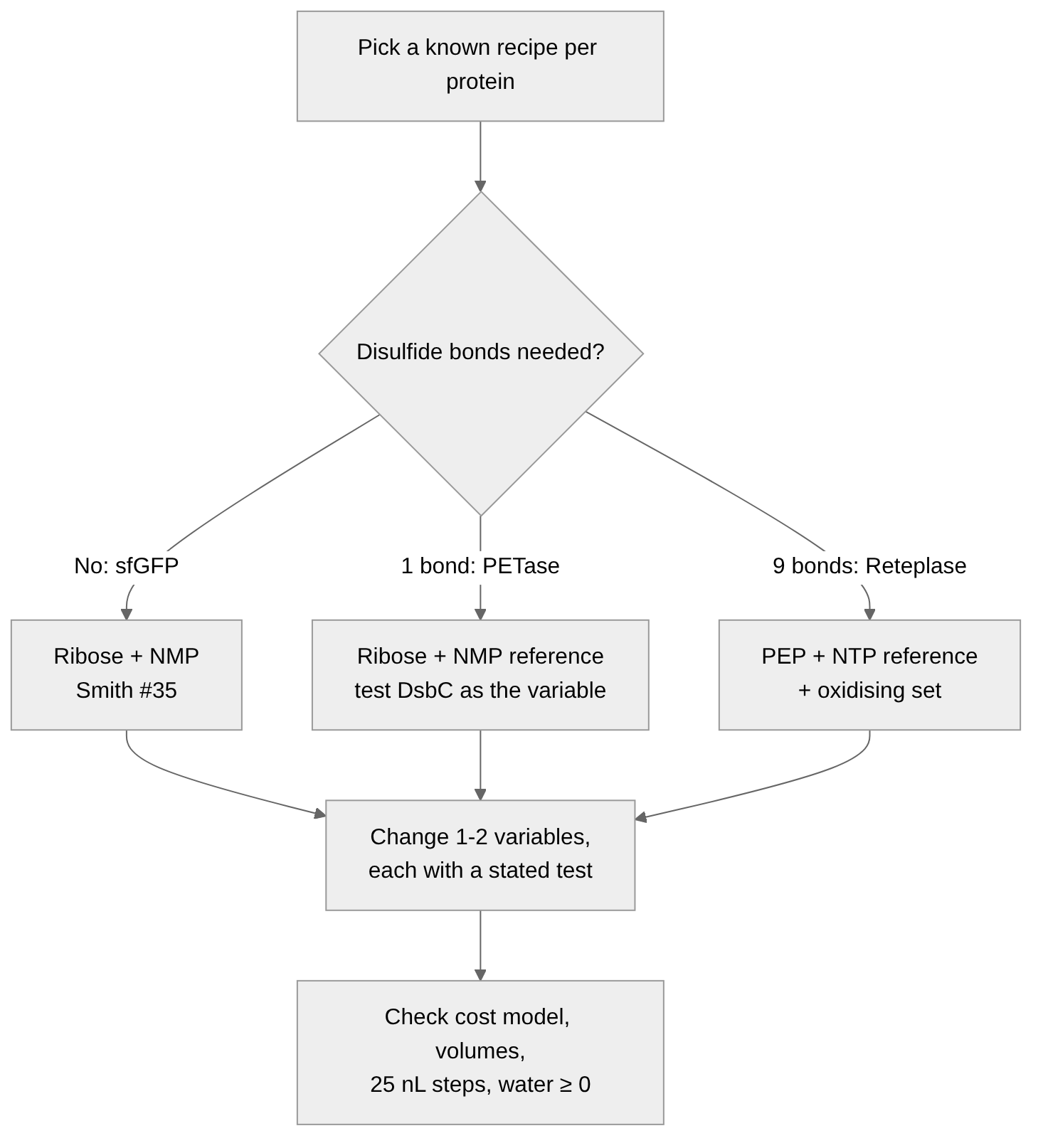
Figure 1. How a known recipe is chosen for each protein, and the checks every design must pass. SVG version

0.1 Requirements checklist
| Requirement (Section 3 of the brief, as I read it) | Where it is answered | Status |
|---|---|---|
| A1. Potassium and magnesium glutamate: why they differ, which is more sensitive | Section 3, A1 | Done in this report |
| A2. PEP+NTP versus Ribose+NMP | Section 3, A2 | Done |
| A3. Compare two literature compositions | Section 3, A3 | Done |
| B1. One 20 µL composition each for sfGFP, PETase and Reteplase | Section 4, B1a–B1c (concentrations in designer units, with nL volumes) | Designed. You must enter and publish them in the designer |
| B2. Add or upvote a Community Reagent, with rationale and links | Section 4, B2 | Rationale and links done. You must cast the vote |
| B3. Check forum access (bonus: post an idea) | Section 4, B3 | Idea drafted. You must confirm access and post |
| C. (Optional) T7 plasmids in the Asimov Kernel; bonus helper plasmid | Section 5 | Sequence checks and plan only. Not built in the Kernel |
| Cite the AI client and the prompts | Section 10 | Client named. Paste your exact prompts |
| Be ready to defend every design at recitation | Section 9, and the toolkit’s recitation tab | Prepared |
| Project brief: costing, manufacturing principles, cybersecurity, legislation, constraints | Sections 2, 6, 7 and 8 | Done |
1. Background and key terms
1.1 How the reaction works
Cell-free protein synthesis (CFPS) makes protein in a tube from a broken-open cell extract, with no living cells. The E. coli lysate (the clarified liquid left after the cells are broken and spun) supplies ribosomes, tRNAs and metabolic enzymes. It also supplies T7 RNA polymerase (a fast single-protein viral enzyme that copies DNA to mRNA, but only from a T7 promoter), because the BL21 Star (DE3) strain carries its gene. The reaction mix must supply building blocks (amino acids, nucleotides), an energy system that keeps ATP topped up, salts that keep ribosomes and RNA stable, and, for disulfide-bonded proteins, a redox system.
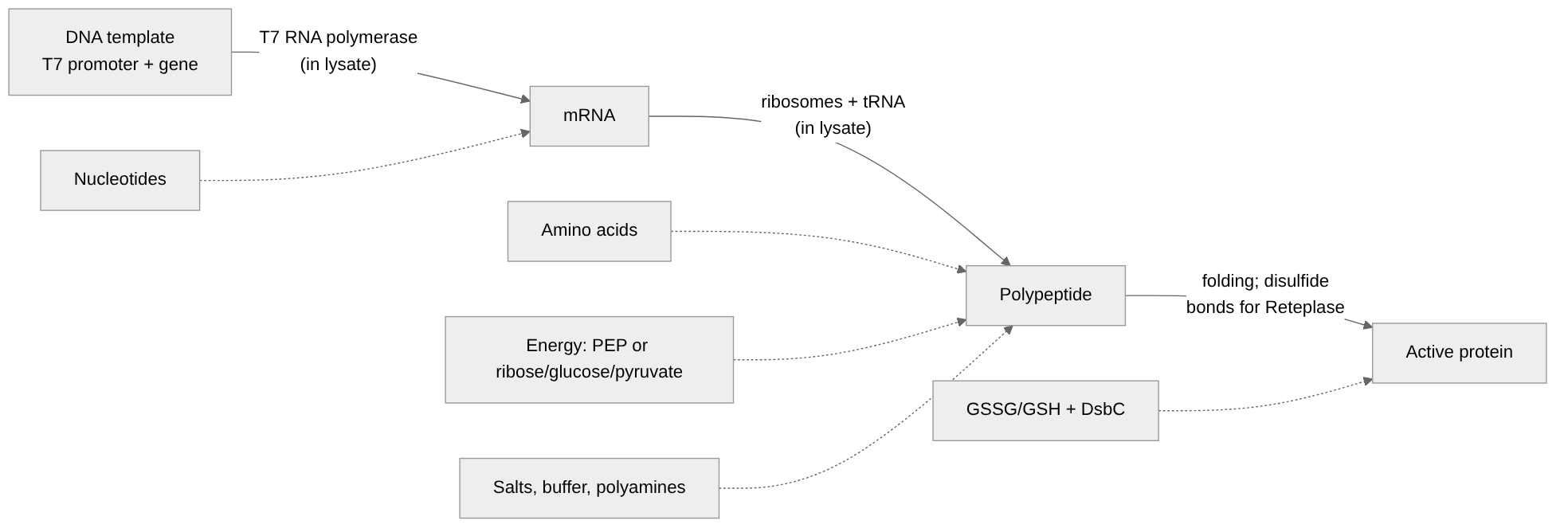
Figure 2. How a cell-free reaction makes protein, and which reagent groups feed each step. SVG version

1.2 Rules of the exercise
| Item | Rule |
|---|---|
| Reaction volume | 20 µL (20,000 nL) |
| Fixed (9,000 nL) | 5,000 nL lysate (25%), 2,000 nL DNA template, 2,000 nL base buffer |
| Variable | 11,000 nL from the reagent menu; nuclease-free water tops up to 20,000 nL |
| Granularity | every volume a multiple of 25 nL |
| Base buffer already supplies (final) | 30 mM HEPES-KOH, 200 mM K-glutamate, 2.6 mM Mg-glutamate, 1 mM of each of 18 amino acids, 1 mM cysteine |
| Scoring | Staged screen: 384-well → 96-well → 2 mL tube; the best tube result wins |
Reading the designer’s numbers. Each concentration the designer shows is a total in the 20 µL reaction, including what the base buffer supplies. I tested this: with that reading, my volume arithmetic reproduces the designer’s water row for all 12 reference plates, within 0.005 µL (rounding).
1.3 Terms (what each is, what it does, why it matters here)
| Term | What it is and how it works | Why it matters |
|---|---|---|
| Titer | Amount of product per litre (g/L for sfGFP) | Denominator of specific cost |
| Specific cost | Total reaction cost ÷ titer: $/g (sfGFP) or $ per µM† of activity (enzymes) | The score; a cheap recipe that makes little protein loses |
| µM† | The designer’s activity unit for PETase and Reteplase, from an activity assay | Used only to rank enzyme recipes; the exact definition is unconfirmed [VERIFY] |
| Disulfide bond | A covalent S–S link between two cysteines that locks a protein’s fold | sfGFP: none (2 free cysteines). TfCut2: 1. Reteplase: 9 |
| GSSG / GSH | Oxidised and reduced glutathione: a redox pair. GSSG helps form disulfide bonds; GSH can break wrong ones | Sets the redox potential for Reteplase |
| DsbC | An E. coli enzyme that rearranges wrongly paired disulfide bonds into correct ones. $5,632/mL | The biggest cost line in any design that contains it |
| DSB lysate / IAM | Lysate made without DTT and treated with iodoacetamide (IAM), which caps free thiols (–SH) | Gives Reteplase an oxidising starting point |
| NTPs / NMPs | Nucleoside tri- / monophosphates: the letters of RNA with three or one phosphate. NMPs are 20–50× cheaper per mL; lysate enzymes add the phosphates | NTPs cost ~$939/L; the NMP set about $77/L |
| PEP | Phosphoenolpyruvate: a high-energy phosphate donor that regenerates ATP directly. $2.202/mL | $661/L at 30 mM |
| Ribose, glucose, pyruvate | Cheap sugars and a sugar-derived acid that the lysate’s metabolism turns into ATP | The cheap energy route |
| Polyamines (spermidine, putrescine) | Positively charged molecules that bind RNA and ribosomes and stabilise them | Cheap titer lever |
| HEPES, phosphate, Bis-Tris | pH buffers (pKa ≈ 7.5, ≈ 7.2 and ≈ 6.8). Phosphate also feeds ATP and nucleotide synthesis | pH control; see B2 |
| Catalase | An enzyme that converts hydrogen peroxide to water and oxygen | Part of Smith #35 |
2. Cost model
| Worked example | Calculation | Result |
|---|---|---|
| Lysate | 0.005 mL × $4.00 × 50,000 | $1,000/L |
| sfGFP DNA | 0.002 mL × $1.933 × 50,000 | $193.30/L |
| Base buffer | 0.002 mL × $0.22 × 50,000 | $22.00/L |
| PEP at 30 mM | 6,000 nL → 0.006 mL × $2.202 × 50,000 | $660.60/L |
| DsbC at 1 µM | 200 nL → 0.0002 mL × $5,632 × 50,000 | $56,320/L |
Fixed cost per litre: sfGFP $1,215.30 · PETase $1,229.80 · Reteplase $1,250.40.
Validation. My model’s specific cost versus Smith et al.’s published values: #77 $414 vs $422; #26 $419 vs $425; #35 $426 vs $430; #74 $441 vs $446; 1793119_36 $461 vs $466. The model reads 1–2% low consistently, which fits small unitemised costs. Oxalic acid has no list price and is modelled at $0, so PEP-plate totals are slightly understated [VERIFY].
Reference plates in the designer, costed with this model:
| Plate | Reagents $/L | Total $/L | Titer / activity | Specific cost |
|---|---|---|---|---|
| sfGFP PEP | 2,288 | 3,503 | 0.61 g/L | $5,743/g |
| sfGFP Ribose | 105 | 1,320 | 0.46 g/L | $2,869/g |
| Smith #35 | 80 | 1,295 | 3.04 g/L | $426/g |
| PETase PEP | 283,888 | 285,118 | 314.6 µM† | $906/µM† |
| PETase Ribose | 281,705 | 282,934 | 274.8 µM† | $1,030/µM† |
| Reteplase PEP | 283,907 | 285,157 | 10.9 µM† | $26,161/µM† |
| Reteplase Ribose | 281,699 | 282,949 | 0.81 µM† | $349,320/µM† |
Implication. Because the fixed cost is about $1,215–1,250/L, a 10% titer gain cuts $/g by about 9%, while removing $75/L of reagents saves under 6%. A reagent earns its place if its share of the total cost is smaller than the titer gain it produces.
3. Part A — Comparing cell-free reaction compositions
A1. Why do potassium glutamate and magnesium glutamate differ between compositions? Which is more sensitive?
Evidence. Jewett & Swartz (2004), Table II, PANOx-SP, fraction of maximum chloramphenicol acetyltransferase (CAT) yield, one solute varied at a time:
| Mg-glutamate (mM) | 8 | 12 | 16 | 20 | 24 | 28 |
|---|---|---|---|---|---|---|
| Relative yield | 0.54 | 0.76 | 0.90 | 1.00 | 0.73 | 0.39 |
| K-glutamate (mM) | 100 | 125 | 150 | 175 | 200 | 225 |
|---|---|---|---|---|---|---|
| Relative yield | 0.63 | 0.79 | 0.93 | 1.00 | 0.94 | 0.92 |
The Cytomim system shows the same pattern: Mg optimum 8 mM (0.62 at 4 mM, 0.41 at 16 mM), K optimum 130 mM (0.95 even at 200 mM).
| Formulation | K-glutamate (mM) | Mg-glutamate (mM) |
|---|---|---|
| PANOx-SP (Jewett 2004) | 175 | 20 (+ ~3.3 from the extract) |
| Cytomim (Jewett 2004) | 130 | 8 |
| RFopt (Olsen 2026, as tabulated by Smith) | 362 | 8 |
| Smith compositions (preprint Table 2) | 273–313 | 7.0–8.8 |
| Designer reference plates (all 12) | 200 | 8.85 |
Answer.
- Magnesium is far more sensitive. Its curve is narrow and falls steeply on both sides (0.39 at 28 mM), whereas potassium sits on a broad plateau (0.92 at 225 mM).
- Why values differ between compositions (hypotheses consistent with the data, not measured here):
- Mg²⁺ is bound by NTPs, phosphate and RNA, so the free-Mg optimum moves with the nucleotide and phosphate load. NTP-based PANOx-SP needs 20 mM; NMP-based systems run near 8 mM.
- The extract itself contributes K⁺, Mg²⁺ and acetate, so “added” amounts are not totals.
- Each lysate batch differs; Olsen re-optimised Mg and phosphate for every new lysate.
- Consequence for my design. The base buffer already supplies 200 mM K-glutamate, so potassium cannot go below 200 mM, which is already above Jewett’s PANOx-SP and Cytomim optima. The only available move is upward, where the curve is flat to falling (0.94 → 0.92), so I leave it. I also leave Mg unchanged and treat a ±0.5–1 mM fine scan as a second-round experiment, because changing the narrowest-optimum variable without a scan is a gamble.
- Open discrepancy. Smith’s Table 2 lists 273–313 mM K-glutamate for compositions that the designer shows at 200 mM. I follow the designer and ask the course team why [VERIFY].
A2. How is a PEP+NTP formulation different from a Ribose+NMP formulation?
| PEP + NTP | Ribose + NMP | |
|---|---|---|
| ATP regeneration | PEP donates its phosphate to ADP directly (fast, one step) | The lysate’s sugar metabolism builds ATP over many steps; needs oxygen and buffered phosphate |
| RNA building blocks | Pre-built CTP, GTP, UTP (plus ATP) | Monophosphates (AMP, CMP, GMP, UMP); the lysate adds phosphates. Guanine + ribose can replace GMP; adenosine can partly replace AMP; CMP/UMP cannot be replaced by nucleosides (Smith) |
| Extra cofactors in the designer references | Folinic acid, CoA, NAD, putrescine, spermidine, oxalic acid | Nicotinamide, sometimes spermidine and catalase |
| Reagent cost (sfGFP) | $2,288/L (NTPs ≈ $939, PEP $661, CoA $520, NAD $125) | $105/L (Smith’s best: $43–80/L) |
| Known risk | Phosphate released from PEP builds up and inhibits synthesis; pH drifts below 6.5 (Jewett) | Phosphate must be buffered (Smith); NMP mixes can precipitate (Olsen kept them warm) |
| Where it wins | Reteplase: about 13× the reference activity of the ribose plate (10.9 vs 0.81 µM†) | sfGFP: 22× lower reagent cost; also PETase below ~0.24 µM DsbC |
Olsen and Smith both conclude that NTPs are not cost-effective for sfGFP; the Reteplase result is the exception because activity, not reagent price, is the limiting factor.
A3. Two literature compositions: reagents and concentrations compared
| PANOx-SP (Jewett & Swartz 2004) | Smith 1793122_35 (Smith et al. 2026, preprint) | |
|---|---|---|
| Energy system | PEP 33 mM | Ribose 40 mM, glucose 8.3 mM, pyruvate 9.1 mM |
| Nucleotides | NTPs | NMPs (AMP 0.5; CMP, GMP, UMP 1.0 mM) + adenosine 0.4 mM |
| K-glutamate / Mg-glutamate | 175 / 20 mM | 273.2 / 8.8 mM (Smith’s table; see A1) |
| NH4-glutamate | 10 mM | none |
| Polyamines | Spermidine 1.5 mM, putrescine 1 mM | Spermidine 1.2 mM |
| Oxalate | 2.7 mM | none |
| Buffer | — | HEPES 67.5 mM + 15 mM K-phosphate |
| Other | — | Nicotinamide 4 mM, catalase 187.5 U/mL |
| Result | ~700 µg/mL CAT (15 µL, 3 h, a different protein) | 3.04 g/L sfGFP in 2 mL tubes; $430/g |
Contrast. PANOx-SP is a PEP-driven system with a heavy salt and nucleotide load and 20 mM Mg. Smith #35 swaps PEP and NTPs for sugars and NMPs, drops Mg to 8.8 mM, and adds a pH buffer and nicotinamide. Both keep a polyamine and glutamate salts. Yields are not directly comparable (different protein, scale and time); the comparison is of formulation logic and cost structure.
4. Part B — Design one reaction composition for each protein
The brief asks for novel designs; a first pass starts from a known formulation and changes a small number of variables, each with a stated mechanism and a test that could prove it wrong. All designs were checked for non-negative water and 25 nL steps. Enter values in the designer’s units (total final concentration).
B1a. sfGFP — start from Smith #35, change two things
Why #35 and not the cheapest, #77. From Smith Table 1 (tube cost; titers in g/L by format):
| Composition | $/g (tube) | Tube | 96-well | 384-well |
|---|---|---|---|---|
| #77 | $422 | 3.04 | 0.66 | 0.29 |
| #26 | $425 | 3.01 | 0.86 | 0.33 |
| #35 | $430 | 3.04 | 1.52 | 0.72 |
| #74 | $446 | 2.92 | 1.31 | 0.49 |
| 1793119_36 | $466 | 2.77 | 1.28 | 0.78 |
#77 is cheapest in tubes but weakest in 384-well plates, which is the stage that decides what advances. Choosing it would risk early elimination for an $8/g advantage. (384-well error bars are large, e.g. 0.72 ± 0.38, so this is a risk judgement, not a certainty.)
Changes
| Change | Mechanism and evidence | Cost effect |
|---|---|---|
| GMP 1.0 mM → guanine 0.2 mM | Olsen and Smith report guanine + ribose can replace GMP without titer loss (confirmed in #77 and #74). Ribose (40 mM) is already present | about −$5.3 |
| Spermidine 1.2 → 1.5 mM | Jewett’s optimum is 1.5 mM (0.92 at 1 mM, 0.54 at 5 mM); Smith finds spermidine runs have roughly double the median titer (a correlation) | +$1.31 |
| Net | −$4.00/L ($1,294.93 → $1,290.93) |
Composition (water 3,875 nL; reagents 7,125 nL)
| Reagent | Enter | nL | $/L |
|---|---|---|---|
| K-glutamate / Mg-glutamate | 200 / 8.85 mM | 0 / 250 | 0 / 0.81 |
| Amino acids / Tyrosine / Cysteine | 4.8 / 1.2 / 5.0 mM | 1,525 / 75 / 400 | 6.33 / 0.04 / 0.48 |
| HEPES pH 7.5 | 67.5 mM | 750 | 4.88 |
| K-phosphate di:mono / mono:di | 7.5 / 7.5 mM | 300 / 300 | 0.36 / 0.27 |
| Glucose / Sodium pyruvate / Ribose | 8.3 / 9.1 / 40 mM | 150 / 200 / 1,200 | 0.02 / 1.64 / 10.80 |
| Nicotinamide / Spermidine | 4 / 1.5 mM | 800 / 125 | 0.08 / 6.53 |
| AMP / CMP / UMP | 0.5 / 1 / 1 mM | 100 / 200 / 200 | 3.50 / 12.70 / 8.39 |
| Adenosine / Guanine | 0.4 / 0.2 mM | 325 / 150 | 0.03 / 0.02 |
| Catalase | 187.5 U/mL | 75 | 18.75 |
| Reagents / Total | 7,125 nL | $75.63 / $1,290.93 |
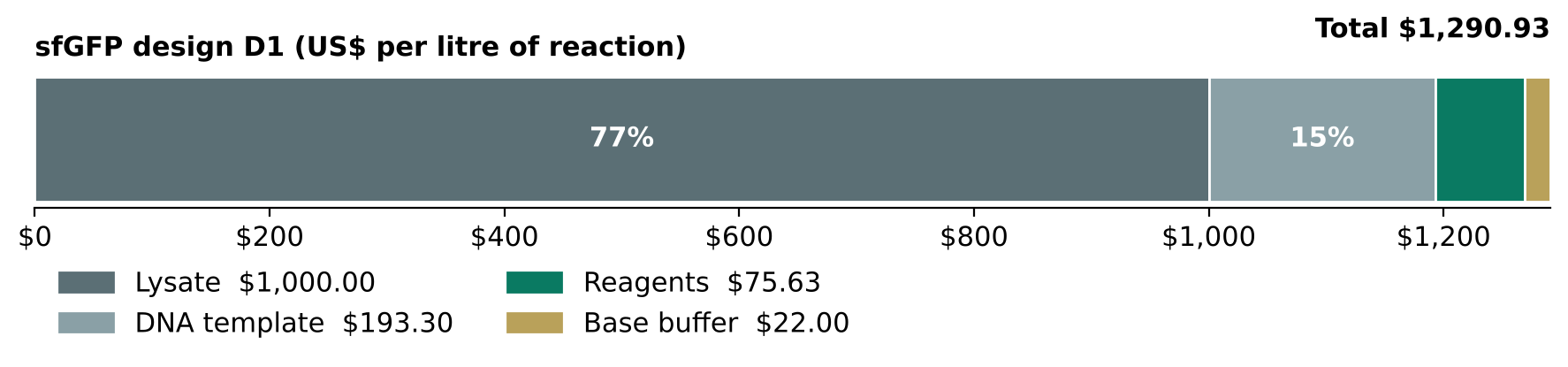
Figure 3. Where each litre of the sfGFP design (D1) costs money: the fixed block is 94%. SVG version
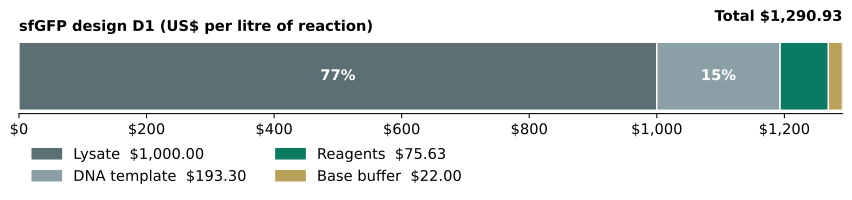
At #35’s tube titer (3.04 g/L) this would be about $425/g; that is the baseline’s titer, not a prediction.
Test that could prove it wrong. D1 fails if its titer is below #35’s on the same plate. Because the design is cost-neutral, any real gain must come from titer.
Why not the alternatives
| Option | Reason rejected |
|---|---|
| PEP + NTP (reference plate, $5,743/g) | 14× the reagent cost; titer 0.61 vs 3.04 g/L |
| sfGFP Ribose reference ($2,869/g) | 7× worse specific cost than #35 |
| #77, #26 | Cheaper in tubes but 0.29–0.33 g/L in 384-well plates |
| CMP/UMP → nucleosides | Smith reports it failed |
| Sodium hexametaphosphate | Smith reports no benefit |
| Adding CoA ($104/mL), NAD ($33/mL), folinic acid | $520, $125 and $22 per litre with no evidence of payback in ribose systems |
| Changing K or Mg | K cannot go below 200 mM; Mg needs a fine scan (A1) |
B1b. PETase — start from the PETase Ribose reference, change one thing
Change. DsbC 5 → 0.125 µM (25 nL). Everything else is identical to the reference.
Why. The brief states TfCut2 has one disulfide bond and that the standard reducing formulation remains compatible with it. At the reference 5 µM, DsbC is 99% of the cost. I confirmed from the supplied sequence that TfCut2 has two cysteines (one bond).
Composition (water 3,450 nL; reagents 7,550 nL)
| Reagent | Enter | nL | $/L |
|---|---|---|---|
| K-glutamate / Mg-glutamate | 200 / 8.85 mM | 0 / 250 | 0 / 0.81 |
| Amino acids (Tyr, Cys stay at 1 mM) | 5 mM | 1,600 | 6.64 |
| HEPES pH 7.5 | 75 mM | 900 | 5.85 |
| K-phosphate mono:di | 15 mM | 600 | 0.54 |
| Ribose / Nicotinamide | 49.96 / 4 mM | 1,500 / 800 | 13.50 / 0.08 |
| AMP / CMP / GMP / UMP | 3 / 2.125 / 2.125 / 2.125 mM | 600 / 425 / 425 / 425 | 20.97 / 26.99 / 11.33 / 17.83 |
| DsbC | 0.125 µM | 25 | 7,040 |
| Reagents / Total | 7,550 nL | $7,144.53 / $8,374.33 |
Test that could prove it wrong, in cost terms
- To beat the reference’s specific cost, D2 needs only 3.0% of its activity (about 8.1 µM† of the reference’s 274.8).
- To justify any DsbC versus none (the same recipe without DsbC costs $1,334.34/L), D2 must be 6.3× as active as that no-DsbC version.
Why one variable only. A single change keeps any difference attributable to DsbC; bundling other changes would confound it. A group member is testing the PEP PETase reference at 3.75 µM, so my design does not duplicate that.
Why not the alternatives
| Option | Reason rejected |
|---|---|
| Copy the 5 µM reference unchanged | DsbC is 99% of cost and nothing is learned |
| PEP backbone | Cheaper per unit activity only above ~0.24 µM DsbC (see B1d); D2 sits below that |
| Oxidising set (IAM lysate, extra GSSG) | The brief says reducing conditions are compatible; Olsen found oxidising additions cut sfGFP yield by 75–97% in RFopt |
| No DsbC | Kept as the lower bound for the next round; one disulfide could still need assistance |
B1c. Reteplase — start from the Reteplase PEP reference, change one thing
Change. DsbC 5 → 1 µM (200 nL). Everything else is identical to the reference.
Why PEP+NTP. The two Reteplase references differ 13-fold in activity (10.9 vs 0.81 µM†) while their costs without DsbC differ only 2.6-fold ($3,557 vs $1,349 per litre). Even with DsbC at zero, PEP is about 5× cheaper per unit activity. Caveats: single plates, and the µM† unit is unconfirmed.
Why 1 µM DsbC. DsbC is 94% of this design’s cost. At 1 µM it costs one-fifth as much as at 5 µM. The literature level quoted on the course forum from Yin & Swartz (2004) is 75 µg/mL, which at DsbC’s 25.5 kDa is about 2.9 µM. So lowering from 5 µM has support, but 1 µM is below that level. A peer states DsbC saturates near 1 µM, but the passage quoted does not say so, so I treat it as a hypothesis. D3 is a deliberate cost test; 2.5 µM is the safer alternative but needs about 51% of the reference activity to break even versus 21% at 1 µM.
Composition (water 1,400 nL; reagents 9,600 nL)
| Reagent | Enter | nL | $/L |
|---|---|---|---|
| Mg-glutamate / NH4-glutamate | 8.85 / 10 mM | 250 / 200 | 0.81 / 7.20 |
| Amino acids (Tyr, Cys stay at 1 mM) | 2 mM | 400 | 1.66 |
| HEPES pH 7.5 | 57.5 mM | 550 | 3.58 |
| PEP | 30 mM | 6,000 | 660.60 |
| Folinic acid / CoA / NAD | 0.025 mg/mL / 0.25 / 0.375 mM | 50 / 100 / 75 | 22.45 / 520.00 / 125.05 |
| Putrescine / Spermidine / Oxalic acid | 1.25 / 1.5625 / 3.75 mM | 50 / 125 / 150 | 1.09 / 6.53 / 0 (unpriced) |
| GSSG / GSH | 4.0375 / 1 mM | 475 / 200 | 17.34 / 1.70 |
| DsbC | 1 µM | 200 | 56,320 |
| ATP / CTP / GTP / UTP | 1.25 / 0.875 each mM | 250 / 175 each | 19.24 / 244.45 / 344.25 / 331.15 |
| Reagents / Total | 9,600 nL | $58,627.09 / $59,877.49 |
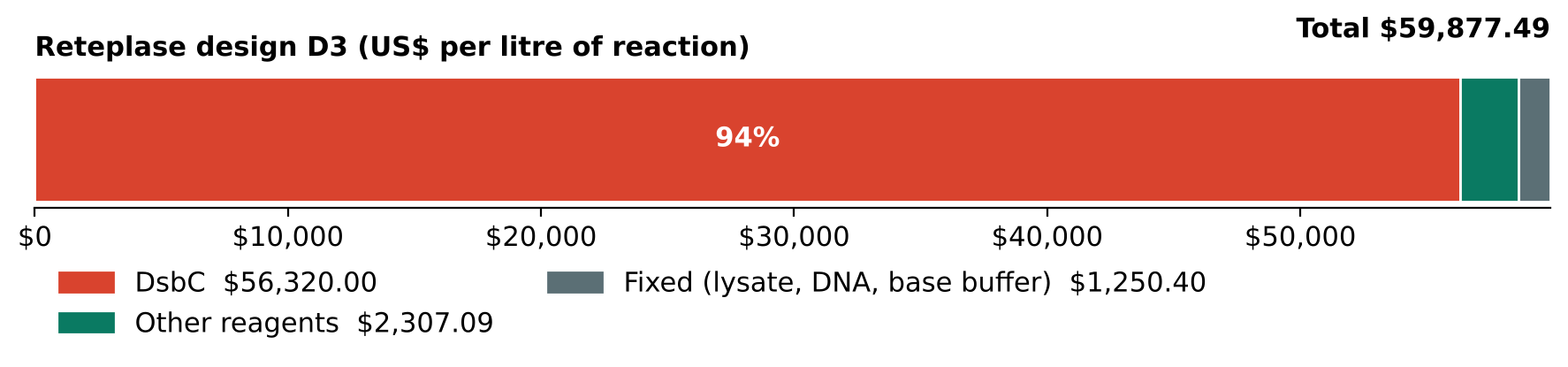
Figure 4. Where each litre of the Reteplase design (D3) costs money: DsbC is 94%. SVG version
Test that could prove it wrong. D3 needs about 21% of the reference’s activity (2.3 µM† of 10.9) to match the reference’s specific cost. Below that, 1 µM does not pay back.
Why keep everything else (CoA, NAD, NTPs, oxalate, polyamines). It is the known formulation. CoA + NAD + NTPs total about $1,600/L, under 3% of D3, so removing them cannot decide the outcome now; they are second-round tests.
Why not the alternatives
| Option | Reason rejected |
|---|---|
| Ribose backbone | 13× lower reference activity |
| DsbC 5 µM | 99% of cost; nothing learned |
| DsbC 0.25 µM ($17,637/L) | Higher risk of near-zero activity for a nine-bond protein; kept for the ladder |
| Raising HEPES | Olsen’s pH problem was in the ribose formulation and was fixed by raising the buffer’s pH, which the designer already sets to 7.5 |
| NTP → NMP swap ($58,984/L, saves $893) | Only 1.5% while DsbC is present, and adds a second variable |
| No DsbC | High risk of an uninformative zero |
B1d. DsbC break-even (from the workbook)
| DsbC (µM) | nL | $/L | Activity multiple needed — Reteplase | — PETase ribose |
|---|---|---|---|---|
| 0.125 | 25 | 7,040 | 3.0× | 6.3× |
| 0.25 | 50 | 14,080 | 5.0× | 11.6× |
| 0.5 | 100 | 28,160 | 8.9× | 22.1× |
| 1 | 200 | 56,320 | 16.8× | 43.2× |
| 2.5 | 500 | 140,800 | 40.6× | 106.5× |
| 5 | 1,000 | 281,600 | 80.2× | 212.0× |
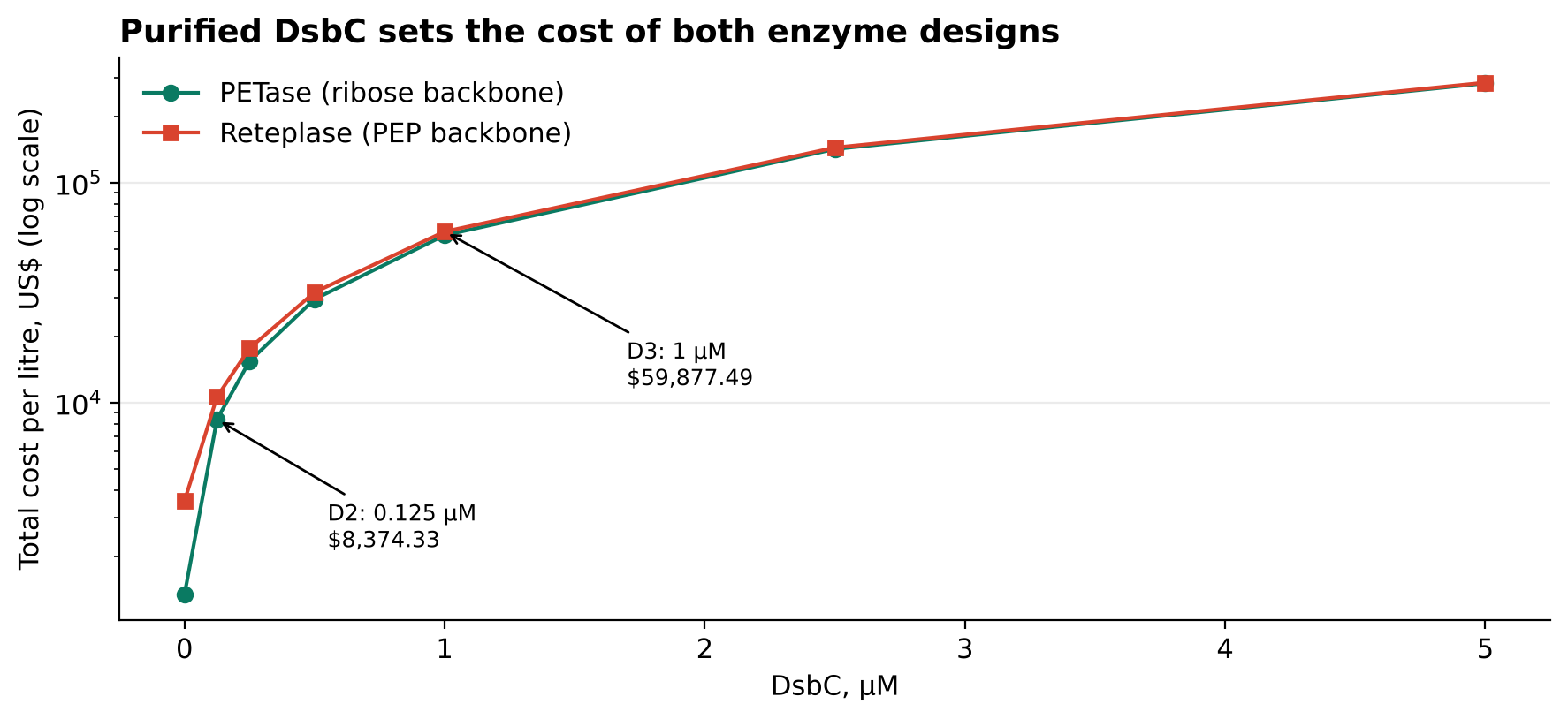
Figure 5. Total cost per litre against DsbC level for both enzyme designs (log scale); D2 and D3 are marked. SVG version
Backbone crossover (assuming activity does not change with DsbC level, a simplification): setting (C_ribose + d)/T_ribose = (C_PEP + d)/T_PEP gives 0.24 µM DsbC for PETase (ribose cheaper below it, PEP above it) and a negative value for Reteplase, so PEP wins at every DsbC level.
B2. Community reagent: Bis-Tris
Decision. I upvote the existing Bis-Tris proposal [confirm it is on the Community Reagents list and add your vote]. If it is not listed, I propose it with the rationale below.
What it is. Bis-Tris is a buffer with a pKa of about 6.8 (near-neutral pH), which resists pH change in the 6–7.2 range. It is a stable small molecule with no activity to lose, no cold chain, and no protein-sourcing delay.
How I chose it. I screened candidates against three criteria: cost-effective, stable, and useful for more than one protein.
| Candidate | Cost-effective | Stable | Multi-protein | Verdict |
|---|---|---|---|---|
| Bis-Tris | likely cheap (commodity buffer; price not on my list [VERIFY]) | Yes | Yes (pH matters for all three) | Chosen |
| Skp (chaperone) | Unknown; protein reagent | Less (protein) | Reteplase only | Reasonable alternative; Yin & Swartz report it raised active vtPA yield, but it fails my stability and breadth tests |
| PEG-8000 (crowding agent) | Probably cheap | Yes | Yes | Weak evidence in the sources; a viscous solution may be hard to dispense in 25 nL droplets (my inference) |
| tRNA | No price in my files; likely costly | Moderate | Yes | Not evidenced as cost-effective |
| DsbA | Protein | Less | Reteplase only | GSSG already oxidises non-enzymatically; the bottleneck is untangling wrong pairings, which only DsbC does |
Evidence and links
- Jewett & Swartz (2004): PEP-based reactions fall below pH 6.5 by the end of the reaction, and they suggest a buffer with a pKa near 6.8, such as Bis-Tris, as an approach. https://doi.org/10.1002/bit.20026
- Olsen et al. (2026): glutathione acidified the ribose formulation below pH 7.0, and correcting the pH recovered yield. https://doi.org/10.1038/s41467-026-69605-8
- Smith et al. (2026): buffering or pH control can materially improve specific cost. https://www.biorxiv.org/content/10.64898/2026.02.05.703998v1
Caveat. Olsen found that adding a buffer on its own to the minimal formulation did not improve yield, so Bis-Tris is a plausible low-risk test, not a proven gain.
One reagent or several? I kept it to one. The brief asks for at least one with a rationale, I must be able to defend every choice at recitation, and reagents come from a limited shared pool where duplicating an existing proposal wastes a slot.
B3. Forum
- I confirm access to the cfps-coopetition channel [tick when done].
- Idea to post: run a DsbC dose-response (0, 0.125, 0.25, 0.5, 1, 2.5 µM) across plates for Reteplase, because DsbC is about 94% of the cost of my Reteplase design and a TA reported ~95% in theirs.
B4. Submission notes (from the forum)
| Item | Detail | Action |
|---|---|---|
| JSON names | A peer’s working names: GSSG = oxidized_glutathione, GSH = reduced_glutathione, DsbC = dsbc_ecoli | Take every other name from the repo’s example JSON or the website export |
| PEP display bug | Re-opening a submitted design can drop the PEP amount (two PEP entries in the database); the organiser says submitted designs are unaffected | D3 contains PEP; after submitting, check the export still shows 6,000 nL [VERIFY] |
| Salt Optima | A peer asked what this setting does and I saw no answer | Confirm the water row for D1–D3 reads 3.875, 3.45 and 1.40 µL in the live designer [VERIFY] |
5. Part C (optional) — Asimov Kernel plasmids and helper plasmid
C1. T7-compatible plasmids
Check of the supplied sequences. I counted residues and cysteines:
| Protein | Residues (with tags) | Cysteines | Consistent with |
|---|---|---|---|
| sfGFP | 240 | 2 | no disulfide (2 free thiols) |
| TfCut2 | 309 | 2 | 1 disulfide bond |
| Reteplase | 399 | 18 | 9 disulfide bonds |
The lengths match the overview document (240, 309 and 399). Tags in the sequences: a Strep II tag (WSHPQFEK) at the C-terminus of sfGFP; an N-terminal Strep II tag + linker + TEV site on PETase and Reteplase; and a C-terminal HiBiT tag (VSGWRLFKKIS) on both.
Layout to reproduce (from Ginkgo’s own plasmids, 2,511 / 2,696 / 2,966 bp): backbone (origin and selection marker, for propagation only) → T7 promoter (TAATACGACTCACTATAGGG) → ribosome binding site and spacer → ATG, coding sequence, stop codon → T7-type terminator → backbone.
Kernel steps: (1) codon-optimise each protein for E. coli; (2) remove stray restriction sites for the chosen cloning method; (3) avoid internal terminator-like hairpins and strong internal RBS motifs; (4) confirm the reading frame across the tags and a single stop codon; (5) check GC content and repeats for synthesis; (6) translate the final sequence back and match it to the brief. I have not run the Kernel; this step must be done in the tool.
C2. Bonus — T7 helper plasmid for functional Reteplase (speculative)
Design. A second T7 plasmid expressing the mature E. coli DsbC (without its periplasmic signal peptide, so it is made in the cytoplasm-like reaction), with the same RBS and terminator as the target plasmid, and a tag (for example HiBiT or Strep II) to follow it.
Why DsbC and not the alternatives. DsbC is the enzyme that fixes wrong pairings, which is Reteplase’s bottleneck. DsbA only forms disulfides, and GSSG already does that; Yin & Swartz (as quoted on the forum) found PDI, GroEL/GroES, DnaK/DnaJ/GrpE and DsbA gave no significant benefit.
Cost logic (a calculation, not a result).
- Exogenous 1 µM DsbC costs $56,320/L.
- 1 µM × 25.5 kDa = 25.5 µg/mL = 0.0255 g/L, about 0.8% of the 3.04 g/L sfGFP yield, so it is plausible in theory for the reaction to make that much.
- A helper plasmid at 1 nM out of the 5 nM total DNA would cost about 1/5 of the DNA line, roughly $46/L (DNA at $228/L for 5 nM).
Why it might not work.
- The model allows exactly one DNA template (2,000 nL, 5 nM), so a helper would have to be co-formulated into that stock; this reduces the target gene dose and may not be permitted [VERIFY with the course team].
- It competes with Reteplase for ribosomes and ATP and adds a lag, so DsbC may arrive after misfolding has begun. A peer argues that overexpressing DsbC in the production strain before lysis is the better route (out of scope here).
- DsbC must be in its reduced, active form to act as an isomerase; whether it stays active in a GSSG-rich mix is untested.
6. Cybersecurity, legislation and quality
| Area | Risk | Control |
|---|---|---|
| Credentials | gcloud auth login --update-adc stores application-default credentials locally | Dedicated account; never commit credential files; log out after upload |
| Supply chain | git clone and uv sync pull code and dependencies from the internet | Use the official ginkgobioworks/autonomous-cfps repo; review and pin dependencies; isolated environment |
| Input integrity | A tampered or malformed JSON could drive an automated lab | Validate with the Pydantic model; keep a SHA-256 hash of each submitted file |
| Confidentiality | Human-team designs and results are shared among teams | Nothing confidential in sample IDs or notes |
| AI-assisted design | LLM output can contain wrong volumes or reagents | Re-check every design against the designer’s CSV; cite AI use (required) |
| Personal data | Account and course data are personal information | POPIA (Protection of Personal Information Act 4 of 2013, South Africa) |
| Biosafety / GMO | The experiments run at Ginkgo; my part is in silico | If local wet work is ever added, South Africa’s Genetically Modified Organisms Act 15 of 1997 may apply [VERIFY] |
| Therapeutic regulation | Reteplase is an approved human drug | Any real production for human use falls under biologics regulation (for example FDA, EMA, SAHPRA); this exercise yields research material only |
| Public posts | Forum posts and screenshots can expose tokens, email addresses or file paths | Post design values only; scan any pasted text for secrets first (the toolkit’s scanner does this); no credentials in screenshots |
| Fingerprints | A hash shows a design file changed, not who changed it | Record the hashes in Section 8 and keep them apart from the submitted files |
| Academic integrity | AI-assisted work must be disclosed, and peer ideas credited | Section 10 names the AI client and prompts; peer and forum claims are labelled as such; follow the stricter of the course and university AI rules [VERIFY] |
Manufacturing and quality principles applied: start from a known baseline; change one or two variables; write the hypothesis and the failure criterion in advance; replicates (n = 4) and controls on every plate; compare only within the same plate format; keep traceable records (design ID, file hash, date); cost every option before choosing it.
7. Constraints, risks and boundary-pushing
This section lists what could limit or break the designs, and where they push beyond what the sources show. The cost model cannot see any of it.
7.1 Timing and scoring unknowns
| Item | What I know | What I do not know | Action |
|---|---|---|---|
| Deadline | Course due date 6 October; Ginkgo’s official submission window runs to 20 October | Whether the course accepts late work | Ask the TA |
| Scoring metric | The objective is lowest specific cost ($/g or $ per µM†) | Whether ranking uses measured yield, cost, or a mix, and how an untested design is treated | Ask which metric counts. D2 and D3 are written as cost tests |
| Activity unit | The designer ranks enzymes in µM† | Its exact definition | Ask the course team |
7.2 Wet-lab risks the cost model cannot see
| Risk | Why it matters | Designs affected | What I did or would do |
|---|---|---|---|
| Small-volume dispensing | A fixed pipetting error is a larger share of a small volume. D2’s DsbC is 25 nL, the smallest step the designer allows. Under the toolkit’s assumed error model (3% CV plus 15 nL standard deviation, my placeholder, not a lab specification) the concentration error is about 60% at 25 nL, about 8% at 200 nL (D3’s DsbC) | D2 most; D3’s small additions (putrescine 50 nL, folinic acid 50 nL) | Ask Ginkgo for the real dispensing specification; read D2’s result against replicate scatter; the 0.25 µM rung (50 nL) is the fallback |
| Precipitation (magnesium with phosphate-rich mixes, oxalate) | A precipitate can remove reagents or block assays | D3 (PEP, NTPs, oxalate, Mg 8.85 mM) | D2 and D3 keep every salt of their reference plates unchanged, so this risk belongs to the reference, not to my change |
| Activity is not expression | Protein made is not protein active; Reteplase has nine bonds to form correctly | D2, D3 | The break-even figures state how much activity each DsbC level must keep (3.0% for D2, about 21% for D3); below that the saving is not worth it |
| Plate format | Titers differ by format (Smith #35: 3.04 g/L in tubes, 1.52 in 96-well, 0.72 in 384-well) | All | Compare only within one plate format |
| Lysate batch | Olsen re-optimised magnesium and phosphate for each new lysate | All | I start from the references run in the designer, so batch effects are shared |
| Untested changes | Two of three designs change an expensive additive for which my sources give indirect evidence only | D2, D3 | Each design has a stated failure test (Section 4) |
7.3 Where the designs push beyond the evidence, and where they stay conservative
| Design | Basis | Assessment | |
|---|---|---|---|
| Pushes | D2: DsbC 0.125 µM, 40× below the reference | The brief says TfCut2 has one disulfide bond and tolerates the reducing formulation. I found no direct dose data for it | A genuine hypothesis; the no-DsbC version (cost $1,334.34/L) is the lower bound for round two |
| Pushes | D3: DsbC 1 µM | The forum-quoted literature level is about 2.9 µM (for a related protein, vtPA). A peer claims saturation near 1 µM, which the quoted passage does not state | Deliberate cost test; 2.5 µM is the safer alternative |
| Conservative | D1: two small changes to Smith #35 | Evidence for guanine as a GMP replacement; Jewett’s spermidine optimum | Cost-neutral (−$4.00/L); any gain has to come from titer |
| Conservative | Everything else in all three designs | Unchanged from known formulations | Keeps any difference attributable |
7.4 Ideas considered but not evaluated
- Redox tuning instead of purified DsbC (adjusting GSH and GSSG). D3 already contains both, and I have not costed or sourced a version that replaces DsbC, so I make no claim about it.
- Helper plasmid that makes DsbC in the reaction (Section 5): possible in theory, but only one DNA template is allowed and permission is unclear.
- Overexpressing DsbC in the lysate strain before lysis (a peer’s idea): outside this exercise.
7.5 Integrity and ethics
- AI assistance is disclosed (Section 10). Numerical claims were checked against the course PDFs, the draft coopetition overview and the designer CSV.
- Peer and forum statements are quoted as peer statements; Smith et al. (2026) is a preprint.
- Public posts contain design values only, with no credentials, emails or file paths.
8. Supporting tools
| Tool | What it is | Supports |
|---|---|---|
Costing workbook HTBAA_HW3_CFPS_Costing.xlsx | Sheets: Summary, Designs (R01–R12 references, D1–D3 submissions, A1–A3 alternatives), DsbC_Breakeven, Prices. Every figure is a live formula | Sections 2 and 4 |
| CFPS Design Toolkit (web page) | Nine tabs: Design & cost; Optimise (cheapest cuts first, DsbC ladder); Sensitivity (tornado chart, price shock); Dispensing (Monte Carlo of pipetting error); Scale-up ($/g, batch cost, plates); Sequence (promoter, frame, cysteines, tags, terminator, restriction sites); Integrity & secrets (SHA-256 fingerprint, credential scanner); Assumptions register; Recitation trainer | Sections 4, 5, 6, 7 and 9 |
Figures. Figures 1–5 are supplied as PNG and SVG files in the images/ folder beside this report; keep the folder structure when uploading to the website.
How the toolkit was checked. When it loads it recomputes D1–D3 and compares them with this report: $1,290.93, $8,374.33 and $59,877.49 per litre, and water rows of 3.875, 3.45 and 1.40 µL. It also tests its own SHA-256 routine against a known value. Its DsbC ladder reproduces the break-evens in B1d.
What it is not. It is a planning model of the designer, not the designer. Its optimiser trades cost against departure from a known recipe and cannot predict yield. Its dispensing figures use placeholder error values. The final designs must be entered in the live designer, where the water row should match.
Design fingerprints (SHA-256 of the toolkit’s canonical JSON for each design, with label “D1 sfGFP”, “D2 PETase” and “D3 Reteplase” and date 2026-10-13; recomputed independently in Python and matching):
| Design | SHA-256 |
|---|---|
| D1 sfGFP | b0709ffeff68c2a82700a516a8ce5be160f15daa0c79f3ae83e5135324d43c6a |
| D2 PETase | 147b290f5aaf6845266033229d33b8c3b04fc2d940e2d0258066de02a18b8871 |
| D3 Reteplase | fab3201e2592b424ff7a613da2e1027332fe659cd48fc54d0baf0d6893ec9c3a |
A hash shows that the content later differs; it does not show who changed it. The toolkit link is private until its owner shares it, so share it before putting a link on a public page.
9. Defence pack
9.1 What I did, why, and how (short version)
What. I designed one 20 µL cell-free reaction for each target by taking a known recipe and changing as little as possible: sfGFP (Smith #35 with guanine replacing GMP and spermidine at 1.5 mM), PETase (the ribose reference with DsbC cut from 5 to 0.125 µM), and Reteplase (the PEP reference with DsbC cut to 1 µM). For the community reagent I chose Bis-Tris.
Why. The score is cost per gram or per unit of activity. Lysate and DNA fix about $1,215–1,250/L, so for sfGFP the lever is titer, and for the two enzymes the lever is purified DsbC, which at 5 µM is 99% of the reference cost. Each change targets either titer or the DsbC line, and each comes with a written hypothesis and a result that would prove it wrong.
How. I built a cost model from the price list and the reaction rules, checked it against all 12 designer reference plates (water row within 0.005 µL) and against Smith’s published $/g (within 2%), then used it to compare options, compute break-even activity for DsbC and choose baselines. Every rejected option has a numeric or evidence-based reason.
9.2 Likely questions
| Question | Answer |
|---|---|
| Why not copy the cheapest sfGFP recipe? | #77 is cheapest in tubes ($422/g) but reaches only 0.29 g/L in 384-well plates versus 0.72 for #35, and 384-well is the stage that decides advancement |
| Why change spermidine and GMP? | Both have evidence and cost little: Jewett’s spermidine optimum is 1.5 mM, and guanine + ribose replacing GMP was confirmed in #77 and #74. Net −$4/L |
| Why is Mg unchanged if it is the most sensitive? | Changing the narrowest-optimum variable without a scan is a gamble; it is a second-round fine scan. All 12 references share 8.85 mM |
| Why only one change for each enzyme? | So any difference can be attributed to DsbC |
| Is 1 µM DsbC supported? | Partly. The literature level quoted is 75 µg/mL (about 2.9 µM) versus the 5 µM reference; a peer claims a plateau near 1 µM but the passage quoted does not say so. D3 is a deliberate test, with 2.5 µM as the safer alternative |
| Why keep CoA, NAD and NTPs in Reteplase? | Known formulation; together they are under 3% of D3, so they cannot decide the outcome now |
| What would show you are wrong? | sfGFP titer below #35’s; PETase activity below 3% of the reference; Reteplase activity below about 21% of the reference |
| Weakest assumptions? | Oxalic acid priced at $0; µM† undefined; activity assumed independent of DsbC in the crossover maths; the K-glutamate discrepancy |
| Why Bis-Tris? | Stable, probably cheap, and pH control matters for all three proteins; Jewett, Olsen and Smith all point to pH or buffering |
| Why not a helper plasmid? | Optional and speculative: one-template limit, ribosome and ATP competition, lag, and unclear permission |
| Next steps? | A six-point DsbC ladder crossed with the PEP/ribose backbone, a Mg fine scan, then NTP→NMP and CoA/NAD removal in Reteplase once DsbC is lowered |
| What if 25 nL of DsbC is dispensed badly in D2? | It is the smallest step the designer allows, so any fixed pipetting error is a large share of it. Under my assumed error model the concentration error is about 60% (about 8% for D3’s 200 nL). I would read D2 against replicate scatter and fall back to 0.25 µM |
| Why trust numbers produced with AI help? | They were cross-checked: the water row of all 12 reference plates reproduced within 0.005 µL; model $/g within about 2% of Smith’s; sequence cysteine counts match the expected bonds; the toolkit re-derives D1–D3 on every load; the design hashes were recomputed independently |
| Oxalic acid is unpriced. Does that change the answer? | It is modelled at $0, so PEP-plate totals are slightly low. Oxalate is a small addition (150 nL in D3) against a cost dominated by DsbC, so the conclusions hold; I flag it rather than hide it |
10. Use of AI
AI client: Claude (Anthropic), Claude Sonnet 5.5, used through a claude.ai Project, to read the brief, papers and lecture material, build the cost model and workbook, and draft this report. I verified the numerical claims against the course PDFs, the draft coopetition overview and the designer’s CSV export. The toolkit’s code was also written with Claude and tested in a headless browser against the report’s totals; I did not independently audit the code.
Prompts used (replace with your exact wording before submitting):
- [Prompt: how to approach the assignment in an original, analytical way, with reasoning for choices and rejected alternatives, and costing]
- [Prompt: the costing workbook request]
- [Prompt: draft proposed solution in markdown with diagrams, formulations and calculations]
- [Prompt: explain terms, alternatives not chosen, and a short defence description]
- [Prompt: apply relevant group-chat items]
- [Prompt: explain what the assignment is]
- [Prompt: a cost-effective, stable, multi-use community reagent; one or several?]
- [Prompt: write the report for the webpage]
- [Prompt: other constraints, limitations or boundary-pushing aspects I am not considering]
- [Prompt: can I build a tool useful for this assignment, and a wider set of tools]
- [Prompt: write the updated markdown report with all requirements]
11. Limits and open items
- Oxalic acid has no list price; modelled at $0.
- µM† is unconfirmed, so PETase and Reteplase specific costs are relative rankings only.
- Smith’s Table 2 lists K-glutamate at 273–313 mM where the designer shows 200 mM.
- Smith et al. 2026 is a preprint (not peer reviewed). Peer statements from the forum are quoted as peer statements and were not independently verified.
- Titers from different plate formats are not comparable.
- Plate, labour and assay costs are excluded.
- Part C was not built in the Kernel.
- The toolkit’s dispensing-error parameters (3% CV, 15 nL) are placeholders, and its optimiser has no yield model.
- The toolkit is a model of the designer, not the designer; its link is private until shared.
- I could not confirm the scoring metric, the exact meaning of µM†, or the course rule on late work (Section 7.1).
- Confirm: the community reagent list and your vote; forum access; the live designer’s water row for D1–D3; the PEP export after submitting; and whether late submission is accepted.
12. References
- Smith, A. A., et al. (2026). Using a GPT-5-driven autonomous lab to optimize the cost and titer of cell-free protein synthesis. bioRxiv. https://www.biorxiv.org/content/10.64898/2026.02.05.703998v1 (preprint)
- Olsen, M. L., et al. (2026). Design-driven optimization of low-cost reagent formulations for reproducible and high-yielding cell-free gene expression. Nature Communications. https://doi.org/10.1038/s41467-026-69605-8
- Jewett, M. C., & Swartz, J. R. (2004). Mimicking the Escherichia coli cytoplasmic environment activates long-lived and efficient cell-free protein synthesis. Biotechnology and Bioengineering, 86(1), 19–26. https://doi.org/10.1002/bit.20026
- Silverman, A. D., Karim, A. S., & Jewett, M. C. (2020). Cell-free gene expression: an expanded repertoire of applications. Nature Reviews Genetics, 21, 151–170. https://doi.org/10.1038/s41576-019-0186-3
- Rasor, B. J., et al. (2021). Toward sustainable, cell-free biomanufacturing. Current Opinion in Biotechnology, 69, 136–144. https://doi.org/10.1016/j.copbio.2020.12.012
- Yin, G., & Swartz, J. R. (2004). Enhancing multiple disulfide bonded protein folding in a cell-free system. Biotechnology and Bioengineering. https://doi.org/10.1002/bit.10827 (cited as quoted on the course forum; not independently checked)
- Ginkgo Bioworks. CFPS coopetition overview and guidelines (draft), HTBAA copy; designer composition table (CSV export).