Week 4 Cell-Free Manufacturing
HTBAA Week 4 — Batch Design and Automated Cell-Free Manufacturing
Section 4 report — for submission on the homework website (version 1, 19 October 2026)
Platform: Ginkgo Nebula · Echo 525 acoustic dispenser · 384-well staged screen Objective: turn the three Week 3 compositions into batches that can be falsified, not just run
Reading notes. This week builds directly on Week 3, which designed one 20 µL composition per target (D1 sfGFP, D2 PETase, D3 Reteplase) and costed them. Week 4 designs the batches that test the one variable each design was built around. Items marked [VERIFY] are unconfirmed and collected in Section 10. Every number plotted in this report is a design-time prediction written before the run, not a measurement. They are recorded here precisely so the run can contradict them.
0. Summary
| Batch | Target | Variable swept | Wells | Hypothesis | What would falsify it |
|---|---|---|---|---|---|
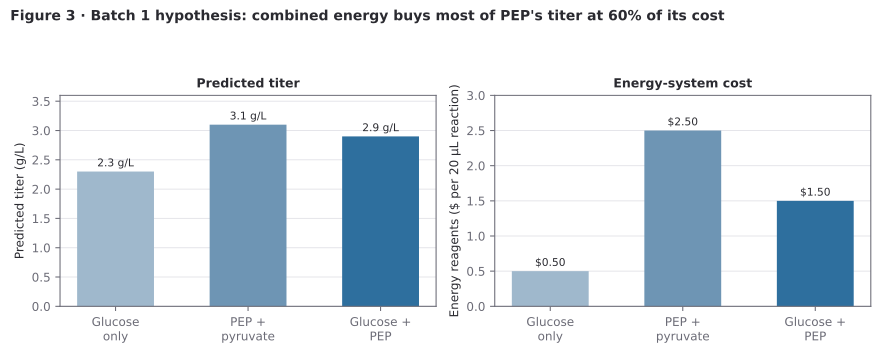
| 1 | sfGFP | Energy system: glucose / PEP+pyruvate / combined | 9 | Combined buys most of PEP’s titer at ~60% of PEP’s energy cost | Combined titer ≤ glucose-only titer |
| 2 | PETase | GSSG 0 → 2.0 mM at fixed DTT 2 mM | 12 | Activity peaks at a mid GSSG level; too much oxidises indiscriminately | Flat activity across all four levels, or monotonic rise to 2.0 mM |
| 3 | Reteplase | Isomerase: DsbC / Trx / both | 9 | Two isomerases rescue more 9-bond topologies than either alone | Combination ≤ the better single isomerase |
| Total | 30 |
Why these three. Week 3 ended with one open question per protein, and each batch answers exactly one:
- sfGFP was cost-neutral by construction, so the only lever left is titer — and the energy system is the cheapest titer lever that remains untested on this lysate.
- PETase was submitted at 0.125 µM DsbC on the argument that one disulfide bond does not need much help. Batch 2 asks the complementary question: can the redox buffer alone form that bond, with no expensive enzyme at all?
- Reteplase was submitted at 1 µM DsbC, below the literature level. Batch 3 asks whether a different isomerase, or two in parallel, does more per dollar than more of the same one.
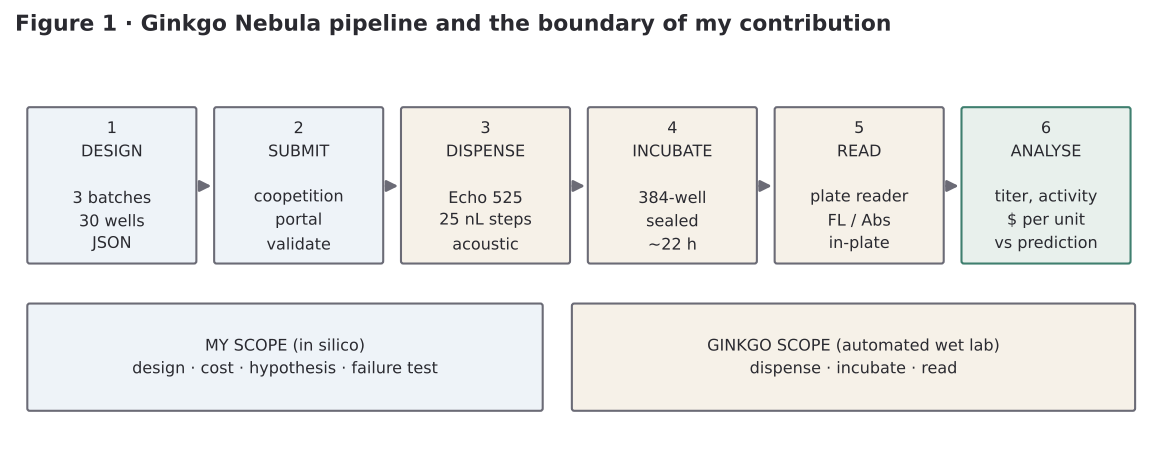
Figure 1. The six stages from design to analysis. Stages 1–2 and 6 are mine; stages 3–5 run unattended at Ginkgo, which is why every hypothesis and failure test has to be written down before submission. SVG version
0.1 Requirements checklist
| Requirement (Section 4 of the brief, as I read it) | Where it is answered | Status |
|---|---|---|
| Design batches of reactions that vary parameters systematically | Sections 3–5 (Batches 1–3, with JSON) | Designed. You must submit them in the portal |
| State a hypothesis per batch | Each batch section, “Hypothesis” and “Falsification test” | Done |
| Analyse the provided control experiment (384-well vs 96-well) | Section 6 | Framework and hypotheses written; the report itself is not yet in my hands [VERIFY] |
| Propose a rubric criterion for accepting submitted compositions | Section 7 | Done |
| Optional: AI-agent design contributions | Section 8.3 | Approach stated |
| Cite the AI client and prompts | Section 9 | Client named. Paste your exact prompts |
| Costing, manufacturing principles, cybersecurity, legislation | Sections 2.3, 8 | Done |
1. The platform, and what it changes about design
1.1 Terms
| Term | What it is | Why it matters here |
|---|---|---|
| Ginkgo Nebula | Ginkgo’s automated screening platform that runs submitted CFPS compositions without a human at the bench | My design is executed exactly as written; no one adjusts it mid-run |
| Echo 525 | An acoustic liquid handler that ejects droplets with sound instead of a pipette tip, in 25 nL steps | Sets the 25 nL granularity rule and makes very small additions possible but relatively imprecise |
| 384-well plate | A plate with 384 wells of ~20–80 µL working volume | The first screening stage; small volumes mean more evaporation and more surface per unit volume |
| Staged screen | 384-well → 96-well → 2 mL tube; only strong performers advance | A design that fails in 384-well never reaches the stage where it would have won (see Week 3, B1a) |
| Replicate | The same composition dispensed into more than one well | Separates a real effect from dispensing and plate noise |
| Titer vs activity | Protein made vs protein that works | For PETase and Reteplase these can diverge completely; both must be measured |
1.2 What automation takes away
Three things a human at a bench does implicitly are not available:
- No mid-run judgement. Nobody notices a precipitate and re-pipettes. Any composition that fails physically produces a number anyway, and that number looks like a result.
- No improvised controls. Controls must be designed in at submission time or the batch is uninterpretable.
- No “I’ll just try one more.” The plate map is fixed when it is submitted, so the batch has to contain its own falsification test.
Each batch below therefore carries a written hypothesis, a prediction, and a result that would make the hypothesis wrong — all fixed before any data exists.
1.3 Requested plate layout
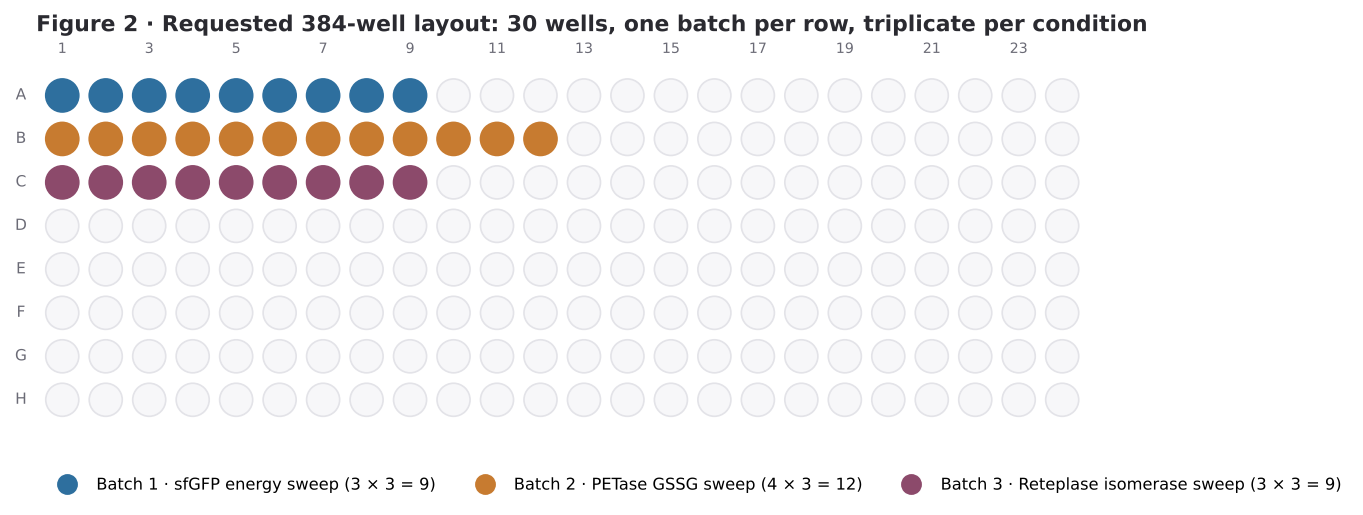
Figure 2. Requested layout. One batch per row keeps a row-wise plate artefact (edge effects, a thermal gradient) from being mistaken for a dose response within a batch. Triplicates sit adjacent so that dispensing scatter is visible directly. SVG version
| Row | Batch | Conditions | Replicates | Wells |
|---|---|---|---|---|
| A | 1 · sfGFP energy | 3 | 3 | A1–A9 |
| B | 2 · PETase GSSG | 4 | 3 | B1–B12 |
| C | 3 · Reteplase isomerase | 3 | 3 | C1–C9 |
| Total | 30 |
Caveat on the layout. Row-wise grouping trades one risk for another: it protects against within-batch gradients being read as dose responses, but it means a whole batch shares any row-level artefact. If the portal supports it, a randomised well assignment with the batch recorded in metadata is strictly better [VERIFY whether the portal accepts a randomised map].
2. Design principles carried from Week 3
2.1 One variable per batch
Each batch changes one thing and holds the Week 3 composition constant underneath it. This is the same discipline that produced D1–D3 and for the same reason: a batch that changes two things cannot attribute its own result.
2.2 Every batch contains its own baseline
Each batch includes the condition that represents “no change from Week 3” or “the null” — glucose-only energy, zero GSSG, DsbC alone. Without that well, a difference has nothing to be a difference from.
2.3 Cost is tracked per condition, not just per batch
The score is specific cost. A condition that raises titer by 10% and cost by 40% loses. Each batch section therefore prices its own conditions, using the Week 3 cost model:
3. Batch 1 — sfGFP, energy system
3.1 Hypothesis
A combined glucose + PEP system reaches most of the titer of full PEP+pyruvate at substantially less than its energy cost, because the two systems are rate-limited at different times: PEP regenerates ATP fast but is consumed early, while glucose regenerates slowly but lasts.
3.2 Mechanism
| System | ATP route | Speed | Duration | Energy reagents $/reaction |
|---|---|---|---|---|
| Glucose only | Glycolysis → pyruvate → TCA; many steps, needs O₂ and buffered phosphate | Slow | Sustained | ~$0.50 |
| PEP + pyruvate | PEP donates phosphate to ADP in one step (pyruvate kinase) | Fast | Limited — PEP depletes | ~$2.50 |
| Combined | Both routes available | Fast then sustained | Sustained | ~$1.50 |
Translation is the ATP-hungry phase (roughly 4 ATP per amino acid incorporated, counting tRNA charging, initiation, elongation and termination), and it happens early. Folding and chromophore maturation continue for hours afterwards at much lower ATP demand. If that is right, the reaction needs a fast source early and a slow one late — which is what the combined condition supplies.
3.3 Predictions
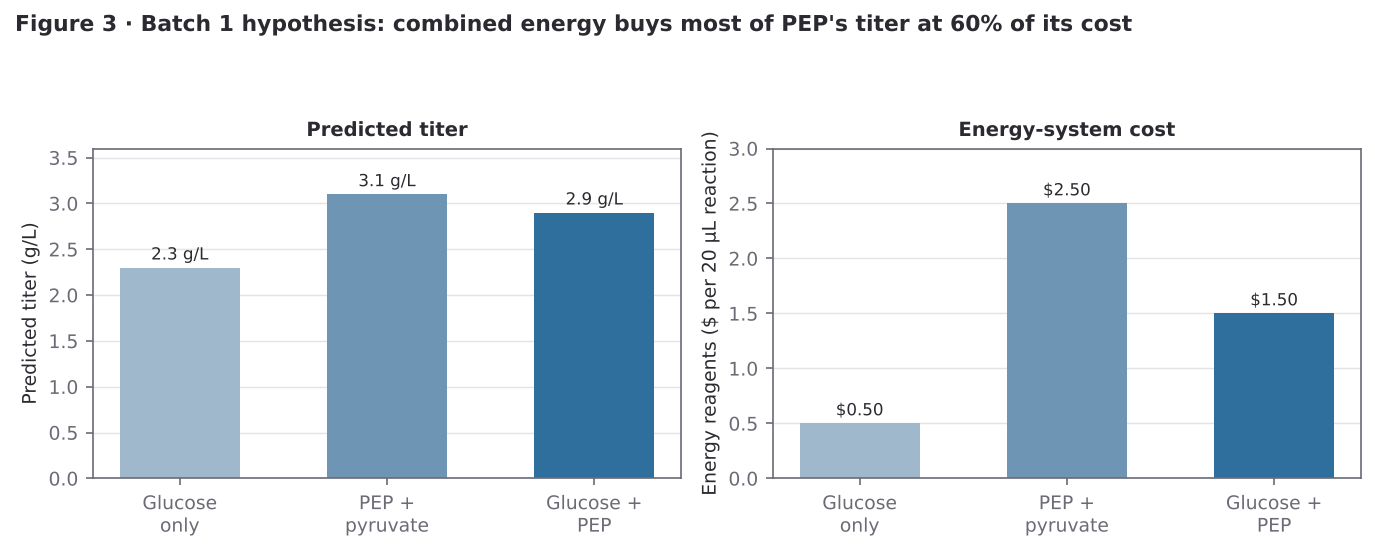
Figure 3. Predictions written before the run, not measurements. The hypothesis is the shape — combined close to PEP on titer, close to glucose on cost — not the exact values. SVG version
| Condition | Predicted titer | Energy cost/reaction | Predicted specific cost |
|---|---|---|---|
| Glucose only | 2.3 g/L | $0.50 | lowest reagent cost, lowest titer |
| PEP + pyruvate | 3.1 g/L | $2.50 | highest titer, highest cost |
| Combined | 2.9 g/L | $1.50 | predicted best $/g |
3.4 Falsification test
The hypothesis is wrong if combined titer ≤ glucose-only titer: that would mean PEP contributes nothing on this lysate and the cheap system should simply be used alone. It is also wrong, in the opposite direction, if PEP+pyruvate beats combined by more than its cost difference justifies.
3.5 Submission JSON
Reagent names and the exact JSON schema must be taken from the repo’s example file or the portal export before submitting — the names above are descriptive. [VERIFY]
4. Batch 2 — PETase, GSSG scan
4.1 Hypothesis
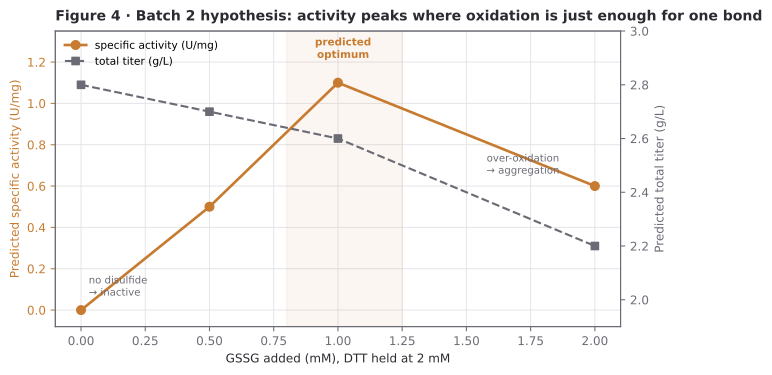
PETase’s single disulfide bond can be formed by a redox buffer alone, with no purified isomerase, and the relationship between GSSG and activity is non-monotonic: too little leaves the bond unformed, too much oxidises cysteines indiscriminately and drives aggregation.
This is the complementary test to Week 3’s D2. D2 asked “how little DsbC can we get away with?” ($7,040/L even at 0.125 µM). Batch 2 asks whether the answer is none at all — which, if true, removes the single largest cost line from the PETase design.
4.2 Mechanism
A disulfide bond forms when two cysteine thiols are oxidised:
DTT at 2 mM holds the reaction reducing, which is why the standard formulation leaves cysteines free. Adding GSSG shifts the balance. The useful window is narrow: enough oxidising power to form the one correct bond, not so much that every exposed cysteine pairs with whatever is nearest.
Because PETase has exactly two cysteines, there is only one possible pairing — so unlike Reteplase there is no mispairing problem to solve, only a formation problem. That is the specific reason an isomerase may be unnecessary here and indispensable there.
4.3 Predictions
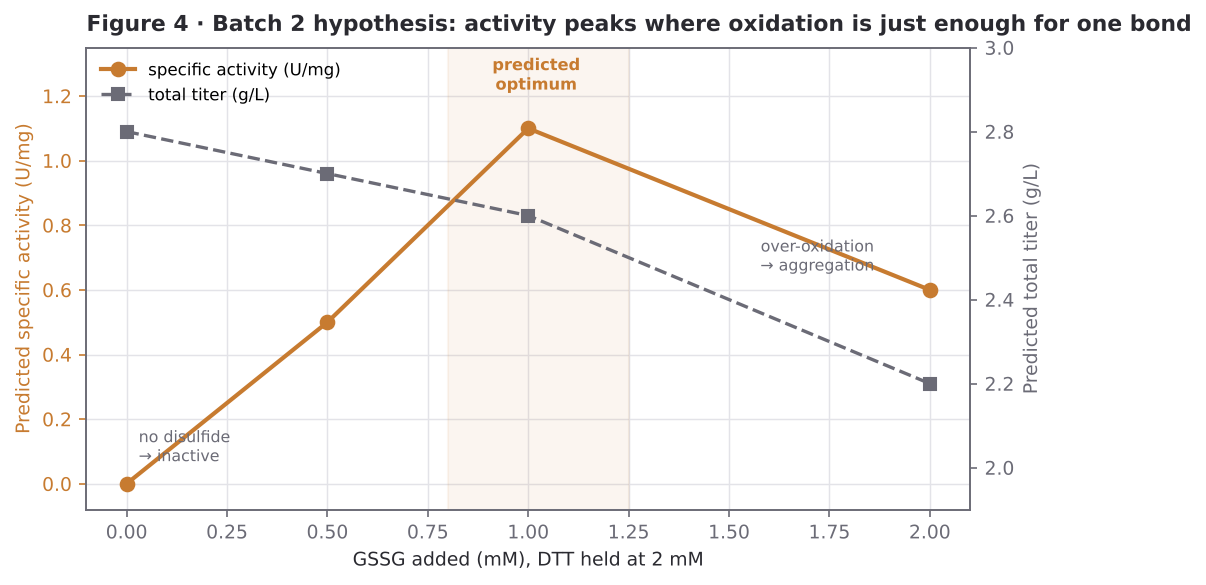
Figure 4. Predictions written before the run. The claim is the shape: an interior maximum in activity, with total titer falling monotonically as oxidation increases. A flat activity line or a monotonic rise would both refute it. SVG version
| GSSG (mM) | Predicted specific activity | Predicted titer | Reading |
|---|---|---|---|
| 0 (DTT only) | ~0 U/mg | 2.8 g/L | Protein made, bond unformed, enzyme inactive |
| 0.5 | rising | 2.7 g/L | Bond forming in some fraction of molecules |
| 1.0 | peak | 2.6 g/L | Predicted optimum |
| 2.0 | falling | 2.2 g/L | Over-oxidation, aggregation, titer loss |
4.4 Falsification test
The hypothesis fails if activity is flat across all four levels (GSSG irrelevant — the bond forms or fails for another reason), or if activity rises monotonically to 2.0 mM (no over-oxidation penalty in this range, so the scan should extend higher rather than peak here).
A null result at every level, with titer present throughout, would be the most informative failure: it would say the bond is not forming under any redox condition reachable this way, and that D2’s 0.125 µM DsbC was buying something real after all.
4.5 Submission JSON
5. Batch 3 — Reteplase, isomerase comparison
5.1 Hypothesis
For a nine-disulfide protein, two isomerases in parallel at half concentration each rescue more correctly folded molecules than either isomerase alone at full concentration, because they act on partly different sets of mispaired intermediates.
5.2 Mechanism, and why this protein is different
PETase’s two cysteines admit one pairing. Reteplase’s eighteen cysteines admit an enormous number of wrong ones:
Only one topology (or a small family) is active. This is the entire problem: oxidation is easy, correct oxidation is not. GSSG supplies oxidising power indiscriminately, so a molecule that forms nine bonds in the wrong arrangement is permanently stuck unless something breaks and re-forms them. That is what an isomerase does.
- DsbC breaks mispaired bonds and allows re-formation. It is the reference choice and the entire cost of D3 (94%).
- Thioredoxin (Trx) is a different oxidoreductase with different substrate preferences.
- If their substrate preferences only partly overlap, splitting the budget between them covers more of the mispaired population than doubling down on one.
If they fully overlap, the combination is simply a diluted single isomerase and will underperform both — which is exactly what makes this a real test rather than a free lunch.
5.3 Predictions
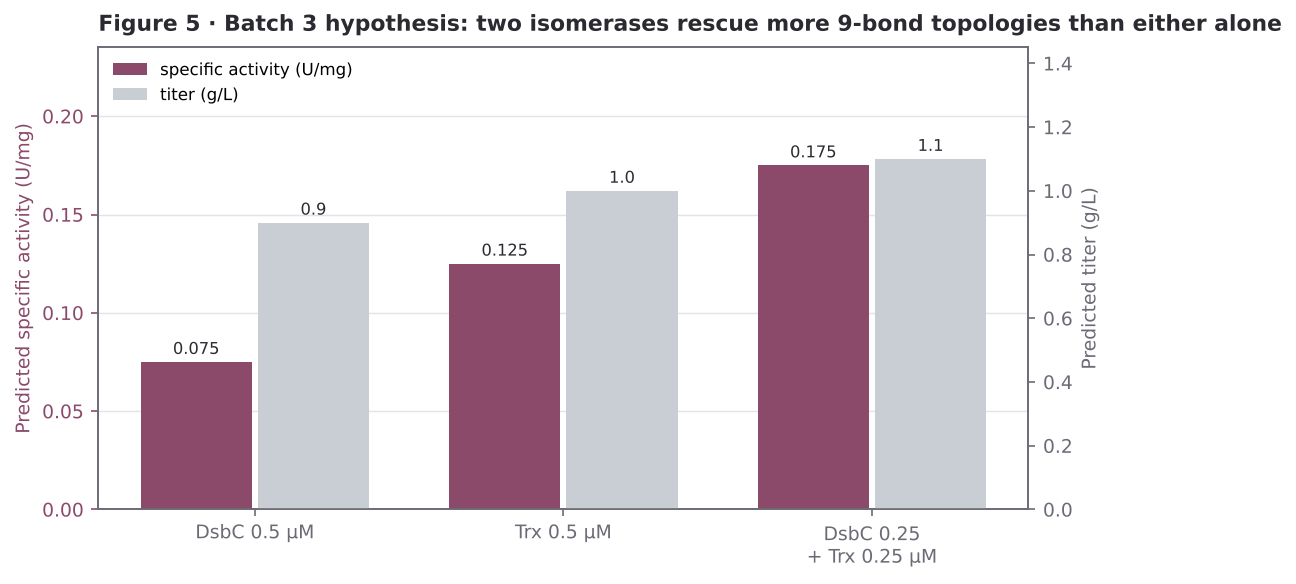
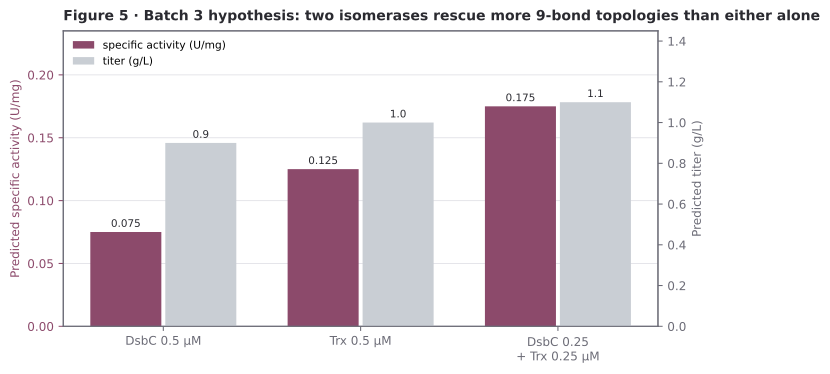
Figure 5. Predictions written before the run. The combination is deliberately budget-matched (0.25 + 0.25 µM vs 0.5 µM alone) so that any advantage is attributable to parallelism rather than to more total enzyme. SVG version
| Condition | DsbC | Trx | Predicted specific activity | Predicted titer |
|---|---|---|---|---|
| DsbC alone | 0.5 µM | 0 | 0.075 U/mg | 0.9 g/L |
| Trx alone | 0 | 0.5 µM | 0.125 U/mg | 1.0 g/L |
| Both | 0.25 µM | 0.25 µM | 0.175 U/mg | 1.1 g/L |
5.4 Falsification test
The hypothesis fails if the combination is less active than the better single isomerase. That outcome would mean the two enzymes work on the same intermediates, and the correct move is to spend the whole budget on whichever one wins.
This is the batch most likely to be refuted, and it is worth running for that reason: Week 3’s D3 spends $56,320/L on DsbC on the assumption that DsbC is the right enzyme at all. Batch 3 is the first test of that assumption rather than of its dose.
5.5 Submission JSON
Note on Trx availability. Thioredoxin was proposed as a community reagent in Week 3’s reasoning. If it is not in the approved pool at submission time, Batch 3 cannot run as written. The fallback is a DsbC dose ladder (0.25 / 0.5 / 1.0 µM) in the same nine wells, which tests dose rather than identity and is strictly less informative. [VERIFY Trx is in the pool before submitting]
6. Analysis of the provided control experiment
Status: framework only. The control report (sfGFP_control_...) is referenced by the brief but I have not yet read it, so this section states what I will test and what each outcome would mean rather than reporting findings. No numbers are claimed. [VERIFY — retrieve the report and complete this section before submission]
6.1 The question
The same sfGFP control composition is run in 384-well and 96-well formats and does not give the same titer. Smith’s own data shows the pattern clearly (#35: 3.04 g/L in tubes, 1.52 in 96-well, 0.72 in 384-well). Why?
6.2 Candidate explanations and how to tell them apart
| Hypothesis | Mechanism | Signature in the data |
|---|---|---|
| Oxygen availability | Small wells have a high surface-to-volume ratio. The ribose/glucose energy system needs oxygen to regenerate NAD⁺; a PEP system needs it much less | Format gap should be larger for sugar-based compositions than PEP-based ones |
| Evaporation | More surface per unit volume concentrates every solute over a long incubation, pushing Mg²⁺ past its narrow optimum | Gap grows with incubation time; edge wells worse than interior wells |
| Edge effects | Outer wells sit at a different temperature and lose more volume | Position-dependent signal: a spatial gradient, not random scatter |
| Assay path length | Less liquid means a shorter optical path, so the same concentration reads lower | A pure scaling factor — the ratio between conditions is preserved even though absolute values drop |
| Dispensing error share | A fixed volumetric error is a larger fraction of a smaller total | Replicate scatter wider in 384-well, means similar |
These are distinguishable. The last one in particular matters for interpretation: if the format difference is an assay artefact (path length), rankings transfer between formats and the staged screen is sound. If it is biological (oxygen, evaporation), rankings may not transfer, and a composition can be eliminated in 384-well for a reason that would not apply at 2 mL — which is precisely the risk Week 3 flagged when choosing Smith #35 over the cheaper #77.
6.3 What I will extract from the report
- Replicate scatter in each format (separates noise from effect).
- Whether the gap is a constant factor or condition-dependent (artefact vs biology).
- Edge-vs-interior well positions if the plate map is included.
- Incubation time, and whether any time course is available.
6.4 Why this matters for my batches
If rankings do not transfer across formats, then Batch 1’s energy comparison is the one most affected — the sugar-based condition is exactly the one an oxygen limitation would penalise in 384-well. In that case the combined condition could win in 384-well for the wrong reason. I will read Batch 1 with that caveat and, if the control report supports an oxygen effect, request a 96-well confirmation before drawing a conclusion.
7. Proposed rubric criterion
Protein-target-specific novelty
Criterion. Accept a submitted composition if it tests a reagent combination not already represented in the approved pool for that protein; reject it as a duplicate otherwise, unless it states a distinct hypothesis in its comments.
Why novelty rather than predicted performance. A pool selected on predicted performance converges: everyone submits near the current best-known composition, replicates it many times, and the collective learns almost nothing about the rest of the space. A pool selected on novelty spends the same plate capacity mapping more of it. The coopetition’s value is the dataset it produces, not any single winning recipe.
Why per-protein rather than global. A condition that is well-explored for sfGFP may be untested for Reteplase, and the three proteins have genuinely different chemistry — the whole argument of Week 3. Treating “GSSG 1 mM” as explored because someone ran it on PETase would wrongly block the Reteplase version of the same question.
Implementation. Index each accepted composition by (protein, energy_system, redox_condition, isomerase, notable_cofactors). On submission, compare the tuple against the pool.
| Proposed composition | Decision | Reason |
|---|---|---|
| sfGFP + thioredoxin | Accept | Isomerase never tested on a zero-disulfide protein; informative either way |
| sfGFP identical to an accepted entry | Reject | No new information; replicates belong inside a batch, not across submissions |
| PETase at GSSG 1.0 mM when 0.5 and 2.0 exist | Accept | Fills a gap in an existing dose series |
| Reteplase + DsbC 5 µM (the reference) | Reject as a submission, retain as a plate control | Already the reference; it belongs on the plate as a control, not as a competing entry |
| Reteplase + a novel cofactor, no hypothesis stated | Request a hypothesis, then accept | Novelty is necessary but not sufficient — an uninterpretable well is wasted capacity |
Known weakness. Novelty rewards exploring and can starve the refinement of a promising region. A practical pool would reserve a fraction of capacity — say 70% novel, 30% refinement around current leaders — rather than applying the criterion absolutely. I would propose it with that split rather than as a pure rule.
8. Costing, quality and cybersecurity for automated submission
8.1 Cost per batch
| Batch | Wells | Dominant cost | Note |
|---|---|---|---|
| 1 · sfGFP | 9 | Lysate (fixed block) | Energy reagents differ by ~$2/reaction across conditions; the comparison is cheap |
| 2 · PETase | 12 | Lysate (DsbC removed in all conditions) | Removing DsbC is what makes a 12-well scan affordable at all |
| 3 · Reteplase | 9 | Isomerase | Budget-matched at 0.5 µM total across all three conditions, so cost is constant within the batch |
Batch 3 holds total isomerase constant deliberately: if cost varied across conditions, a cheaper condition could win on specific cost without winning on folding, and the batch would answer a different question than the one asked.
8.2 Quality principles applied
- One variable per batch; everything else inherited unchanged from Week 3.
- A null/baseline condition inside every batch.
- Triplicates, adjacent, so dispensing scatter is directly visible.
- Hypothesis, prediction and falsification test written before submission and recorded in the JSON itself.
- Titer and activity measured separately wherever they can diverge.
- Comparisons only within one plate format (Section 6).
8.3 Cybersecurity and integrity
| Area | Risk | Control |
|---|---|---|
| Automated execution | A malformed or tampered JSON is executed by machines with no human sanity check | Validate against the Pydantic schema before upload; keep a SHA-256 hash of each submitted file; re-export after submission and compare |
| Submission integrity | A known portal display bug has dropped reagent amounts on re-opening a saved design | Export and verify every submitted batch after saving; treat the export, not the screen, as the record [VERIFY] |
| Credentials | Portal and cloud tooling store local credentials | Dedicated account; no credential files in any repo; log out after upload |
| Supply chain | Submission tooling pulls dependencies from the internet | Official repo only; pinned dependencies; isolated environment |
| AI-assisted design | Generated JSON can contain plausible but wrong reagent names or volumes | Every field cross-checked against the portal’s own schema export; AI use disclosed (Section 9) |
| Shared pool | Compositions and results are visible to other teams | No confidential content in sample IDs or comments; the comments field is a scientific record, not a private note |
| Public posts | Screenshots can leak tokens, emails, file paths | Post design values only; scan pasted text before posting |
Legislation. Unchanged from Week 3 in substance: personal data under POPIA (South Africa); the wet work runs at Ginkgo so no local GMO permit is engaged; Reteplase is an approved therapeutic and anything produced here is research material only, not clinical supply.
8.4 Optional AI-agent contribution
If the portal’s AI design agent is used, I would constrain it to propose compositions that satisfy the Section 7 novelty criterion and require a stated hypothesis per proposal, for the same reason a human submission needs one: a composition no one can interpret consumes plate capacity without producing information. Any agent-proposed composition I submit would be cost-checked against the Week 3 model before submission and disclosed as agent-proposed.
9. Use of AI
AI client: Claude (Anthropic), used through a claude.ai Project, to work through the batch logic, the combinatorics of disulfide pairing, the plate layout trade-off, and the drafting of this report. Figures were generated from a Python script I can supply on request; the plotted values are my stated predictions, not model output.
Prompts used (replace with your exact wording before submitting):
- [Prompt: design batches that test the Week 3 compositions, one variable each]
- [Prompt: what would falsify each hypothesis]
- [Prompt: how to analyse the 384-well vs 96-well control comparison]
- [Prompt: propose a rubric criterion for accepting submitted compositions]
- [Prompt: cybersecurity considerations for submitting to an automated lab]
- [Prompt: write the Week 4 report for the webpage]
10. Limits and open items
- The control report has not been read. Section 6 is a framework, not an analysis, and must be completed before submission.
- Thioredoxin availability is unconfirmed. Batch 3 as written depends on it being in the approved pool; the fallback is a DsbC dose ladder.
- Every plotted value in Figures 3–5 is a prediction, written before the run so that it can be contradicted. None is a measurement.
- The JSON reagent names are descriptive, not taken from the portal schema; they must be replaced from the repo example or portal export before submission.
- Plate layout is row-grouped, which protects within-batch comparisons but exposes each batch to row-level artefacts. A randomised map would be better if the portal supports one.
- µM† remains undefined, so Batch 2 and Batch 3 produce relative rankings only.
- Specific activity assumes titer and activity are measured on the same wells. If the portal returns only one of the two for a given protein, Batches 2 and 3 lose most of their value and would need redesigning around whichever is returned.
- Replicate count of 3 is the minimum that distinguishes scatter from effect; it will not resolve small differences. If the format comparison in Section 6 shows wide 384-well scatter, these batches need more replicates or a 96-well confirmation stage.
11. Figures and assets
All figures live in the images/ folder beside this file; keep the folder structure when uploading to the website.
| File | Shows | Type |
|---|---|---|
images/fig1_nebula_workflow.{png,svg} | Six-stage pipeline, scope boundary | Schematic |
images/fig2_plate_layout.{png,svg} | Requested 384-well map, 30 wells | Design specification |
images/fig3_batch1_energy.{png,svg} | Batch 1 predicted titer and cost | Prediction |
images/fig4_batch2_gssg.{png,svg} | Batch 2 predicted activity/titer vs GSSG | Prediction |
images/fig5_batch3_isomerase.{png,svg} | Batch 3 predicted activity/titer by isomerase | Prediction |
Figures 3–5 plot predictions recorded before the run. When results arrive, the honest presentation is to overlay measured values on these same axes rather than redrawing them — the gap between the two is the actual finding.
12. References
- Smith, A. A., et al. (2026). Using a GPT-5-driven autonomous lab to optimize the cost and titer of cell-free protein synthesis. bioRxiv. https://www.biorxiv.org/content/10.64898/2026.02.05.703998v1 (preprint)
- Olsen, M. L., et al. (2026). Design-driven optimization of low-cost reagent formulations for reproducible and high-yielding cell-free gene expression. Nature Communications. https://doi.org/10.1038/s41467-026-69605-8
- Jewett, M. C., & Swartz, J. R. (2004). Mimicking the Escherichia coli cytoplasmic environment activates long-lived and efficient cell-free protein synthesis. Biotechnology and Bioengineering, 86(1), 19–26. https://doi.org/10.1002/bit.20026
- Yin, G., & Swartz, J. R. (2004). Enhancing multiple disulfide bonded protein folding in a cell-free system. Biotechnology and Bioengineering. https://doi.org/10.1002/bit.10827 (cited as quoted on the course forum; not independently checked)
- Silverman, A. D., Karim, A. S., & Jewett, M. C. (2020). Cell-free gene expression: an expanded repertoire of applications. Nature Reviews Genetics, 21, 151–170. https://doi.org/10.1038/s41576-019-0186-3
- Rasor, B. J., et al. (2021). Toward sustainable, cell-free biomanufacturing. Current Opinion in Biotechnology, 69, 136–144. https://doi.org/10.1016/j.copbio.2020.12.012
- Ginkgo Bioworks. CFPS coopetition overview and guidelines (draft), HTBAA copy; Nebula platform and submission documentation.
- HTBAA Week 3 submission (companion report,
../week3/).