Week 8 LAB: Bacterial Cell Manufacturing

Substrate Surface Wettability as a Control Variable in Biomanufactured Mycobacterium smegmatis Biofilms
COVER PAGE
Student Name: Shakera Karolia Student Email: shakera1579@gmail.com Course: HTBAA Fall 2026 (How to Biomanufacture Almost Anything) — BioClub Tokyo node Document Date: 17 November 2026 Relates to: Week 8 LAB — Bacterial Cell Manufacturing (Prof. Margaret Saha, College of William & Mary). Shared experiment sheet deliverable, due 17 November 2026 Document type: Experimental proposal — selection of one controlled variable, with rationale, for the class-wide biofilm standardisation experiment Variable selected: Substrate — polystyrene surface treatment. Growth medium held constant. Organism: Mycobacterium smegmatis mc²155 — BSL-1, genome-sequenced, deposited by W. R. Jacobs (ATCC 700084; GenBank CP000480; now formally Mycolicibacterium smegmatis) Wet-lab status: No wet-lab facility at this node. Execution requested at William & Mary, per the protocol’s provision for nodes without laboratory capability. Companion pages: Homework — heterogeneity and characterisation (the two set questions) · This proposal, explained in plain English · The homework, explained · FAQ — anticipated questions
1 — OBJECTIVE
This proposal selects substrate surface treatment as the single controlled variable, holding the growth medium constant, and asks two questions of it:
- Does surface wettability change the quantity of biofilm produced?
- Does it change the reproducibility of biofilm production between replicate wells?
The second question is the one that matters. The programme’s stated endpoint is a standardised, lot-controlled biofilm suitable for therapeutic testing, and a test article that cannot be made the same way twice cannot support an attribution of effect to a therapeutic agent. Reproducibility is therefore the deliverable; biomass is the supporting measurement.
2 — RATIONALE FOR THE CHOICE OF VARIABLE
2.1 Why the programme requires a controlled variable at all
The course is manufacturing a biofilm deliberately, as a test article — a standardised object against which phage preparations or antimicrobials can be evaluated. The justification given in lecture is that biofilms are implicated in the majority of infections and in the great bulk of chronic infections refractory to therapy, and that progress is obstructed by the absence of a reproducible model. The governing constraint follows directly:
If one phage cluster destroys the biofilm more effectively than another, that difference must originate in the phage and not in the biofilm. Where batch variability is large, the difference frequently originates in the biofilm.
Each controlled variable examined across the cohort is therefore a candidate contributor to that variability. The question is which candidate is most likely to be material for this organism, and which is most likely to be going unrecorded.
2.2 Why the substrate, rather than a medium component
The majority of the variable space in this programme concerns medium composition — iron availability, carbohydrate identity, carbon concentration, nitrogen ratio, divalent cations, lipid and sterol supplementation. The substrate space is comparatively sparse and, where occupied, consists almost entirely of material identity comparisons: different polymers, metals, glasses or biological scaffolds placed into a standard well.
Neither of those addresses the property that the biology of this organism actually implicates.
M. smegmatis possesses an atypical cell envelope. Where most bacteria present a conventional surface chemistry, the mycobacterial wall is constructed principally from mycolic acids — very long-chain fatty acids that render the cell exceptionally non-polar. This property drives the characteristic aggregation of mycobacteria into cords, and contributes substantially to the therapeutic resistance of the genus.
This envelope chemistry is not static. Ojha et al. demonstrated that mycolate synthesis is specifically remodelled during biofilm formation, mediated by a dedicated chaperone (GroEL1), and that strains with altered mycolate profiles are defective in biofilm formation (Cell, 2005). DePas, Bergkessel and Newman characterise the same envelope as conferring the hydrophobicity that governs aggregation behaviour (mBio, 2019).
The reasoning that follows: if the adhesive interface of the cell is a lipid, then the substrate property matched to it is surface free energy — the degree to which a surface is water-repellent or water-attracting — rather than elemental or bulk-material identity.
This also explains the decision not to propose a materials panel. Substituting titanium for silicone alters surface chemistry, stiffness, roughness and surface energy simultaneously; an observed difference in outcome cannot be attributed to any one of them. Holding the bulk polymer constant and varying only the surface treatment isolates the property of interest.
3 — EXPERIMENTAL DESIGN
3.1 The two arms
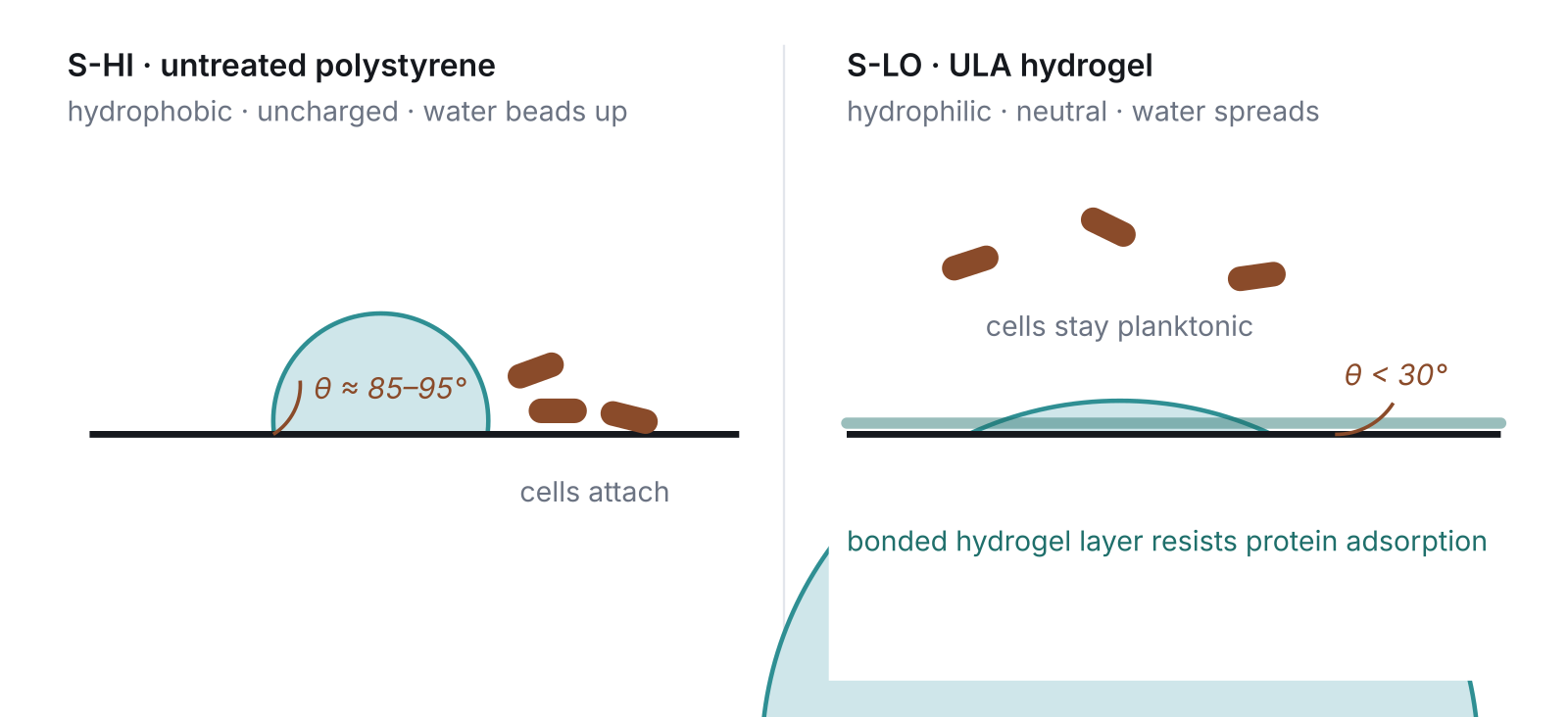
Figure 1 — The two experimental arms. Water contact angle (θ) is the operational measure of wettability: a high angle indicates water beading on a non-polar surface, a low angle indicates spreading on a polar one. Because the mycobacterial envelope is itself non-polar, the prediction is that cells attach readily to the untreated surface and poorly to the protein-resistant hydrogel. Angles shown are nominal supplier ranges, treated as acceptance criteria to be verified per lot rather than as measurements.
| S-HI | S-LO | |
|---|---|---|
| Material | Untreated (“non-treated” / bacteriological-grade) polystyrene | Ultra-Low Attachment (ULA) polystyrene — covalently bound neutral hydrophilic hydrogel |
| Example SKU | Standard untreated 96-well flat-bottom | Corning Costar 3474 flat-bottom ULA, or equivalent |
| Wettability | Hydrophobic, θ ≈ 85–95° | Hydrophilic, θ < 30° |
| Surface charge | Uncharged | Neutral |
| Protein adsorption | Adsorbs protein readily | Engineered to resist protein adsorption |
| Role in the design | Reference arm | Test arm |
Contact angles are specified as acceptance criteria, to be confirmed from the supplier Certificate of Analysis or by goniometry on one well per lot. They are not assumed. A single vendor family and a single lot per arm are used, with lot numbers recorded as part of the manufacturing record.
3.2 Why this specific pair, and not the conventional one
The conventional form of this experiment compares untreated polystyrene against tissue-culture-treated (TC-treated) polystyrene. The manufacturer’s own surface documentation explains why that comparison is difficult to interpret:
- untreated polystyrene is hydrophobic and uncharged;
- TC-treated polystyrene is hydrophilic and negatively charged;
- the ULA hydrogel is hydrophilic and neutrally charged.
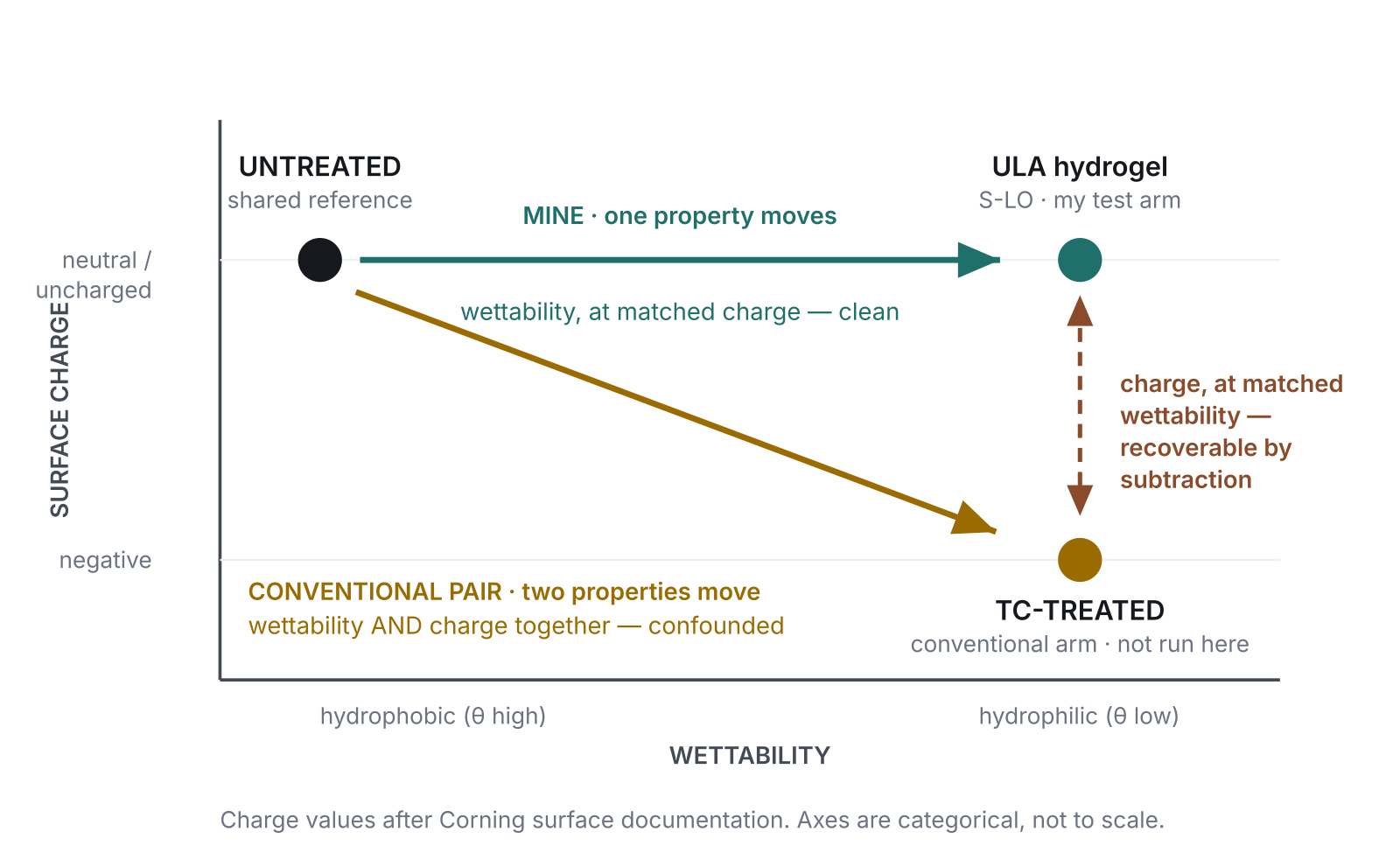
Figure 2 — The surface property map, and the basis for the pairing. The conventional pairing moves diagonally: wettability and surface charge change together, so an observed difference cannot be attributed to either property. Selecting the neutral hydrogel as the hydrophilic arm holds charge non-negative in both wells and moves horizontally — wettability alone. The vertical contrast, which this design does not measure directly, remains recoverable by subtraction should an untreated-versus-TC dataset become available elsewhere in the programme, because both pairings share the untreated reference.
This is the principal methodological argument of the proposal. A two-level comparison can only support an attribution if exactly one property differs between the levels. The conventional pairing fails that test; the pairing proposed here satisfies it.
A secondary consequence is worth recording: because the untreated arm is the reference common to both pairings, this design is additive to the conventional one rather than duplicative of it. Two experiments sharing a baseline yield three characterised surface states and a recoverable charge contrast, without either duplicating the other’s wells.
3.3 Why the comparison is made at plate level rather than as an insert
The assignment brief defines the substrate as “something you place in the 96 well plate.” This proposal varies the plate surface itself. That decision was taken deliberately, and the reasoning is set out here rather than left implicit, because the alternative reading is the more literal one.
A disc-format version of this experiment was considered first. It would have been preferable on two counts: it would place both arms in a single plate, eliminating the plate confound described in §4.4, and it would reduce the sourcing burden to one consumable. Four candidate routes were examined and each was rejected on a specific, identifiable ground.
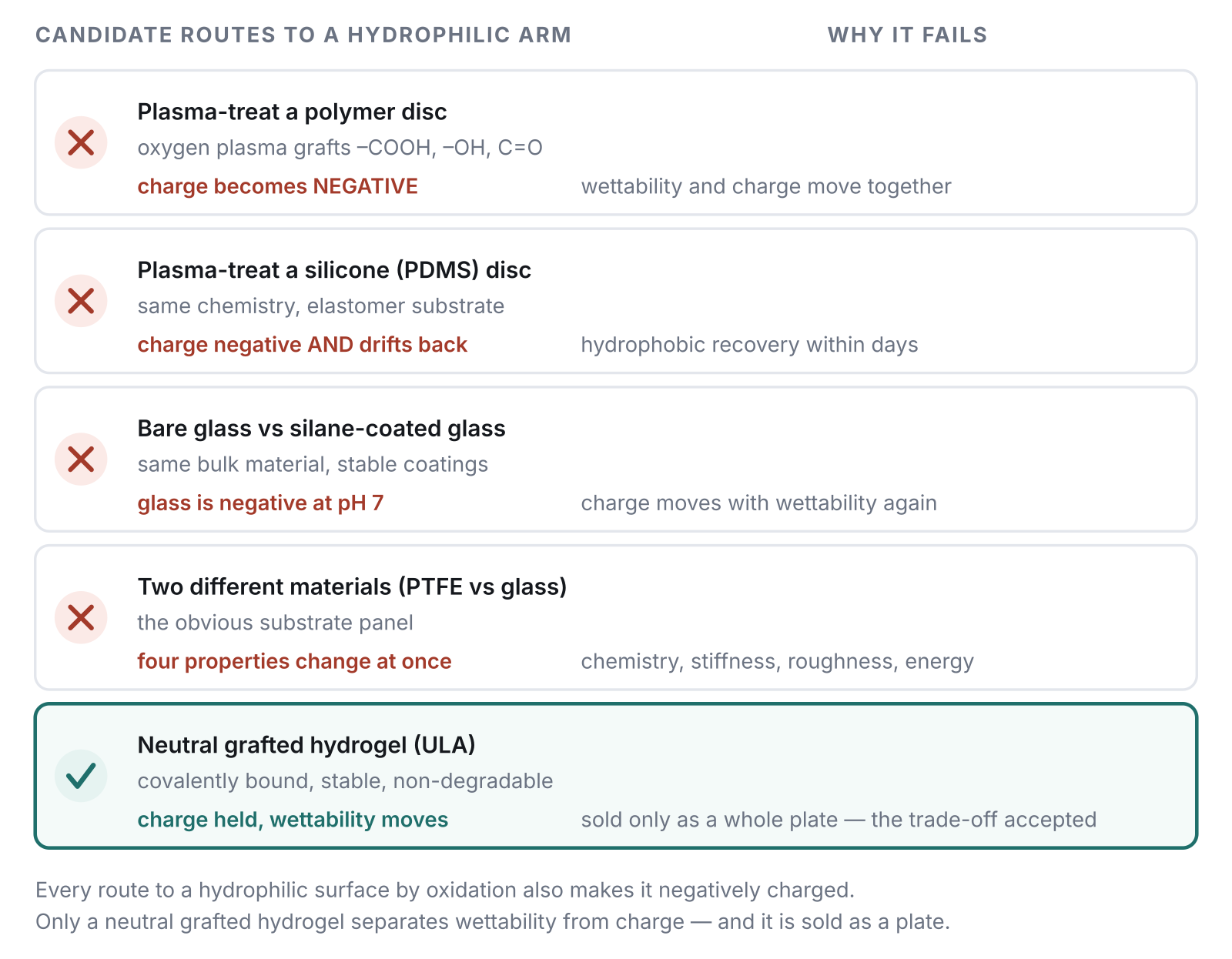
Figure 7 — Candidate routes to a hydrophilic arm, and why each fails. The elimination is not a matter of convenience. Each rejected route reintroduces precisely the confound the design in §3.2 exists to remove, or else fails to hold the variable steady for the duration of the run.
The common failure is charge. Every practical method of making a polymer surface hydrophilic by oxidation — oxygen plasma, corona discharge, the industrial process that produces tissue-culture-treated plastic — works by grafting oxygen-containing functional groups (carboxyl, hydroxyl, carbonyl) onto the surface. Those groups are what make the surface wettable, and they are also what make it negatively charged. Wettability and charge are not independently adjustable by this route; they are two consequences of one chemical modification.
The same objection disposes of the glass pairing. Bare glass is hydrophilic but bears a negative surface charge at neutral pH; a silane-coated glass disc is hydrophobic and uncharged. The pair is stable and uses one bulk material, but it moves charge alongside wettability, exactly as the tissue-culture comparison does.
A second, independent failure applies to elastomers. Plasma treatment of silicone (polydimethylsiloxane, PDMS) is not durable. Hydrophobic recovery — the migration of low-molecular-weight species from the bulk back to the surface — returns the material toward its original state over hours to days. Jokinen, Suvanto and Franssila tracked ten polymers by water contact angle for more than 100 days and found recovery kinetics varying widely by material, with silicone among the fastest to revert.
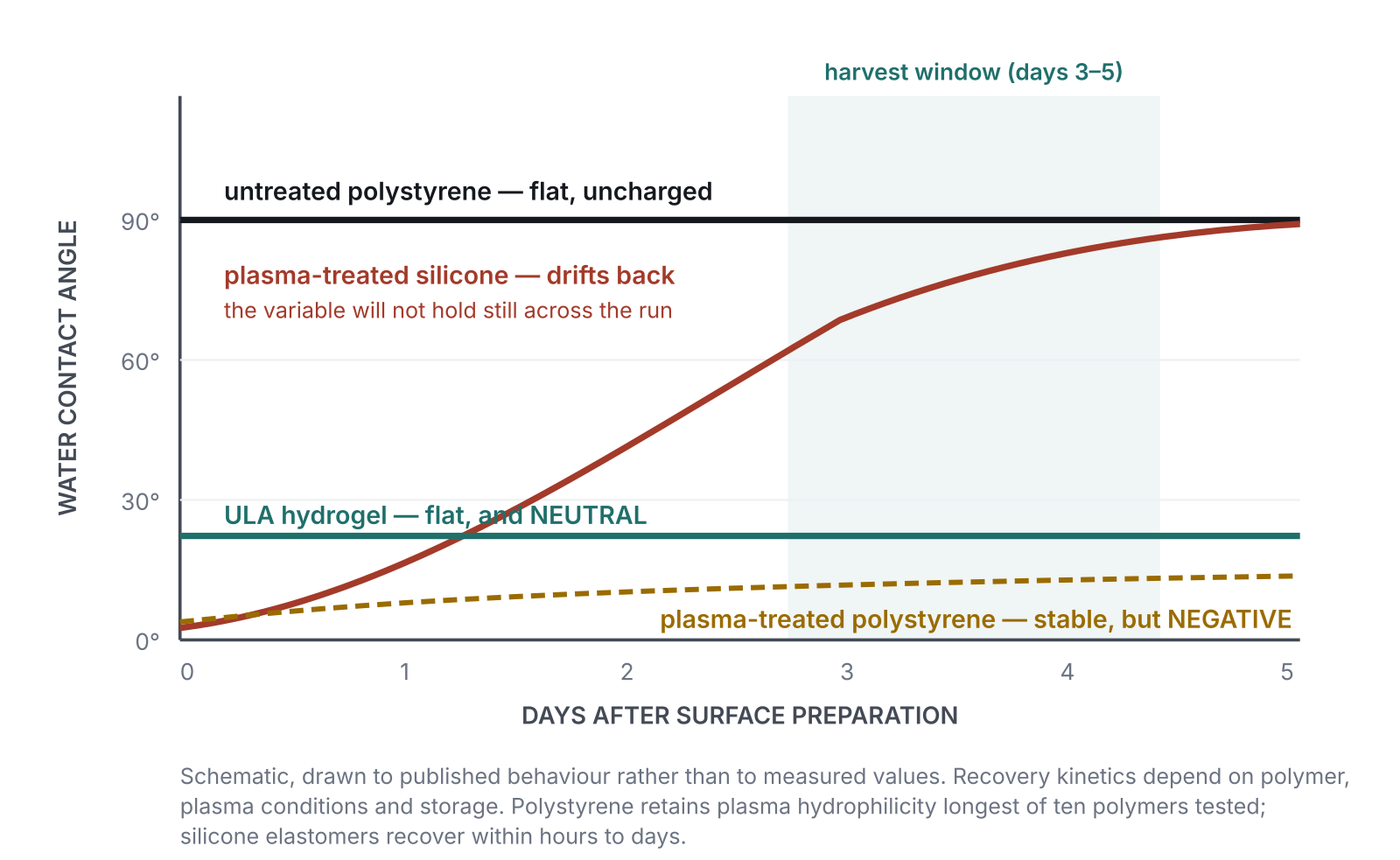
Figure 8 — Why surface stability over the run is a design constraint, not a detail. The experiment harvests at days 3–5. A plasma-treated silicone surface is still changing throughout that window, so the independent variable would not hold its specified value while the dependent variable was being generated. Note the asymmetry revealed by the same literature: polystyrene retains plasma hydrophilicity longest of the ten polymers tested — but plasma-treated polystyrene is the negatively charged route, so stability is gained at the cost of the charge control.
The retained route and its acknowledged cost. The Ultra-Low Attachment surface is the only option examined that holds charge constant while moving wettability. Its coating is covalently bound to the polystyrene, and the manufacturer specifies it as stable, biologically inert and non-degradable — so unlike a plasma treatment it does not drift during the run. It is not manufactured as a disc or insert; it is available only as a complete vessel.
The design therefore accepts a known cost (plate identity confounded with surface, managed by the controls in §4.4) in exchange for the only configuration in which the stated variable is both isolated and stable. Where a specification cannot be met, the appropriate response is to state which constraint is binding and what was traded against it, rather than to substitute a different experiment that appears to satisfy the brief while failing to answer the question.
4 — PROTOCOL
4.1 Growth medium — held constant
The medium is not the variable and is therefore specified in full and held identical across every well of both arms. Complete Hatfull/Ojha biofilm medium:
| Component | Concentration | Function |
|---|---|---|
| KH₂PO₄ (potassium dihydrogen phosphate) | 13.6 g/L | Phosphate source and buffer |
| (NH₄)₂SO₄ (ammonium sulfate) | 2 g/L | Inorganic nitrogen and sulfate |
| Casamino acids | 5 g/L | Amino acid source; also contributes trace iron |
| pH | 7.2, adjusted with 10 M NaOH | — |
| Added aseptically post-autoclave, per 94 mL base | ||
| 40% glucose | 5 mL | Primary carbon source |
| 0.1 M CaCl₂ | 1.0 mL (~1 mM final) | Divalent cation |
| 1 M MgSO₄ | 0.1 mL (~1 mM final) | Divalent cation |
| FeSO₄·7H₂O | 0.50 mg/L (~1.8 µM Fe) | Iron; required for pellicle maturation |
Why iron is specified at this level. Iron is held at the protocol’s standard reference concentration (Fe-STD, 0.50 mg/L FeSO₄·7H₂O) rather than at a convenient or arbitrary value. Ojha & Hatfull established that M. smegmatis pellicle maturation requires supplemental iron above approximately 1 µM, while planktonic growth does not — meaning iron is a known active variable for the specific process under study. Fixing it at the documented reference level places this surface panel on the same iron baseline as the medium-variable work elsewhere in the programme, so that the datasets occupy a common coordinate system rather than separate ones.
A single medium batch is prepared for both plates, with the lot recorded.
4.2 Inoculation and incubation
Conducted exactly as the reference protocol, so that these wells remain comparable to the remainder of the cohort rather than constituting an isolated dataset:
- 67 µL culture, washed free of Tween-80 and resuspended in Tween-free medium at OD₆₀₀ ≈ 0.7;
- into 133 µL biofilm medium per well — 200 µL total per well;
- humidified incubation, perimeter wells water-filled;
- common 3–5 day maturation timepoint.
4.3 Well allocation and replicate structure
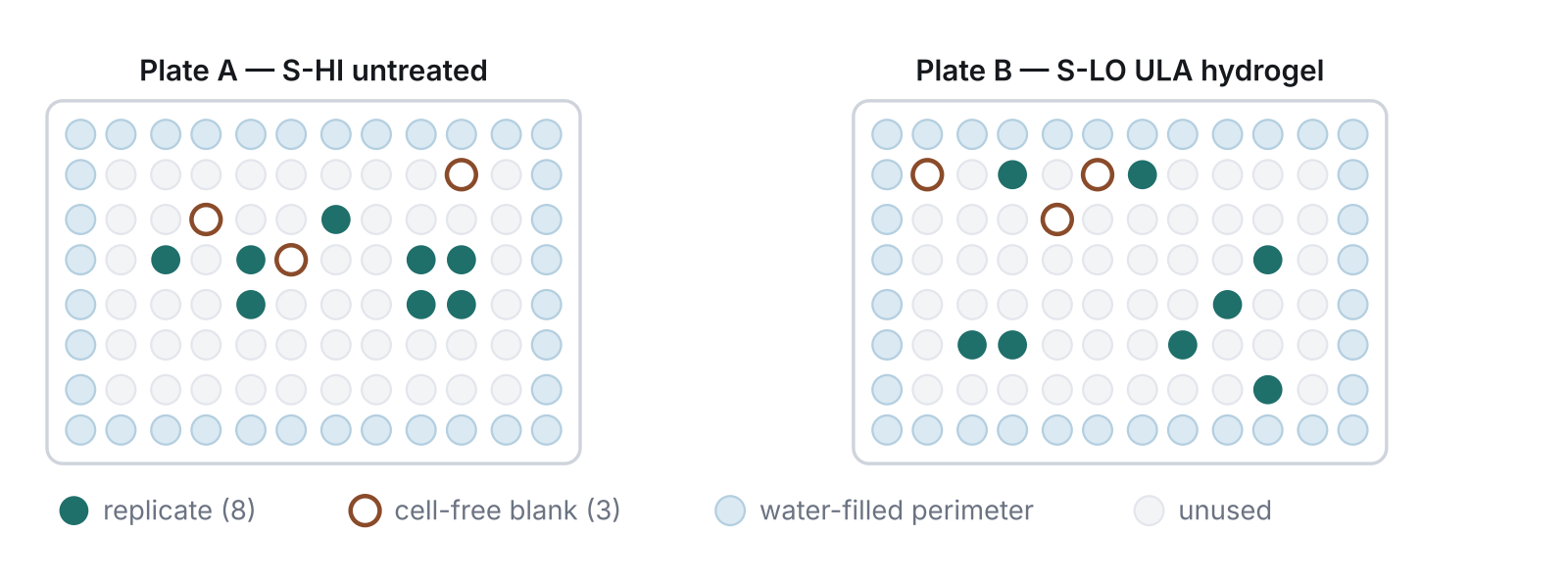
Figure 3 — Plate maps at the Full tier. Eight replicates and three cell-free blanks per arm, randomised across the plate interior and deliberately not clustered, because microplates exhibit systematic edge effects that would otherwise be absorbed into the replicate variance. The perimeter is water-filled to limit evaporation. Both plates are run from one inoculum preparation, one medium batch, on one day, within the same incubation run.
| Tier | Wells | Allocation |
|---|---|---|
| Full | 22 | 8 replicates + 3 cell-free surface-matched blanks per arm |
| Reduced | 12 | 4 replicates + 2 blanks per arm |
| Minimum | 10 | 3 replicates + 2 blanks per arm |
Why neither arm may be dropped. Designs with three or more levels degrade gracefully: a level can be removed and the remainder still constitutes a comparison. A two-level design has no such margin — removing either arm eliminates the experiment. The fallback tiers therefore reduce replicate count rather than arm count, accepting reduced statistical power in preference to no comparison at all.
4.4 Process controls, and why each is necessary
Because the two surfaces are supplied as two distinct plate types, plate identity is confounded with surface unless explicitly controlled. Designs that place test materials as inserts into a single plate avoid this problem; this design cannot, because surface treatment is only available as a whole plate. The confound is therefore managed rather than ignored:
| Control | Why it is required |
|---|---|
| One inoculum preparation for both plates | Removes inoculum aggregation state as a between-arm difference |
| One medium batch for both plates | Removes medium lot as a between-arm difference |
| Both plates inoculated on one day, same incubation run | Removes day and incubator conditions as between-arm differences |
| Replicates randomised within each plate, never clustered | Prevents systematic edge effects being read as replicate variance |
| Perimeter wells water-filled | Limits evaporation, the principal confounder at 96-well scale |
| Plate positions rotated within the incubator | Prevents incubator position aliasing with surface |
| Every volume recorded | Permits post-hoc attribution if an anomaly appears |
None of these constitute the novel content of the proposal. Each is nevertheless load-bearing: omitting any one would permit variance to re-enter downstream of the property being measured, rendering the central comparison uninterpretable.
5 — MEASUREMENT
Crystal violet is a cationic triarylmethane dye carrying a delocalised positive charge, which binds electrostatically to negatively charged material. The assay proceeds by binding, washing, acid solubilisation and absorbance reading at 590 nm.
Why this creates a specific hazard for this design. The dye is positively charged and the two surfaces differ in chemistry. Dye retention in the absence of any biofilm therefore cannot be assumed equal between the arms. An uncorrected comparison would in part be measuring the consumable rather than the biological product.
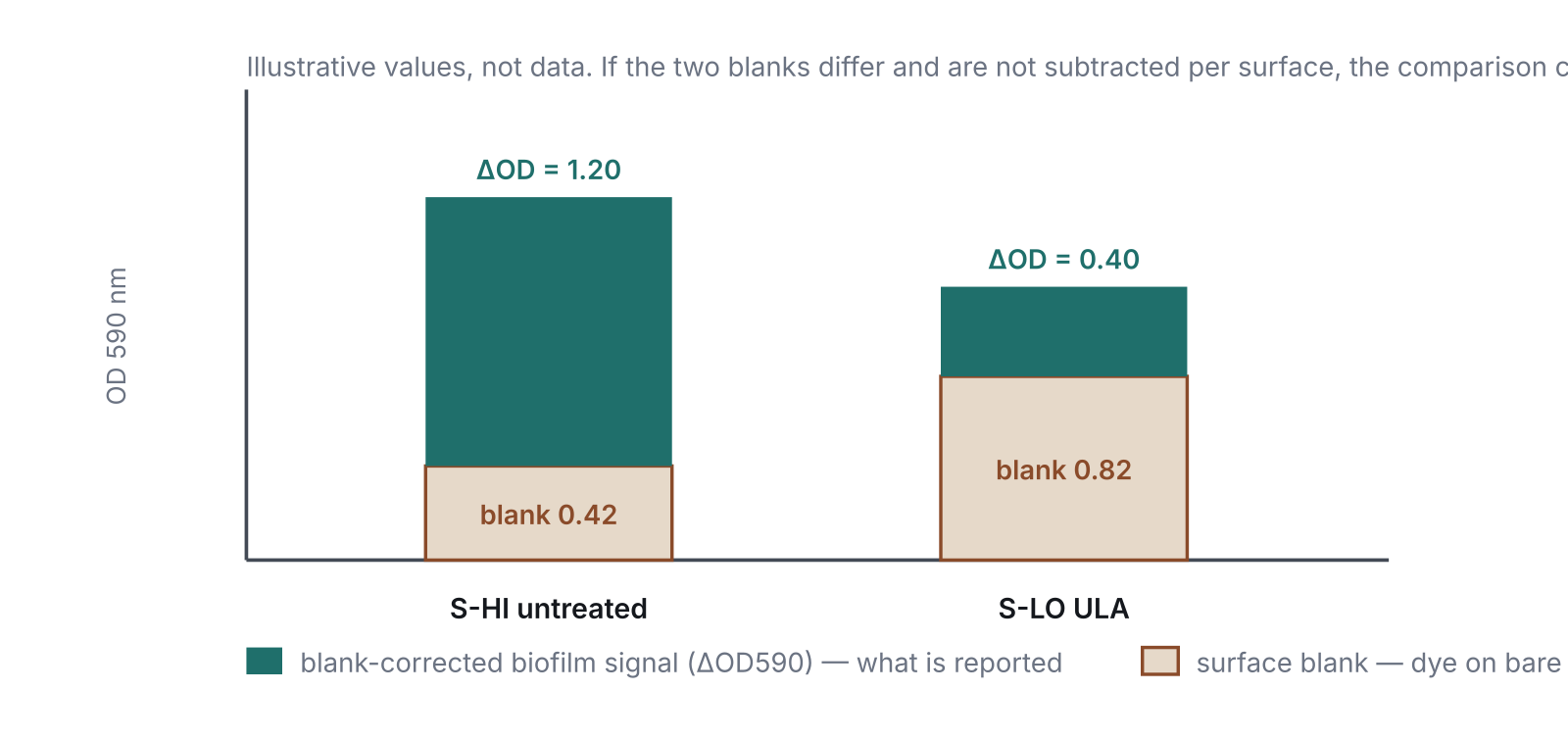
Figure 4 — Why the blanks are load-bearing. Each surface carries its own cell-free blank, processed through the complete protocol. Only the blank-corrected difference is reported. Where surface-specific blanks differ in magnitude, reporting raw absorbance can compress, eliminate or invert the true comparison. Values shown are illustrative rather than measured.
Accordingly:
- a cell-free, surface-matched blank is processed through the complete protocol for each surface;
- results are reported as ΔOD₅₉₀ against the surface-matched blank, never as raw OD₅₉₀;
- blank values are published alongside the data rather than silently subtracted, so that the correction is auditable.
This follows directly from the limitation stated in lecture — that crystal violet reports negatively charged material and would systematically under-report a matrix of different charge density.
5.1 Quantities reported
| Quantity | Meaning |
|---|---|
| ΔOD₅₉₀ per well | Blank-corrected biofilm biomass |
| Mean ΔOD₅₉₀ per arm | Biomass effect of surface (tests H1) |
| CV per arm | Process reproducibility on that surface (tests H2) |
| Blank OD₅₉₀ per surface | Reported separately, as a property of the consumable |
6 — HYPOTHESES AND PREDICTIONS
H1 — Biomass
S-LO < S-HI. The non-polar, mycolate-rich envelope should attach preferentially to the hydrophobic uncharged surface and poorly to the protein-resistant neutral hydrogel.
Why this question is worth asking beyond the immediate result: H1 tests whether mycobacterial attachment can be suppressed by surface chemistry alone — without antimicrobial, biocide or released agent. This is the intervention class that device manufacturers are actually able to deploy, since medical devices are modified by applied coatings rather than by re-specification of bulk materials. A positive result for S-LO suppression is therefore translationally meaningful and not merely a negative control.
H2 — Variance
(This hypothesis is my own inference and is not drawn from the cited literature.)
Between-replicate CV is lower at S-HI than at S-LO.
Reasoning. Early attachment is a counting process. Where adhesion energy comfortably exceeds the stochastic barrier to attachment, effectively every arriving particle is retained, and replicate wells converge on a similar outcome. Where adhesion energy approaches zero, whether a given well seeds at all approaches a stochastic event, and replicates scatter. A second contribution arises arithmetically: as mean biomass falls toward the blank, CV rises because the denominator shrinks.
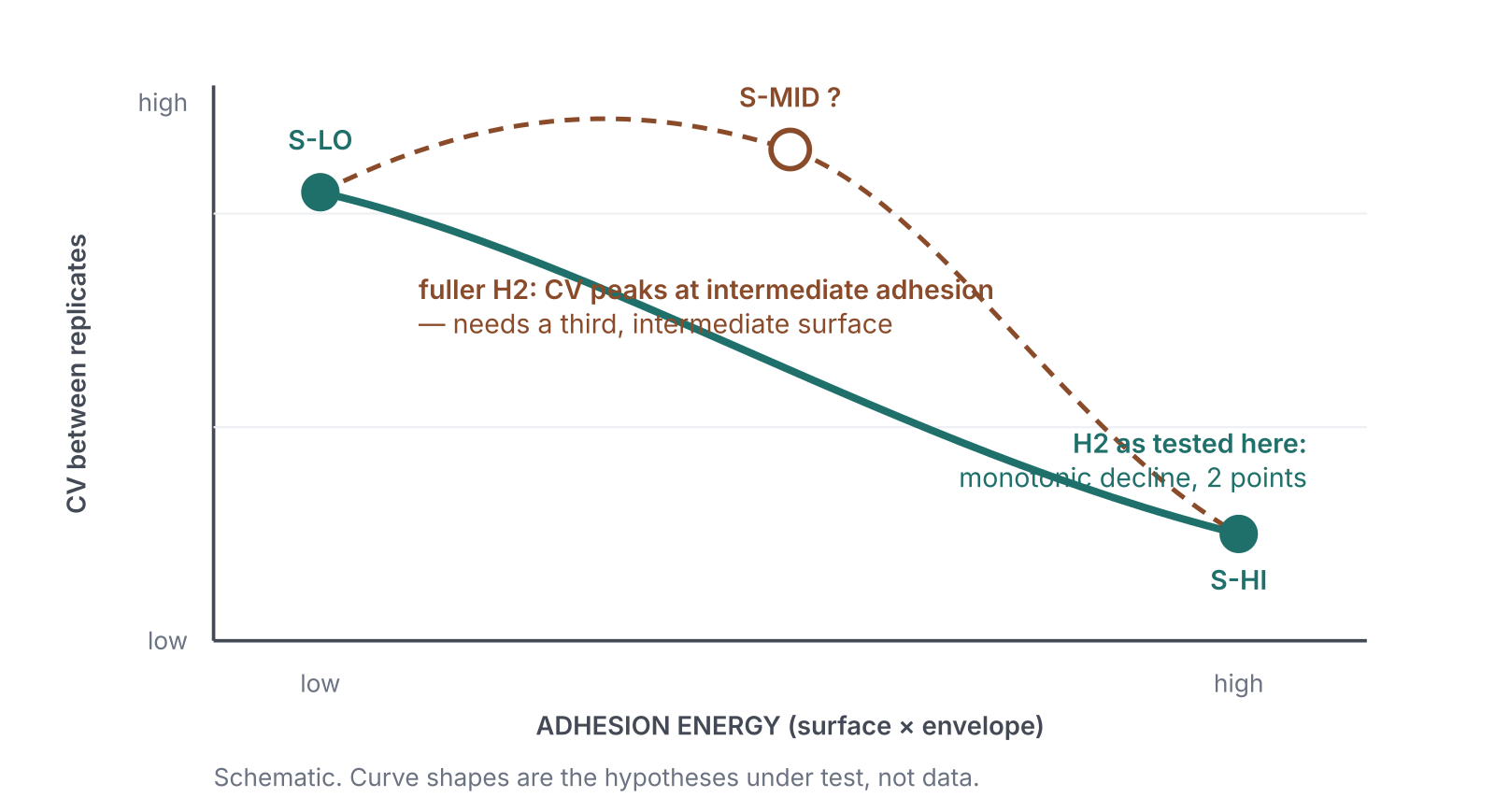
Figure 5 — H2, and the limit of a two-point design. The solid curve is the hypothesis this experiment can test: CV declines as adhesion energy rises. The dashed curve represents the fuller claim — that CV reaches a maximum at intermediate adhesion, where attachment sits nearest its stochastic threshold — which two points cannot distinguish from a monotonic decline. Resolving between them requires a third, intermediate surface.
A limit on what this design can establish, stated before the result. Estimates of spread are substantially noisier than estimates of means at the same sample size, so a CV comparison between two arms at n = 8 has modest power. This experiment is therefore correctly read as range-finding: it can indicate that one surface is more reproducible than the other, and it cannot settle it. The nested design proposed in the companion homework page — three seed states across three plates and three independent days, with variance partitioned by source — is the route to a powered answer. Claiming more than that here would be the same error this proposal criticises elsewhere.
The consequence if H2 holds, stated plainly because it is counter-intuitive: the manufacturing recommendation would be to standardise on untreated polystyrene — the least remarkable surface available — because at this stage of the programme the lowest-variance process window is worth more than the larger effect size. Reproducibility is the product. Biomass is not.
7 — FALSIFICATION AND RISK REGISTER
7.1 The principal threat: the conditioning film
The medium contains 5 g/L casamino acids — that is, protein fragments. Protein adsorbs preferentially to hydrophobic surfaces, and does so within minutes. The organism may therefore never contact the specified polymer at all; it may contact an adsorbed protein film formed upon it.
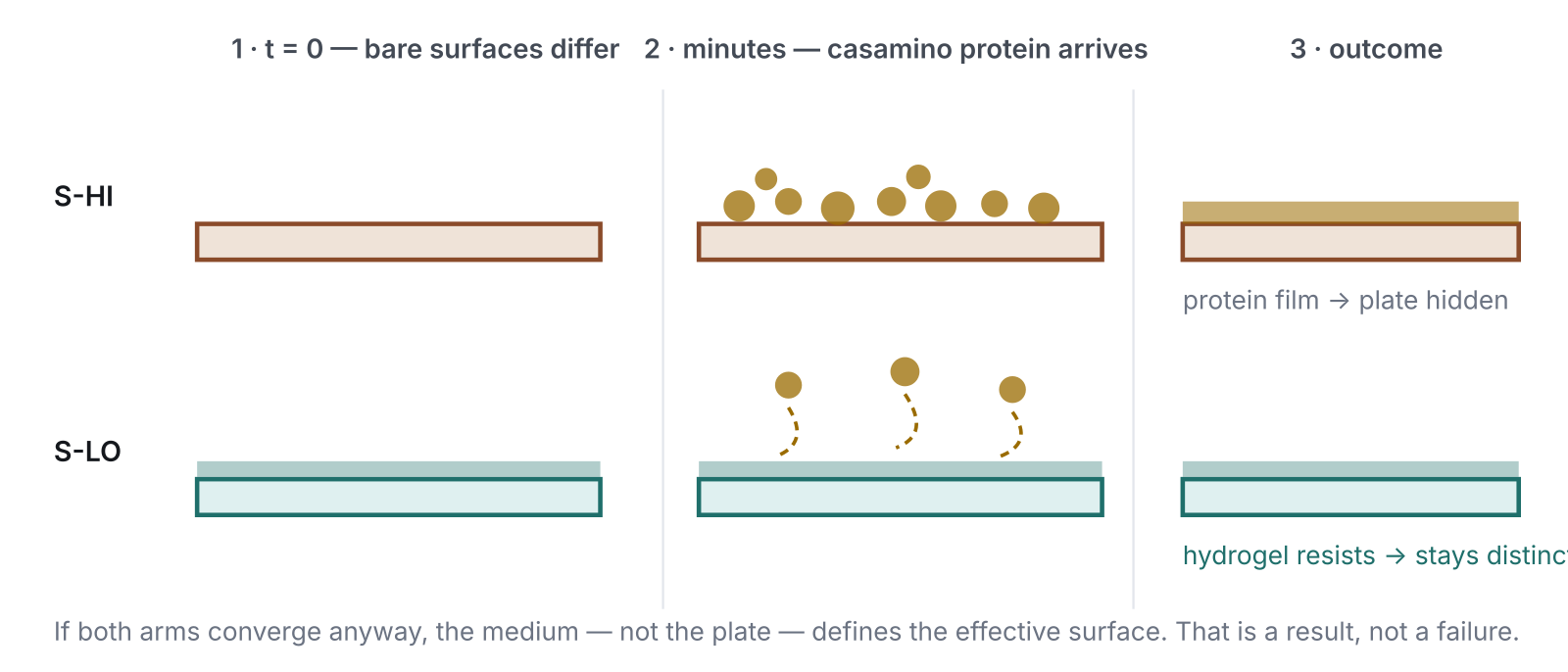
Figure 6 — The conditioning-film failure mode, and why this pairing is resistant to it. In a conventional untreated-versus-TC comparison, an adsorbed protein film could mask both surfaces and eliminate the measurable difference. The ULA hydrogel is engineered specifically to resist protein adsorption, and should therefore remain distinguishable once a film has formed. This constitutes a second, independent justification for selecting it as the hydrophilic arm.
Why a convergent result would still be informative. If both arms converge despite the protein-resistant chemistry of S-LO, the correct interpretation is that the medium — not the plate — defines the effective growth surface. That is a substantive finding about where the standardisation effort should be directed, not a failed experiment. It is testable directly by adding a pre-conditioning arm (one hour in sterile medium, aspirate, then inoculate), should well capacity permit.
7.2 Risk register
| Risk | Why it matters | Mitigation |
|---|---|---|
| Conditioning film masks the surface | The specified variable never contacts the cells | ULA resists protein adsorption; optional pre-conditioning arm; convergence reported as a positive finding |
| Floor effect at S-LO | If attachment is suppressed almost completely, biomass approaches the blank and CV becomes mathematically unstable | Report the suppression itself as the result, expressed as a detection limit rather than a ratio |
| Plate confounded with surface | Two surface treatments require two plate types | Single inoculum, single medium batch, single day, same incubation run, randomised positions |
| Differential dye binding | Crystal violet is cationic; the surfaces differ chemically | Surface-matched cell-free blanks through the complete protocol; report ΔOD₅₉₀ only |
| Edge effects and evaporation | Perimeter bias at 96-well scale can exceed the effect being measured | Water-filled perimeter, randomised placement, humidified incubation |
| Contact angles not as specified | Nominal values are catalogue figures, not measurements | Treated as acceptance criteria, verified from CoA or goniometry per lot |
| Two levels only | No graceful degradation | Both arms retained at every fallback tier |
7.3 Cost posture
The variable requires one additional plate type. It requires no specialised reagent, no instrument beyond the plate reader already in use, and no fabrication. The binding constraint is plate availability and incubator capacity rather than consumable cost — which is the appropriate profile for a variable proposed by a node that cannot execute it directly.
8 — CONTRIBUTION TO THE STANDARDISATION PROGRAMME
The class protocol specifies “standard 96-well flat-bottom polystyrene.”
Untreated and tissue-culture-treated plates both satisfy that description. They are visually indistinguishable, they are stocked alongside one another, and they are substituted without being recorded. Where participating nodes draw from different stock, surface treatment constitutes an uncontrolled factor beneath every other result generated in the programme — including the medium-composition series, none of which would display any indication of it.
Two outputs follow:
A measurement of the magnitude of that uncontrolled factor — specifically, how much of the between-node variance observed in the programme could be attributable to plate treatment alone.
A specifiable and purchasable control. A plate SKU together with a contact-angle acceptance criterion can be entered into a bill of materials, second-sourced, and verified on receipt. This is the precondition for the programme’s stated endpoint: a lot-numbered biofilm released against a written specification, in the manner of a commercial enzyme preparation.
9 — GLOSSARY
| Term | Definition |
|---|---|
| Acceptance criterion | A specified property a material must demonstrably meet on receipt, verified rather than assumed. Used here for contact angle. |
| Biofilm | A surface-attached microbial community embedded in a self-produced matrix of extracellular polymeric substances. |
| Blank (cell-free) | A well processed through the complete assay protocol without inoculum, used to quantify signal arising from the consumable rather than the biological product. |
| Casamino acids | An acid hydrolysate of casein, supplying amino acids as a nutrient source. Its protein fragments are the source of the conditioning-film risk. |
| Certificate of Analysis (CoA) | Supplier documentation stating measured properties of a specific manufactured lot. |
| Conditioning film | A layer of adsorbed macromolecules, typically protein, that forms on a surface in a nutrient medium prior to microbial attachment, potentially masking the underlying material. |
| Contact angle (θ) | The angle formed where a liquid droplet meets a solid surface; the operational measure of wettability. High θ indicates a water-repellent surface, low θ a water-attracting one. |
| Cording | The characteristic aggregation of mycobacteria into rope-like bundles, driven by mycolic acid content of the envelope. |
| Crystal violet | A cationic triarylmethane dye binding electrostatically to negatively charged material; the standard total-biomass stain for biofilm quantification. |
| CV (coefficient of variation) | Standard deviation divided by the mean, expressed as a percentage. The measure of replicate-to-replicate consistency used throughout. |
| Statistical power | The probability that an experiment detects an effect that is really there. Variance comparisons need far more replicates than mean comparisons for the same power. |
| Detection limit | The lowest signal distinguishable from the blank. Where a treatment suppresses signal to this level, the correct report is the limit itself rather than a computed ratio. |
| Edge effect | Systematic difference in the outer wells of a microplate, arising principally from evaporation and thermal gradient, which biases results if replicates are clustered. |
| EPS (extracellular polymeric substances) | The self-produced biofilm matrix: polysaccharides, proteins, lipids and extracellular DNA. |
| Hydrophilic / hydrophobic | Water-attracting / water-repellent. Determined by surface free energy and reported operationally as contact angle. |
| Hydrophobic recovery | The return of a plasma-treated polymer surface toward its original water-repellent state over hours to days, as low-molecular-weight species migrate from the bulk back to the surface. |
| Insert (disc) | A small piece of test material placed into a well, used by designs that compare materials within a single plate. |
| PDMS (polydimethylsiloxane) | Silicone elastomer, widely used in medical devices and microfluidics. Hydrophobic by nature; plasma-hydrophilised only temporarily. |
| Plasma treatment | Exposure of a surface to ionised gas, which grafts oxygen-containing groups onto it. Makes the surface hydrophilic and, as a consequence, negatively charged. |
| Silanisation | Chemical attachment of a silane layer to glass, typically to make it hydrophobic. |
| Mycolic acids | Very long-chain fatty acids forming the principal structural component of the mycobacterial cell envelope, responsible for its non-polar character. |
| OD₆₀₀ (optical density at 600 nm) | A turbidity measurement used as a proxy for cell concentration; used here to standardise the inoculum. |
| Pellicle | A biofilm formed at an air–liquid interface. |
| Planktonic | Free-floating and unattached, as opposed to surface-associated. |
| Polystyrene, untreated | Native polystyrene; non-polar and uncharged. The default surface of bacteriological-grade plates. |
| Polystyrene, TC-treated | Polystyrene modified by plasma or corona oxidation, grafting polar oxygen-containing groups; hydrophilic and negatively charged. |
| Surface free energy | The thermodynamic property governing how readily a liquid or macromolecule wets and adheres to a surface. |
| ULA (Ultra-Low Attachment) | A covalently bound, neutrally charged hydrophilic hydrogel coating applied to polystyrene, engineered to resist protein adsorption and cell attachment. |
| ΔOD₅₉₀ | Absorbance at 590 nm after subtraction of the surface-matched blank; the reported biomass quantity. |
10 — REFERENCES
DePas WH, Bergkessel M, Newman DK (2019). Aggregation of nontuberculous mycobacteria is regulated by carbon–nitrogen balance. mBio 10(4):e01715-19. https://doi.org/10.1128/mBio.01715-19 · free full text
Ojha A, Anand M, Bhatt A, Kremer L, Jacobs WR, Hatfull GF (2005). GroEL1: a dedicated chaperone involved in mycolic acid biosynthesis during biofilm formation in mycobacteria. Cell 123(5):861–73. https://doi.org/10.1016/j.cell.2005.09.012
Ojha A, Hatfull GF (2007). The role of iron in Mycobacterium smegmatis biofilm formation: the exochelin siderophore is essential in limiting iron conditions for biofilm formation but not for planktonic growth. Molecular Microbiology 66(2):468–83. https://doi.org/10.1111/j.1365-2958.2007.05935.x · free full text
Jokinen V, Suvanto P, Franssila S (2012). Oxygen and nitrogen plasma hydrophilization and hydrophobic recovery of polymers. Biomicrofluidics 6(1):016501. https://doi.org/10.1063/1.3673251 · free full text — water contact angle tracked for ten polymers over 100+ days; the basis for the surface-stability argument in §3.3
Hydrophobic recovery of PDMS surfaces in contact with hydrophilic entities: relevance to biomedical devices (2022). Materials 15(6):2313. https://doi.org/10.3390/ma15062313 · free full text — recovery characterised as a process of hours to days
Corning Life Sciences. Corning Surfaces for Cell Culture, product information sheet CLS-CC-013 — surface chemistry and charge of untreated, TC-treated and Ultra-Low Attachment polystyrene. https://www.corning.com/catalog/cls/documents/product-information-sheets/CLS-CC-013.pdf
Corning Life Sciences. Corning Ultra-Low Attachment Surface. https://www.corning.com/worldwide/en/products/life-sciences/products/surfaces/ultra-low-attachment-surface.html
Strain and resources
- Mycobacterium smegmatis mc²155 — ATCC 700084. BSL-1; genome-sequenced; deposited by W. R. Jacobs; GenBank CP000480. Now formally Mycolicibacterium smegmatis (NCBI taxid 246196).
11 — STATEMENT OF ORIGINAL CONTRIBUTION
The published results and manufacturer specifications cited above are not my work. The following constitute my own reasoning and are identified as such in the text where they appear:
- the argument that surface free energy, rather than material identity, is the substrate property matched to a mycolate-rich envelope, and the resulting decision to hold the bulk polymer constant (§2.2);
- the use of a neutrally charged hydrophilic surface in place of the conventional TC-treated arm, specifically to hold surface charge constant and isolate wettability (§3.2);
- the observation that two pairings sharing an untreated reference permit the charge contrast to be recovered by subtraction, making the designs additive rather than duplicative (§3.2);
- H2, the prediction that between-replicate CV is lower on the higher-adhesion surface, together with the counter-intuitive manufacturing recommendation that follows from it (§6);
- the identification of differential crystal violet binding across surface chemistries as a confound requiring surface-matched blanks in this specific design (§5);
- the identification of surface treatment as an unrecorded factor underlying other results in the programme (§8);
- the floor-effect risk at S-LO and the decision to report suppression as a detection limit rather than as a ratio (§7);
- the systematic elimination of disc-format routes in §3.3, and the identification of surface charge as the common failure mode shared by every oxidation route to a hydrophilic surface — the argument is mine; the recovery kinetics it rests on are cited.
All figures are original schematics prepared for this submission. Contact angle values are nominal supplier ranges presented as acceptance criteria to be verified, not measurements. Figures 4 and 5 are illustrative and do not represent data.
End of document.