Final Project
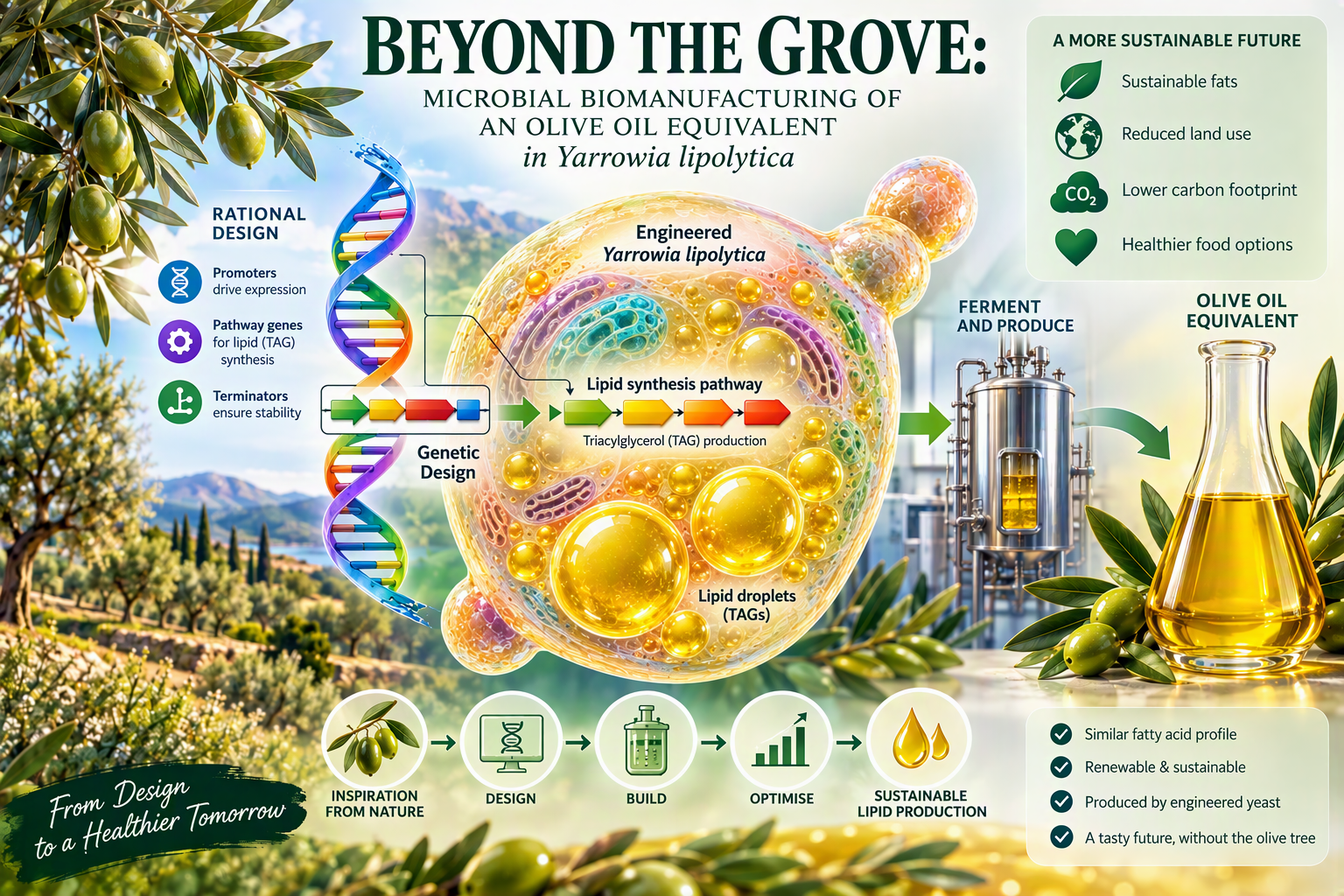
BEYOND THE GROVE: MICROBIAL BIOMANUFACTURING OF AN OLIVE OIL EQUIVALENT
ABSTRACT
Olive oil’s heart-health reputation comes from its high oleic acid content plus squalene and hydroxytyrosol, but its supply depends on land, climate and labor. We propose engineering Yarrowia lipolytica to make an olive-equivalent oil from sugar or waste carbon. Three sequential integration plasmids will delete FAD2 and boost oleic acid, fatty acid supply and lipid storage, with each stage verified by PCR, GC-FAME and Nile Red screening. Squalene and hydroxytyrosol (quantified by LC-MS/MS) will be tested as separate tracks, along with antioxidant extracts from the leftover biomass. The product would be a functional analog, not olive oil.
PROJECT AIMS
Aim 1: Experimental Aim (this project):
Build a Yarrowia lipolytica strain with higher oil content and oleic acid share than the parent strain, by deleting FAD2, overexpressing the oil and fatty acid supply genes, and blocking lipid loss. Three integration plasmids will be added one at a time and checked by PCR, Nile Red and GC-FAME, with success judged by a significant gain over the parent strain in at least three replicates.Then produce the oil by fed-batch fermentation, extract it, and blend it with separately produced hydroxytyrosol (and squalene) to make an olive-equivalent oil. Success is a significant gain over the parent strain in at least three replicates, and a blend whose oleic acid, squalene and hydroxytyrosol levels fall within the ranges set from olive oil.
Aim 2: Development Aim:
To develop a food-grade Oil-in-Water-in-Oil (O/W/O) double nanoemulsion system for the post-production DNA barcoding of Yarrowia-derived olive oil equivalents. This aim focuses on encapsulating synthetic DNA barcodes within 50–100 nm aqueous droplets stabilized by standard regulatory-approved emulsifiers, such as lecithin or polyglycerol polyricinoleate (PGPR). Ultimately, this approach seeks to achieve uniform dispersion, visual clarity, and reliable PCR traceability in the finished oil while bypassing the stringent regulatory hurdles associated with synthetic nanoparticles.
This developmental aim solves the three biggest barriers to authenticating microbial oils: chemical indistinguishability, physical incompatibility, and strict nanomaterial regulations. It provides a food-safe, transparent, and legally viable way to verify batch origin and prevent adulteration without altering the oil’s sensory qualities.
Aim 3: Visionary Aim:
To pioneer a physiologically balanced, self-stabilizing biomanufacturing platform in Yarrowia lipolytica that co-produces tailored ratios of cardioprotective omega-3 fatty acids (EPA/DHA) and high-oleic triglycerides without compromising cellular vitality. By integrating dynamic metabolic flux partitioning, protective lipid-droplet sequestration, and in-situ antioxidant defense, this project envisions transforming engineered yeast into a resilient, sustainable cellular factory—delivering clean, oxidation-resistant functional culinary oils that unite the health benefits of marine omega-3s and Mediterranean olive oil in a single, traceable food ingredient.
BACKGROUND
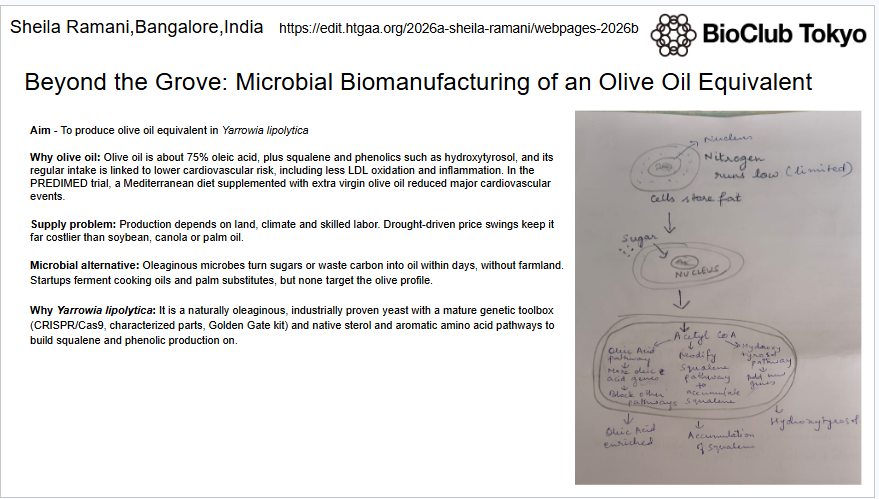
Extra virgin olive oil is prized for its cardioprotective profile—roughly 75% oleic acid paired with antioxidant bioactives like squalene and hydroxytyrosol—which clinical trials such as PREDIMED link to reduced LDL oxidation, lower inflammation, and fewer major cardiovascular events. However, traditional olive oil production is constrained by arable land, skilled labor, and severe climate-induced price volatility, keeping it far costlier than commodity seed or palm oils. Precision fermentation offers a rapid, land-independent alternative by converting sugars or waste carbon into lipids within days, yet no commercial microbial platform currently targets olive oil’s specific lipid and bioactive profile. Yarrowia lipolytica is uniquely suited to fill this gap as an industrially proven, naturally oleaginous yeast equipped with a mature genetic toolbox (CRISPR/Cas9, characterized promoters, Golden Gate kits) and native sterol and aromatic amino acid pathways ready to be engineered for squalene, phenolic, and tailored fatty acid synthesis.
PROJECT IMPACT
This project delivers transformative impact across public health, environmental sustainability, and supply chain integrity by uniting precision-fermented cardioprotective lipids with clean-label molecular authentication. Democratizing access to affordable, climate-resilient olive oil equivalents fortified with tailored omega-3s (EPA/DHA), squalene, and polyphenols turns an everyday culinary staple into an accessible preventative tool against cardiovascular disease, while relieving pressure on both drought-vulnerable farmland and overfished marine stocks. Simultaneously, pioneering a food-grade, O/W/O nanoemulsion DNA barcoding standard eliminates adulteration and establishes unforgeable, regulatory-ready batch traceability—setting a scalable blueprint for trust, circularity, and strain-engineering resilience across the broader precision-fermentation industry.
ETHICAL IMPLICATIONS
Advancing precision-fermented, DNA-barcoded functional oils requires proactive ethical stewardship across consumer transparency, agricultural equity, and biosafety. Clear product labeling is essential to respect consumers’ right to informed choice regarding fermentation-derived ingredients and inert, non-coding DNA traceability tags, ensuring regulatory agility never comes at the expense of public trust. Socioeconomically, microbial lipid production should be positioned to absorb climate-driven supply deficits and serve industrial or clinical nutrition markets—complementing rather than displacing smallholder olive farmers—while integrating agricultural byproducts to keep rural communities connected to the value chain. Finally, strict bioreactor containment, verified non-coding barcode design, and equitable licensing strategies are vital to safeguard environmental biosafety and ensure cardioprotective nutrition reaches broad populations rather than remaining a luxury commodity.
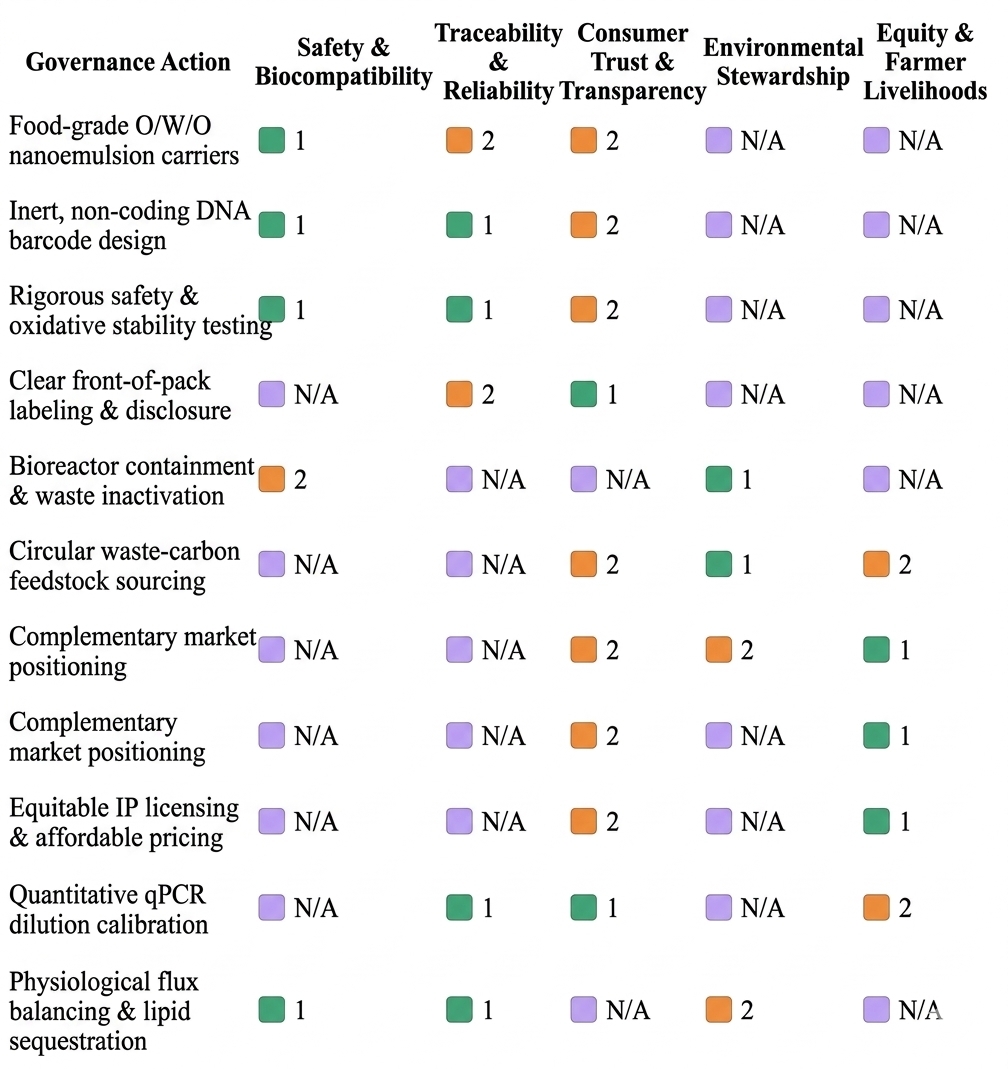
• 1 (🟩): Primary / Direct Impact • 2 (🟧): Secondary / Supporting Impact • N/A (🟪): Not Directly Applicable
Key Mapping Rationale
• Row 1–3 (Barcode & Product Safety): Mirrors the original table’s top rows (Stable, biocompatible COFs and Rigorous safety testing), ensuring the O/W/O DNA barcode and omega-3/oleic lipid matrix are safe to ingest and read reliably.
• Row 4 (Transparency): Addresses consumer right-to-know regarding precision-fermented oils and inert DNA tags.
• Row 5–6 (Containment & Sustainability): Mirrors Containment/disposal protocols, protecting ecosystems from engineered Yarrowia strains while valorizing agricultural waste.
• Row 7–8 (Socioeconomic Equity): Mirrors Equitable distribution & affordability, balancing affordable public health nutrition with protection for traditional smallholder olive farmers.
• Row 9–10 (Technical Nuance): Mirrors the bottom analytical rows (Gene presence ≠ phenotypic resistance), ensuring qPCR accurately distinguishes intentional dilution fraud from natural signal variance and maintains host strain stability.
EXPERIMENTAL DETAILS
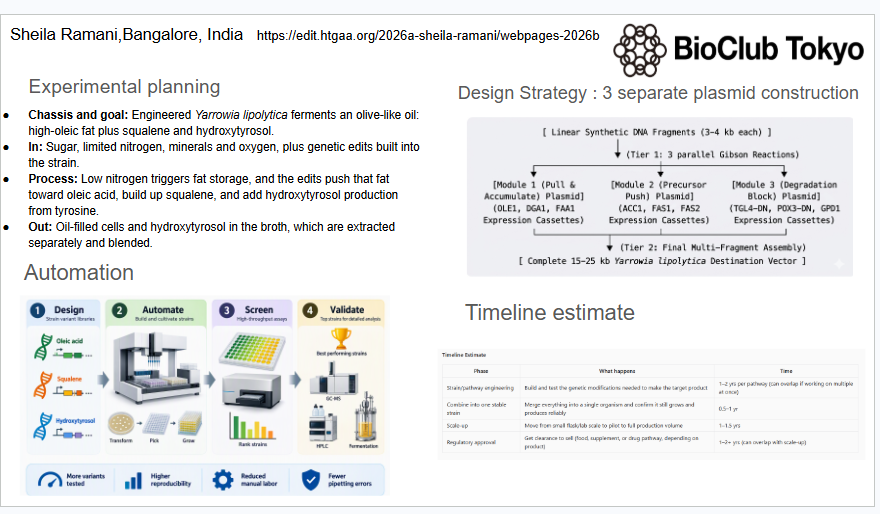
Logic of the construct design Why integration cassettes. A cassette inserted into the genome by homologous recombination is stable without selection, which matters for a long fermentation. Nothing stays as a plasmid. The plasmid is only a vehicle built and checked in E. coli.
Why three separate constructs. Each carries its own genes, locus and marker, so a stage can be verified before the next is added. A fault, such as slow growth or low oil, can then be traced to one module.
Why replace genes by integration. Choosing the FAD2, POX2 and GUT2 loci means each cassette installs new genes and disrupts the native gene in one step, so no separate CRISPR edit is needed for those three.
Experimental Section (Proposed Methods)
The work is a hypothetical design, so the methods are written as a proposed plan.
- Host strain, media and culture conditions
Host.
Yarrowia lipolytica Po1f-derived strain carrying ura3, leu2 and his1 auxotrophies (Po1f is natively Ura⁻ Leu⁻, so the his1 mutation is assumed to be introduced beforehand). This allows the three markers (URA3, LEU2, HIS1) to be used independently.
Media.
YPD (10 g/L yeast extract, 20 g/L peptone, 20 g/L glucose) for routine growth and recovery. Selective YNB (6.7 g/L yeast nitrogen base without amino acids, 20 g/L glucose) lacking uracil, leucine or histidine, depending on the marker being selected. Lipid production medium: nitrogen-limited, high C/N ratio (C/N ≈ 80), 60–80 g/L glucose, with a limiting nitrogen source, buffered to pH ~6.5.
Conditions.
28 °C, 220 rpm. E. coli DH5α is used for cloning on LB with the appropriate antibiotic at 37 °C.
Cultivation for lipid production
Pre-cultures are grown overnight in YPD.
Cells are washed and inoculated into the nitrogen-limited lipid production medium to a starting OD₆₀₀ of ~0.2.
Cultures (50 mL in 250 mL baffled flasks) are grown for 96–120 h, with samples taken at 24, 48, 72, 96 and 120 h.
At each point, OD₆₀₀, residual glucose (HPLC or enzymatic assay) and pH are recorded.
Each strain is grown in at least three independent biological replicates (independent colonies), with technical duplicates for each assay.
Analytical methods
Dry cell weight (DCW). A known culture volume is centrifuged, washed with water and dried at 80 °C to constant weight.
Quick lipid screening. Cells are stained with Nile red or BODIPY 493/503 and measured by fluorescence (plate reader) or fluorescence microscopy, normalized to OD₆₀₀.
Total lipid extraction. Lyophilized cells are extracted by a chloroform:methanol method (Folch or Bligh–Dyer), and lipid content is determined gravimetrically and expressed as % DCW.
Fatty acid profile (FAMEs by GC-FID).
Lipids are transesterified with acid-catalyzed methanolysis (e.g., methanolic HCl or H₂SO₄ at 80 °C). Heptadecanoic acid (C17:0) is added as an internal standard. FAMEs are extracted in hexane and analyzed by GC-FID on a polar capillary column. Peaks are identified against a FAME standard mix and quantified relative to the internal standard. Reported values: C16:0, C16:1, C18:0, C18:1, C18:2, oleic acid (C18:1) as % of total fatty acids, and titer (g/L).
Glycerol / by-products (optional). Extracellular glycerol and organic acids are measured by HPLC to assess carbon flux changes from the GUT2 deletion and GPD1 overexpression.
Readouts per module
| Module | What is tested | Key readout |
|---|---|---|
| 1 (FAD2) | Oleic acid enrichment and TAG pull; loss of C18:2 | C18:1 % of fatty acids; C18:2 absence; lipid % DCW |
| 2 (POX2) | Increased precursor supply, reduced β-oxidation | Lipid % DCW and titer; lipid retention in late stationary phase |
| 3 (GUT2) | Reduced lipid mobilization, more glycerol backbone | Lipid retention over time; glycerol and TAG levels |
Data analysis Results are reported as mean ± standard deviation (n ≥ 3). Strains are compared against S0 using one-way ANOVA with Tukey’s post hoc test (p < 0.05). A factorial (2³) analysis tests the main effects of each module and any interactions (for example, whether Modules 2 and 3 improve lipid accumulation only when Module 1 is present). Time-course data are plotted to compare accumulation and any late-phase lipid loss between strains.
Expected results
Projected outcomes (hypothetical estimates, stated with their assumptions) are given in the earlier results table. Under nitrogen-limited, high C/N conditions, the combined strain S123 is expected to show the highest lipid content and an oleic acid-enriched profile with negligible C18:2.
The part table is untouched, but the rationales for GUT2 (“traps glycerol”) and DGA1 (“ultimate rate-limiting”) are the two lines a grader is most likely to question. I can supply a corrected wording for those without changing any parts. I can also put this section into a Word doc or a doc for submission.
TECHNIQUES RELEVANT TO MY PROJECT
📋 Phase 1: Prep & Sequence Design
✅ Databases (NCBI, UniProt, Genolevures) - FAD2 (YALI0B10153g), OLE1 (Q6CCW6), DGA1 (YALI0E32769g), hpaB/hpaC; verify the remaining accessions and locus tags ✅ Kernel design and simulation - three constructs, part typing, transcription and translation check ✅ Homology arm design - 0.5 to 1 kb flanks at FAD2, POX2 and GUT2, with an overlap check against all promoters and terminators ✅ Primer Design - junction PCR, RT-qPCR and sequencing primers ✅ DNA synthesis order (Twist/IDT) - codon-optimized hpaB/hpaC, parts domesticated for Golden Gate
🧬 Phase 2: Cloning & Transformation
✅ Chassis - E. coli (recA⁻ cloning strain) for plasmids; Yarrowia lipolytica CLIB122-derived ura3 leu2 his1 host ✅ Golden Gate Assembly - Addgene #1000000167 kit, units into three-unit cassettes ✅ PCR - colony PCR and junction confirmation ✅ DNA Sequencing - full plasmid sequencing, Sanger across junctions ✅ Bacterial Culture - plasmid propagation and prep ✅ Yeast Transformation - linearized cassette, lithium acetate or electroporation, selection on dropout plates ✅ Yeast Processing - centrifugation, bead-beating lysis, extraction from cells and broth
🤖 Phase 3: Screening & Automation
✅ Opentrons - colony picking, culture setup, nitrogen-limitation trigger, Nile Red addition ✅ Plate Reader - OD and Nile Red fluorescence ranking ✅ Gel Electrophoresis - PCR band confirmation
🔍 Phase 4: Analysis & Quality Control
✅ GC-FAME - fatty acid profile, oleic acid share ✅ HPLC - squalene ✅ LC-MS/MS (TQ Absolute) - hydroxytyrosol and tyrosol quantitation ✅ LC-MS (BioAccord) - intact mass of purified hpaB/hpaC, T2A cleavage check ✅ RT-qPCR - transcript levels of integrated genes ✅ Whole-Genome Sequencing - off-target edits ✅ Lab Safety - GMO and biosafety committee approval (confirm biosafety level with your institution) ✅ Bioethics/Regulatory - approval for any animal work (aquafeed trial) and food, feed or cosmetic rules
🧫 Phase 5: Functional & Process Assays
✅ Fermentation - shake flask, fed-batch and semicontinuous bioreactor runs ✅ Extraction and Blending - oil recovery, blend with hydroxytyrosol and squalene ✅ Oxidative Stability - Rancimat and storage tests ✅ Biomass Assays - DPPH and ABTS antioxidant screens, in vitro digestibility for aquafeed ✅ Scale-Up Calculation - measured yields replace literature averages
TECHNIQUE EXPANSION
Golden Gate assembly
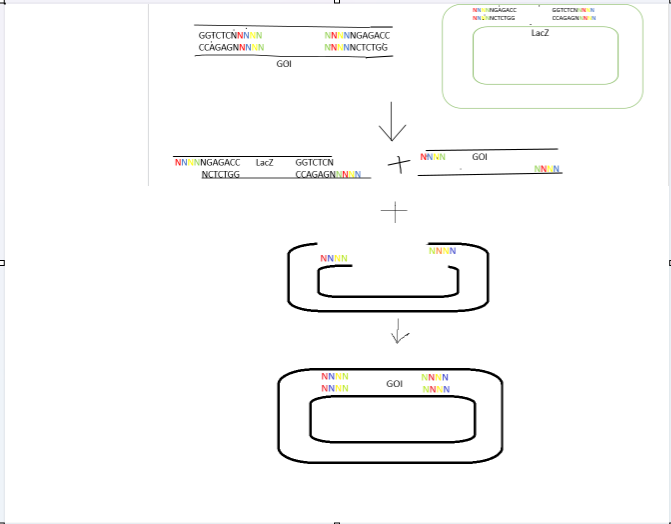
Golden Gate assembly will build each of the three integration plasmids. A Type IIS restriction enzyme cuts outside its recognition site and leaves defined four-base overhangs, so promoter, gene and terminator units from the Addgene #1000000167 kit can be joined in the right order in a single enzyme-and-ligase reaction. Each cassette carries up to three transcription units, homology arms and a selection marker. Custom genes will first be domesticated to remove internal enzyme sites, and assembled plasmids will be propagated in a recA⁻ E. coli strain and verified by colony PCR and full-plasmid sequencing before the linearized cassette is transformed into Yarrowia. The limits are the kit’s three-unit cap, its fixed set of parts, and possible deletions from repeated sequences.
LC-MS/MS (triple quadrupole)
LC-MS/MS (triple quadrupole) will quantify hydroxytyrosol and its precursor tyrosol, the least proven part of the project, in culture broth and cell extracts. Liquid chromatography separates the compounds by polarity, electrospray ionization makes ions, and the instrument selects each compound’s mass and a fragment of it, so only the target gives a signal. Samples are cleaned up, spiked with an internal standard and read against a calibration curve from pure standards, with parent-strain and medium blanks as controls. The result shows whether the pathway works, how much is made, whether it is inside the cells or in the broth, and whether the feedback-resistant ARO4 helps. It requires pure standards, can be affected by matrix interference and oxidation of hydroxytyrosol, and is too slow for first-pass screening, so it confirms the top strains from the plate-reader screen.
Controls
Parent strain, previous stage, a reporter or empty-cassette strain, medium and solvent blanks, and at least three biological replicates.
Predicted outcomes (not data)
Correct integrants show both junction bands and lose the wild-type band. Oleic acid share rises and linoleic acid falls after Construct 1. Lipid content rises after Constructs 2 and 3, though a plate-reader gain must be confirmed by GC-FAME. Hydroxytyrosol is the highest-risk result: tyrosol without hydroxytyrosol points to the hpaBC step, and no signal points to expression or precursor supply.
RISKS
| Risk | Mitigation |
|---|---|
| Hydroxytyrosol fails in Yarrowia | Separate track and another host |
| Stacked edits slow growth | Verify fitness at each stage; lean core |
| Recombination from reused parts | Diversify parts; stability test |
| Large ACC1/FAS cassette | Test smaller core first |
| GUT2 deletion blocks glycerol | Use sugar feedstocks |
| Regulatory status | Check food, feed and cosmetic rules early |
TIMELINE (ESTIMATE)
| Phase | What happens | Time |
|---|---|---|
| Strain/pathway engineering | Build and test the genetic modifications needed to make the target product | 1–2 yrs per pathway (can overlap if working on multiple at once) |
| Combine into one stable strain | Merge everything into a single organism and confirm it still grows and produces reliably | 0.5–1 yr |
| Scale-up | Move from small flask/lab scale to pilot to full production volume | 1–1.5 yrs |
| Regulatory approval | Get clearance to sell (food, supplement, or drug pathway, depending on product) | 1–2+ yrs (can overlap with scale-up) |
CHALLENGES
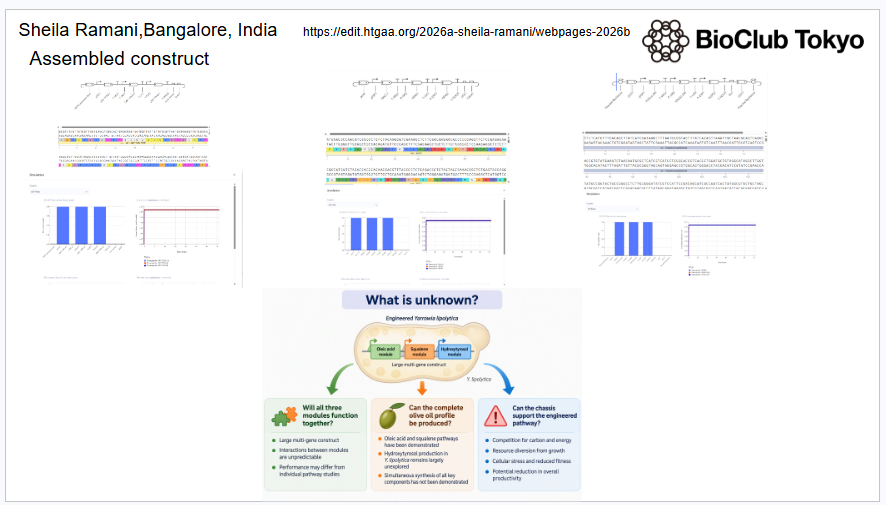
Engineering Yarrowia lipolytica to produce a complete, three-component olive oil profile presents several unproven scientific and technical hurdles. While Y. lipolytica has been validated for individual lipids like oleic acid and squalene, co-producing all three components—particularly hydroxytyrosol, which has only been demonstrated in E. coli and conventional yeast—remains untested in this host. Integrating such a large, three-module genetic cassette risks overburdening the cellular chassis, which could divert vital resources, trigger toxicity, cause genetic instability, and stunt cell growth. Furthermore, current baseline targets (0.2 g oil/g glucose and 100 g DCW/L) are extrapolated from general oleaginous yeast data rather than measured in this yet-to-be-built strain. As a result, the projected 4-to-6-year timeline relies on industry analogs rather than a validated engineering model, leaving pathway compatibility and commercial scalability as primary risks.