Week 1 HW: Final Project Ideas
1)What you would like to biomanufacture and why?
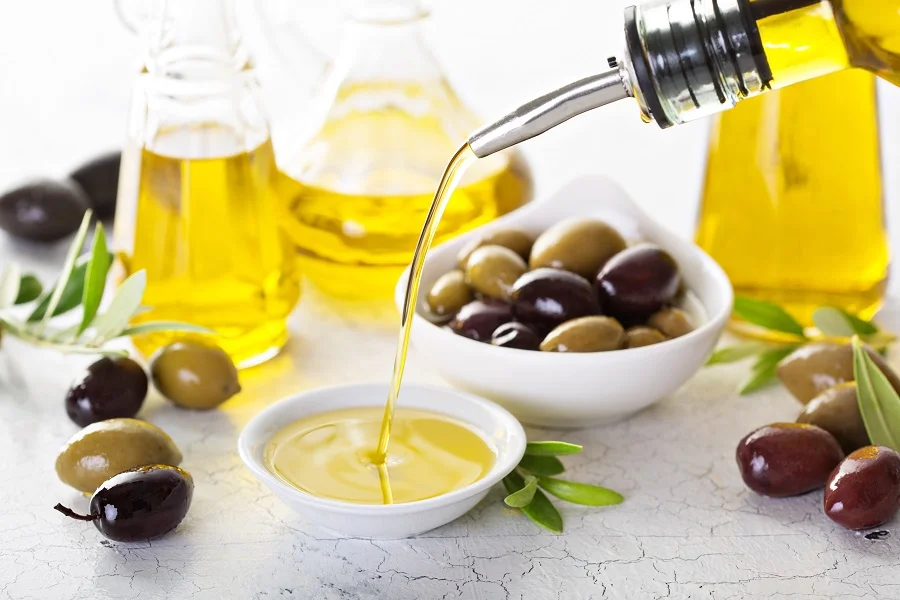
I would like to biomanufacturer an equivalent of olive oil in microrganisms. High in polyphenols and antioxidants (from minimal processing) — linked in multiple studies to reduced inflammation and better cardiovascular outcomes It has proven long-term epidemiological support for heart health, longevity, and reduced chronic disease risk.
Reasons for olive oil being expensive
Oil palm and soybean yield vastly more oil per hectare than olive trees Olive harvesting is still heavily manual/labor-intensive in many regions, especially for higher-quality EVOO(Extra Virgin Olive Oil) Olive trees are climate-sensitive (drought-vulnerable), so supply swings are large and frequent Extra virgin grade requires mechanical-only extraction (no chemical solvents, no heat processing), which limits yield extraction efficiency compared to refined oils. Companies are already fermenting oleaginous microbes into edible oil alternatives — Zero Acre Farms ferments sugars from sugarcane/sugar beets into oils and fats marketed as a healthier, more sustainable cooking oil, and academic work on yeasts like Cutaneotrichosporon oleaginosus is exploring similar microbial oils as sustainable substitutes for plant oils (shorter life cycles, less labor, less climate sensitivity). None of these are explicitly marketed as “olive oil equivalent,” though — the closest real products (Zero Acre, C16 Biosciences’ palm oil alternative) target general cooking oil or palm oil replacement, not olive oil specifically.
2)What living system would you use?
Chassis: Yarrowia lipolytica (engineered yeast)Y. lipolytica
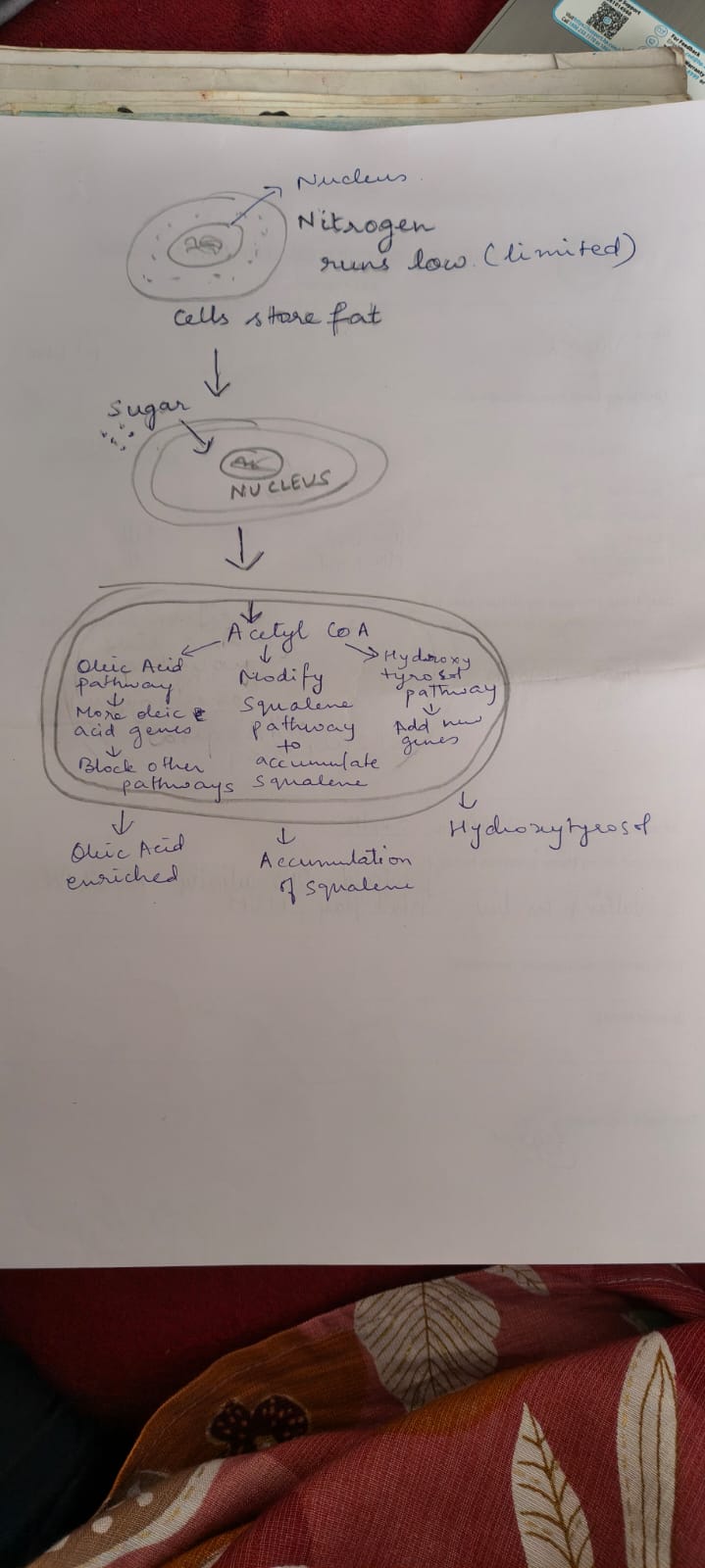
Goal: Ferment an oil similar to olive oil — high-oleic fat + hydroxytyrosol antioxidant + squalene.
In: Sugar (glucose/glycerol) as food, nitrogen (limited on purpose), minerals, oxygen — plus genetic edits built into the strain beforehand.
What happens:
Cells grow normally on sugar. When nitrogen runs low, cells switch to storing fat — genetic tweaks (boost oleic-acid-making genes, block competing pathways) push that fat to be mostly oleic acid, like olive oil. A tweak to the yeast’s own sterol pathway makes it accumulate squalene instead of converting it further. Added genes (borrowed from pathways proven in E. coli/yeast) let the cell make hydroxytyrosol, olive oil’s main antioxidant, from tyrosine.
Out: Yeast biomass full of oil droplets + hydroxytyrosol dissolved in the broth. Break open the cells, extract the oil, separately extract the hydroxytyrosol, then blend them into one finished product.
3)How would you use automation?
What I’d automate: Building and screening many strain variants at once — for all three engineering pieces (oleic acid, squalene, hydroxytyrosol) would be cumbersome.
Why this step: Each piece has many design choices to test (different genes, promoter strengths, knockdown levels). Testing these by hand is slow and inconsistent — and this is also where the biggest unknowns are (especially hydroxytyrosol in Yarrowia, never done before), so testing more variants matters most here.
How: Robot pipettes DNA into cells, picks colonies into plates Robot grows cultures and triggers nitrogen starvation at the same exact time across all wells Robot adds Nile Red dye, a plate reader quickly ranks all strains by fat content (similar quick tests could work for squalene/hydroxytyrosol) Only the best strains move on to slower, precise lab tests (GC-MS, HPLC)
Why it helps: Faster, more consistent than pipetting by hand, and lets you test far more variants per week — freeing people up to solve the harder problems instead of repetitive pipetting. Less error prone.
4)How much would you need to make, and how long would it take?
Back-of-envelope: scaling up the Yarrowia olive-oil-equivalent
Step1 “Let’s say we want to make 100 tonnes of oil a year — enough to actually sell as a product, not just a lab experiment.”
Step 2 — Convert to daily production
Assumes the plant runs ~300 days/year,
$$100,000 \text{ kg / year} \div 300 \text{ working days} \approx 333.33 \text{ kg oil/day}$$
≈ ~330 kg oil/day
Step 3 — Estimate feedstock needed
Assume the yeast turns sugar into oil at roughly 20% efficiency" (0.2 g oil per g glucose — a commonly cited rough figure for engineered oil-producing yeast,
330 kg oil ÷ 0.2 ≈ ~1,650 kg glucose/day
Oil Yield per Liter per Batch:100 g DCW/L × 50% = 50 g oil/L
Target Oil per Batch (5-day cycle):330 kg oil/day × 5 days = 1,650 kg oil per batch
Required Working Volume:1,650,000 g ÷ 50 g/L = 33,000 liters working volume
So: 1 liter of culture ≈ 50g oil. To get 330 kg/day over a 5-day cycle → need 1,650 kg oil per batch → 1,650,000 g ÷ 50 g/L ≈ ~33,000 liters
“So I’d need one big ~30,000-40,000 liter tank running continuously — that’s industrial scale, similar to existing fermentation plants for things like citric acid.”
Timeline Estimate
| Phase | What happens | Time |
|---|---|---|
| Strain/pathway engineering | Build and test the genetic modifications needed to make the target product | 1–2 yrs per pathway (can overlap if working on multiple at once) |
| Combine into one stable strain | Merge everything into a single organism and confirm it still grows and produces reliably | 0.5–1 yr |
| Scale-up | Move from small flask/lab scale to pilot to full production volume | 1–1.5 yrs |
| Regulatory approval | Get clearance to sell (food, supplement, or drug pathway, depending on product) | 1–2+ yrs (can overlap with scale-up) |
5)What don’t you know yet?
Real scientific unknowns Whether hydroxytyrosol production actually works in Yarrowia — only proven in E. coli/yeast so far Whether combining all three engineered pathways in one cell causes unexpected problems (growth defects, instability),burden on cell, cell toxicity Estimates, not verified numbers Yield/density figures (0.2 g oil/g glucose, 100 g DCW/L) are typical for oleaginous yeast in general — not measured for this specific strain, which doesn’t exist yet The 4–6 year timeline is based on similar companies’ history, not a real project model
AI prompts used
Different ideas for biomanufacturing insulin in rice
can we peogram rice to produce something that makes it less diabetic?
which is healthier palm oil or olive oil?
can olive oil be produced in microbes?
an olive oil equivalent
can I imitate the pathway producing olive oil in plants to cyanobacteria or algae?
any other living system suitable for olive oil prodcution?
has olive oil already been peoduced by organisms?
can Yarrowia be used to produce olive oil as a whole?
can olive oil be manufactured as such in the microrganism?
Timeline approximation.
References:
Jach, Monika Elżbieta, and Anna Malm. 2022. “Yarrowia lipolytica as an Alternative and Valuable Source of Nutritional and Bioactive Compounds for Humans” Molecules 27, no. 7: 2300. https://doi.org/10.3390/molecules27072300
Lee S, Lee JH, Park HJ and Baek S-H (2025) Yarrowia lipolytica as a promising cell factory for microbial production of value-added nutraceuticals . Front. Bioeng. Biotechnol. 13:1673169. doi: 10.3389/fbioe.2025.1673169
Barrera-Chamorro, Luna, Teresa Gonzalez-de la Rosa, Jose L. del Rio-Vazquez, Maria Torrecillas-Lopez, Elvira Marquez-Paradas, Carmen M. Claro-Cala, Sergio Montserrat-de la Paz, and Maria D. Navarro-Hortal. 2026. “Olive Oil as a Modulator of Gut Microbiota and Intestinal Health: A Narrative Review from Microbial Metabolism to Host Responses” Nutrients 18, no. 14: 2235. https://doi.org/10.3390/nu18142235