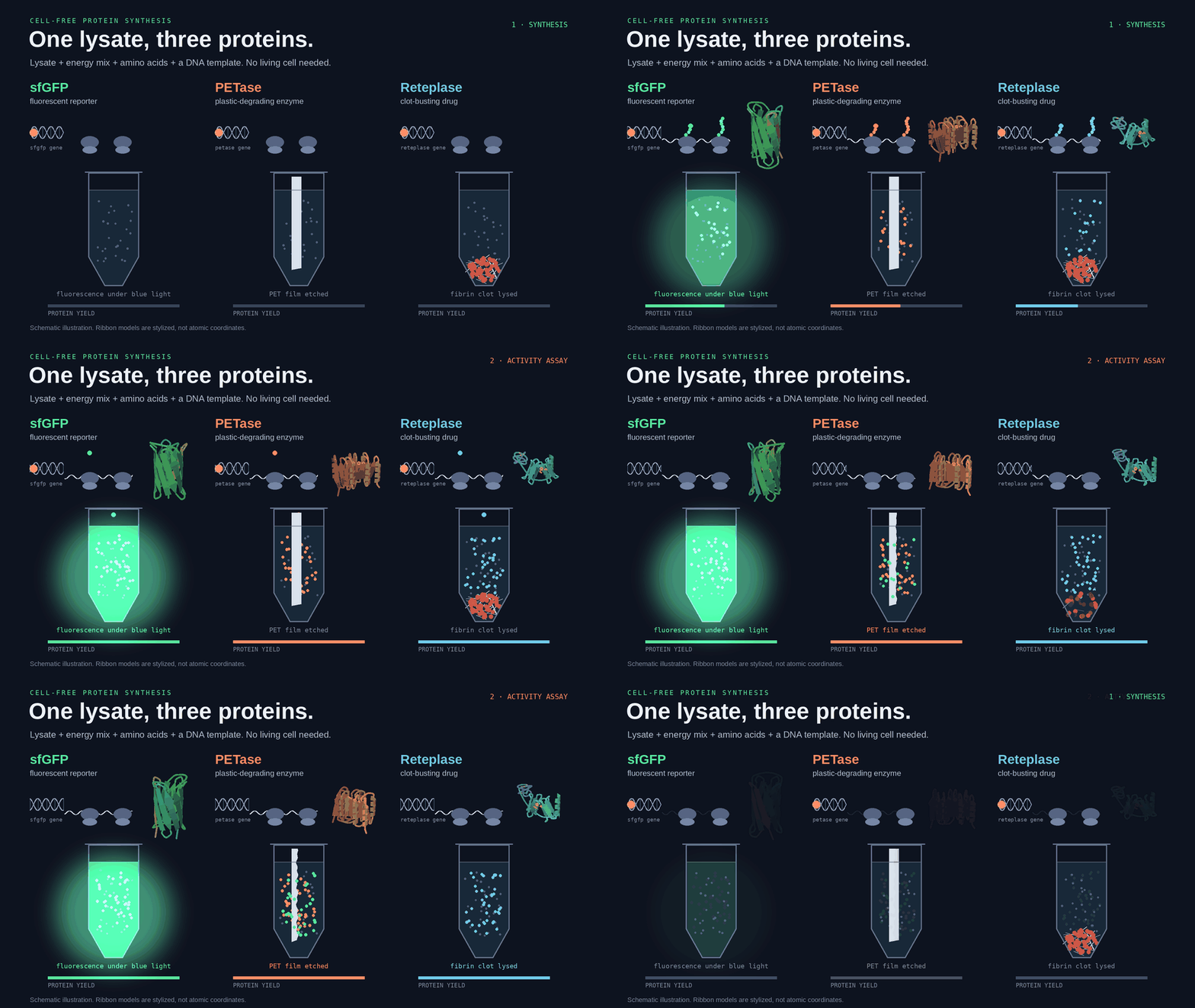
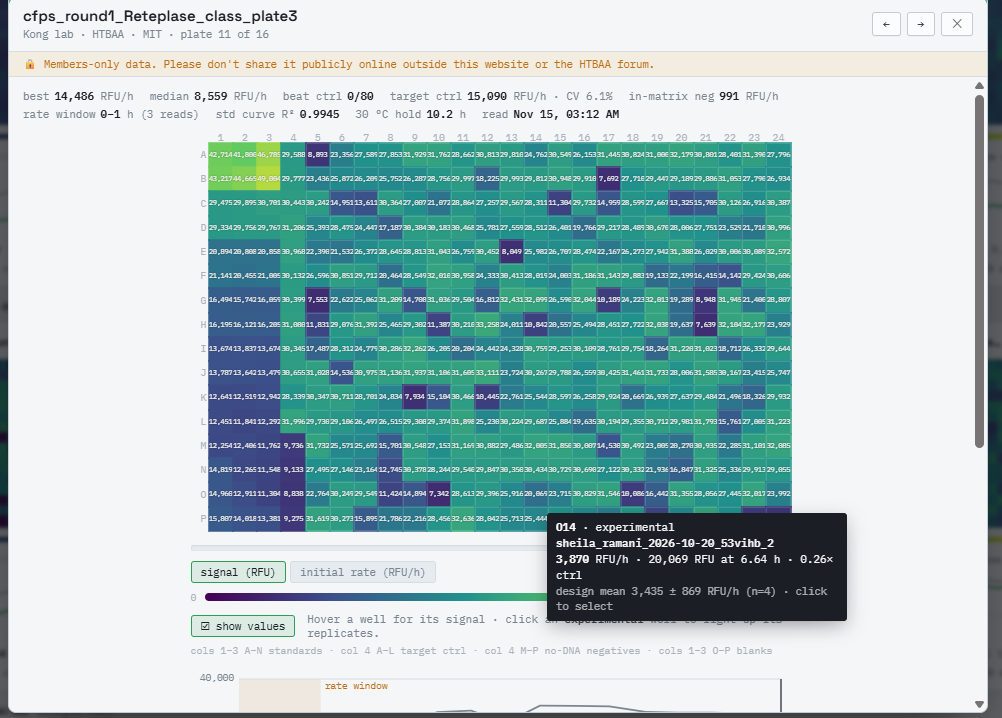
A. DESIGN A BATCH OF CELL-FREE REACTION COMPOSITIONS
When designing experiments, you’ll often want to compare several conditions that differ only slightly, such as one reagent at a few different concentrations, and batches let you submit those together. To make a batch, click “+ add mix” in the designer to copy your current composition into additional columns, change reagent(s) to a different concentration in each column, add an overall hypothesis plus a short rationale for each mix when submitting.
You should batch experimental conditions that are intended to be directly compared with each other. When we pick the final experimental conditions, we’ll try to include whole batches rather than splitting them up.
A batch is a JSON object with an overall experiment_hypothesis and a samples list. Each item in the list is a dictionary for one composition: a unique sample_id and reagent_list of reagent volumes in nL that sum to exactly 20,000, and metadata with that composition’s protein_target and comments.
For example, to specify a parameter sweep, you keep every sample identical except the reagent you’re varying, and adjust water to keep the total at 20,000 nL:
The JSON for compositions for sfGFP Batch 1
Experiment Log
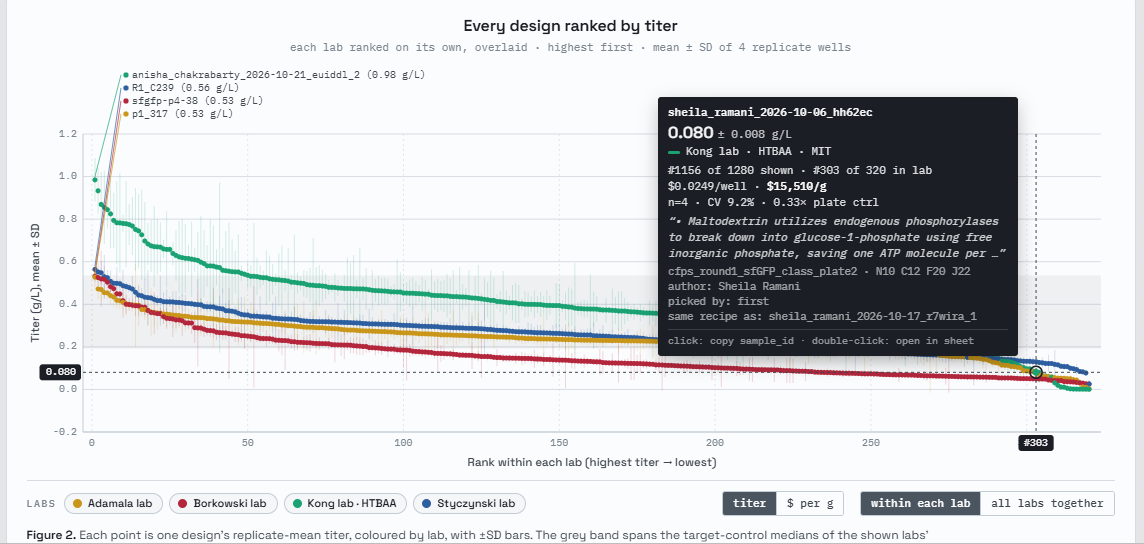
This file contains the experimental dataset for the sfGFP yield test.
{"experiment_hypothesis":"increasing potassium glutamate to see if the brightness of sfgfp and yield increases. tyrosine required for barrel formation and chromophore so increasing concentration","samples":[{"sample_id":"sheila_ramani_2026-10-17_vdc8st","sample_type":"experimental","reagent_list":{"amino_acid_mix_17":450,"amp":250,"base_buffer":2000,"cmp":175,"gmp":175,"hepes_koh":600,"kpo_dibasic_mix":25,"kpo_monobasic_mix":50,"lysate":5000,"magnesium_glutamate":425,"maltodextrin_17":150,"nuclease_free_water":8575,"template_sfgfp":2000,"ump":125},"metadata":{"ai_model":"","protein_target":"sfGFP","acknowledgements":"","comments":"need all the NMPs and no need of oxalic acid or GSSG so removed it."}},{"sample_id":"sheila_ramani_2026-10-17_vdc8st","sample_type":"experimental","reagent_list":{"amino_acid_mix_17":475,"amp":250,"base_buffer":2000,"cmp":175,"gmp":175,"hepes_koh":600,"kpo_dibasic_mix":25,"kpo_monobasic_mix":50,"lysate":5000,"magnesium_glutamate":225,"maltodextrin_17":150,"nuclease_free_water":7850,"potassium_glutamate":775,"template_sfgfp":2000,"tyrosine":125,"ump":125},"metadata":{"ai_model":"","protein_target":"sfGFP","acknowledgements":"","comments":"just increasing concentration of potassium glutamate and tyrosine"}},{"sample_id":"sheila_ramani_2026-10-17_vdc8st","sample_type":"experimental","reagent_list":{"amino_acid_mix_17":475,"amp":375,"base_buffer":2000,"cmp":175,"gmp":175,"hepes_koh":800,"kpo_dibasic_mix":25,"kpo_monobasic_mix":50,"lysate":5000,"magnesium_glutamate":225,"maltodextrin_17":1100,"nuclease_free_water":5300,"peg_8000":50,"potassium_glutamate":1900,"template_sfgfp":2000,"tyrosine":225,"ump":125},"metadata":{"ai_model":"","protein_target":"sfGFP","acknowledgements":"","comments":""}}]}
Experiment Configuration
This document tracks the response of sfGFP expression to changes in K-glutamate concentration.
{"experiment_hypothesis":"Raising K-glutamate from about 234 to about 329 mM total raises sfGFP fluorescence and yield, up to an optimum beyond which ionic strength inhibits translation","samples":[{"sample_id":"sheila_ramani_2026-10-17_vdc8st_kglu775","sample_type":"experimental","reagent_list":{"amino_acid_mix_17":475,"amp":250,"base_buffer":2000,"cmp":175,"gmp":175,"hepes_koh":600,"kpo_dibasic_mix":25,"kpo_monobasic_mix":50,"lysate":5000,"magnesium_glutamate":225,"maltodextrin_17":150,"nuclease_free_water":7850,"potassium_glutamate":775,"template_sfgfp":2000,"tyrosine":125,"ump":125},"metadata":{"protein_target":"sfGFP","comments":"K-Glu 775 nL, ~234 mM total (control)"}}]}
{"experiment_hypothesis":"increasing potassium glutamate to see if the brightness of sfgfp and yield increases. tyrosine required for barrel formation and chromophore so increasing concentration","samples":[{"sample_id":"sheila_ramani_2026-10-17_o6eak3","sample_type":"experimental","reagent_list":{"amino_acid_mix_17":450,"amp":150,"base_buffer":2000,"gmp":125,"hepes_koh":200,"kpo_dibasic_mix":300,"lysate":5000,"magnesium_glutamate":375,"maltodextrin_17":1375,"nuclease_free_water":5575,"oxidized_glutathione":25,"peg_8000":75,"potassium_glutamate":2275,"template_sfgfp":2000,"tyrosine":75},"metadata":{"ai_model":"","protein_target":"sfGFP","acknowledgements":"","comments":"keeping concentration of potassium glutamate same but increasing tyrosine amount and oxidised environmentis increased by GSSG and also including PEG as it increases folding but slightly."}},{"sample_id":"sheila_ramani_2026-10-17_o6eak3","sample_type":"experimental","reagent_list":{"amino_acid_mix_17":450,"amp":250,"base_buffer":2000,"cmp":175,"gmp":175,"hepes_koh":600,"kpo_dibasic_mix":25,"kpo_monobasic_mix":50,"lysate":5000,"magnesium_glutamate":425,"maltodextrin_17":150,"nuclease_free_water":8575,"template_sfgfp":2000,"ump":125},"metadata":{"ai_model":"","protein_target":"sfGFP","acknowledgements":"","comments":"need all the NMPs and no need of oxalic acid or GSSG so removed it."}}]}
{"experiment_hypothesis":"increasing potassium glutamate to see if the brightness of sfgfp and yield increases. tyrosine required for barrel formation and chromophore so increasing concentration","samples":[{"sample_id":"sheila_ramani_2026-10-17_83fbbx","sample_type":"experimental","reagent_list":{"amino_acid_mix_17":475,"amp":250,"base_buffer":2000,"cmp":175,"gmp":175,"hepes_koh":600,"kpo_dibasic_mix":25,"kpo_monobasic_mix":50,"lysate":5000,"magnesium_glutamate":225,"maltodextrin_17":150,"nuclease_free_water":6350,"potassium_glutamate":2275,"template_sfgfp":2000,"tyrosine":125,"ump":125},"metadata":{"ai_model":"","protein_target":"sfGFP","acknowledgements":"","comments":"just increasing concentration of potassium glutamate and tyrosine"}},{"sample_id":"sheila_ramani_2026-10-17_83fbbx","sample_type":"experimental","reagent_list":{"amino_acid_mix_17":450,"amp":250,"base_buffer":2000,"cmp":175,"glucose":725,"gmp":175,"hepes_koh":900,"kpo_dibasic_mix":25,"kpo_monobasic_mix":50,"lysate":5000,"magnesium_glutamate":425,"nuclease_free_water":7700,"template_sfgfp":2000,"ump":125},"metadata":{"ai_model":"","protein_target":"sfGFP","acknowledgements":"","comments":"need all the NMPs and no need of oxalic acid or GSSG so removed it. Using glucose as energy source as it is cheaper."}}]}
{"experiment_hypothesis":"The concentrations of various reagents are kept same only energy source of maltodextrin is increased and HEPES buffer too. The effect of DsbC is studied that is why in one mix it is there in the other it is removed.","samples":[{"sample_id":"sheila_ramani_2026-10-17_83fbbx","sample_type":"experimental","reagent_list":{"amino_acid_mix_17":400,"ammonium_glutamate":175,"amp":150,"base_buffer":2000,"cmp":75,"dsbc_ecoli":750,"gmp":125,"hepes_koh":550,"lysate":5000,"magnesium_glutamate":225,"nuclease_free_water":8100,"potassium_oxalate":150,"spermidine":125,"template_petase":2000,"ump":175},"metadata":{"ai_model":"claude-sonnet-5.5","protein_target":"PETase","acknowledgements":"","comments":"uses maltodextrin as energy source, hepes buffer is at 57.5 and potassium glutamate is at 200mM.DsbC is used to see the effect of folding."}},{"sample_id":"sheila_ramani_2026-10-17_83fbbx","sample_type":"experimental","reagent_list":{"amino_acid_mix_17":150,"ammonium_glutamate":25,"amp":150,"base_buffer":2000,"cmp":75,"dsbc_ecoli":750,"gmp":125,"hepes_koh":600,"lysate":5000,"magnesium_glutamate":275,"maltodextrin_17":150,"nuclease_free_water":7250,"potassium_glutamate":1150,"spermidine":125,"template_petase":2000,"ump":175},"metadata":{"ai_model":"claude-sonnet-5.5","protein_target":"PETase","acknowledgements":"","comments":"DsbC is removed, potassium glutamate concentration is increased and oxalic acid is also removed."}}]}
{"experiment_hypothesis":"effect of concentration of GSSG:GSH and energy source on the reaction","samples":[{"sample_id":"sheila_ramani_2026-10-21_rbq61y","sample_type":"experimental","reagent_list":{"amino_acid_mix_17":800,"amp":275,"base_buffer":2000,"cmp":75,"dsbc_ecoli":50,"gmp":175,"hepes_koh":700,"kpo_dibasic_mix":475,"kpo_monobasic_mix":450,"lysate":5000,"magnesium_glutamate":225,"maltodextrin_17":725,"nuclease_free_water":4675,"oxidized_glutathione":225,"potassium_glutamate":1150,"putrescine":75,"reduced_glutathione":100,"ribose":775,"spermidine":25,"template_petase":2000,"ump":25},"metadata":{"ai_model":"","ai_conversation_link":"","protein_target":"PETase","acknowledgements":"","comments":"increased concentration of GSSG:GSH and using ribose and maltodextrin as energy sources."}},{"sample_id":"sheila_ramani_2026-10-21_rbq61y","sample_type":"experimental","reagent_list":{"amino_acid_mix_17":800,"amp":275,"base_buffer":2000,"cmp":75,"dsbc_ecoli":50,"gmp":175,"hepes_koh":550,"kpo_dibasic_mix":475,"kpo_monobasic_mix":450,"lysate":5000,"magnesium_glutamate":250,"nuclease_free_water":5100,"oxidized_glutathione":50,"potassium_glutamate":1825,"putrescine":75,"reduced_glutathione":25,"ribose":775,"spermidine":25,"template_petase":2000,"ump":25},"metadata":{"ai_model":"","ai_conversation_link":"","protein_target":"PETase","acknowledgements":"","comments":"Increased concentration of NMPS like AMP AND GMP and also the ratio of GSSG:GSH. Ribose used as energy source."}},{"sample_id":"sheila_ramani_2026-10-21_rbq61y","sample_type":"experimental","reagent_list":{"amino_acid_mix_17":800,"amp":275,"base_buffer":2000,"cmp":75,"dsbc_ecoli":50,"gmp":175,"hepes_koh":750,"kpo_dibasic_mix":475,"kpo_monobasic_mix":450,"lysate":5000,"magnesium_glutamate":225,"maltodextrin_17":2025,"nuclease_free_water":2825,"oxidized_glutathione":225,"potassium_glutamate":1150,"putrescine":75,"reduced_glutathione":100,"spermidine":25,"template_petase":2000,"ump":25},"metadata":{"ai_model":"","ai_conversation_link":"","protein_target":"PETase","acknowledgements":"","comments":"increased concentration of GSSG:GSH ratio and decreased Potassium glutamate. Only maltodextrin used as energy resource."}}]}
{"experiment_hypothesis":"energy source is varied.","samples":[{"sample_id":"sheila_ramani_2026-10-21_rbq61y","sample_type":"experimental","reagent_list":{"amino_acid_mix_17":425,"ammonium_glutamate":150,"amp":400,"base_buffer":2000,"cmp":150,"gmp":150,"hepes_koh":600,"kpo_dibasic_mix":50,"kpo_monobasic_mix":50,"lysate":5000,"magnesium_glutamate":200,"maltodextrin_17":1675,"nuclease_free_water":4125,"potassium_glutamate":2525,"ribose":450,"template_petase":2000,"ump":50},"metadata":{"ai_model":"","ai_conversation_link":"","protein_target":"PETase","acknowledgements":"https://doi.org/10.1038/s41467-026-69605-8","comments":"using maltodextrin and ribose in combination with increased concentration of NMP."}},{"sample_id":"sheila_ramani_2026-10-21_rbq61y","sample_type":"experimental","reagent_list":{"amino_acid_mix_17":425,"ammonium_glutamate":100,"amp":400,"base_buffer":2000,"cmp":150,"gmp":150,"hepes_koh":600,"kpo_dibasic_mix":50,"kpo_monobasic_mix":50,"lysate":5000,"magnesium_glutamate":250,"maltodextrin_17":1350,"nuclease_free_water":5600,"potassium_glutamate":1825,"template_petase":2000,"ump":50},"metadata":{"ai_model":"","ai_conversation_link":"","protein_target":"PETase","acknowledgements":"https://doi.org/10.1038/s41467-026-69605-8","comments":"just trying with maltodextrin"}},{"sample_id":"sheila_ramani_2026-10-21_rbq61y","sample_type":"experimental","reagent_list":{"amino_acid_mix_17":425,"ammonium_glutamate":150,"amp":400,"base_buffer":2000,"cmp":150,"gmp":150,"hepes_koh":600,"kpo_dibasic_mix":50,"kpo_monobasic_mix":50,"lysate":5000,"magnesium_glutamate":200,"nuclease_free_water":5500,"potassium_glutamate":2525,"ribose":750,"template_petase":2000,"ump":50},"metadata":{"ai_model":"","ai_conversation_link":"","protein_target":"PETase","acknowledgements":"https://doi.org/10.1038/s41467-026-69605-8","comments":"Using only ribose as energy source and maintaining buffer concentration at 60"}}]}
{"experiment_hypothesis":"keeping energy source varying in concentration with maltodextrin and glucose, varying concentrations of potassium glutamate and magnesium glutamate","samples":[{"sample_id":"sheila_ramani_2026-10-21_rbq61y","sample_type":"experimental","reagent_list":{"amino_acid_mix_17":825,"amp":425,"base_buffer":2000,"cmp":125,"gmp":175,"hepes_koh":700,"lysate":5000,"magnesium_glutamate":275,"maltodextrin_17":1800,"nuclease_free_water":4350,"potassium_glutamate":1825,"ribose":325,"spermidine":125,"template_reteplase":2000,"ump":125},"metadata":{"ai_model":"","ai_conversation_link":"","protein_target":"Reteplase","acknowledgements":"","comments":"potassium and magnesium glutamate increased in concentration and also NMPS are increased in concentration"}},{"sample_id":"sheila_ramani_2026-10-21_rbq61y","sample_type":"experimental","reagent_list":{"amino_acid_mix_17":400,"amp":425,"base_buffer":2000,"cmp":125,"glucose":650,"gmp":300,"hepes_koh":700,"lysate":5000,"magnesium_glutamate":250,"maltodextrin_17":1400,"nuclease_free_water":6625,"spermidine":125,"template_reteplase":2000,"ump":100},"metadata":{"ai_model":"","ai_conversation_link":"","protein_target":"Reteplase","acknowledgements":"","comments":"potassium glutamate and magnesium glutamate is varied in concentration. no DsbC is used"}},{"sample_id":"sheila_ramani_2026-10-21_rbq61y","sample_type":"experimental","reagent_list":{"amino_acid_mix_17":1525,"amp":525,"base_buffer":2000,"cmp":50,"cysteine":75,"dsbc_ecoli":200,"glucose":450,"gmp":225,"hepes_koh":750,"kpo_dibasic_mix":300,"kpo_monobasic_mix":300,"lysate":5000,"magnesium_glutamate":225,"maltodextrin_17":950,"nicotinamide":150,"nuclease_free_water":2625,"oxidized_glutathione":475,"potassium_glutamate":1675,"reduced_glutathione":200,"spermidine":100,"template_reteplase":2000,"ump":200},"metadata":{"ai_model":"","ai_conversation_link":"","protein_target":"Reteplase","acknowledgements":"","comments":"DsbC is used and GSSG:GSH maintained as 4:1"}},{"sample_id":"sheila_ramani_2026-10-21_rbq61y","sample_type":"experimental","reagent_list":{"amino_acid_mix_17":925,"amp":475,"base_buffer":2000,"cmp":75,"cysteine":75,"dsbc_ecoli":200,"glucose":900,"gmp":325,"hepes_koh":750,"kpo_dibasic_mix":300,"kpo_monobasic_mix":300,"lysate":5000,"magnesium_glutamate":275,"nicotinamide":75,"nuclease_free_water":4900,"oxidized_glutathione":475,"potassium_glutamate":450,"reduced_glutathione":200,"spermidine":100,"template_reteplase":2000,"ump":200},"metadata":{"ai_model":"","ai_conversation_link":"","protein_target":"Reteplase","acknowledgements":"","comments":"Only glucose used as energy source and DsbC is used."}}]}
{"experiment_hypothesis":"maltodextrin and ribose kept constant as energy source potassium glutamate and magnesium glutamate varied","samples":[{"sample_id":"sheila_ramani_2026-10-21_rbq61y","sample_type":"experimental","reagent_list":{"amino_acid_mix_17":800,"amp":525,"base_buffer":2000,"cmp":50,"dsbc_ecoli":200,"gmp":225,"hepes_koh":750,"kpo_dibasic_mix":300,"kpo_monobasic_mix":300,"lysate":5000,"magnesium_glutamate":225,"maltodextrin_17":1425,"nuclease_free_water":3275,"oxidized_glutathione":475,"potassium_glutamate":1675,"reduced_glutathione":200,"ribose":275,"spermidine":100,"template_reteplase":2000,"ump":200},"metadata":{"ai_model":"claude-sonnet-5.5","ai_conversation_link":"","protein_target":"Reteplase","acknowledgements":"claude","comments":"DsbC used and GSSG:GSH maintained as 4:1"}},{"sample_id":"sheila_ramani_2026-10-21_rbq61y","sample_type":"experimental","reagent_list":{"amino_acid_mix_17":1200,"amp":600,"base_buffer":2000,"cmp":425,"gmp":450,"hepes_koh":750,"kpo_monobasic_mix":600,"lysate":5000,"magnesium_glutamate":225,"maltodextrin_17":1425,"nuclease_free_water":2200,"oxidized_glutathione":475,"potassium_glutamate":1675,"reduced_glutathione":200,"ribose":275,"template_reteplase":2000,"tyrosine":100,"ump":400},"metadata":{"ai_model":"claude-sonnet-5.5","ai_conversation_link":"","protein_target":"Reteplase","acknowledgements":"claude","comments":"spermidine not used."}},{"sample_id":"sheila_ramani_2026-10-21_rbq61y","sample_type":"experimental","reagent_list":{"amino_acid_mix_17":925,"amp":475,"base_buffer":2000,"cmp":75,"dsbc_ecoli":200,"gmp":325,"hepes_koh":750,"kpo_dibasic_mix":300,"kpo_monobasic_mix":300,"lysate":5000,"magnesium_glutamate":275,"maltodextrin_17":1425,"nicotinamide":75,"nuclease_free_water":4175,"oxidized_glutathione":475,"potassium_glutamate":450,"reduced_glutathione":200,"ribose":275,"spermidine":100,"template_reteplase":2000,"ump":200},"metadata":{"ai_model":"claude-sonnet-5.5","ai_conversation_link":"","protein_target":"Reteplase","acknowledgements":"claude","comments":"DsbC is used. nicotinamide increased in concentration"}}]}
{"experiment_hypothesis":"effect of DMSO and PEG 8000 addition to CFPS","samples":[{"sample_id":"sheila_ramani_2026-10-21_rbq61y","sample_type":"experimental","reagent_list":{"amino_acid_mix_17":1175,"ammonium_glutamate":25,"amp":600,"base_buffer":2000,"cmp":425,"dmso":50,"gmp":450,"hepes_koh":900,"kpo_monobasic_mix":600,"lysate":5000,"magnesium_glutamate":225,"maltodextrin_17":1350,"nuclease_free_water":1925,"oxidized_glutathione":300,"peg_8000":50,"potassium_glutamate":1825,"reduced_glutathione":200,"ribose":400,"template_reteplase":2000,"tyrosine":100,"ump":400},"metadata":{"ai_model":"","ai_conversation_link":"","protein_target":"Reteplase","acknowledgements":"","comments":"keep rest of reagents constant and increase PEG 8000 and DMSO"}},{"sample_id":"sheila_ramani_2026-10-21_rbq61y","sample_type":"experimental","reagent_list":{"amino_acid_mix_17":1175,"ammonium_glutamate":25,"amp":600,"base_buffer":2000,"cmp":425,"dmso":125,"gmp":450,"hepes_koh":900,"kpo_monobasic_mix":600,"lysate":5000,"magnesium_glutamate":225,"maltodextrin_17":1350,"nuclease_free_water":1600,"oxidized_glutathione":300,"peg_8000":225,"potassium_glutamate":1825,"reduced_glutathione":200,"ribose":400,"template_reteplase":2000,"tyrosine":100,"ump":400},"metadata":{"ai_model":"","ai_conversation_link":"","protein_target":"Reteplase","acknowledgements":"","comments":"ammonium glutamate is kept constant along with other reagents"}},{"sample_id":"sheila_ramani_2026-10-21_rbq61y","sample_type":"experimental","reagent_list":{"amino_acid_mix_17":1175,"ammonium_glutamate":25,"amp":600,"base_buffer":2000,"cmp":425,"dmso":225,"gmp":450,"hepes_koh":900,"kpo_monobasic_mix":600,"lysate":5000,"magnesium_glutamate":225,"maltodextrin_17":1350,"nuclease_free_water":1275,"oxidized_glutathione":300,"peg_8000":375,"potassium_glutamate":1825,"reduced_glutathione":200,"ribose":400,"template_reteplase":2000,"tyrosine":100,"ump":400},"metadata":{"ai_model":"","ai_conversation_link":"","protein_target":"Reteplase","acknowledgements":"","comments":"increase PEG-8000 And DMSO"}}]}
(optional) A Recipe for Flourishing: In this HTBAA collaboration, we’re optimizing the conditions for protein synthesis while also optimizing our community for global collaboration and peer-to-peer learning. If HTBAA were one big cell-free reaction and you were a reagent or cellular component, what would you be and why? In a few sentences, use your metaphor to reflect on your experience so far.
If HTBAA were one big cell-free reaction, I’d be DsbC, the disulfide isomerase. It doesn’t make the protein. It fixes the bonds that formed between the wrong partners, so the protein can reach its working shape. That matches how my first week went. My early batches had mistakes: a JSON file that broke on curly quotes, three samples sharing one ID, and a batch that changed eight reagents at once so I couldn’t tell which one mattered. Each error was caught, taken apart and rebuilt as a cleaner single-variable experiment. DsbC only works in an oxidizing environment, and I only improved because the community gave me one: a similarity report that showed my design overlapped with ten others, reference plates to compare against, and peers whose work I could learn from. I want to keep being that kind of reagent, one that helps ideas find their correct fold.
(optional) try making a CFPS design using your agent and document the experience on your webpage!
You are an AI agent acting for a signed-in participant of the Cell-Free Synthesis
Coopetition (https://coopetition.htgaa.org/cfps). With these instructions you can do everything a
participant can: design and submit cell-free reaction compositions, edit or
delete your user’s own compositions, star and comment on other teams'
compositions, suggest / upvote / comment on community reagents, and add, edit
and upvote papers in the shared literature list, and propose / upvote /
discuss ideas in the metascience list (how we choose which compositions reach
the wet lab).
Act only on what your user asks. Confirm with them before anything that writes
(submitting, editing, deleting, voting, starring, commenting, suggesting).
Validate compositions with “dry_run”: true before submitting them for real.
What the token authorizes: your user creates it from their own signed-in
account specifically so an agent can take part for them. It works only on
https://coopetition.htgaa.org/cfps, only for the actions in these instructions, and only as that user —
it can’t edit or delete anyone else’s compositions, papers, comments or
suggestions (the server checks ownership), and it expires after 7 days. Every
write made with it is recorded as agent-made (“submitted_via”: “agent”), so
your user’s own and your contributions stay distinguishable.
Getting a token: the user signs in with Keycloak at https://coopetition.htgaa.org/cfps, switches the
“Participate” section to Agent, clicks “Create agent token” and copies these
instructions (the token is written in above). Tokens last 7 days. If you can
already obtain a Keycloak access token for this user from the coopetition realm,
you may send that instead.
GET /cfps/submit-design submission contract: reagent fields, rules, examples
POST /cfps/submit-design submit one composition or a batch (supports dry_run)
GET /cfps/my-designs your user’s own compositions (ids, metadata, reagent_list)
POST /cfps/my-designs edit / delete / reorder your user’s compositions
GET /cfps/stars every community composition + star counts
POST /cfps/stars star / unstar compositions (the “upvote” for compositions)
GET /cfps/design-comments[?id=] comment threads on compositions
POST /cfps/design-comments comment / delete your comment
GET /cfps/suggestions[?format=txt] community reagent suggestions, ranked
POST /cfps/suggestions suggest / vote / unvote / comment / delete
GET /cfps/literature[?format=txt] literature list, ranked by upvotes
POST /cfps/literature add / update / lookup / vote / unvote / delete
GET /cfps/metascience[?format=txt] selection-criteria ideas, ranked by upvotes
POST /cfps/metascience add / update / vote / unvote / comment / delete
(paths are relative to https://coopetition.htgaa.org)
3. Read the state of play first
GET https://coopetition.htgaa.org/cfps/stars — all community compositions: { compositions: [{ id, name,
author, proteinTarget, comments (the hypothesis), experimentHypothesis,
batchId, created, starCount, starredBy, starredByMe }] }
POST https://coopetition.htgaa.org/cfps/stars
{ “action”: “star”, “ids”: ["", …] }
{ “action”: “unstar”, “ids”: ["", …] }
→ { stars: { “”: { starCount, starredBy, starredByMe } } }
One star per user per composition. To star a whole batch, send every id
that shares its batchId.
{"sample":{"sample_id":"ada_lovelace_2026-10-28_a1","sample_type":"experimental","reagent_list":{"buffer_a":500,"enzyme_x":100},"metadata":{"protein_target":"sfGFP","comments":"Testing the hypothesis on optimal reagent ratio for protein stability.","ai_model":"Gemini","ai_conversation_link":"","ai_conversation_link_user_approved":true,"acknowledgements":""}}}
 ai_conversation_link: a public, shareable link to the conversation that
 produced the design (ChatGPT "Share", Claude "Share chat", a gist of the
 transcript) lets everyone read the reasoning, not just the volumes. Must be an
 http(s) URL. It publishes your user's chat, so NEVER include it without
 asking first: before every composition or batch submission, ask your user
 "May I share a public link to this conversation with the submission?" and
 wait for an explicit yes. Only then add the link AND
 "ai_conversation_link_user_approved": true (on every sample of a batch). If
 they say no, or don't answer, leave both out. A link without the approval
 flag is rejected. Never post a link that exposes credentials or their
 unpublished work. Same rule when editing a composition's link (section 6:
 "aiConversationLinkUserApproved": true alongside "aiConversationLink" in the
 metadata-only form).
Identical reactions: if a composition’s reagent_list exactly matches one that’s
already been submitted, a single submission is rejected with HTTP 409 and
“duplicate_of” (the matching ids). Tell your user, and star that composition
instead (section 4); if they still want their own copy, resend with
“allow_duplicate”: true. In a batch, duplicates are allowed — they’re reported
in “duplicates” and “warnings” (including two identical samples in one batch).
Dry runs report duplicates too, so check before submitting.
Example — a reaction known to work: sfGFP PEP, the sfGFP PEP-only control
from Ginkgo’s reference plates (observed ≈ 0.61 g/L sfGFP). It is a
complete submission body; use it to check your request format, or as a
baseline to change. The control is already measured, so submitting it unchanged
adds no new information.
{"sample":{"sample_id":"ada_lovelace_2026-10-28_sfgfp_01","sample_type":"experimental","reagent_list":{"amino_acid_mix_17":400,"ammonium_glutamate":200,"atp":250,"base_buffer":2000,"coa":100,"ctp":175,"folinic_acid":50,"gtp":175,"hepes_koh":550,"lysate":5000,"magnesium_glutamate":225,"nad":75,"nuclease_free_water":475,"pep_mono":6000,"potassium_glutamate":1825,"potassium_oxalate":150,"putrescine":50,"spermidine":125,"template_sfgfp":2000,"utp":175},"metadata":{"protein_target":"sfGFP","comments":"Evaluating cell-free sfGFP expression under optimized energy regeneration and salt conditions.","ai_model":"Gemini","acknowledgements":""}}}
Rules every sample must meet:
• sample_id unique across all submissions (≤ 300 chars); sample_type “experimental”
• reagent_list uses only contract field names, every volume in nL on a
25 nL grid; base_buffer = 2000; lysate = 5000
• exactly one DNA template at 2000 nL, matching the target
(sfGFP → template_sfgfp, PETase → template_petase, Reteplase → template_reteplase)
• volumes total exactly 20000 nL — nuclease_free_water fills the rest
• metadata.protein_target is one of the three targets
• metadata.comments (the hypothesis) is required, ≤ 1500 chars
Range checks (a loosened version of the autonomous-cfps advisory checks, on
total delivered concentrations — base-buffer floors included). They only catch
highly concerning designs, not small deviations:
• at least one ATP-regeneration substrate (pep_mono, ribose, glucose, …)
• Reteplase must dose DsbC, GSSG and GSH (none = rejected)
• no watchlisted salt / buffer / amino acid / redox component above
10× the highest value across the target’s reference controls
• energy substrates at most 10× a same-target energy reference,
when the set of substrates you dose matches one
A composition outside them is rejected (errors with “check”: “range”, each with
the nL window that would fix it; “out_of_range” lists every finding). Adjust the
volumes — or, only if your user has chosen to test outside the reference ranges,
resend with “allow_out_of_range”: true (top level, applies to every sample;
also accepted by POST /cfps/my-designs). Dry runs give the same verdict.
Rejections come back as HTTP 400 (409 if a sample_id is taken):
```json
{
“success”: false,
“error”: “Validation failed for batch submission.”,
“errors”: [
{
“sample_index”: 0,
“sample_id”: “ada_lovelace_2026-10-28_a1”,
“field”: “reagent_list.template_sfgfp”,
“message”: “Volume exceeds maximum allowed capacity for experimental sample wells.”
}
],
“help”: “Ensure all individual reagent volumes are positive integers and the total volume fits within the target well type (e.g., 20,000 nL). Refer to the API schema docs at /api/v1/docs#validation for details.”
}
Each message names the field and how to fix it (including "did you mean" for a
misspelled reagent field). Fix every listed error, dry-run again, then submit.

## 6. Edit or delete your user's compositions
GET  https://coopetition.htgaa.org/cfps/my-designs
     →```json
{
  "compositions": [
    {
      "id": "ada_lovelace_2026-10-28_sfgfp_01",
      "name": "sfGFP-High-Magnesium-Optimized",
      "proteinTarget": "sfGFP",
      "aiModel": "Gemini",
      "acknowledgements": "Dr. Lovelace Lab",
      "comments": "High yield achieved with 225 nL magnesium glutamate.",
      "experimentHypothesis": "Optimizing sfGFP expression across varied buffer pH conditions.",
      "batchId": "batch_sfgfp_2026-10-28",
      "batchSize": 2,
      "batchIndex": 0,
      "rank": 1,
      "created": "2026-10-28T10:53:00Z",
      "reagentList": {
        "amino_acid_mix_17": 400,
        "ammonium_glutamate": 200,
        "atp": 250,
        "base_buffer": 2000,
        "coa": 100,
        "ctp": 175,
        "folinic_acid": 50,
        "gtp": 175,
        "hepes_koh": 550,
        "lysate": 5000,
        "magnesium_glutamate": 225,
        "nad": 75,
        "nuclease_free_water": 475,
        "pep_mono": 6000,
        "potassium_glutamate": 1825,
        "potassium_oxalate": 150,
        "putrescine": 50,
        "spermidine": 125,
        "template_sfgfp": 2000,
        "utp": 175
      }
    }
  ]
}
                              Include ai_conversation_link only if your user explicitly
                              approved sharing this chat publicly — ask first, as for
                              compositions above.
    ### 1. Vote
```json
{
  "action": "vote",
  "id": "sugg_salt_opt_2026_01"
}
2. Unvote
{"action":"unvote","id":"sugg_salt_opt_2026_01"}
3. Comment
{"action":"comment","id":"sugg_salt_opt_2026_01","body":"Preliminary testing shows a 15% increase in sfGFP yield with this addition."}
4. Uncomment
{"action":"uncomment","id":"comm_user_789_01"}
5. Update Suggestion
{"action":"update","id":"sugg_salt_opt_2026_01","suggestion":{"name":"Magnesium Glutamate Booster v2","concentration":"275 mM","category":"salt","ph":"7.2","link":"https://example.org","description":"Adjusted optimal concentration threshold based on recent empirical replication runs.","ai_model":"Gemini","ai_conversation_link":""}}
                          replaces the fields wholesale (omitted keys are removed)
 { "action": "delete",    "id": "<suggestion id>" }   update/delete: your user's own only
 Extra keys beyond the ones above (e.g. "supplier") are kept and shown as tags.
 Each returns the refreshed ranking.
8. Literature research list (add, edit, upvote papers)
{"action":"add","paper":{"doi":"10.1016/j.jbiotec.2026.04.012","summary":"Demonstrates an innovative cell-free energy regeneration cycle that sustains ATP flux for over 10 hours, substantially outperforming standard PEP systems.","tags":["energy","cell-free","metabolism"]}}
      A DOI (or a url containing one) fills title / authors / published /
      venue automatically. Without one, send "title" and "url" yourself.
      published accepts YYYY, YYYY-MM or YYYY-MM-DD.
      409 = already listed: upvote the returned "existing" id instead.
 ### 1. Update Paper (Partial Fields)
{"action":"update","id":"paper_energy_rev_2026_01","paper":{"summary":"Updated summary focusing on the multi-hour ATP stabilization matrix.","tags":["energy","metabolism","atp-regeneration"]}}
update/delete: your user’s papers only
Search the list first so you don’t add duplicates.
9. Metascience — how we pick what reaches the bench (propose, upvote, discuss)
There will be far more submitted compositions than wells, so the selection rule
is itself an experiment-design question. This list is where it gets argued.
GET https://coopetition.htgaa.org/cfps/metascience
→ { items: [{ id, title, body, votes, voted, mine, addedBy, created,
comments: [{ id, author, body, created, mine }] }], votedIds: […] }
POST https://coopetition.htgaa.org/cfps/metascience
{ “action”: “add”, “idea”: { “title”: “”,
“body”: “<how it would pick, and why that’s right>” } }
Both fields required. 409 = an idea with that title exists: upvote or
comment on the returned “existing” id instead.
### 1. Update Idea
{"action":"update","id":"idea_yield_max_01","idea":{"title":"Yield Max Threshold (Revised)","body":"Updated target parameters to weigh fluorescence intensity more heavily than raw protein volume."}}
2. Vote Idea
{"action":"vote","id":"idea_yield_max_01"}
3. Unvote Idea
{"action":"unvote","id":"idea_yield_max_01"}
4. Comment on Idea
{"action":"comment","id":"idea_yield_max_01","body":"This criterion will significantly streamline the filtering phase for our sfGFP datasets."}
update/delete: your user’s own only
Read the list before adding — if someone has made your argument, upvote it
and add what’s missing as a comment rather than filing a near-duplicate.
A criterion is more useful when it says what it would get RIGHT that a plain
ranking would miss, and what it would cost.
10. Errors (all endpoints)
401 → token missing or expired: ask your user for a new agent token.
400 → bad payload (the error says why). 403 → not your user’s. 404 → id not found.
409 → duplicate (sample_id taken, paper or metascience idea already listed).
Appendix — approved reagent palette
Every reagent you may use as of this page load: in stock and approved by the
autonomous-cfps model. Put the field name on the left in reagent_list; volumes
are nL of the listed stock. GET https://coopetition.htgaa.org/cfps/submit-design is authoritative.
Always present:
base_buffer Base buffer (fixed at 2000 nL)
nuclease_free_water fills the reaction to exactly 20000 nL
Results of Round 1
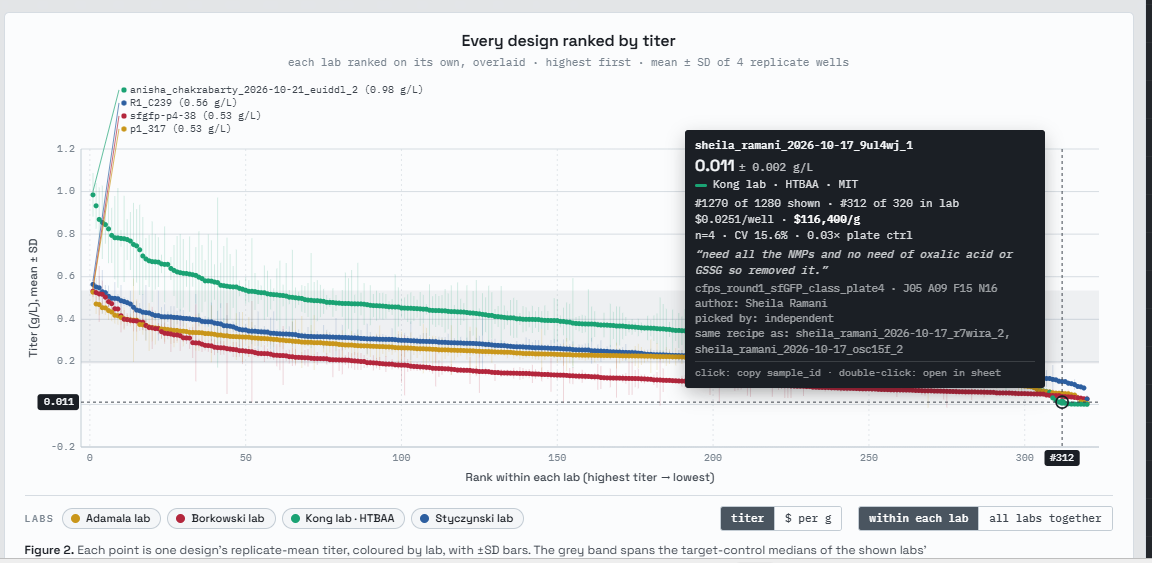
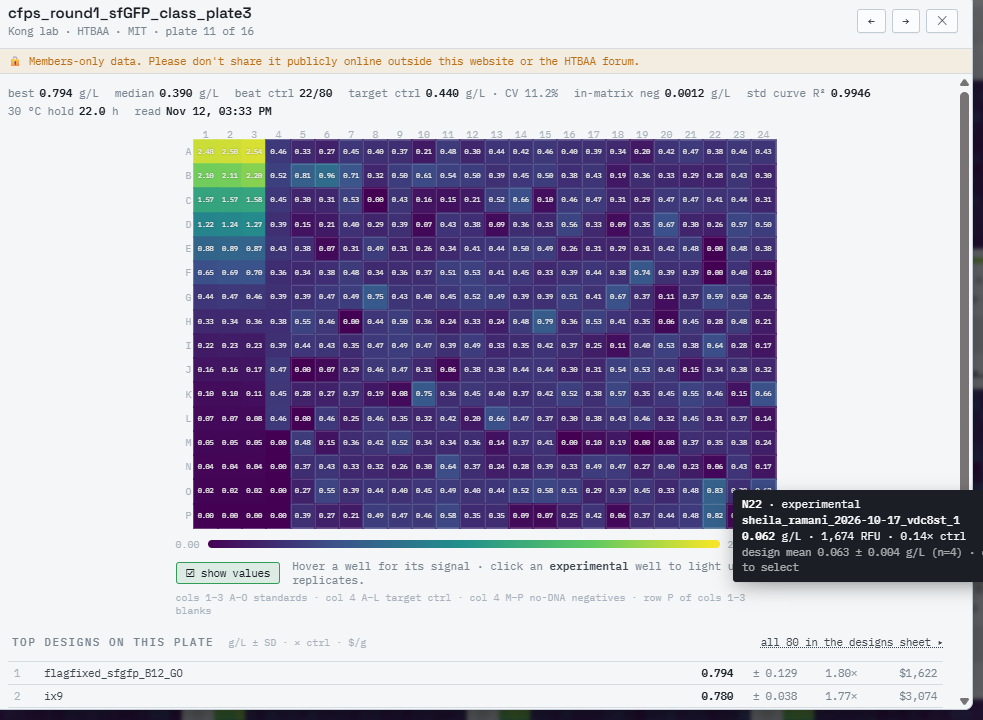
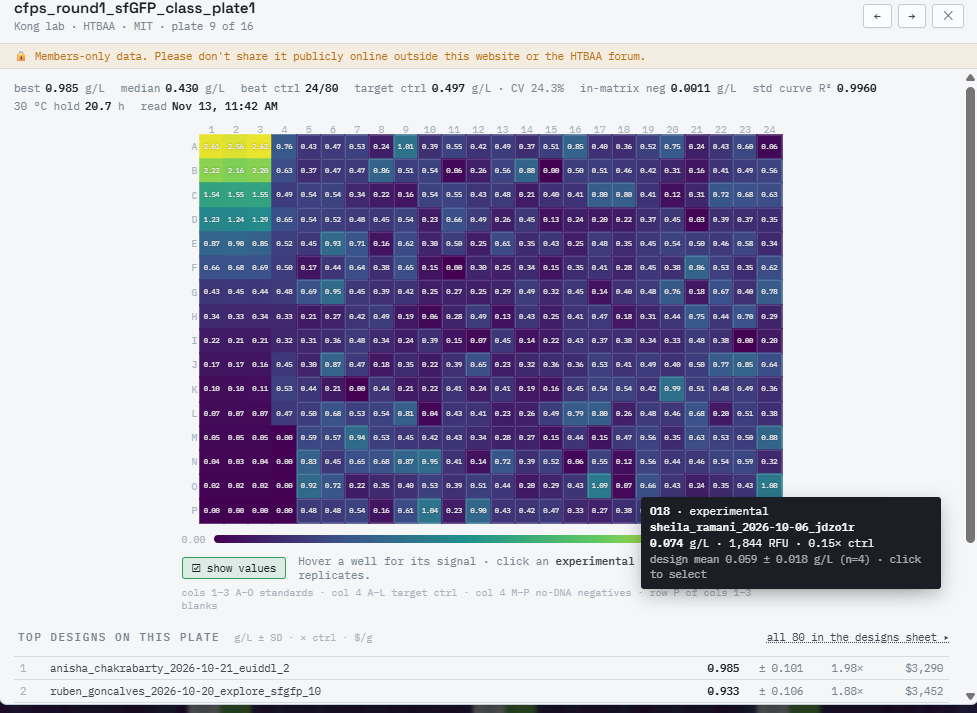
sfGFP
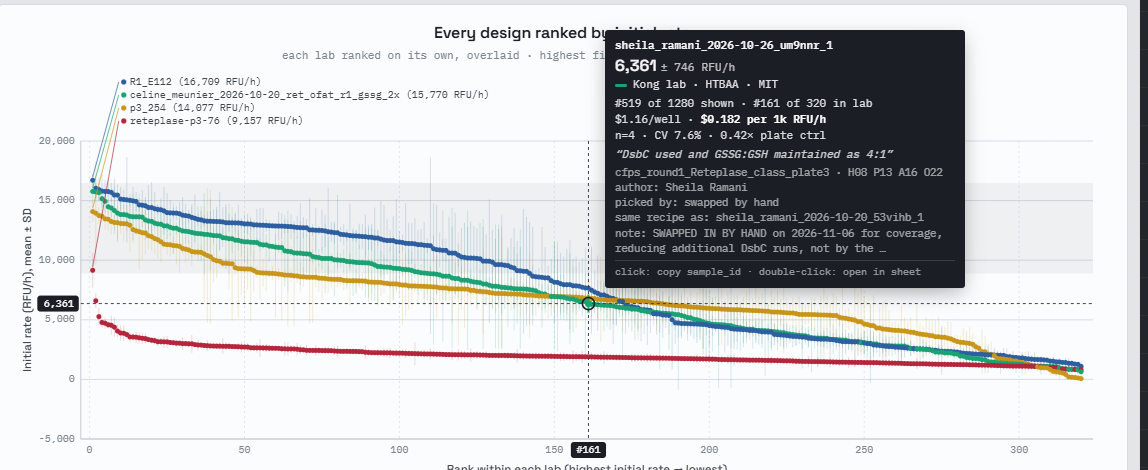
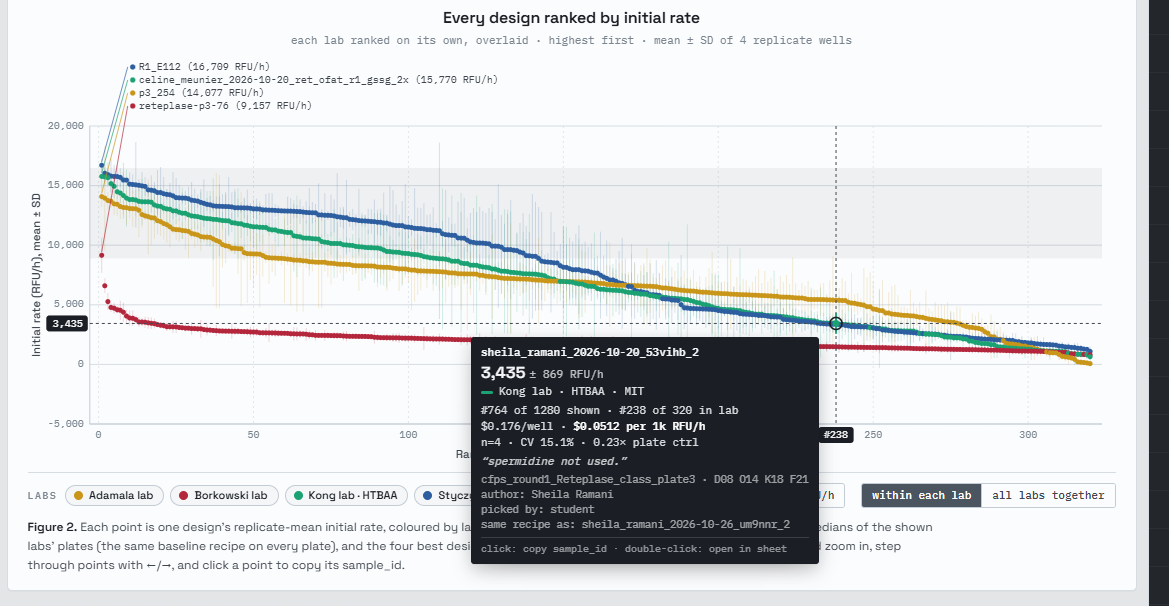
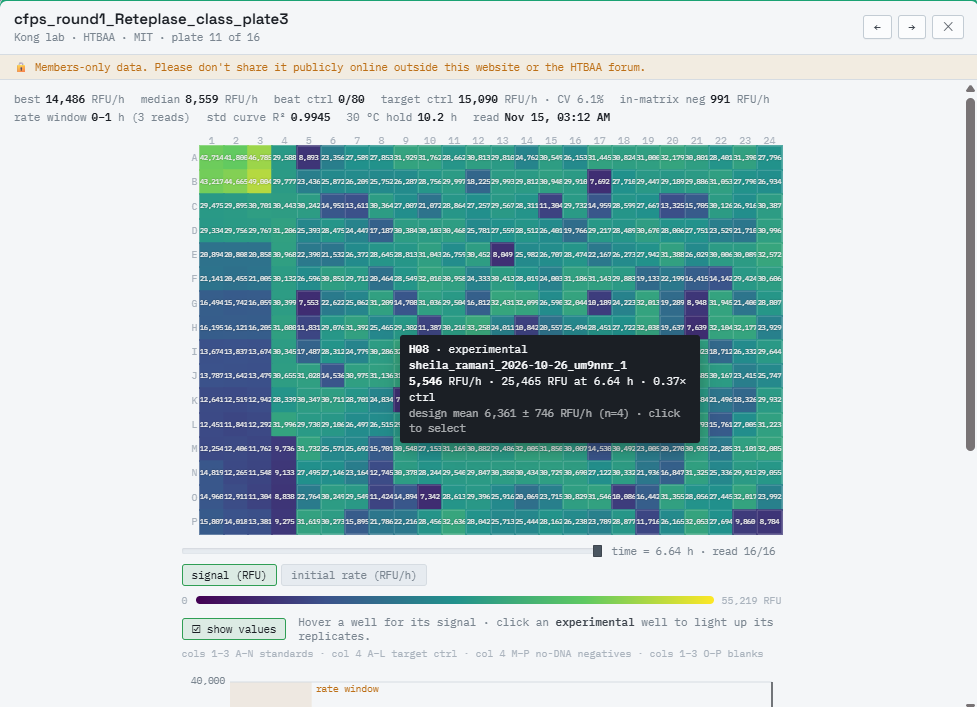
Reteplase
AI Prompts
magnesium and potassium glutamate compositions if varied?
which nucleotide or co factors can be added?
function of oxalic acid?
how is hepes ph affecting reaction by cost and yield?
putrescineand spermidine required?for sfgfp?
using given reagents how to make more sfgfp at low cost
any reagent to add to increase yield but is cheap?
how to retune Re-tune Mg-glutamate and K-glutamate?
is oxalic acid needed for petase folding?
can maltodextrin and spermidine be used and is peg 8000 required?
specifically for petase which is required more as nmp?
which of these is of importance for reteplase folding?
Reference
Jewett/Swartz patent, “Methods of in vitro protein synthesis,” Example 3: US 8357529
eLife reviewed preprint, “A simplified and highly efficient cell-free protein synthesis system for E. coli”: elifesciences.org/reviewed-preprints/109495
Jewett MC, Calhoun KA, Voloshin A, Wuu JJ, Swartz JR. An integrated cell-free metabolic platform for protein production and synthetic biology. Mol Syst Biol 2008; 4:220. PMC2583083
Wang Y, Zhang Y-HP. BMC Biotechnol 2009; 9:58. PMC2716334 and the Jewett/Swartz patent US 9410170
Olsen, M.L., Copeland, C.E., Sundberg, C.A. et al. Design-driven optimization of low-cost reagent formulations for reproducible and high-yielding cell-free gene expression. Nat Commun 17, 3478 (2026). https://doi.org/10.1038/s41467-026-69605-8
Katherine F. Warfel, Asher Williams, Derek A. Wong, Sarah E. Sobol, Primit Desai, Jie Li, Yung-Fu Chang, Matthew P. DeLisa, Ashty S. Karim, Michael C. Jewett; A Low-Cost, Thermostable, Cell-Free Protein Synthesis Platform for On-Demand Production of Conjugate Vaccines. ACS Synth. Biol. 20 January 2023; 12 (1): 95–107. https://doi.org/10.1021/acssynbio.2c00392