I am currently an entrepreneur designing robots which can move and fly.
Experience with scientific research, biology and bioengineering
Research Scientist and Engineer at Deptt. of Computer Science (HCI Group), Stanford University on Crowdsourcing as Future of Work and Governance Models
Research Engineer at Deptt. of Bioengineering (Riedel Kruse Lab), Stanford University on Cloud Biology Labs for Research and Education (Euglena Phototaxis), and Interactive Biotic Games (Live micro-organisms)
DIY fluorescent microscope automation with micro-manager using a plugin - managed by BioCurious, an open biomakerspace in california, US
phageParser: an open-source, Python-based bioinformatics tool designed to automate the extraction, curation, and analysis of CRISPR information from public genetic data - contributed code under Mozilla Sprint 2016 organized by Mozzila Science Lab
Computer-Aided Genetic Design for Structural Cellulose using Kernel (by Asimov)
Subsections of Shirish Goyal — HTBAA Fall 2026
Week 1 HW: Final Project Ideas
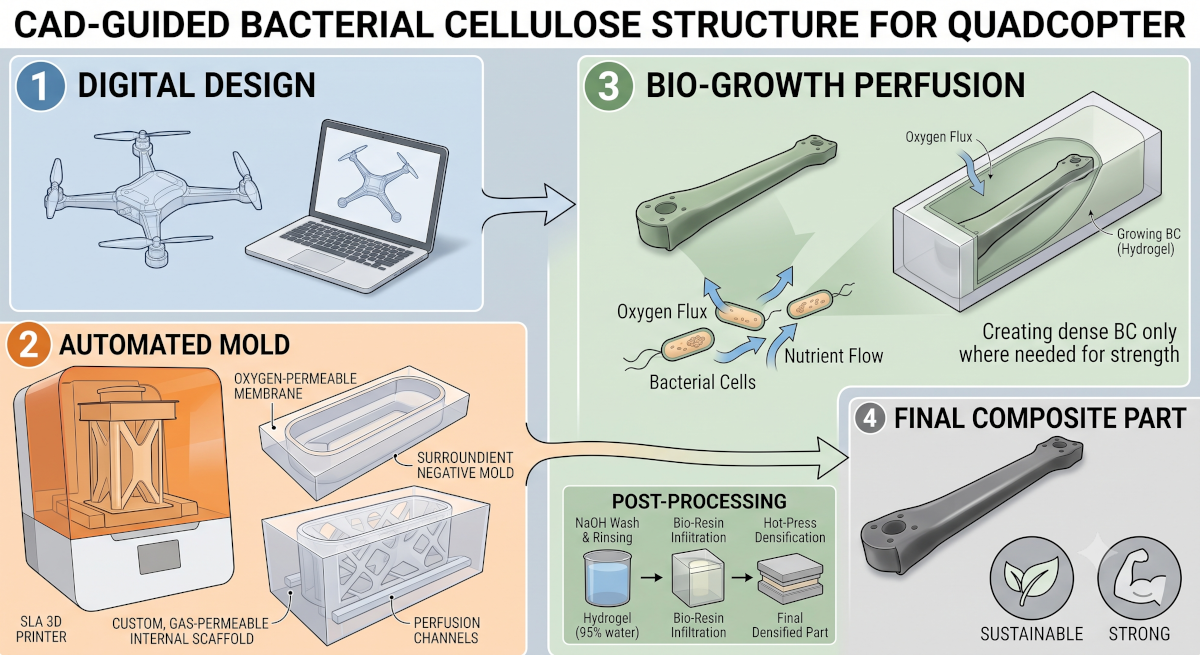
*figure generated using Gemini
(1) What you would like to biomanufacture and why?
Describe the target product or output you would like to make.
A CAD-guided structural bio-composite (bacterial cellulose) synthesized directly by bacteria which can compete with carbon-fiber based structures in terms of tensile strength.
Why are you interested in making it?
Carbon fiber composites are produced for structural tensile strength with rigid shape and low weight. But they produce hazardous airborne dust during machining processes and are non-recyclable. Similarly, bacterial cellulose while strong but grows in a flat rigid disorganized planar shape which requires further machining to produce a definite shape.
By using a CAD based negative mold, we can constrain the bacteria to grow directly into the 3D geometry to attain a high-performance high-strength structural component that is biologically renewable and recyclable. Additionally, we can create the CAD based mold as well in later stages using the same method to get rid of polymer usage in the complete process.
Although this method can be used to create structural components which are light, strong and find their usage in multiple fields but currently we are focusing on robotics and drones which have very critical constraints for tensile strength and weight, which can be addressed on priority avoiding dependency on oil based composites and their hazardous outcomes.
(2) What living system would you use?
Propose at least one living-system manufacturing chassis that could produce your target—for example, a microbial, mammalian, or cell-free system.
Although at current stage, I am not too sure about the right candidate for the living system which might fit the required tensile strength and low weight constraints but I would look at any high-yielding bacteria which can secrete pure and crystalline cellulose which solidifies in a short time. One of such bacteria is Komagataeibacter xylinus (https://en.wikipedia.org/wiki/Komagataeibacter_xylinus) which is member of acetic acid bacteria which normally produce acetic acid during fermentation but this one unusually also produces bacterial cellulose. Although it is chemically identical to plant cellulose but has distinct physical structure and properties. It selectively navigates toward oxygen gradient (aerotaxis) which can be used to drive patterning.
At a high level, describe how the system would make your target product. What goes into the system? What biological process or processes occur? What comes out? You do not need to design the complete biological system yet. Make reasonable assumptions where necessary and identify them.
Inputs for the process
Inputs for the biological process would be
molasses or crude glycerol for energy
yeast extract, phosphate buffer and magnesium sulphate
3D printed PDMS mold for patterning (oxygen permeable)
Other unknowns (based on bacteria we chose finally)
Material Comparison Matrix
Parameter
Carbon Fiber Composite
Unconstrained Bacterial Cellulose
Proposed Densified Bio-composite
Origin
Petro or oil based
Biological fermentation
Biological fermentation (K. xylinus)
Geometry
3D molded & CNC machined
Flat pellicle / disorganized mat
Net-shape CAD geometry (in-mold)
Fiber Alignment
Directional / unidirectional
Random interwoven nanofibrils
Microfluidically guided / shear aligned
Environmental Hazard
Toxic airborne dust, non-recyclable
Non-toxic, biodegradable
Non-toxic, bio-recyclable
Prototyping Cycle
Hours (curing autoclave)
20–25 days (fermentation)
~20 days (parallelizable across molds)
Proposed production system
flowchart TD
    subgraph Digital["1. Digital Design"]
        CAD["CAD Drone Arm Model"] --> Invert["Negative Mold Design"]
        Invert --> Print["3D Print PDMS Mold\n(O₂ Permeable + Microfluidics)"]
    end

    subgraph Bio["2. Living System Culturing"]
        Feed["Nutrient Feed:\nMolasses / Glycerol + MgSO₄"] --> Perfusion["Opentrons Liquid Handling\n(Continuous Perfusion)"]
        Print --> Reactor["Perfusion Reactor"]
        Perfusion --> Reactor
        Inoc["Inoculate K. xylinus"] --> Reactor
        Reactor --> Pattern["Aerotaxis Patterning\n(Guided 3D Synthesis)"]
    end

    subgraph Post["3. Post-Processing & Densification"]
        Pattern --> Harvest["Demold 3D Hydrogel\n(~95% Water)"]
        Harvest --> Wash["Alkaline Wash (NaOH)\n(Decellularization)"]
        Wash --> HotPress["Heated Compression\n(Fiber Densification & Alignment)"]
        HotPress --> Arm["Finished Composite Arm\n(22.5g, High Tensile Strength)"]
    end
(3) How would you use automation?
Identify at least one automation technology that you would combine with your living system.
This could include a large-scale Cloud Lab, a desktop liquid-handling robot such as an Opentrons, a programmable microfluidics platform such as Nuclera’s, or another automation technology.
Possible ways of automation during the process
3D printing system to convert digital CAD file to physical oxygen permeable PDMS mold with microfluidic channels to control air and liquid flow for overall tensile strength
Multi-channel perfusion control
Continuous oxygen monitoring
Continuous optical monitoring for desired tensile strength
Describe what part of the biomanufacturing workflow you would automate and why. For example, you might automate liquid handling, culturing, assembly, screening, sampling, measurement, optimization, or another step.
We will use Opentrons liquid handling for precise perfusion control adjusting the feed rates dynamically to maintain stationary-phase cellulose synthesis as it is very important to prevent static growth of bacteria which can produce non-uniform density and any stirring can easily destroy the fibers. So an automated liquid control is highly desired to control the media, oxygen levels and byproduct clearance
(4) How much would you need to make, and how long would it take?
Perform a back-of-the-envelope calculation estimating what it would take to manufacture your target at a meaningful scale.
We will start with the arms of the drone as their design is simpler and uniform. Later we can target the complete body of the drone.
For a small drone or quadcopter, we will need 4 structural hollow arms ($200 mm long \times 20 mm wide \times 15 mm high$ with wall thickness of $1.5 mm$)
(a) How much?Define a scale relevant to your project and calculate approximately how much of your target product you would need to manufacture.For example, if you are producing a medicine, you might estimate the amount required to treat 1,000 people, everyone in Massachusetts, or everyone in the world. If you are producing a building material, you might calculate the amount required for one structure or an entire neighborhood. If you are producing an art or design artifact, define an appropriate scale yourself.Clearly show your calculation, including units, assumptions, and sources for important numbers.
Each mold cavity will need about $0.35 litre$ of media to support growth of $22.5 g$ arm over several days.
(b) How long?Using your proposed living system and automation technology, estimate how long it would take to manufacture that amount.Consider quantities such as production rate, yield, volume, number of parallel experiments or reactors, automation throughput, or whatever parameters are most appropriate for your system.You may discover that the automation technology you would use to prototype your system is very different from what you would use to manufacture at scale. If so, describe both.Again, we are looking for a reasonable engineering estimate. Show your assumptions and calculations.
$$\text{Run time} = \frac{\text{22.5 g of arm}}{\text{Synthesis rate of 1.2 g/day}} \implies \approx 20 \text{continuous days}$$
We can target higher number of drones so that more arms can be produced in single lot considering the lengthier run time.
Lead time needed for prep work:
Mold prep = 2 days
Perfusion bio-growth in mold = 20 days
Automated Cleaning and densification = 3 days
$$\text{Total Batch Time} = 2\text{ days (mold prep)} + 20\text{ days (growth)} + 3\text{ days (cleaning/densification)} = 25\text{ days}$$
(5) What don’t you know yet?
After completing your analysis, identify the 2–3 biggest technical unknowns, bottlenecks, or assumptions in your proposed biomanufacturing system.What would you need to learn, measure, or experimentally determine to know whether your idea could actually work?
a) Right living candidate for tensile strength
We are not sure right now if K. xylinus will be appropriate for the tensile strength and low weight we are looking for building arms of the drone
b) CAD to final product tolerances
Since we are trying to match the final arm to CAD model, we are not sure if tolerances can be achieved for the bacterial cellulose which is 95% water by weight can easily shrink on drying up or during densification. As a remedial measure, we will have to compensate for it in the CAD model and mold.
c) Wall thickness constraints
Since bacteria will start building cellulose along the oxygen permeable walls, the cellulose layers can easily block further diffusion of the oxygen and nutrients to further areas and this will practically limit the overall wall thickness which can be achieved.
d) Desired Tensile strength
Bacterial cellulose network is produced in an interwoven fashion which can affect the mechanical properties which are required to compete with carbon fiber. Carbon fibers are aligned in single direction along load path to achieve the extreme strength. This might be controllable using microfluidic channels along which the liquid culture flows.
Week 2 HW: DNA Design (CAD-Guided Genetic Construct)
Overview
In Homework 1, we proposed a CAD-guided structural bio-composite using bacterial cellulose to produce high-tensile, light-weight arms for drones and robotics as a sustainable alternative to non-recyclable carbon fiber composites.
In Homework 2, we transition from physical product concept to nucleotide sequence. Using Kernel by Asimov, we design the genetic construct that encodes and regulates the biocatalytic machinery required to synthesize, extrude, and crystallize cellulose nanofibers. We also explore lean manufacturing frontiers—incorporating cellulose spheroids as modular building blocks and optogenetic projection lithography to eliminate expensive mold tooling.
Part 0: Set Up in Kernel
Asimov Kernel Workspace:HTBAA 2026
Repository Name:shirish-structural-cellulose
Folder Name:goyal-cellulose-composite
Note for evaluation: All parts and assembled constructs described below are saved within the goyal-cellulose-composite folder under the shirish-structural-cellulose repository in the HTBAA 2026 workspace.
Part 1: Define Your Expression Target
1. What molecule are you expressing?
Molecule:Bacterial Cellulose Synthase Catalytic Subunit A (BcsA)
Biochemical Function: Cellulose is a $\beta$-1,4-glucan polysaccharide; it is not a protein directly encoded by DNA. Instead, we express the rate-limiting catalytic enzyme BcsA, a membrane-embedded glycosyltransferase. BcsA binds cytoplasmic UDP-glucose, polymerizes it into linear $\beta$-1,4-glucan chains, and translocates the nascent polymers across the inner bacterial membrane into the periplasm.
Allosteric Control: BcsA features an essential regulatory C-terminal PilZ domain that acts as an allosteric switch. It remains inactive until bound by the bacterial secondary messenger cyclic diguanylate ($c\text{-di-GMP}$).
2. What is the sequence and where does it come from?
Römling, U. & Galperin, M. Y. (2015). Bacterial cellulose biosynthesis: diversity of operons, subunits, and functions. Trends in Microbiology, 23(9), 545–557.
3. What host or chassis?
Chassis:Escherichia coli K-12 (e.g., BL21(DE3) or BW25113 derivative).
Justification: While Komagataeibacter xylinus is the native master producer of thick cellulose pellicles, E. coli is selected as our engineering and prototyping chassis because:
It possesses a complete, cryptic cellulose export machinery (bcsQABZC / bcsEFG) that can be allosterically unlocked or supplemented.
It has an extensive, mature optogenetic toolkit, enabling light-guided stereolithography (maskless 3D bioprinting without molds).
It offers rapid doubling times (~20 minutes vs. >8 hours for K. xylinus) and seamless compatibility with standard BioBrick/MoClo part libraries in Kernel.
Targeting / Translocation Mechanism: BcsA contains 8 transmembrane (TM) $\alpha$-helices. It does not require a cleavable N-terminal signal peptide; its hydrophobic transmembrane segments serve as internal signal-anchor sequences recognized co-translationally by the bacterial Signal Recognition Particle (SRP) and inserted into the plasma membrane via the SecYEG translocon. The catalytic GT-2 glucosyltransferase domain faces the cytoplasm, while the polymer exit pore opens toward the periplasmic BcsB guide protein.
Part 2: Design Your Genetic Parts
Every construct is designed modularly in Kernel. Below are the layers chosen for the expression cassette in E. coli:
Layer
Part Name
Kernel / Registry ID
Source / Type
Justification
Transcription Start
pTac_Promoter
BBa_K180000
Synthetic hybrid (trp + lac)
A strong, IPTG-inducible hybrid promoter providing tight transcriptional repression during growth and robust expression during production.
Translation Start
RBS_B0034
BBa_B0034
Registry standard (aaagaggagaaa)
High-efficiency Shine-Dalgarno consensus ribosome binding site optimized for strong translational initiation in E. coli.
Coding Sequence
bcsA_CDS
UniProt P37653
E. coli K-12 CDS (codon-optimized)
Encodes full-length catalytic glucosyltransferase enzyme with intact active site and c-di-GMP-binding PilZ domain.
Targeting
Native_TM_Domains
Embedded in CDS
Internal TM domains
8 native transmembrane helices direct co-translational insertion into the inner membrane without artificial tags.
Transcription Stop
double_term_B0015
BBa_B0015
Registry standard (dIdT stem-loops)
Dual forward terminator providing $>98%$ termination efficiency to prevent read-through into the plasmid backbone.
Vector Context
pUC19_backbone
BBa_K4411017
iGEM Registry / Asimov Public (2,641 bp)
High-copy pUC origin of replication (>500 copies/cell in E. coli) and Ampicillin resistance (AmpR / bla) for positive selection.
Summary:
pTac_Promoter: Decouples cell growth from biopolymer synthesis, preventing early metabolic burden and cell clumping before the desired cell density is reached in the reactor/mold.
RBS_B0034: Ensures high translation rates to maintain a steady influx of BcsA complexes into the membrane envelope.
bcsA_CDS: Supplies the core catalytic engine (2,619 bp, 872 aa) that polymerizes glucose into structural $\beta$-1,4-glucan chains.
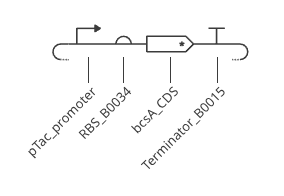
flowchart LR
    subgraph Backbone["Vector Backbone: pUC19 (BBa_K4411017, 2,641 bp)"]
        direction LR
        P["Promoter<br/>pTac (~63 bp)"] --> RBS["5' UTR / RBS<br/>BBa_B0034 (12 bp)"]
        RBS --> CDS["Coding Sequence (CDS)<br/>bcsA (872 aa, 2,619 bp)"]
        CDS --> T["Terminator<br/>BBa_B0015 (~79 bp)"]
    end
Construct Architecture & Verification:
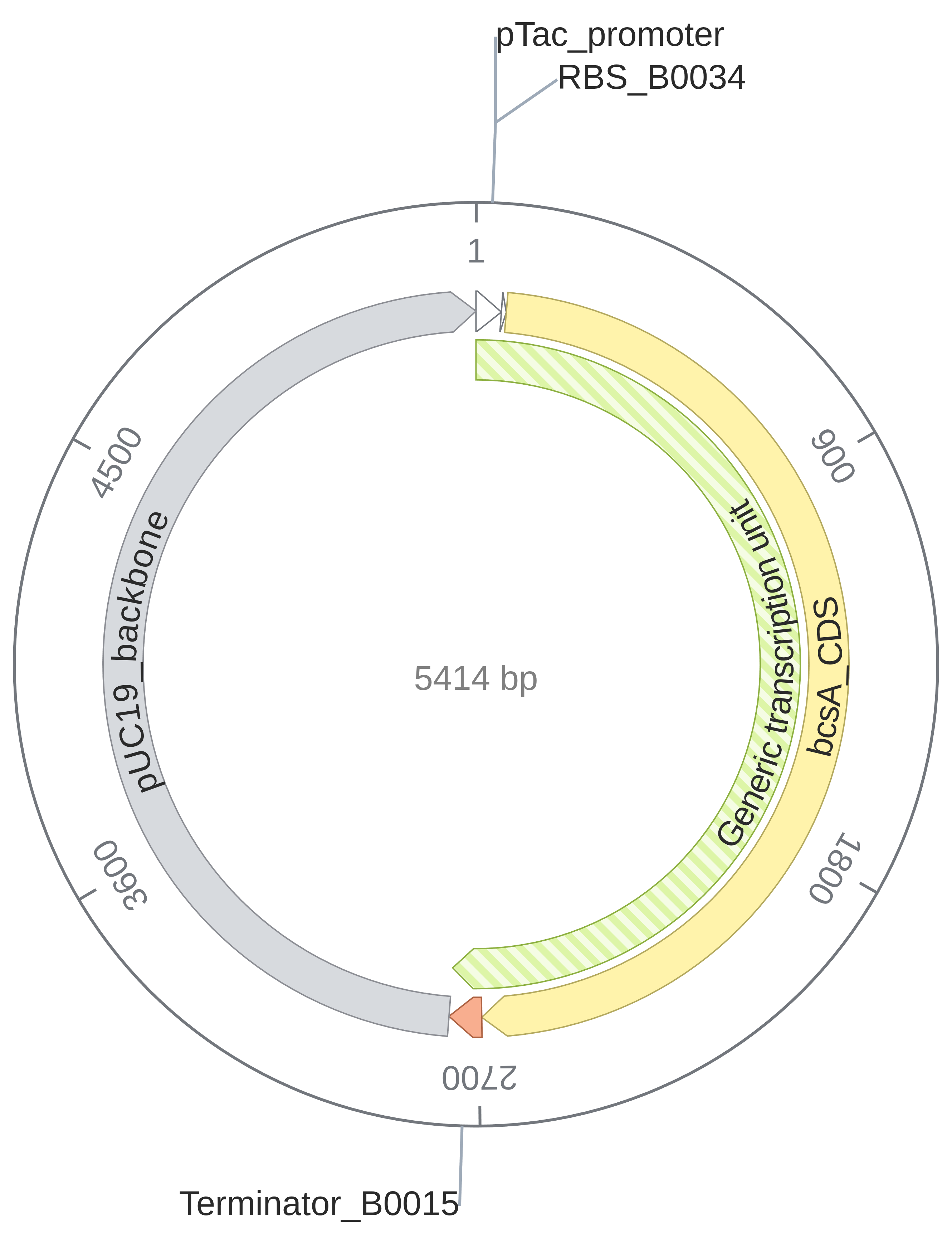
Total Plasmid Size:5,414 bp (consisting of $2,641\text{ bp pUC19 backbone} + 63\text{ bp pTac promoter} + 12\text{ bp RBS} + 2,619\text{ bp bcsA CDS} + 79\text{ bp terminator}$).
Reading Frame: Translation starts precisely at the canonical ATG start codon (+1 frame) and remains strictly in-frame across all 872 codons without frameshifts or premature stops.
Stop Codons: Tandem stop codons (TAA TGA) are positioned immediately after codon 872 to ensure unambiguous translational termination prior to the terminator hairpin.
Orientation: Clockwise transcription unit from pTac through bcsA_CDS to Terminator_B0015 as rendered on the circular map.
Part 4: Optimize and Quality-Check
Kernel’s integrated computational design suite was run on the coding sequence and assembled plasmid:
Constraints Applied: Avoided standard restriction cloning sites (EcoRI, XbaI, SpeI, PstI, and Golden Gate BsaI), included tandem stop codons (TGA + TAA), and maintained standard bacterial GC balance without CpG avoidance.
What the Optimization Returned (Kernel CSV Output Analysis):
Optimized CDS: 2,622 bp (incorporating tandem termination codons TGATAA).
Signal Peptide / Targeting: Kernel flagged Signal peptide: Detected at the N-terminus, accurately identifying the hydrophobic transmembrane domain 1 that acts as an internal signal-anchor sequence for co-translational insertion via the bacterial SecYEG translocon.
Key Synonymous Codon Shifts:
Arginine codons: Rare CGG and CGA triplets were systematically replaced by CGT, the dominant and most abundant arginyl-tRNA species in E. coli.
Leucine codons: TTG and CTT were converted to CTG (the preferred leucine codon in E. coli).
Isoleucine codons: ATC shifted to ATT.
Serine codons: AGT shifted to AGC.
Biological Significance: Because BcsA is an 8-pass transmembrane protein, ribosome stalling at rare codons can lead to translational detachment, incomplete peptide elongation, or misfolding into toxic inclusion bodies. Codon optimization harmonizes elongation kinetics with the host’s tRNA supply while eliminating restriction enzyme hazards.
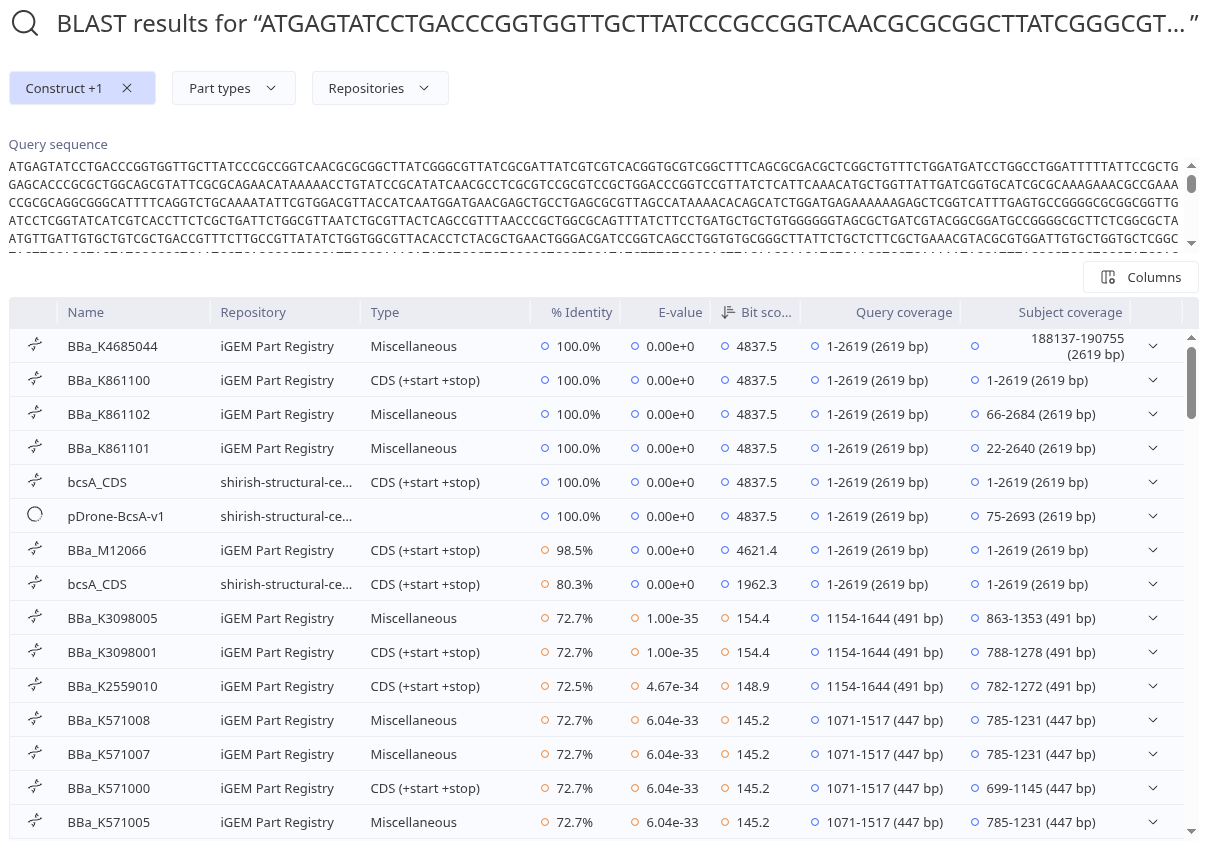
Tool Used: Kernel Integrated BLAST Search (querying the iGEM Part Registry and workspace repositories).
Query Sequence: Full-length bcsA_CDS (2,619 bp).
Screenshot Reference:blast-results.png
What the Tool Returned:
Top Registry Match:BBa_K861100 and BBa_K4685044 in the iGEM Part Registry returned $100.0%$ sequence identity with an E-value of $0.00\text{e}+0$, a Bit score of $4837.5$, and $100%$ query coverage ($1\text{–}2,619\text{ bp}$). In the iGEM registry, BBa_K861100 is the canonical E. coli K-12 bcsA part.
Assembled Construct Verification: The search confirmed that our assembled construct pDrone-BcsA-v1 carries the exact 2,619 bp coding sequence at positions $75\text{ to }2,693\text{ bp}$ ($100%$ identity, Bit score $4837.5$), directly proving correct in-silico assembly.
Codon-Optimized Variant Match: The search also detected our codon-optimized variant (bcsA_CDS) with $80.3%$ sequence identity (Bit score $1962.3$, E-value $0.00\text{e}+0$).
Conserved Homologs: More distant glycosyltransferase homologs (BBa_K3098005, BBa_K3098001) aligned with $72.7%$ identity over a $491\text{ bp}$ region corresponding to the conserved catalytic GT-2 core domain (E-value $1.00\text{e}-35$).
Conclusion:
Is the CDS what we think it is?Yes. It perfectly matches verified bcsA (cellulose synthase catalytic subunit A) parts in the iGEM registry.
Is it identical to a natural gene, or novel? The input sequence is $100%$ identical to the natural E. coli K-12 bcsA gene. The codon-optimized version is a novel synthetic nucleotide sequence ($80.3%$ DNA identity) that translates to the identical natural enzyme.
What is the closest match? Canonical iGEM BioBrick part BBa_K861100 (E. coli K-12 bcsA).
3. Biosecurity & Safety Screen
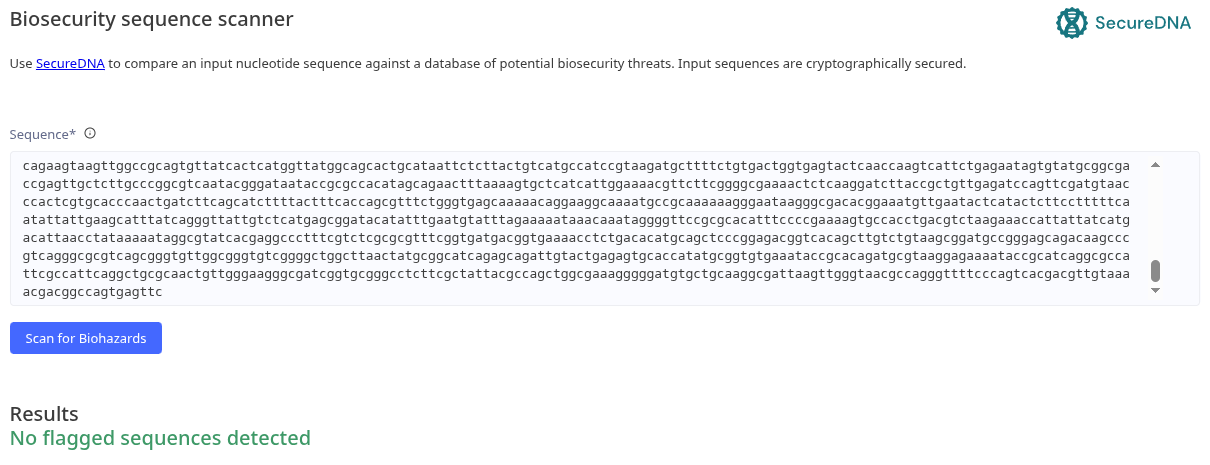
Tool Used: Kernel Biosecurity Sequence Scanner (powered by SecureDNA).
What it Checks For: SecureDNA cryptographically evaluates input nucleotide sequences against curated databases of high-consequence biological hazards, including:
Select agents and Dual-Use Research of Concern (DURC) priority lists.
Regulated bacterial and viral human, animal, and plant pathogens (e.g., Ebola, Smallpox, Anthrax).
The result is completely expected. Our construct expresses the catalytic subunit of bacterial cellulose synthase (bcsA) in a standard laboratory E. coli K-12 vector context (pUC19).
E. coli K-12 is a well-characterized Biosafety Level 1 (BSL-1) organism, and bacterial cellulose is a benign, non-toxic polysaccharide used commercially in food products (such as Nata de coco and Kombucha) and biomedical wound dressings.
No biohazard flags were raised, and the construct is approved as completely safe for commercial DNA synthesis orders.
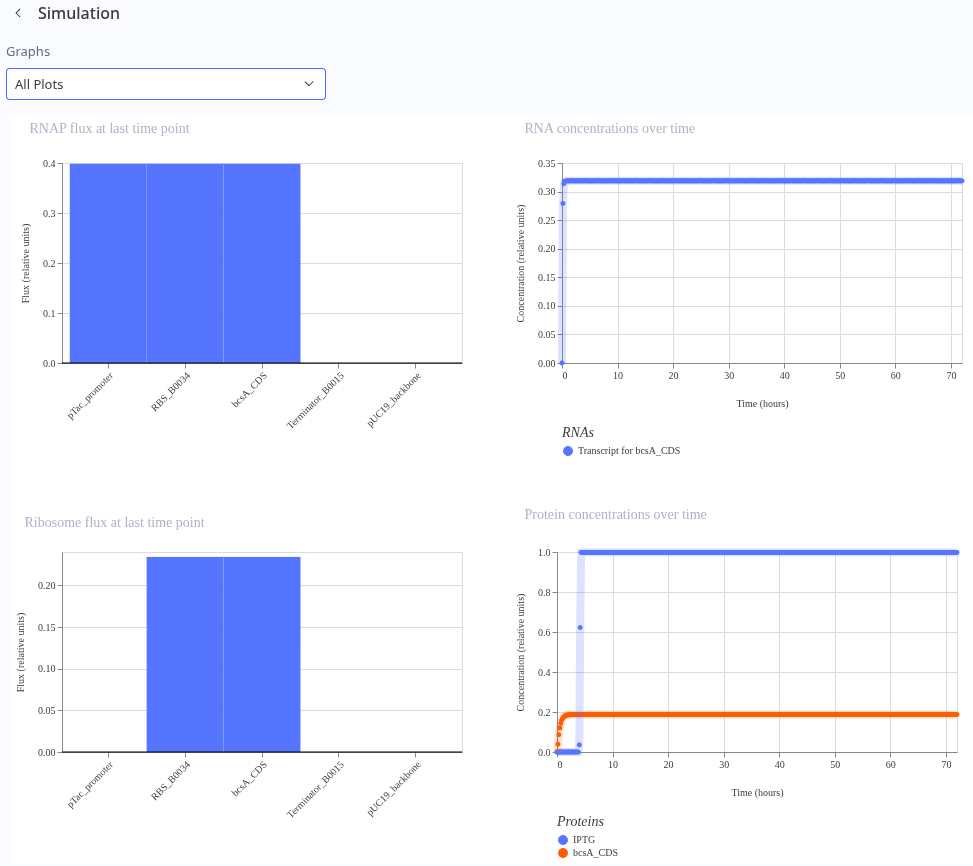
Induction: Chemical ligand IPTG added at Hour 4 (Set concentration to max).
Screenshot Reference:simulation-results.png
Quantitative Interpretation of Biophysical Plots:
RNA Polymerase (RNAP) Flux Along DNA:
Active transcription initiates at pTac_promoter and sustains a uniform flux of $0.40$ relative units across the RBS_B0034 and bcsA_CDS coding region.
At Terminator_B0015, RNAP flux drops abruptly to $0.00$ relative units, with zero leakage into the pUC19_backbone. This confirms that the double terminator provides 100% termination efficiency, preventing read-through from interfering with plasmid replication.
Flux remains completely flat across the entire 2,619 bp bcsA_CDS, demonstrating an absence of translational bottlenecks, rare-codon stalling, or deleterious secondary structures.
Drops to $0.00$ cleanly at the tandem stop codons.
RNA Concentrations Over Time:
Rapid transcriptional accumulation reaching a steady-state mRNA concentration of $\sim 0.32$ relative units, remaining stable over the 72-hour window.
Protein Concentrations Over Time (IPTG Dynamic Induction):
Hours 0–4 (Uninduced State): BcsA protein concentration is held tightly at $0.00$ relative units, verifying that the promoter exhibits no premature metabolic leakage during initial biomass growth.
Hour 4 (IPTG Added): Upon addition of maximal IPTG ligand (blue trace), transcriptional repression is instantly relieved.
Hours 4–72 (Production Phase): BcsA enzyme (orange trace) rapidly accumulates and plateaus at a robust steady-state concentration of $\sim 0.20$ relative units, modeling successful on-demand biomanufacturing.
Part 5: From Design to Build
A sequence in software is not yet physical DNA. Grounded in this week’s assigned literature, we reason through the physical constraints, error rates, assembly mechanisms, and scaling pathways required to manufacture our genetic construct:
1. How would you build it?
Synthesis & Assembly Strategy:
Direct chemical synthesis of the full 5,414 bp plasmid in a single continuous reaction is physically impractical due to cumulative coupling error rates.
Instead, we order the ~2.6 kb bcsA expression cassette as two linear double-stranded DNA fragments (~1.3 kb each, gBlocks) synthesized by a commercial provider (Twist Bioscience or IDT).
We will assemble these synthetic fragments into the linearized pUC19 vector (BBa_K4411017) using Gibson Assembly (Gibson et al., 2009).
Biochemical Mechanism (Gibson et al., 2009):
Gibson assembly operates via an isothermal, single-tube 3-enzyme cocktail:
T5 Exonuclease (5’ to 3’) chews back the 5’ ends of adjacent fragments sharing 35–40 bp homologous overlapping sequences, exposing single-stranded 3’ overhangs.
The complementary single-stranded 3’ overhangs specifically anneal to one another.
Phusion DNA Polymerase fills in the remaining gaps.
Taq DNA Ligase covalently seals the phosphodiester nicks.
Justification: Gibson assembly is completely scarless, operates with near 100% efficiency for inserts under 6 kb, and eliminates the sequence constraints imposed by restriction enzyme recognition sites.
2. What does synthesis constrain?
Synthesis Error Rates & Sequence Complexities:
De novo chemical phosphoramidite synthesis suffers from stepwise coupling efficiencies (~99% per cycle), leading to an exponential accumulation of single-base deletions (n-1mers) and point mutations as oligonucleotide length exceeds 100–150 nt.
Sequence Hazards in bcsA: Because BcsA is an 8-pass transmembrane protein, its coding sequence contains naturally hydrophobic, GC-rich transmembrane segments and repetitive motifs that tend to form stable secondary mRNA/DNA hairpins during polymerase cycling, causing synthesis dropouts.
Error Correction Solutions (Carr et al., 2004; Kong et al., 2007):
Protein-Mediated Error Correction (Carr et al., 2004): During fragment assembly from chip or column oligos, we implement MutS protein-mediated error filtration. The bacterial mismatch repair protein MutS binds with high affinity to base-pair mismatches and small insertion/deletion loops in heteroduplex DNA. By physically removing or cleaving MutS-bound error-prone duplexes (or using Surveyor/CEL endonuclease), error frequencies are reduced by >15-fold, enabling the high-fidelity assembly of the full 2.6 kb enzyme.
Microfluidic Synthesis (Kong et al., 2007): As demonstrated by Kong et al., conducting parallel gene synthesis within integrated microfluidic devices confines reactions to sub-microliter and picoliter volumes. This drastically minimizes reagent consumption, improves thermal heat transfer, suppresses evaporation-driven misincorporations, and enables automated on-chip gene assembly.
3. Prototype vs. Scale
Bench Prototype Scale (Testing One Construct):
For initial laboratory validation, we synthesize two individual column-derived gBlocks, assemble them into pUC19 via benchtop Gibson assembly in an Eppendorf tube, and transform chemically competent E. coli K-12 to verify functional cellulose extrusion.
Production Scale (Tian et al., 2004; Kosuri et al., 2010):
When scaling up to biomanufacture structural composites across varied drone arm CAD geometries, a single fixed construct is rarely optimal. We need combinatorial libraries varying promoter strengths, RBS initiation rates, and linker lengths.
High-Density Microchip Synthesis (Tian et al., 2004; Kosuri et al., 2010):
High-density programmable DNA microchips synthesize pools of tens of thousands of unique oligonucleotides in parallel on a single substrate, reducing the per-base cost by orders of magnitude compared to column synthesis.
Following Kosuri et al. (2010), by flanking specific gene sub-pools with unique orthogonal PCR primer barcodes, we selectively amplify individual fragment subsets from the complex chip pool. Multiplexed assembly and high-throughput next-generation sequencing allow us to screen thousands of construct variants simultaneously.
When scaling living composite manufacturing, we must prevent cross-talk between the cellulose production machinery and the host’s endogenous metabolic pathways.
We leverage the principles established by Stanton et al. (2014) for mining orthogonal prokaryotic repressors to construct independent, non-interfering logic gates.
Furthermore, inspired by synthetic transcriptional oscillators (Elowitz & Leibler, 2000), dynamic feedback circuits can pulsate enzyme expression, preventing the continuous Sec-translocon overloading observed during constant overexpression.
Lean Composite Assembly (Spheroids & Symbiosis):
As shown by Caro-Astorga et al. (2021), producing pre-formed cellulose spheroids in agitated bioreactors cuts the primary material growth phase from 20 days to 24–48 hours, enabling rapid modular additive assembly.
Pairing this with artificial symbiosis (Cultivating Future Materials, 2025) enables circular, low-cost nutrient feeds directly from agricultural or industrial byproducts.
The Risk: BcsA contains 8 transmembrane helices. Overexpression under strong promoters like pTac can overwhelm the bacterial Sec-translocon, resulting in membrane insertion failure, misfolding into insoluble inclusion bodies, or lethal membrane depolarization.
Experimental Test: Culture cells across a range of IPTG inducer concentrations ($0.05 \text{ mM}$ to $1.0 \text{ mM}$) and growth temperatures ($25^\circ\text{C}$ vs. $37^\circ\text{C}$). Isolate the inner membrane fraction using sucrose density gradient ultracentrifugation, followed by SDS-PAGE and Western blot analysis to quantify correctly folded membrane-integrated BcsA versus aggregated cytosolic fraction.
2. Unknown: Nanofiber Crystallinity and Tensile Parity with Carbon Fiber
The Risk: As demonstrated in Unraveling Self-Assembly Mechanisms in BC Hydrogels (2026), high tensile modulus requires tight microfibril ribbon crystallization and nodal network entanglement. Heterologously expressed BcsA produces elementary glucan chains, but without co-expressing crystallization factors (e.g., bcsD from K. xylinus), the material may form an amorphous hydrogel with insufficient tensile strength for drone arms.
Experimental Test:
Measure microfibril ribbon morphology using Scanning Electron Microscopy (SEM) and Atomic Force Microscopy (AFM).
Measure Crystallinity Index using Powder X-Ray Diffraction (XRD).
Perform standard tensile stress-strain testing (ASTM D638) on hot-pressed, densified samples. If tensile strength is below target ($>300 \text{ MPa}$), design a second-generation operon cassette co-expressing bcsD.
The Risk: Even with abundant, correctly folded BcsA in the membrane, the enzyme remains catalytically dormant unless bound to $c\text{-di-GMP}$. If endogenous cellular phosphodiesterases degrade $c\text{-di-GMP}$, cellulose synthesis will stall.
Experimental Test: Screen cellulose secretion using the Calcofluor White fluorescence agar assay (fluoresces blue under UV when bound to $\beta$-1,4-glucans). If fluorescence is weak, co-transform with an optogenetic or inducible diguanylate cyclase (e.g., dgcZ or blue-light activated blg4) to boost intracellular $c\text{-di-GMP}$ upon optical cue.
Readings & References
Gibson, D. G. et al. (2009). Enzymatic assembly of DNA molecules up to several hundred kilobases. Nature Methods, 6(5), 343–345. https://doi.org/10.1038/nmeth.1318
Carr, P. A. et al. (2004). Protein-mediated error correction for de novo DNA synthesis. Nucleic Acids Research, 32(20), e162. https://doi.org/10.1093/nar/gnh160
Kosuri, S. et al. (2010). Scalable gene synthesis by selective amplification of DNA pools from high-fidelity microchips. Nature Biotechnology, 28(12), 1295–1299. https://doi.org/10.1038/nbt.1716
Tian, J. et al. (2004). Accurate multiplex gene synthesis from programmable DNA microchips. Nature, 432(7020), 1050–1054. https://doi.org/10.1038/nature03151
Elowitz, M. B. & Leibler, S. (2000). A synthetic oscillatory network of transcriptional regulators. Nature, 403, 335–338. https://doi.org/10.1038/35002125
Stanton, B. C. et al. (2014). Genomic mining of prokaryotic repressors for orthogonal logic gates. Nature Chemical Biology, 10, 99–105. https://doi.org/10.1038/nchembio.1411
Kong, D. S. et al. (2007). Parallel gene synthesis in a microfluidic device. Nucleic Acids Research, 35(8), e61. https://doi.org/10.1093/nar/gkm121
Caro-Astorga, J., Walker, K. T., Herrera, N., Lee, K.-Y., & Ellis, T. (2021). Bacterial cellulose spheroids as building blocks for 2D and 3D engineered living materials. Nature Communications, 12, 5027. https://doi.org/10.1038/s41467-021-25350-8
Lee, K.-Y., Buldum, G., Mantalaris, A., & Bismarck, A. (2014). More than meets the eye in bacterial cellulose: Biosynthesis, bioprocessing, and applications in advanced fiber composites. Macromolecular Bioscience, 14(1), 10–32.
Cultivating Future Materials (2025). Artificial Symbiosis for Bulk Production of Bacterial Cellulose Composites. bioRxiv, 10.1101/2025.04.23.650277.
Unraveling the Self-Assembly Mechanisms in Bacterial Cellulose Hydrogels (2026).bioRxiv, 10.64898/2026.01.21.700946.
AI Collaboration & Tools Attribution
In accordance with the HTBAA course AI policy (citing AI client and prompts used):
AI System / Client: Google Gemini.
Role in Assignment: Pair-programming and bioengineering conceptual consultation (mapping CAD stereolithography to optogenetic pathways, assisting with Kernel by Asimov workflows, formatting construct architecture, and interpreting BLAST, codon optimization, and SecureDNA outputs) due to background in computer science.
Key Prompts Used:
“How to move from a CAD-guided bacterial cellulose drone arm concept to a genetic construct design in Kernel by Asimov?”
“Can E. coli be programmed to directly engineer 3D shapes without physical molds using photolithography / optogenetics?”
“How to configure Part 2 genetic parts (promoter, RBS, CDS +start +stop, terminator, and pUC19 backbone) in Kernel?”
“How to interpret and analyze the Kernel CSV codon optimization results, BLAST alignments against iGEM parts, and SecureDNA biosecurity scanner outputs?”