Week 1 HW: Final Project Ideas
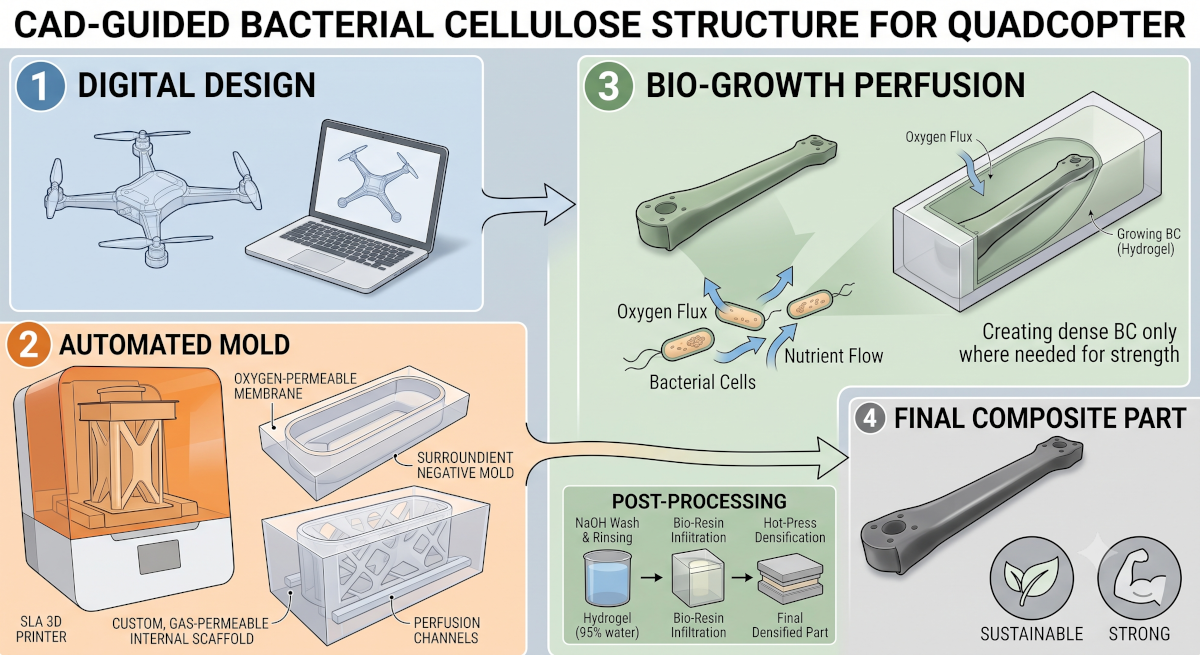
*figure generated using Gemini
(1) What you would like to biomanufacture and why?
Describe the target product or output you would like to make.
A CAD-guided structural bio-composite (bacterial cellulose) synthesized directly by bacteria which can compete with carbon-fiber based structures in terms of tensile strength.
Why are you interested in making it?
Carbon fiber composites are produced for structural tensile strength with rigid shape and low weight. But they produce hazardous airborne dust during machining processes and are non-recyclable. Similarly, bacterial cellulose while strong but grows in a flat rigid disorganized planar shape which requires further machining to produce a definite shape.
By using a CAD based negative mold, we can constrain the bacteria to grow directly into the 3D geometry to attain a high-performance high-strength structural component that is biologically renewable and recyclable. Additionally, we can create the CAD based mold as well in later stages using the same method to get rid of polymer usage in the complete process.
Although this method can be used to create structural components which are light, strong and find their usage in multiple fields but currently we are focusing on robotics and drones which have very critical constraints for tensile strength and weight, which can be addressed on priority avoiding dependency on oil based composites and their hazardous outcomes.
(2) What living system would you use?
Propose at least one living-system manufacturing chassis that could produce your target—for example, a microbial, mammalian, or cell-free system.
Although at current stage, I am not too sure about the right candidate for the living system which might fit the required tensile strength and low weight constraints but I would look at any high-yielding bacteria which can secrete pure and crystalline cellulose which solidifies in a short time. One of such bacteria is Komagataeibacter xylinus (https://en.wikipedia.org/wiki/Komagataeibacter_xylinus) which is member of acetic acid bacteria which normally produce acetic acid during fermentation but this one unusually also produces bacterial cellulose. Although it is chemically identical to plant cellulose but has distinct physical structure and properties. It selectively navigates toward oxygen gradient (aerotaxis) which can be used to drive patterning.
At a high level, describe how the system would make your target product. What goes into the system? What biological process or processes occur? What comes out? You do not need to design the complete biological system yet. Make reasonable assumptions where necessary and identify them.
Inputs for the process
Inputs for the biological process would be
- molasses or crude glycerol for energy
- yeast extract, phosphate buffer and magnesium sulphate
- 3D printed PDMS mold for patterning (oxygen permeable)
- Other unknowns (based on bacteria we chose finally)
Material Comparison Matrix
| Parameter | Carbon Fiber Composite | Unconstrained Bacterial Cellulose | Proposed Densified Bio-composite |
|---|---|---|---|
| Origin | Petro or oil based | Biological fermentation | Biological fermentation (K. xylinus) |
| Geometry | 3D molded & CNC machined | Flat pellicle / disorganized mat | Net-shape CAD geometry (in-mold) |
| Fiber Alignment | Directional / unidirectional | Random interwoven nanofibrils | Microfluidically guided / shear aligned |
| Environmental Hazard | Toxic airborne dust, non-recyclable | Non-toxic, biodegradable | Non-toxic, bio-recyclable |
| Prototyping Cycle | Hours (curing autoclave) | 20–25 days (fermentation) | ~20 days (parallelizable across molds) |
Proposed production system
flowchart TD
    subgraph Digital["1. Digital Design"]
        CAD["CAD Drone Arm Model"] --> Invert["Negative Mold Design"]
        Invert --> Print["3D Print PDMS Mold\n(O₂ Permeable + Microfluidics)"]
    end

    subgraph Bio["2. Living System Culturing"]
        Feed["Nutrient Feed:\nMolasses / Glycerol + MgSO₄"] --> Perfusion["Opentrons Liquid Handling\n(Continuous Perfusion)"]
        Print --> Reactor["Perfusion Reactor"]
        Perfusion --> Reactor
        Inoc["Inoculate K. xylinus"] --> Reactor
        Reactor --> Pattern["Aerotaxis Patterning\n(Guided 3D Synthesis)"]
    end

    subgraph Post["3. Post-Processing & Densification"]
        Pattern --> Harvest["Demold 3D Hydrogel\n(~95% Water)"]
        Harvest --> Wash["Alkaline Wash (NaOH)\n(Decellularization)"]
        Wash --> HotPress["Heated Compression\n(Fiber Densification & Alignment)"]
        HotPress --> Arm["Finished Composite Arm\n(22.5g, High Tensile Strength)"]
    end
(3) How would you use automation?
Identify at least one automation technology that you would combine with your living system.
This could include a large-scale Cloud Lab, a desktop liquid-handling robot such as an Opentrons, a programmable microfluidics platform such as Nuclera’s, or another automation technology.
Possible ways of automation during the process
- 3D printing system to convert digital CAD file to physical oxygen permeable PDMS mold with microfluidic channels to control air and liquid flow for overall tensile strength
- Multi-channel perfusion control
- Continuous oxygen monitoring
- Continuous optical monitoring for desired tensile strength
Describe what part of the biomanufacturing workflow you would automate and why. For example, you might automate liquid handling, culturing, assembly, screening, sampling, measurement, optimization, or another step.
We will use Opentrons liquid handling for precise perfusion control adjusting the feed rates dynamically to maintain stationary-phase cellulose synthesis as it is very important to prevent static growth of bacteria which can produce non-uniform density and any stirring can easily destroy the fibers. So an automated liquid control is highly desired to control the media, oxygen levels and byproduct clearance
(4) How much would you need to make, and how long would it take?
Perform a back-of-the-envelope calculation estimating what it would take to manufacture your target at a meaningful scale.
We will start with the arms of the drone as their design is simpler and uniform. Later we can target the complete body of the drone.
For a small drone or quadcopter, we will need 4 structural hollow arms ($200 mm long \times 20 mm wide \times 15 mm high$ with wall thickness of $1.5 mm$)
$\text{Volume per hollow arm} = 200\text{ mm} \times 20\text{ mm} \times 15\text{ mm} \ (\text{wall: } 1.5\text{ mm}) \approx 15\text{ cm}^3$
$\text{Required density} = \approx 1.5 \text{ g/cm}^3$
$\text{Mass per arm} = 15\text{ cm}^3 \times 1.5\text{ g/cm}^3 \implies 22.5\text{ g of Bacterial Cellulose}$
$\text{Total Drone Arm Mass} = 4 \times 22.5\text{ g} = 90\text{ g}$
(a) How much? Define a scale relevant to your project and calculate approximately how much of your target product you would need to manufacture. For example, if you are producing a medicine, you might estimate the amount required to treat 1,000 people, everyone in Massachusetts, or everyone in the world. If you are producing a building material, you might calculate the amount required for one structure or an entire neighborhood. If you are producing an art or design artifact, define an appropriate scale yourself. Clearly show your calculation, including units, assumptions, and sources for important numbers.
For K. xylinus, cellulose synthesis rate = atleast $1.2 g$ of bacterial cellulose per litre of media volume per day. (Ref: https://link.springer.com/article/10.1007/s00253-025-13582-3, https://pmc.ncbi.nlm.nih.gov/articles/PMC12858580/, https://www.researchgate.net/publication/359877179_Bacterial_Cellulose_Production_by_Komagataeibacter_xylinus_Using_Rice-washed_Water_and_Tofu_Processing_Wastewater_with_the_Addition_of_Sodium_Glutamate)
Each mold cavity will need about $0.35 litre$ of media to support growth of $22.5 g$ arm over several days.
(b) How long? Using your proposed living system and automation technology, estimate how long it would take to manufacture that amount. Consider quantities such as production rate, yield, volume, number of parallel experiments or reactors, automation throughput, or whatever parameters are most appropriate for your system. You may discover that the automation technology you would use to prototype your system is very different from what you would use to manufacture at scale. If so, describe both. Again, we are looking for a reasonable engineering estimate. Show your assumptions and calculations.
$$\text{Run time} = \frac{\text{22.5 g of arm}}{\text{Synthesis rate of 1.2 g/day}} \implies \approx 20 \text{continuous days}$$
We can target higher number of drones so that more arms can be produced in single lot considering the lengthier run time.
Lead time needed for prep work:
- Mold prep = 2 days
- Perfusion bio-growth in mold = 20 days
- Automated Cleaning and densification = 3 days
$$\text{Total Batch Time} = 2\text{ days (mold prep)} + 20\text{ days (growth)} + 3\text{ days (cleaning/densification)} = 25\text{ days}$$
(5) What don’t you know yet?
After completing your analysis, identify the 2–3 biggest technical unknowns, bottlenecks, or assumptions in your proposed biomanufacturing system. What would you need to learn, measure, or experimentally determine to know whether your idea could actually work?
a) Right living candidate for tensile strength
We are not sure right now if K. xylinus will be appropriate for the tensile strength and low weight we are looking for building arms of the drone
b) CAD to final product tolerances
Since we are trying to match the final arm to CAD model, we are not sure if tolerances can be achieved for the bacterial cellulose which is 95% water by weight can easily shrink on drying up or during densification. As a remedial measure, we will have to compensate for it in the CAD model and mold.
c) Wall thickness constraints
Since bacteria will start building cellulose along the oxygen permeable walls, the cellulose layers can easily block further diffusion of the oxygen and nutrients to further areas and this will practically limit the overall wall thickness which can be achieved.
d) Desired Tensile strength
Bacterial cellulose network is produced in an interwoven fashion which can affect the mechanical properties which are required to compete with carbon fiber. Carbon fibers are aligned in single direction along load path to achieve the extreme strength. This might be controllable using microfluidic channels along which the liquid culture flows.