Week 1 HW: Final Project Ideas
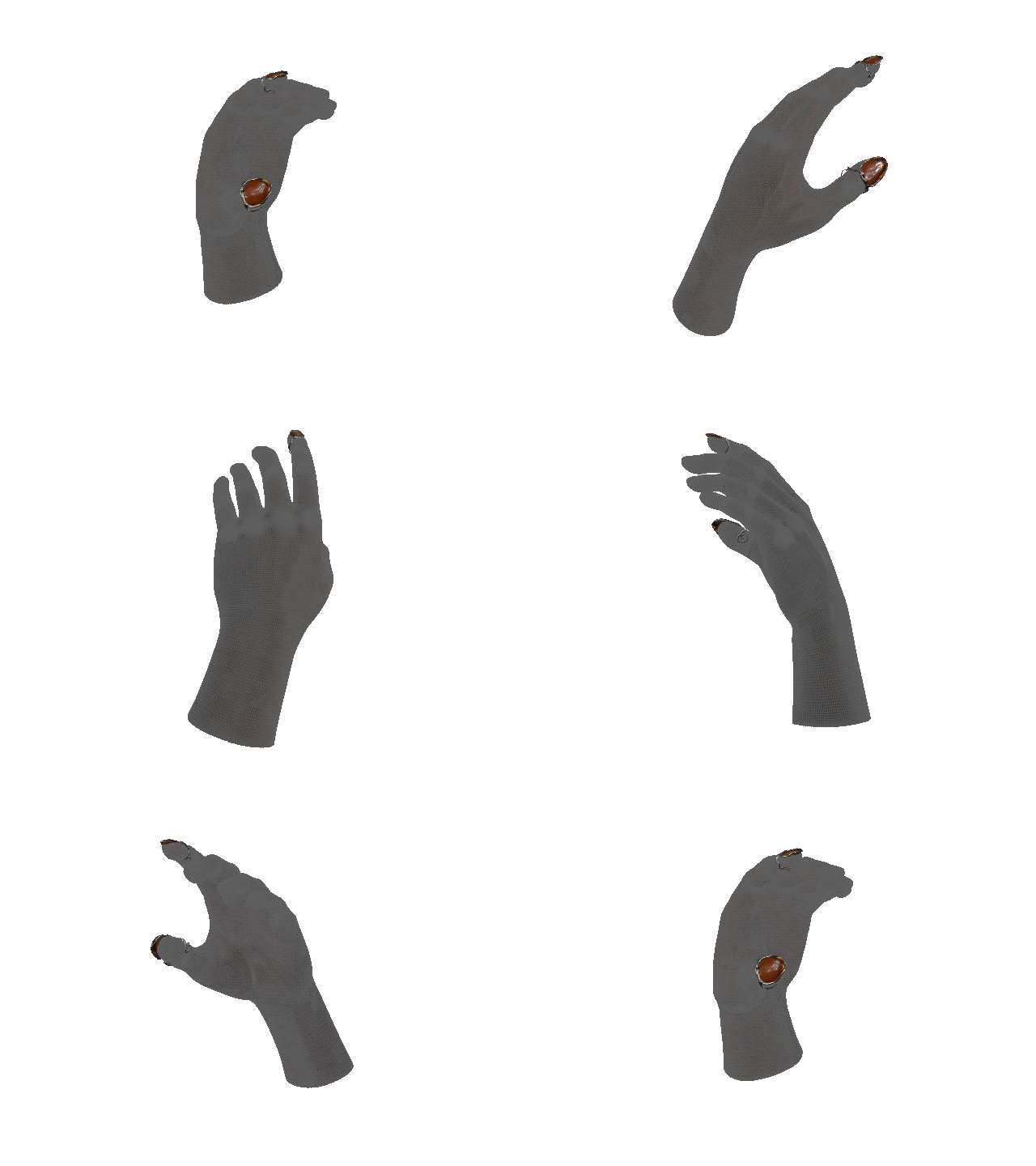
(1) What you would like to biomanufacture and why?
With this project, I was really lost in what to make for a while, but I was definitely hoping to produce something within the realm of materials, so I ended up having a quick chat with some people in the lab about what I could do and was told about BC and how that could be a great starting point. I’m considering designing something related to tech, or improving it, whether that’s tactile interfacing, or extensions of HCI through hardware.
Describe the target product or output you would like to make. Why are you interested in making it?
I’ve recently noticed that if I work continuously using a trackpad or a traditional computer mouse (over 9 hours a day and longer than 3-4 days in a row), I get a clicking sound in my wrist. That is not a new issue (https://pmc.ncbi.nlm.nih.gov/articles/PMC12347275/), and there have been quite a few solutions, such as making more ergonomic designs, though that doesn’t entirely solve it.
Therefore, my hope is that there might be a possibility of improving upon the design of a current computer mouse. More specifically, turning it into a wearable(https://dl.acm.org/doi/abs/10.1109/38.250916, https://arxiv.org/html/2504.05983v1, https://appleinsider.com/articles/19/01/03/apple-researching-wearable-glove-input-device-to-simplify-interactions-with-ar-vr). I wouldn’t want it to be a full glove but rather something closer to a jewellery piece, possibly a nail ring with BC integrated as a sensor element (the bacterial cellulose pad would be housed inside a reusable metal ring casing and could be easily changed when degraded or the user would want a design refresh). That would allow for a solution to the fixed-position problem. My intent is not to create a new gestural way of communicating with computers but to use whatever familiarity users already have through using a mouse; keep it as simple and similar as possible, just move these gestures from the desk surface to mid air.
One interesting piece of reserach that I found as I was writingg out this proposal was the project called NailO: Fingernails as an Input Surface (https://www.hybridbody.human.cornell.edu/nailo). But within this research the actual product element is presented as a sticker which might make the product less durable long term. I think this could be easily improved by defining a structure around the sticker. As a part of my project, I also propose to unite the sensor and art layers through the use of BC
(2) What living system would you use? Propose at least one living-system manufacturing chassis that could produce your target—for example, a microbial, mammalian, or cell-free system. At a high level, describe how the system would make your target product. What goes into the system? What biological process or processes occur? What comes out?
For my product, I would use co-culture biomanufacturing: Komagataeibacter xylinus or rhaeticus (for the growth of the physical patch) and for the second one I would use an engineered melanin strain (chosen based on this paper https://www.sciencedirect.com/science/article/pii/S2772397626000407/ ).
So, for my bath I would need some cheap sugars to act as food then some copper to start the pigmentation process and some conductive salts so the final patch can conduct electricity and sense finger taps.
In terms of what’s gonna happen is that Komagataeibacter bacteria will hopefully eat that sugar then spin out the threads of cellulose at the surface and make a squishy sheet that I could use as a material. Another thing that’s going to happen is colouring the material directly inside the growth bath while it forms
(3) How would you use automation? Identify at least one automation technology that you would combine with your living system. This could include a large-scale Cloud Lab, a desktop liquid-handling robot such as an Opentrons, a programmable microfluidics platform such as Nuclera’s, or another automation technology. Describe what part of the biomanufacturing workflow you would automate and why. For example, you might automate liquid handling, culturing, assembly, screening, sampling, measurement, optimization, or another step.
In terms of automation, there are a few possible options here that I could use depending on availability
Route 1: Using remote access/programming, configuring a reconfigurable automation carts (RAC) module equipped with liquid-handling heads to automatically pipet different ratios of sugars, copper cofactors ($Cu^{2+}$), and conductive salts to multi-well plates. The hope is that its integrated microplate readers will automatically measure the electrical resistance and also(!) colour intensity (optical density) of each sample which would allow for easier ideation.
Route 2: Alternatively, I could use OT2 for a similar thing, though the measuring element would be more limited and manual
Route 3: Alternatively, I could also use chi.bio as the core culturing & screening Tool
(4) How much would you need to make, and how long would it take? Perform a back-of-the-envelope calculation estimating what it would take to manufacture your target at a meaningful scale.
For the proof of concept stage, I’d rather start small with 15 dual-finger gesture testing sets. For all 30 patches it would take 1 single 3.5-day cycle. + then for automated post-processing: glycerol plasticiser soaking, and precision laser cutting would take ~45 minutes. Though thats only the material stage for the ring insert tiles.
For the actual estimation element I do not have enough experience in production of a similar product so I ended up asking this question to Gemini in hopes to get a better answer Prompt: “Could you help me answer these questions for production of self-dyed, piezoresistive Bacterial Cellulose (BC) bio-Ring insert (a swappable biological sensor cartridge mounted within a reusable metallic ring chassis). Embedded with conductive biological dopants, where the grown BC pad acts as a strain/pressure sensor that converts subtle finger taps and pinches into Bluetooth mouse inputs (clicks, scrolls) without requiring a flat desk surface or restricting the wrist. For the manufacturing time can you combine both the biological material calculations and the parallel hardware fabrication timeline for a complete engineering assessment? (4) How much would you need to make, and how long would it take? Perform a back-of-the-envelope calculation estimating what it would take to manufacture your target at a meaningful scale. (a) How much? Define a scale relevant to your project and calculate approximately how much of your target product you would need to manufacture. For example, if you are producing a medicine, you might estimate the amount required to treat 1,000 people, everyone in Massachusetts, or everyone in the world. If you are producing a building material, you might calculate the amount required for one structure or an entire neighborhood. If you are producing an art or design artifact, define an appropriate scale yourself. Clearly show your calculation, including units, assumptions, and sources for important numbers.(b) How long? Using your proposed living system and automation technology, estimate how long it would take to manufacture that amount. Consider quantities such as production rate, yield, volume, number of parallel experiments or reactors, automation throughput, or whatever parameters are most appropriate for your system. You may discover that the automation technology you would use to prototype your system is very different from what you would use to manufacture at scale. If so, describe both. Again, we are looking for a reasonable engineering estimate. Show your assumptions and calculations.”
and here’s the answer that I got:
“(4) How much would you need to make, and how long would it take? (a) How Much?
Unit GeometryDimensions per Insert: $1.0\text{ cm} \times 1.0\text{ cm} \times 0.1\text{ cm}\text{ (1.0 mm wet thickness)} = \mathbf{0.10\text{ mL}}$ volume.Batch CalculationsPilot Prototype Scale (30 Units | 15 User-Testing Pairs):Volume: $30 \times 0.10\text{ mL} = \mathbf{3.0\text{ mL}}$ wet BC pellicle.Gross Area (with 20% laser scrap): $\frac{30\text{ cm}^2}{0.80} = \mathbf{37.5\text{ cm}^2} \quad (\approx 0.00375\text{ m}^2)$.Footprint: A single $6.2\text{ cm} \times 6.2\text{ cm}$ culture dish.Industrial Launch Scale (10,000 Units):Volume: $10,000 \times 0.10\text{ mL} = \mathbf{1.0\text{ Liter}}$ wet BC pellicle.Gross Area (with 20% laser scrap): $\frac{1.0\text{ m}^2}{0.80} = \mathbf{1.25\text{ m}^2}$.Footprint: 5 stacked $50\text{ cm} \times 50\text{ cm}$ static fermentation trays.
(b) How Long?
Parallel Manufacturing Pipeline (10,000 Units)Hardware fabrication and biological fermentation run concurrently:Biological Fermentation (Hours 0–84 | Primary Critical Path):Static Growth: Komagataeibacter + melanin co-culture incubates for 3.5 days (84 hours) in static tray racks to reach $1.0\text{ mm}$ thickness.Parallel Metal Ring & Electronics Fabrication (Hours 0–72):Metal Injection Molding (MIM) & Sintering: 48 hours.Anodizing & Surface Finishing: 12 hours.Flexible PCB & Contact Pins Assembly: 12 hours.Automated Post-Processing & Final Assembly (Hours 84–89):Washing, Glycerol Bath, & Laser Trimming: 3 hours.Robotic Ring Assembly: 2 hours.Total Turnaround TimeBecause metal hardware manufacturing (2.5 days) runs in parallel during biological growth, fermentation is the rate-limiting step.$$\text{Total Turnaround Time} \approx \mathbf{3.7\text{ days per 10,000-unit batch}}$$”
In terms of the volume, I would agree with the pilot prototype scale being 30 units, meaning 15 user-testing pairs and the industrial launch scale being 10,000 Units. For the manufacturing, I would, however be hesitant to say that 4 days would be realistic and would estimate it myself to take up to 3 months with all the sourcing.
- What don’t you know yet? After completing your analysis, identify the 2–3 biggest technical unknowns, bottlenecks, or assumptions in your proposed biomanufacturing system. What would you need to learn, measure, or experimentally determine to know whether your idea could actually work?
Okay, so there’s quite a few things I don’t entirely understand yet about using a nail bed as a surface. I’ve never done it before and I’d be curious to explore how actually compact the hardware can get. That will also define the design of the final product