Week 3 HW: Cell-Free Protocols
A. COMPARE CELL-FREE REACTION COMPOSITIONS (20 minutes)
- Why does the concentration of potassium glutamate and magnesium glutamate differ between compositions? Which is more sensitive?
Here’s how the data describes both on the https://coopetition.htgaa.org/cfps :
“Potassium is the main salt needed for ribosomes to work. Glutamate replaces chloride as the counter-ion because chloride inhibits some CFPS enzymes. Getting the right K⁺ concentration is one of the biggest tuning levers in CFPS. Reteplase Reteplase needs lower K(Glu) (~250 mM) than sfGFP (~354 mM) to reduce aggregation during synthesis”
“Magnesium holds ribosomes together and keeps tRNAs folded correctly. Too little and translation stalls; too much and proteins aggregate. One of the most sensitive optimization parameters in any CFPS formulation. Reteplase Oxidizing (DSB) conditions alter Mg²⁺ sensitivity — the reteplase target uses slightly less (~5.7 mM) than sfGFP (~7 mM).”
Magnesium one is more sensitive
- Explain how a PEP+NTP reaction formulation is different from a Ribose+NMP reaction formulation.
So first things first what’s PEP. PEP is also known as “Phosphoenolpyruvate — a high-energy molecule that directly hands a phosphate group to ADP to make ATP via pyruvate kinase. The most direct and fast ATP regeneration system, used in PANOx-SP. It’s consumed stoichiometrically, so higher starting concentrations extend reaction time.”"
And Ribose is “a 5-carbon sugar that feeds into the pentose phosphate pathway, generating energy and nucleotide precursors. Identified as a major yield driver in RFopt at 50 mM — one of the highest concentrations of any supplement.”"
If NTP are using CTP GTP and UTP in the formulation; NMP are using AMP, CMP, GMP, UMP: they are a monophosphate precursor to the other ones. The second ones are cheaper but more lysete dependent -> needs more fine-tuning
- Choose two cell-free reaction compositions from the literature, compare and contrast the choice of reagents and the concentration of reagents. Note: A recommended starting point would be to review a least one published formulation, such as PANOx-SP (Jewett & Swartz 2004), a cost-optimized formulation from Olsen et al. (2026), and/or an AI-designed formulation from Smith et al. (2026).
| Reagent | PANOx-SP (Jewett & Swartz 2004) | RFopt (2026) |
|---|---|---|
| Energy source | ||
| PEP | 30 mM | – |
| Ribose | – | 50 mM |
| Glucose | – | 10 mM |
| Nucleotides | ||
| ATP | 1.2 mM | – |
| CTP / GTP / UTP | 0.85 mM each | – |
| AMP | – | 3.0 mM |
| CMP / GMP / UMP | – | 2.15 mM each |
| Salts and buffers | ||
| K-glutamate | 130 mM | 362 mM |
| Mg-glutamate | 8 mM | 8 mM |
| NH4-glutamate | 10 mM | – |
| HEPES pH 7.5 | 57 mM | 75 mM |
| Phosphate (di:mono) | – | 15 mM |
| Building blocks | ||
| Amino acids (each) | 2 mM | 5 mM |
| Cofactors and additives | ||
| Folinic acid | 0.03 mg/mL | – |
| tRNA | 0.17 mg/mL | – |
| CoA | 0.27 mM | – |
| NAD | 0.40 mM | – |
| Nicotinamide | – | 4 mM |
| Putrescine | 1.0 mM | – |
| Spermidine | 1.5 mM | – |
| Oxalic acid | 4 mM | – |
B. DESIGN ONE REACTION COMPOSITION FOR EACH OF THE THREE PROTEINS (40 minutes)
- Sign in to coopetition.htgaa.org and publish your first unique 20 µL CFPS reaction composition for each of the following (don’t worry, you can resubmit later):
What if I add some ingredients that were not already in the mix to see whether there are some possible dependencies not entirely explored yet. I’ll keep the refrence baseline the same just add an additional reagent to see what happens OR Could combining successful strategies reveal a useful interaction that no individual reference recipe captures? will go about it purely visually might bring about more interesting results. One thing that stands out is Glucose in the references it might be worth it testing it separately
sfGFP
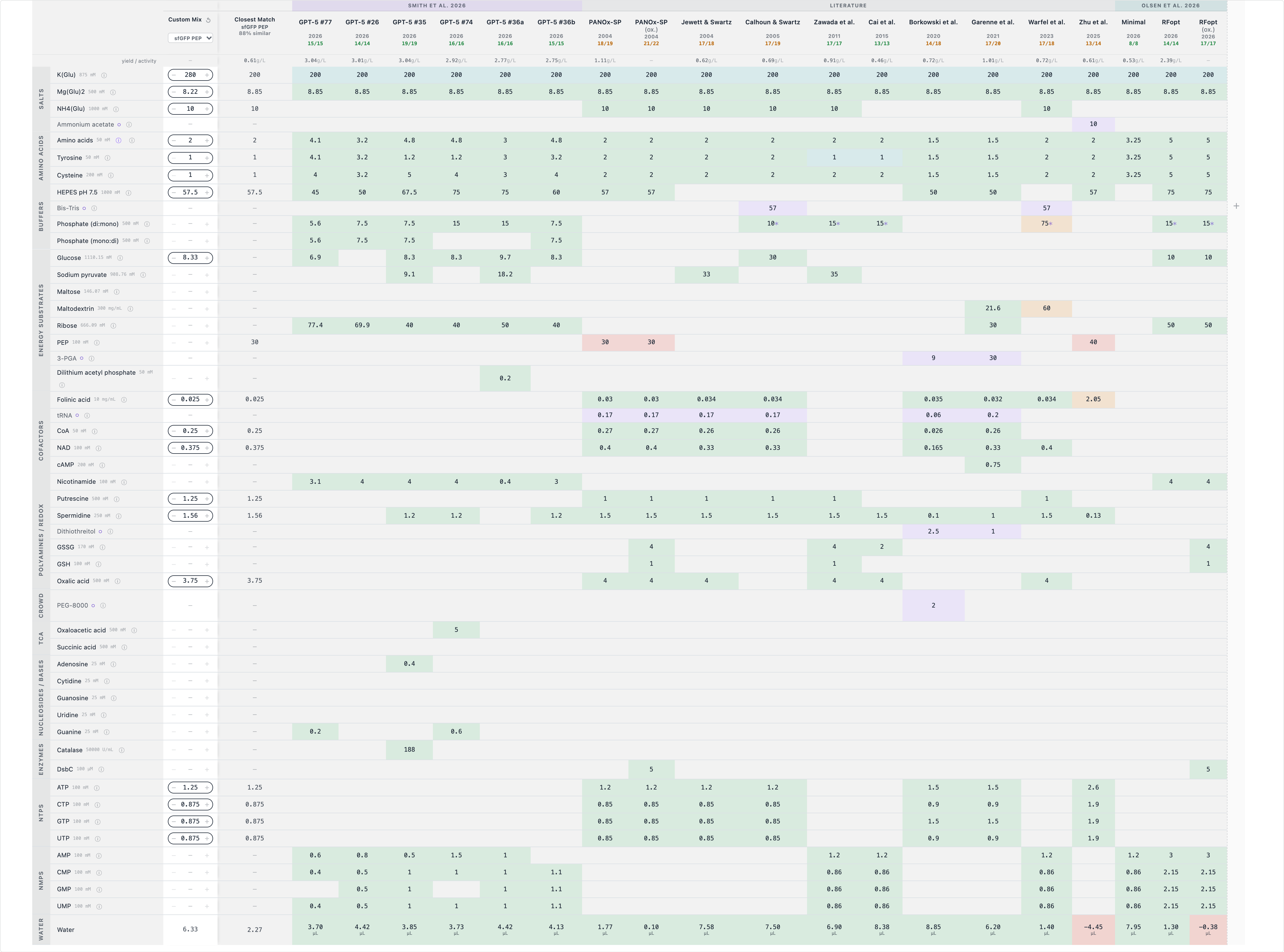
With this one, as I was looking at the other tables, I saw glucose used a lot. so I also added it to check whether adding glucose may provide an additional metabolic substrate that changes energy availability and sfGFP production.
PETase
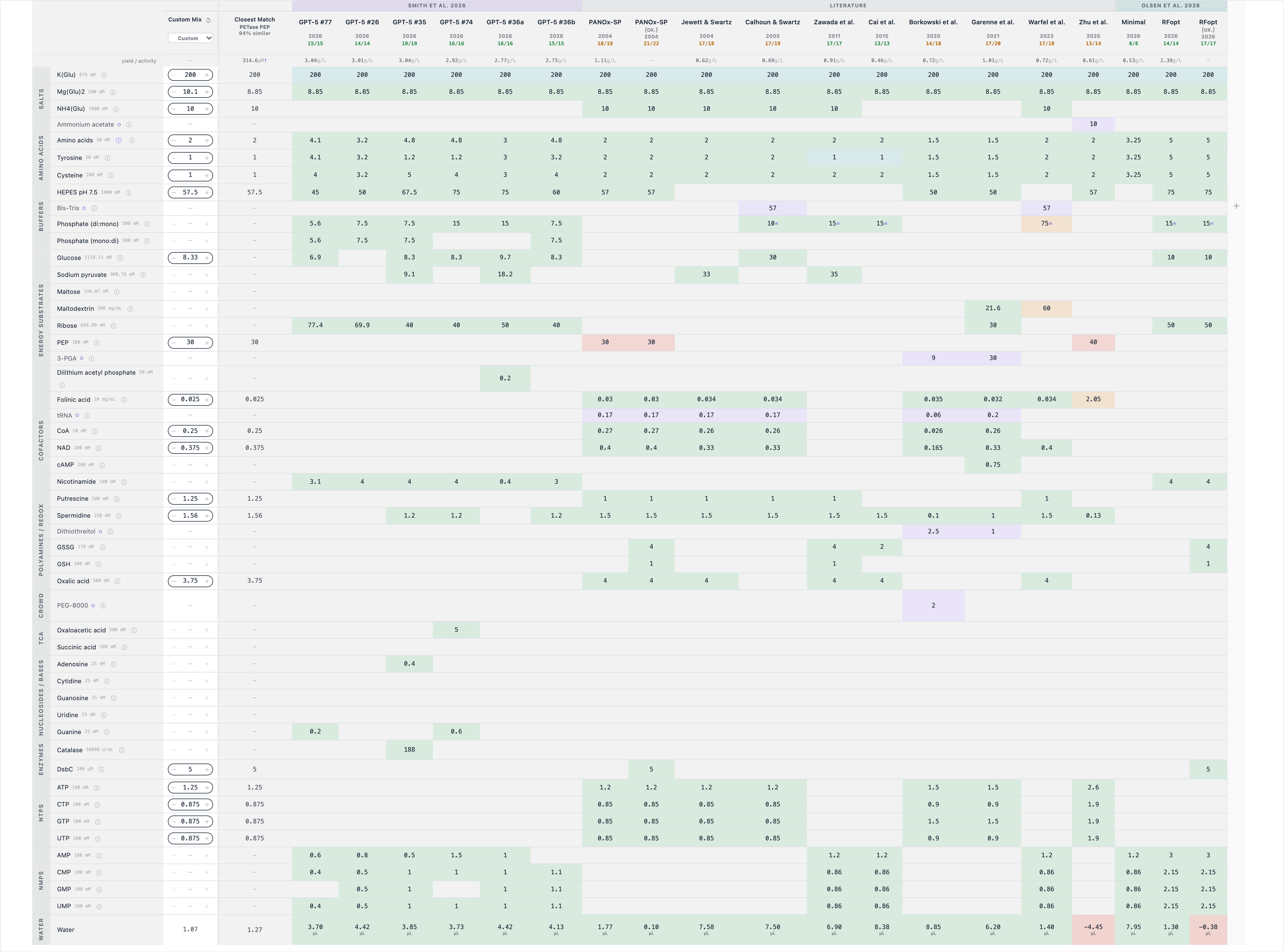
..What if I test the glucose’s effect here too, as glucose might affect protein production too, but the important endpoint is functional enzyme activity. Though more protein doesn’t necessarily mean more active PETase.
Reteplase
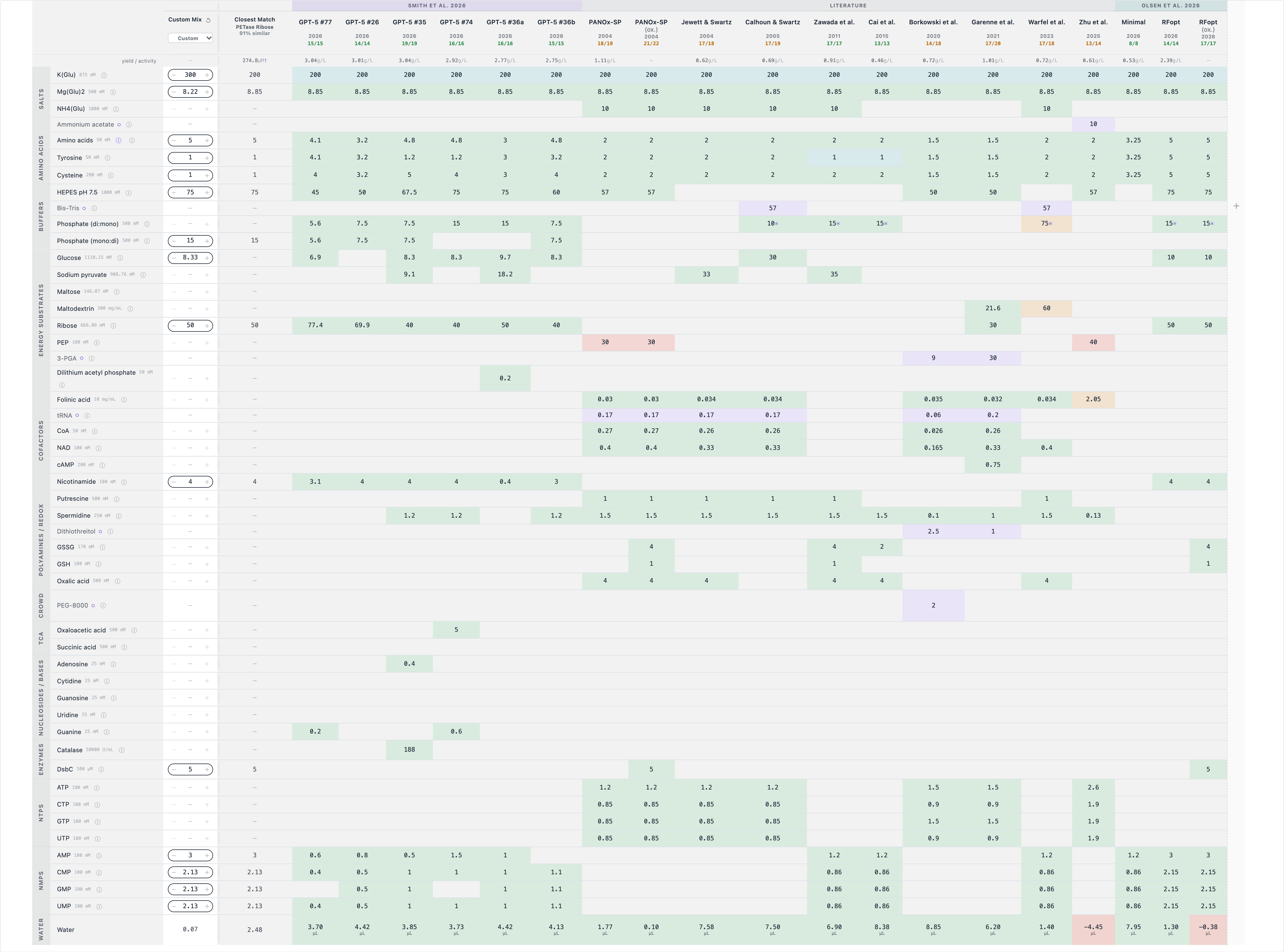
Same here. Would adding glucose provide an additional metabolic substrate and improve reteplase production and functional activity?
- As a HTBAA research team, we will have the opportunity to suggest new reagents to add to the cell-free reagent inventory. Contribute (or upvote) at least one reagent to the “Community Reagents” section of the website and provide a short rationale. Include in your homework documentation how you decided on that specific reagent and provide links to any relevant research.
Voted for FkpA (E. coli chaperone) seems fun!