Week 1 HW: Final Project Ideas
**(1) What you would like to biomanufacture and why? **
Describe the target product or output you would like to make. Why are you interested in making it? Your motivation might be utilitarian—for example, addressing a problem in health, sustainability, food, energy, or manufacturing—but it does not need to be. Your project might instead have a social, cultural, artistic, or personal motivation. Clearly articulate what you want to make, who or what it is for, and why you think it is interesting or important.
My idea is to create a biologic product in which the two-peptide bacteriocin PLNC8 (PLNC8a and PLNC8b) is delivered to the gastric mucosa by engineering a probiotic. H. pylori infections affect about 50% of the world’s population and are responsible for such serious disorders as gastritis, ulcers, and even cancer. Antibiotic treatment has become less effective because of resistance. This biologic is used for H. pylori-infected patients as an add-on treatment in gastroenterology clinics.
(2) What living system would you use?
Propose at least one living-system manufacturing chassis that could produce your target—for example, a microbial, mammalian, or cell-free system. At a high level, describe how the system would make your target product. What goes into the system? What biological process or processes occur? What comes out? You do not need to design the complete biological system yet. Make reasonable assumptions where necessary and identify them.
Chassis: Lactococcus lactis, an acid-tolerant probiotic bacterium with high gastric adhesion efficiency and a history of safe use.
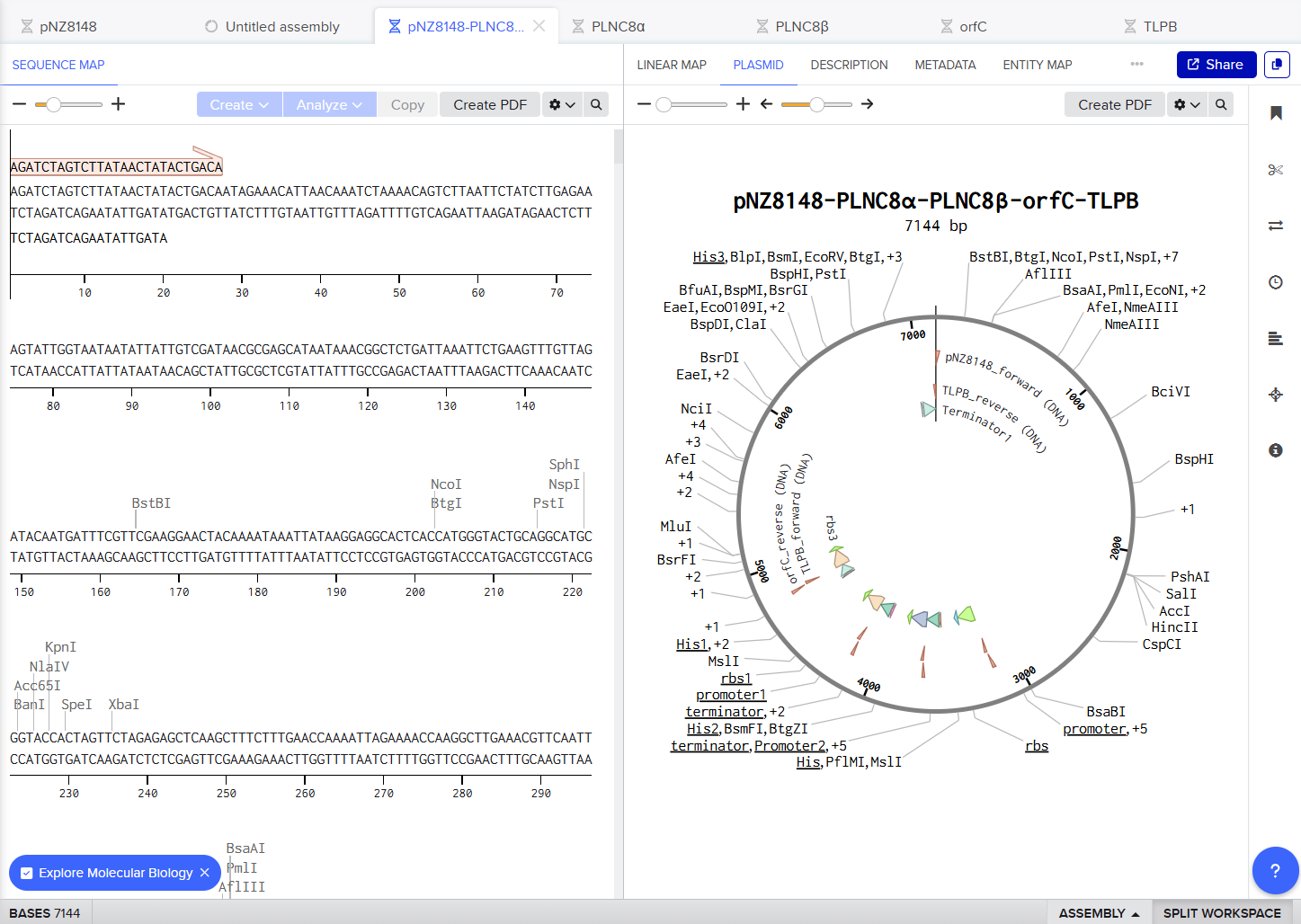
Input: Defined growth medium with the plasmid pNZ8148 containing four genes: PLNC8a, PLNC8b, OrfC (immune resistance protein), and TlpB (urea/pH chemotactic receptor). Each gene consists of a promoter, ribosomal binding site (RBS), a terminator, and a His tag for detection/purification.
Process: Expression and secretion of PLNC8a/b (cationic peptide that causes bacterial membrane perforation); OrfC provides immune protection of L. lactis; TlpB enhances chemotactic activity of L. lactis toward urea/pH specific niches of the gastric mucosa, increasing interaction with H. pylori.
Output: Freeze-dried probiotic capsules (or supernatant) providing living L. lactis and PLNC8 in the stomach.
Assumptions: pNZ8148 (for example, contains a nisin inducible promoter) provides regulated expression; PLNC8 is active in the formulated capsule; TlpB confers functional
(3) How would you use automation?
Identify at least one automation technology that you would combine with your living system. This could include a large-scale Cloud Lab, a desktop liquid-handling robot such as an Opentrons, a programmable microfluidics platform such as Nuclera’s, or another automation technology. Describe what part of the biomanufacturing workflow you would automate and why. For example, you might automate liquid handling, culturing, assembly, screening, sampling, measurement, optimization, or another step.
I will use a desktop liquid-handling robotic system (Opentrons OT-2) for cloning and HTS along with automated bioreactors for the manufacturing process. In a prototype stage, this robotic system can be used for Gibson assembly, transformation, colony picking, and supernatant sampling to identify constructs that have a higher PLNC8 titer. At a manufacturing level, automated bioreactors will control parameters like pH, dissolved oxygen, temperature, and nisin induction.
4) How much would you need to make, and how long would it take?
Perform a back-of-the-envelope calculation estimating what it would take to manufacture your target at a meaningful scale. (a) How much? Define a scale relevant to your project and calculate approximately how much of your target product you would need to manufacture. For example, if you are producing a medicine, you might estimate the amount required to treat 1,000 people, everyone in Massachusetts, or everyone in the world. If you are producing a building material, you might calculate the amount required for one structure or an entire neighborhood. If you are producing an art or design artifact, define an appropriate scale yourself. Clearly show your calculation, including units, assumptions, and sources for important numbers.
Scale: clinical trial supply for 1,000 patients, 14-day treatment period, 1 capsule per day, 10^10 CFU per capsule (a typical probiotic dose).
Number of capsules: 1,000 patients × 14 days × 1 capsule/day = 14,000 capsules.
Total number of CFUs: 14,000 × 1010 = 1.4 × 10¹⁴ CFUs.
With a fermentation yield of ~1011 CFU/mL (~1014 CFUs/L), 1–2 L of
(b) How long? Using your proposed living system and automation technology, estimate how long it would take to manufacture that amount. Consider quantities such as production rate, yield, volume, number of parallel experiments or reactors, automation throughput, or whatever parameters are most appropriate for your system. You may discover that the automation technology you would use to prototype your system is very different from what you would use to manufacture at scale. If so, describe both. Again, we are looking for a reasonable engineering estimate. Show your assumptions and calculations.
Fermentation: 12 to 24 hours per batch using Lactobacillus lactis
Downstream (purification, freeze-drying, encapsulation): 2 to 4 days.
Total: About 3 to 5 days per batch;
5. What don’t you know yet?
After completing your analysis, identify the 2–3 biggest technical unknowns, bottlenecks, or assumptions in your proposed biomanufacturing system. What would you need to learn, measure, or experimentally determine to know whether your idea could actually work?
The stability and function of PLNC8 when formulated and exposed to acid/pepsin. I would test antimicrobial activity in simulated gastric juice and in freeze-dried formulations. Whether TlpB is functional in L. lactis and confers enhanced colonization ability to urea-rich sites. I would perform in vitro tests for chemotaxis and adhesion to mimic the gastric environment. In vivo production titer/cost. I would optimize promoter and codon usage and process conditions, and perform cost of goods analysis.