<YOUR NAME HERE> — HTBAA Fall 2026
About me
Contact info
Homework, Labs, and Projects
See the nav bar on the left to look through my work for How To Biomanufacture Almost Anything (Fall 2026)!
See the nav bar on the left to look through my work for How To Biomanufacture Almost Anything (Fall 2026)!
Stu Angus
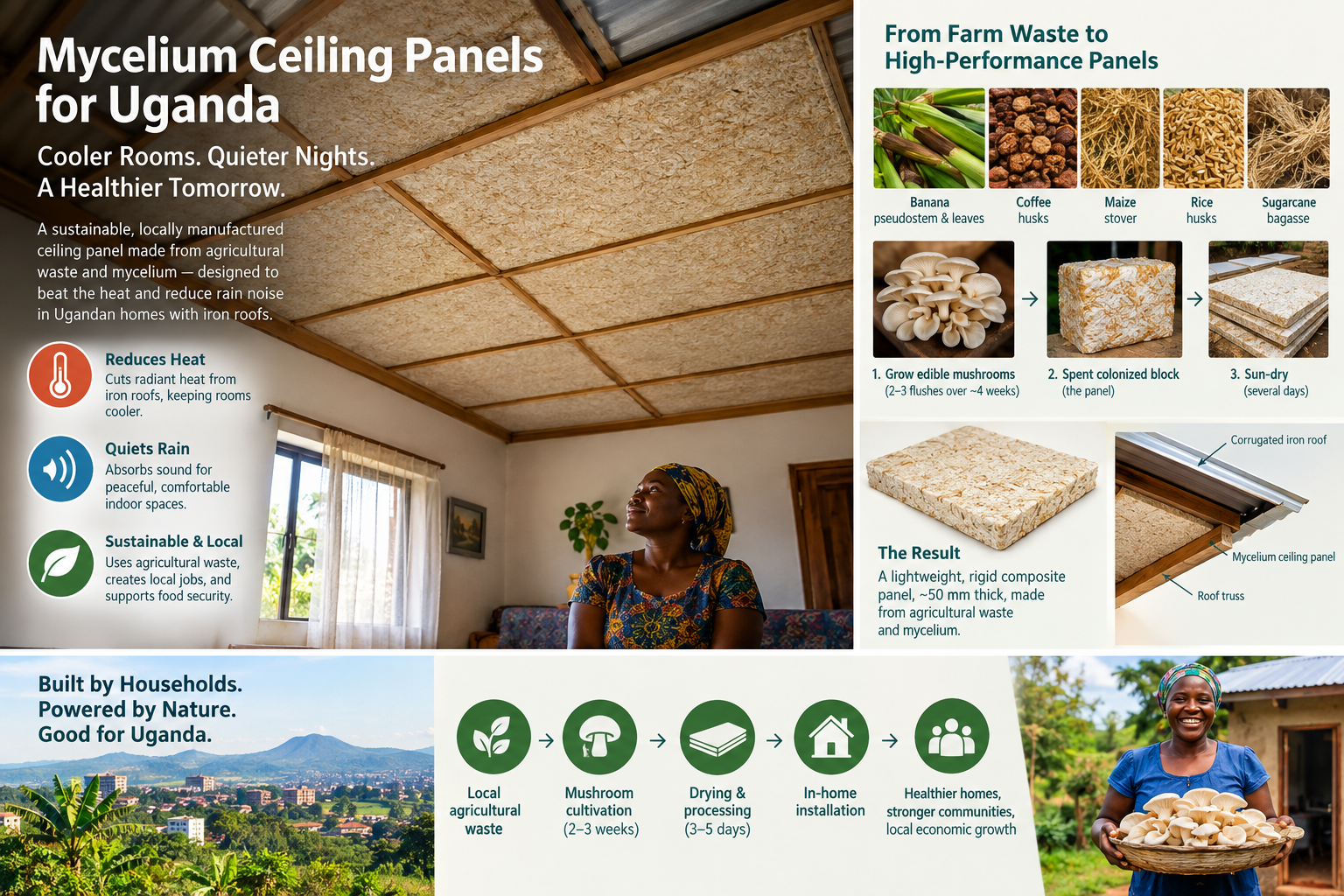
I want to biomanufacture Mycelium-bound composite ceiling panels made from Ugandan agricultural waste, which are to be hung under corrugated iron roofs that are common in local buildings in Uganda. This bioproduct would alleviate the top two complaints from residents who reside in buildings with iron roofs: 1) the iron roofs make the rooms they cover oppressively hot, and 2) the rain on an iron roof is very loud to those inside.
I propose to biomanufacture mycelium-bound composite ceiling panels from Ugandan agricultural waste, grown in place by the households that will use them and seeded from master fungal cultures developed in the US.
The ceiling panels hang beneath corrugated iron roofing to cut radiant heat load and rain noise, the two conditions that most degrade indoor life in Ugandan homes with metal roofs. Because the same organism fruits edible mushrooms before it yields the panel, the material is a byproduct of a food crop Ugandan growers already cultivate. The food income pays for the input.
My personal motivation for making this product is that I know people living in Uganda, and they would benefit personally from this product and also economically from helping to sell it locally in Uganda and potentially throughout Subsaharan Africa.
The product is a rigid, lightweight composite panel roughly 50 mm thick, made of agricultural waste bound together by fungal mycelium and then dried to kill the organism. It is fastened to roof trusses as a ceiling layer underneath corrugated iron sheeting.
Most of the populated country of Uganda sits at 1,100 to 1,300 m elevation, so the capital Kampala runs roughly 17 °C at night and 27 °C in the day, year-round. Almost nobody heats or cools. The two most common complaints are:
A ceiling panel addresses both at once. It also avoids the wall-assembly moisture problems that would sink an in-wall version, and it needs no structural capacity because it carries only its own weight.
Households that build and modify their own homes, where cash is the binding constraint and labour is not. The product is designed so the household supplies free waste biomass and its own labour, and buys only a small quantity of starter culture.
I know people in Uganda who live under iron roofs and would use this. That is the direct motivation. The secondary interest is architectural: this is a case where the constraint of the setting, meaning no electricity, no autoclaves, no cold chain, forces a genuinely distributed manufacturing model rather than a centralised plant with a distribution problem attached.
Pleurotus ostreatus, the oyster mushroom. A white-rot basidiomycete fungus. I chose it over a purpose-engineered organism for three reasons: it is aggressive enough to outcompete contaminants without sterile technique, it grows on almost any lignocellulosic waste, and it is already cultivated in Uganda, so spawn supply chains and agricultural extension knowledge partly exist.
In: agricultural waste (banana pseudostem and leaves, coffee husks, maize stover, rice husks, sugarcane bagasse), water, and spawn. Uganda produces all of these in large volumes as waste, and banana is the dominant staple crop, so pseudostem is abundant year-round.
Process: solid-state fermentation. The substrate is chopped, wetted to roughly 65% moisture, and pasteurised by steeping in hot water or by sun-heating in black plastic. Spawn is mixed in and the mass is packed into a mould. The fungus extends hyphae, the thread-like filaments that make up the mycelial network, secreting lignin- and cellulose-degrading enzymes that let it consume the substrate while its filaments grow through and around every particle. What was a loose pile becomes a continuous bound solid.
Out, in sequence:
CORE OF THE PROPOSAL
Selling a novel building product into a cash-constrained market is hard. Extending a livelihood activity that already exists, and treating the panel as a free byproduct of it, is much easier. The mushrooms pay for the spawn. The panel is what is left over.
The naive version of this business manufactures spawn in the US and ships it to Uganda. That fails on arithmetic. Grain spawn, meaning the starter culture grown on sterilised grain, is heavy and alive: about 43 kg per house (see section 4). Air-freighting perishable live biological material per household, through tropical transit and customs delays, with no cold chain, is not viable.
The fix is to split the workflow by what each side is good at:
flowchart LR
  A[US lab<br/>strain dev + QC] -->|10 mL syringes<br/>~2.5 kg total| B[Uganda<br/>spawn multiplication]
  B -->|3 generations<br/>~15x each| C[8,600 kg<br/>grain spawn]
  C --> D[200 households<br/>substrate colonisation]
  D --> E[Mushrooms<br/>then panels]
Each local amplification generation multiplies mass roughly 10 to 20 times. Three generations turns a shoebox into several tonnes. The export is information, not material. The biology performs the scale-up on the ground.
Opentrons OT-2 or Flex liquid handler, US side, for strain screening. The workflow automated is media preparation, serial dilution, plating of isolate libraries, and contamination QC on every master culture before it ships. Paired with automated time-lapse plate imaging to quantify hyphal extension rate.
The reason to automate here rather than anywhere else is that strain selection is the only step with a genuine throughput problem. I need to screen dozens to hundreds of isolates against several Ugandan substrates, at Ugandan ambient temperatures rather than 22 °C lab bench conditions, on at least four axes:
| Screen | What is measured | Why it matters |
|---|---|---|
| Colonisation rate | Hyphal extension, mm/day, by time-lapse imaging | Sets cycle time and contamination risk |
| Substrate breadth | Growth on banana pseudostem, coffee husk, maize stover | Households use whatever waste they have |
| Thermotolerance | Growth at 25, 30, 35 °C | No climate control available |
| Termite deterrence | Feeding assay against Macrotermes | The highest-risk failure mode |
The last row is the highest-value use of the automation. Termite resistance is the unknown most likely to kill the concept, and a liquid handler plus imaging turns a slow manual assay into something I can run at scale.
The Ugandan side of this workflow is intentionally unautomated. No liquid handlers, no bioreactors, no controlled environment rooms. Colonisation happens in shallow ground pits, which hold stable cool temperature and buffer the day-night swing for free, and in household-scale bags and moulds. Drying is solar.
This is not a gap in the proposal. Automation is front-loaded into the one step where throughput buys something, and the manufacturing itself is distributed, manual, and equipment-free by design. A centralised automated facility in Uganda would introduce a power dependency, a capital requirement, and a distribution problem that the distributed model simply does not have.
Scale chosen: one village of 200 households. This is a meaningful unit because it is roughly the size of a community where a single local spawn operation could serve everyone, and it is the smallest scale at which the distribution model is actually tested.
Step 1: material per house.
Fruiting and respiration consume substrate. Assuming 20% dry matter loss:
At 65% moisture content, dry matter is 35% of wet mass:
At a 5% spawn rate by wet substrate mass:
Step 2: village total and the amplification cascade.
200 houses × 43 kg = 8,600 kg of grain spawn. Working backwards at 15x per generation:
| Stage | Mass | Where |
|---|---|---|
| Mother culture | 2.5 kg | US, automated QC |
| Generation 1 | 38 kg | Uganda, local spawn lab |
| Generation 2 | 570 kg | Uganda, local spawn lab |
| Generation 3 | 8,600 kg | Uganda, distributed |
| Household substrate | 172,000 kg wet | 200 households |
| Finished panel | 48,000 kg | 400 m³ of panel |
THE HEADLINE
2.5 kg of mother culture is roughly 20 to 25 liquid culture syringes. One shoebox, shipped once.
One house needs 43 kg of grain spawn. Working backwards at 15x per generation, only two amplification generations are required rather than three:
| Stage | Mass | Where |
|---|---|---|
| Mother culture | ~190 g | US, automated QC |
| Generation 1 | 2.9 kg | Uganda, local |
| Generation 2 | 43 kg | Uganda, local |
| Household substrate | 860 kg wet | One household |
| Finished panel | 240 kg | 2.0 m³ of panel |
190 g is roughly one 10 mL liquid culture syringe. A single syringe, which costs a few dollars and weighs under 20 g shipped, becomes 240 kg of ceiling panel. That is an amplification of roughly 1,200x by mass from what crosses the border.
Mushroom yield along the way. At a biological efficiency of 60%, meaning fresh mushroom mass as a fraction of dry substrate mass, 300 kg of dry substrate yields roughly 180 kg of fresh oyster mushrooms across two or three flushes. Biological efficiency for P. ostreatus is commonly quoted between 50% and 100%, so this is a mid-range figure and should be treated as approximate.
Single-household timeline:
| Step | Duration |
|---|---|
| US master culture prep and QC | 2 to 3 weeks |
| Shipping and customs clearance | 1 to 2 weeks |
| Local spawn amplification, 2 generations at ~14 days | 4 weeks |
| Substrate colonisation | 3 to 4 weeks |
| Two mushroom flushes | 4 weeks |
| Solar drying | 1 week |
| Total | 15 to 18 weeks |
First cycle, from a standing start, at village scale:
| Step | Duration |
|---|---|
| US master culture prep and QC | 2 to 3 weeks |
| Shipping and customs clearance | 1 to 2 weeks |
| Local spawn amplification, 3 generations at ~14 days | 6 weeks |
| Household substrate colonisation | 3 to 4 weeks |
| Two mushroom flushes | 4 weeks |
| Solar drying | 1 week |
| Total | 17 to 20 weeks |
Steady state: 8 to 10 weeks per batch. Once local spawn is self-sustaining, the US steps drop out entirely and only the last four rows remain.
The throughput argument is parallelism, not rate. All 200 households colonise simultaneously, so the village produces 400 m³ of panel per cycle with no central facility, no power, and no capital equipment on the ground. A centralised plant producing 400 m³ per 10 weeks would be a significant industrial operation.
These are genuinely different, as the assignment anticipates. Prototyping uses an Opentrons liquid handler and plate imaging to screen strains, which is a laboratory-throughput problem. Production uses no automation at all, because the rate-limiting step is biological colonisation time, which no machine shortens. The scale-up mechanism is the organism’s own exponential growth, distributed across households, rather than larger reactors.
Macrotermes species are aggressive across Uganda and a cellulosic panel is, from their point of view, food. Ceiling mounting keeps the panel dry and off the soil, which helps considerably, but this is unmeasured and could be fatal to the concept.
What I would need to determine: feeding-preference assays of colonised, dried panel material against local Macrotermes colonies, comparing strains and comparing mineral loadings. There is literature on fungal metabolites with termiticidal activity, so strain selection may be a genuine lever rather than a hope. This is the single highest-value target for the automated screening described in section 3.
Nobody has published a measurement of ceiling temperature drop or noise reduction from a 50 mm mycelium panel under corrugated iron in equatorial conditions. If the delta is 2 °C, this is a pleasant idea that does not matter. If it is 6 to 8 °C, it is transformative.
What I would need to measure: paired instrumented test structures, one with and one without the panel, logging interior air and surface temperature across a full diurnal cycle, plus sound pressure level during rainfall. This is cheap, requires no biology, and should be done first. It gates everything else.
Two linked unknowns. Can a master culture survive 10 to 14 days of uncooled tropical transit and remain viable and uncontaminated? And is the import permitted?
What I would need to determine: viability testing under simulated transit temperature profiles, comparing agar slants, liquid culture, and dried grain spawn as shipping formats. On the regulatory side, importing live fungal cultures requires a permit from Uganda’s Ministry of Agriculture, Animal Industry and Fisheries. That P. ostreatus is already cultivated there helps the case considerably, but this needs verifying rather than assuming. Separately, if I isolate a native Ugandan strain rather than using a US one, the Nagoya Protocol on access and benefit-sharing applies and a benefit-sharing agreement is required.
One process-safety note on the production side: spore exposure during large-scale colonisation and fruiting is a documented respiratory hazard for mushroom workers. The workflow should be designed around outdoor or well-ventilated handling from the start rather than retrofitted.
Every number used above, with its basis. Figures marked approximate are from general knowledge and would need verification before any of this is acted on.
| Parameter | Value used | Basis |
|---|---|---|
| Roof footprint, typical rural house | 40 m² | Assumption, order-of-magnitude |
| Panel thickness | 50 mm | Design choice, balances performance against material |
| Mycelium composite density | 120 kg/m³ | Approximate; published range roughly 60 to 250 kg/m³ |
| Dry matter loss to fruiting and respiration | 20% | Approximate, varies with flush count |
| Substrate moisture content | 65% | Standard for oyster cultivation |
| Spawn rate | 5% of wet substrate | Approximate; common range 2 to 10% |
| Amplification factor per generation | 15x | Approximate; typical range 10 to 20x |
| Colonisation time per generation | 14 days | Approximate, temperature dependent |
| Biological efficiency, mushroom yield | 60% | Approximate; commonly quoted 50 to 100% |
| Kampala temperature range | 17 to 27 °C | Approximate, year-round |
| Uganda populated elevation | 1,100 to 1,300 m | Approximate |
Three numbers drive the whole calculation and are the ones worth measuring first:
I have not verified the density and amplification figures against primary literature for this draft. Both are standard enough in the mycelium composite and mushroom cultivation literature that the order of magnitude should hold, but the specific values should be sourced before this goes further.
AI Client Used for Ideation: Claude Opus 5.0
Prompt Log:
| # | Date | Prompt (verbatim or summarized) |
|---|---|---|
| 1 | Sep 19, 2026 | “I want to come up with an idea of how to biomanufacture natural insulation for the walls in a building using some kind of biomanufactured foam that reacts or develops from being in contact with the ground/dirt. Can you guide me through this ideation process?” |
| 2 | Sep 19, 2026 | “Let me clarify, the building standards don’t need to be up to code in the US, this idea is for Uganda buildings where building code is less strict and residents often make their own buildings. I want something that they can add to their building structures as insulation, or to improve their indoor environment in some way.” |
| 3 | Sep 19, 2026 | “Thanks for that useful info. I’m also including below the homework assignment that this is a part of. I wanted to focus on Uganda because I know people in Uganda who could use this roofing improvement and it would improve their quality of life, so long as we can make it safe as well. The idea is to manufacture the Spawn packets here in the US (if possible) then send them to Uganda for sale.” — followed by the pasted full text of the HTBAA Homework #1 assignment brief |
| 4 | Sep 19, 2026 | “please assemble the clean document.” |
| 5 | Sep 20, 2026 | Comment left on the draft document: “@Claude let’s see the calculations for 1 household” |
| 6 | Sep 20, 2026 | “Could you reformat all those tables you produced in Scriptome.AI colors? Logo is attached. The green color should be predominant” — with Newest-scriptome-ai-logo.png attached |
| 7 | Sep 20, 2026 | “now can you itemize all the prompts I gave you in this chat so I can provide citations for using Claude as a tool?” |
Reference
Anthropic. (2026). Claude (Opus 5) [Large language model]. https://claude.ai