Week 4 LAB: Cell-Free Manufacturing
A. DESIGN A BATCH OF CELL-FREE REACTION COMPOSITIONS
When designing experiments, you’ll often want to compare several conditions that differ only slightly, such as one reagent at a few different concentrations, and batches let you submit those together. To make a batch, click “+ add mix” in the designer to copy your current composition into additional columns, change reagent(s) to a different concentration in each column, add an overall hypothesis plus a short rationale for each mix when submitting.
You should batch experimental conditions that are intended to be directly compared with each other. When we pick the final experimental conditions, we’ll try to include whole batches rather than splitting them up.
A batch is a JSON object with an overall experiment_hypothesis and a samples list. Each item in the list is a dictionary for one composition: a unique sample_id and reagent_list of reagent volumes in nL that sum to exactly 20,000, and metadata with that composition’s protein_target and comments.
For example, to specify a parameter sweep, you keep every sample identical except the reagent you’re varying, and adjust water to keep the total at 20,000 nL:
“experiment_hypothesis”: “Find the magnesium glutamate level that maximizes sfGFP yield”,
Batch Design
sfGFP
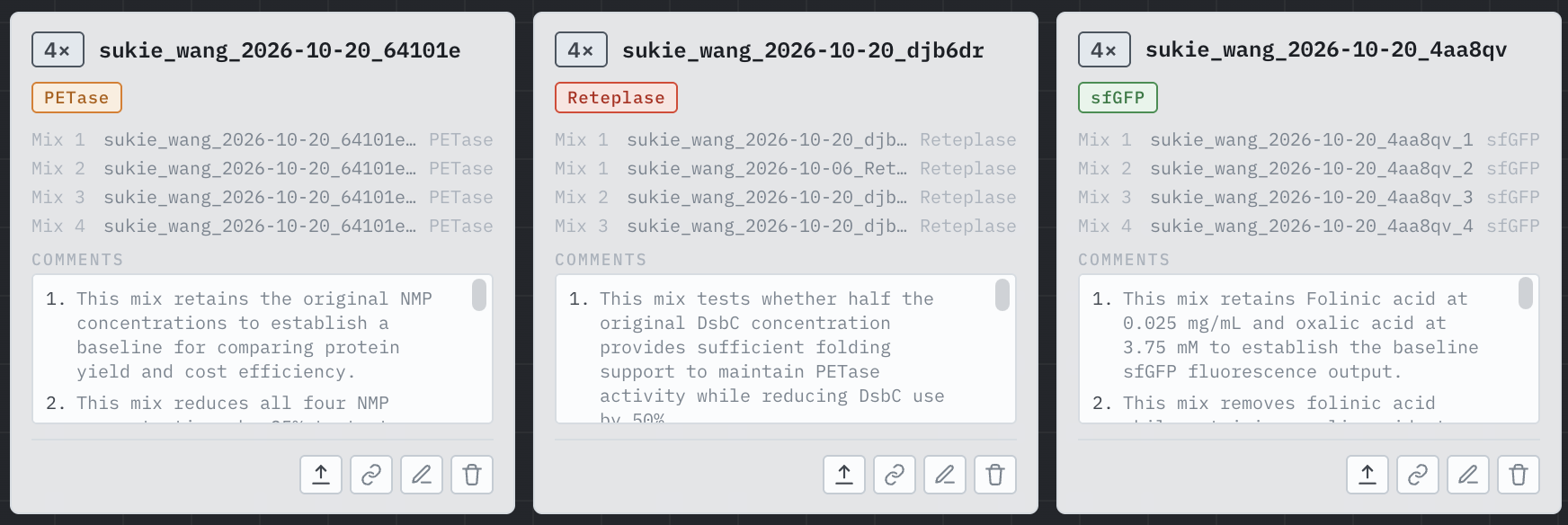
Folinic acid and oxalic acid supplementation may not both be necessary to maintain sfGFP fluorescence output in the current CFPS formulation. Removing either or both may simplify the formulation and reduce reagent costs without substantially decreasing output. A four-condition comparison will test their individual and combined effects.
PETase
Reducing DsbC below the current concentration of 5 µM may lower reaction cost while maintaining PETase activity. Comparing progressively lower DsbC concentrations will help identify the lowest tested level that supports activity comparable to the original formulation.
Reteplase
The current formulation may contain more NMPs than are needed to sustain protein production. I will reduce AMP, CMP, GMP, and UMP concentrations by 25%, preserving their relative proportions while keeping all other components and the total reaction volume unchanged. This moderate reduction tests whether nucleotide input can be lowered without substantially reducing protein yield. Comparing this condition with the original formulation will help determine whether the reduction improves protein production per unit cost.
B. RESEARCH TEAM DISCUSSION, DATA ANALYSIS, METASCIENCE
Data Analysis
One possible explanation is that 384 well plates may have a higher exposed liquid surface area to volume ratio, making the reactions more susceptible to evaporation. This could increase reagent concentrations and alter reaction performance. Deep-well plates may experience less evaporation, keeping concentrations closer to their initial values.
Metascience
One rubric criterion could be how much a proposal can be used to compliment other experiments selected for the plate. It could be for experiments that address underexplored conditions, while keeping necessary controls and replicates. This may potentially broaden what the community learns from a single batch of experiment.
Use of AI
I have used ChatGPT as support for this assignment.