Week 1 HW: Final Project Ideas
Engineering Halomonas for Enhanced PHA Production and Its Biomedical Devices Applications
(1) What do you want to make?
My previous research dealt with the optimization of fermentation conditions to produce PHA using wild type Bacillus megaterium. The PHA molecules can be intended as biomaterial for biomedical devices, such as tissue engineering scaffold, surgical sutures, and wound dressing film. PHA is synthesized and accumulated by microorganisms as a form of stored carbon and energy. It is a family of polymers with varying numbers of monomers, which lead to different characteristics, namely mechanical strength, flexibility, degradation rate, molecular weight, crystallinity, surface property, etc. Essential uses of PHA for biomedical devices include biocompatibility, controlled biodegradability, and ability to be broken down into non-toxic compounds. The molecule itself is particularly interesting for me due to its versatile applications and variability based on the monomers and potential combination with other polymers.
(2) What living system could make it?
Generally, living systems used to produce PHA for biomedical devices are categorized within the Gram-positive bacteria group as its cell wall structure does not contain LPS and toxins, which might contaminate the extracted product. However, after reading one of the articles related to genetic engineering of extremophiles, Halomonas sp. might provide an additional benefit for its tolerance to extreme salt concentration. The ability surely reduces the reliance on strict sterilization as the condition would be unsuitable to support general microorganism. It also demonstrated high production of PHA, up to 70-90% of its dry cell weight, depending on the substrate. Moreover, various carbon sources can be used as the substrate to produce the PHA. Although less information is known compared to the established microbes systems, Halomonas have been utilized for copolymer production through genetic engineering.
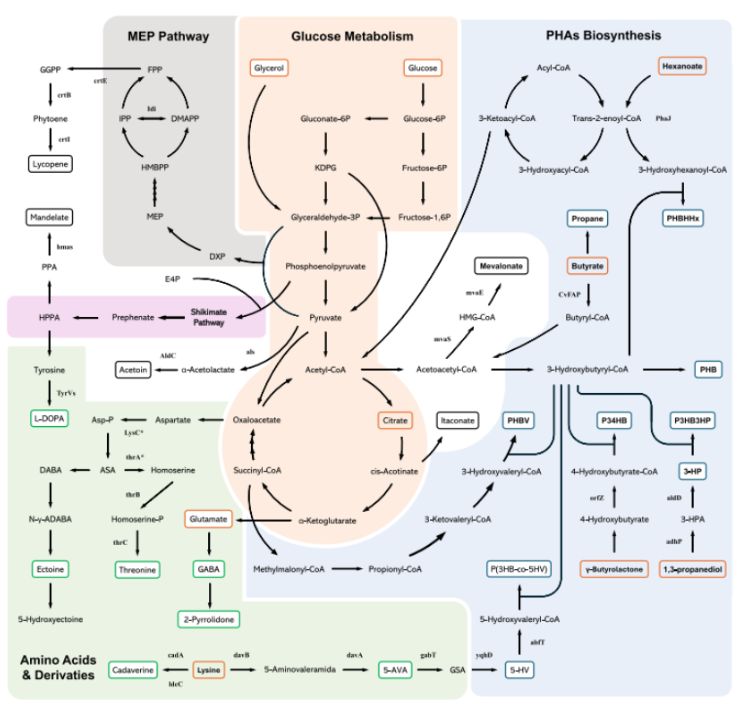
Here are the metabolic pathways from engineered Halomonas (Coimbra et al. 2025). The PHA biosynthesis is the one color light blue. Generally, there are three different routes of PHA production:
- Acetyl-CoA pathway
Production of short chain length PHA through PhaA, PhaB, and PhaC.
- Fatty-acid de novo synthesis pathway
Oxidation of carbon source into acetyl-coA through catalytic role of PhaG.
- Fatty-acid beta-oxidation pathway
Degradation of fatty-acid intermediates to generate hydroxyacyl-CoA precursors, involving PhaJ.
During the initial production of PHAs by Halomonas sp., previous research has explored using simple substrates, such as glucose, rhamnose, mixed volatile fatty acids, and glycerol. Low-cost waste substrates have also been utilized, such as molasses, waste frying oil, dairy waste, and crude glycerol, though being mentioned for its low yield.
Hence, modification of its genome can be done as a strategy to enhance the yield and productivity, while utilizing its ability to grow under unsterile-fermentation conditions. Overexpression is targeted toward a gene or multiple genes related to PHA production and its stability over generations should be monitored.
Some of the workflows:
- Wild-type baseline and strain selection
- Genetic engineering strategy selection
- Construction and codon optimization for Halomonas
- Screen and characterize PHA production
- Optimize and stabilize the production process in lab-scale
- Scale-up through bioreactors and automations
- Harvest, recover, and purify PHA
- Evaluate of the biomedical device suitability
(3) How could automation help you make it?
The system aims to improve consistency across batches, reduce repetitive manual work and human error, enable systematic experimentation, and improve data collection throughout the PHA production process. I imagined it to be an integrated machine for cultivation and sampling systems that support microbial cultivation, automated sampling, measurement, and PHA recovery.
The system would maintain a controlled and enclosed cultivation environment with continuous monitoring that can be adjusted. Important parameters might include salinity, temperature, pH, dissolved oxygen, and other cultivation conditions. The system must account for material compatibility with high saline media, contamination control, and scalability.
This automation would support reproducible experimentation by standardizing cultivation and sampling procedures and minimizing variation between batches. The sampling and measurement could also enable more detailed monitoring of biomass growth, nutrient consumption, and PHA accumulation, with automated quantification of data, including dry cell weight, PHA mass, PHA concentration, and PHA yield.
(4) What would it take to make it at a meaningful scale?
The initial target is a research prototype for tissue engineering scaffold. The focus is for production and characterization of the PHA-based material. The intended number of devices is 10 scaffolds, with 0,5 gram each. Hence, the total will be 5 grams. For reject processing and initial characterization will take 20% each. The target total of that production will be 7 grams.
Parameters of production must be determined, including the working volume of culture, biomass concentration (g/L), PHA content, recovery yield of the PHA, as well as the production time and harvesting time.
Information:
- Working volume (V): 1L
- Biomass concentration (B): 5 g/L
- PHA content (P): 70%
- Recovery yield (Y): 60%
- Cultivation time (T): 48 hours
- Parallel experiment: none, only one
From that information, the hypothetical calculation is:
- Recovery of PHA/batch = V x B x P x Y
- Recovery of PHA/batch = 1 x 5 x 70% x 60% = 2,1 g
So, the number of batches required to produce the target is:
- Total of batches = target PHA / recovery of PHA/batch = 7 / 2,1 = 3,33 = 4 batches
Since one cultivation time takes 48 hours, the process might take more than that due to the system preparation, harvest and recovery process, and cleaning, which might add a total of 12 hours. Roughly, that will be 60 hours in total. So the total time of 4 batches is 240 hours (10 days).
(5) What don’t you know yet?
I have not explored much on extremophiles, especially Halomonas, and all the answers are based on hypotheses and some of the journals that I have read briefly. So the gaps that need to be bridged are:
- What dry biomass concentration and intracellular PHA content can be achieved under the selected cultivation conditions from a particular substrate?
- How do changes in cultivation conditions or genetic modifications affect biomass production, PHA accumulation, and polymer properties?
- Are the cultivation conditions required by extremophiles compatible with the proposed bioreactor and automated production system?
- Can these conditions be maintained consistently throughout the production process?
- Are the properties of the produced PHA consistent between batches?
AI Use Disclosure
I use AI (ChatGPT (OpenAI)) to assist with calculations, clarifying production parameters, and identifying assumptions and potential limitations to the plan.
Prompts Used: Calculator example and verification Parameters that might be critical during fermentation Clarification of the knowledge gaps
References
Coimbra, A. a. B., Prakash, S., Jiménez, J. I., & Rios-Solis, L. (2025). Establishing Halomonas as a chassis for industrial biotechnology: advances in synthetic biology tool development and metabolic engineering strategies. Microbial Cell Factories, 24(1), 133. https://doi.org/10.1186/s12934-025-02757-2
Muigano, M. N., Mauti, G. O., Anami, S. E., & Onguso, J. M. (2025). Advances and challenges in polyhydroxyalkanoates (PHA) production using Halomonas species: A review. International Journal of Biological Macromolecules, 309(Pt 1), 142850. https://doi.org/10.1016/j.ijbiomac.2025.142850
Ye, J., Lin, Y., Yi, X., Yu, Z., Liu, X., & Chen, G. (2022). Synthetic biology of extremophiles: a new wave of biomanufacturing. Trends in Biotechnology, 41(3), 342–357. https://doi.org/10.1016/j.tibtech.2022.11.010