Week 01 — Grown Artifact
HTBAA Homework #1
Grown Artifact
Biological Fabrication through Designed Growth
1. What would I like to biomanufacture and why?
I propose to biomanufacture an ephemeral three-dimensional sculptural artifact combining a lightweight digitally designed scaffold with a biological membrane grown from bacterial cellulose.
The proposed artifact would be approximately 1 meter tall and 50–60 cm wide. Its geometry would be vertical, volumetric, abstract, and organic, positioned somewhere between an architectural structure and a biological form.
The scaffold would establish an initial geometric framework, but the final appearance of the artifact would not be completely predetermined. Instead, bacterial cellulose would develop in relation to the scaffold over time, potentially producing variations in thickness, density, transparency, texture, and spatial distribution.
The artifact would therefore be experienced as a spatial object rather than a frontal image. Its surfaces, openings, layers, and translucency could change depending on the viewer’s position and the way light passes through the material. The relationship between the scaffold and the biological material would remain partially visible, making the fabrication process part of the final aesthetic.
Why this is interesting to me
My interest in this project comes from the intersection of design, spatial experience, digital fabrication, and biological processes.
I became particularly interested in bacterial cellulose through a previous experience growing a kombucha SCOBY. Observing how its texture, thickness, and appearance changed over time suggested the possibility of treating biological growth itself as a design and fabrication process.
This led me to question a conventional assumption in design: that the designer should determine the final form before fabrication begins.
Instead, I am interested in a process where the designer establishes an initial geometry and a set of conditions, while the biological system participates in determining the final morphology.
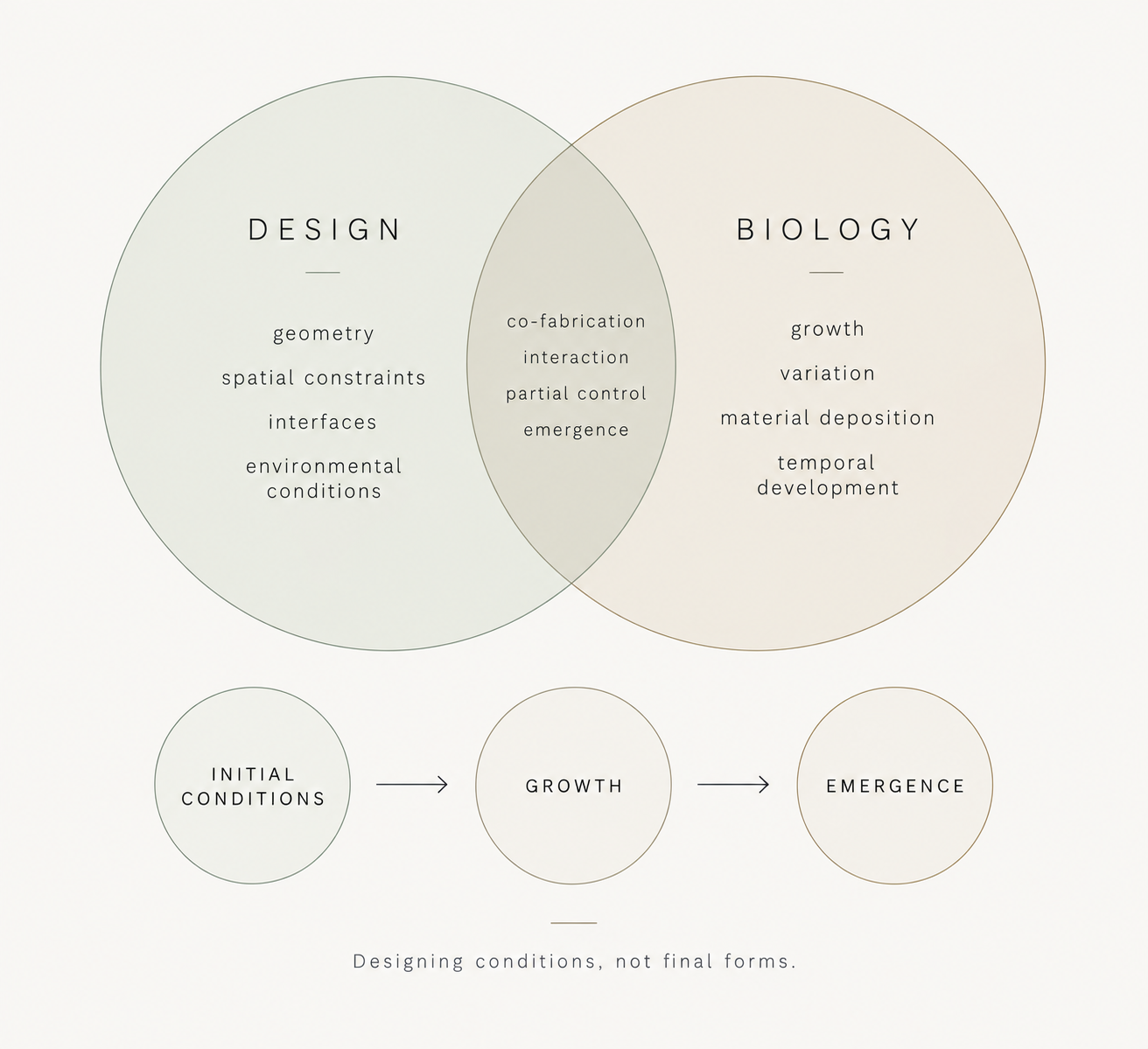
Rather than designing the final object directly, I am interested in designing the conditions under which the object can emerge.
This approach is informed by Neri Oxman’s work on Material Ecology and, more specifically, by her concept of templating, which explores how top-down design frameworks can guide or influence bottom-up biological and material processes. In Templating Design for Biology and Biology for Design, Oxman describes the possibility of combining top-down design procedures with bottom-up biological or material growth (Oxman, 2015).
Grown Artifact adapts this principle to bacterial cellulose: the scaffold establishes a spatial framework and environmental interface, while biological growth contributes to the formation of the final morphology.
The project can therefore be understood as a form of co-fabrication between a designer and a biological system.
The designer establishes:
- geometry;
- spatial constraints;
- interfaces;
- environmental conditions.
The biological system contributes:
- growth;
- material deposition;
- variation;
- temporal development;
- emergent morphology.
The final artifact would consequently be neither completely designed nor completely spontaneous.
It would emerge from the interaction between both systems.
2. What living system would I use?
The proposed biological manufacturing system is bacterial cellulose produced by a microbial culture associated with kombucha, particularly cellulose-producing bacteria from the Komagataeibacter genus.
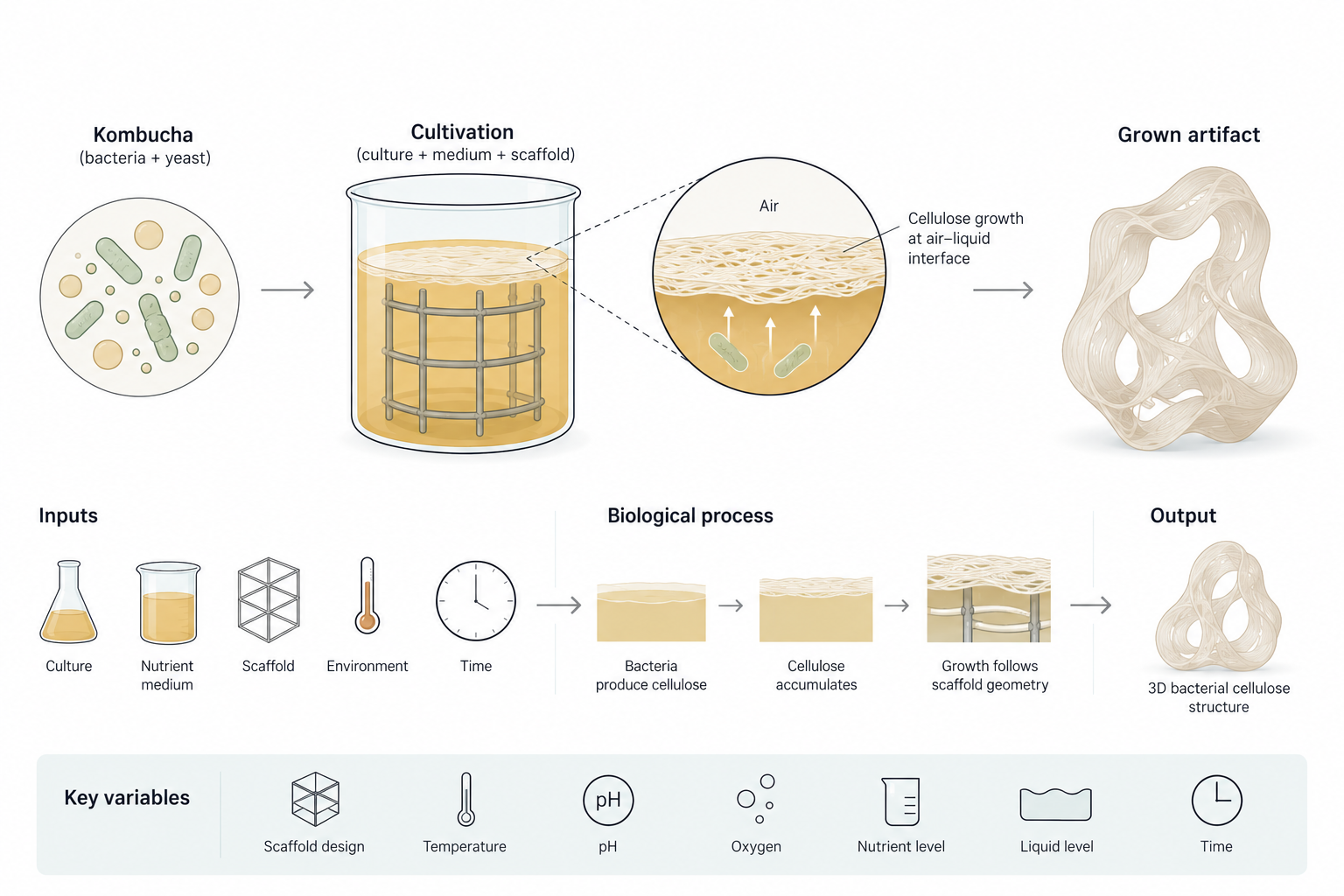
Kombucha is a symbiotic culture of bacteria and yeasts. Within this system, cellulose-producing bacteria generate cellulose extracellularly, forming a cellulose-rich membrane, particularly at the air–liquid interface.
This behavior is important because it establishes both an opportunity and a constraint for the project.
The opportunity is that the microorganisms naturally produce a visible, macroscopic material layer.
The constraint is that bacterial cellulose does not simply grow uniformly around an arbitrary three-dimensional object. Its formation is strongly related to cultivation conditions and the air–liquid interface.
Recent research provides two particularly relevant precedents.
Loh et al. (2025) developed a bacterial cellulose bioreactor combining a supportive mesh scaffold with intermittent nutrient feeding. The mesh anchored the growing pellicle at the air–liquid interface, allowing continuous growth and greater control over thickness. Their system was tested from 250 mL to 10 L and produced pellicles exceeding 80 mm in thickness.
Caro-Astorga et al. (2021) demonstrated another approach to three-dimensional bacterial cellulose fabrication. They produced millimetre-scale bacterial cellulose spheroids from Komagataeibacter rhaeticus and used them as building blocks to grow continuous 3D shapes. Their experimental structures grew and fused over approximately 4–10 days.
These studies demonstrate that bacterial cellulose can be produced in thicker and three-dimensional configurations. However, they use different fabrication strategies from the one proposed here.
Grown Artifact therefore asks a more specific question:
Can a deliberately designed scaffold and interface guide bacterial cellulose growth into a larger, continuous spatial artifact while retaining biological variation?
This becomes the central biological question of the project.
What goes into the system?
At a high level, the biological system would require:
- an established bacterial-cellulose-producing culture;
- a nutrient-containing cultivation medium;
- a suitable cultivation environment;
- a designed scaffold or support structure;
- time for biological growth.
What happens biologically?
The cellulose-producing bacteria synthesize cellulose extracellularly.
The cellulose accumulates as a network at the growth interface, progressively forming a material layer.
The resulting material would then interact with the scaffold and its geometry.
What comes out?
The desired output is not simply a quantity of bacterial cellulose.
The desired output is a spatially organized biological material system in which the morphology of cellulose is influenced by the relationship between:
scaffold geometry + biological growth + environmental conditions + time
This is an important distinction.
The project is not assuming that the final one-meter artifact can already be produced reliably.
Instead, the ability to guide bacterial cellulose toward the proposed spatial configuration is itself part of the experimental question.
Proposed hypothesis
I hypothesize that a scaffold designed around the spatial and environmental requirements of bacterial cellulose growth can influence the distribution, thickness, continuity, and morphology of cellulose deposition, enabling the formation of a coherent three-dimensional artifact while retaining biological variation.
This hypothesis does not assume complete control over biological growth.
Instead, the goal is to investigate whether biological variability can be constrained sufficiently to produce a coherent spatial artifact.
Design and biological variables
The experiment would distinguish between design variables and biological/environmental variables.
Design and scaffold variables
Possible scaffold variables include:
- geometry;
- curvature;
- surface area;
- aperture size;
- density;
- orientation;
- porosity;
- surface characteristics;
- distance from the air–liquid interface;
- relationship between scaffold and growing cellulose.
Biological and environmental variables
Relevant variables could include:
- temperature;
- pH;
- oxygen availability;
- nutrient concentration;
- cultivation time;
- liquid level;
- culture volume;
- surface-to-volume relationship.
The intention would not be to change every variable simultaneously.
Instead, experiments would progressively investigate relationships between variables to determine which conditions produce observable changes in cellulose morphology.
How would I know if it worked?
The experiment would be considered successful if changes in scaffold geometry or cultivation conditions produced measurable differences in the resulting bacterial cellulose.
The main observations would include:
- surface coverage;
- thickness;
- continuity;
- spatial distribution;
- attachment to the scaffold;
- morphology;
- variation between experimental conditions.
The objective would not be to obtain an identical result in every experiment.
Instead, the objective would be to determine whether changes in the designed conditions produce repeatable and observable changes in biological morphology.
This would allow the project to evaluate the relationship between:
designed conditions → biological response → resulting morphology
rather than evaluating the artifact only through its visual appearance.
3. How would I use automation?
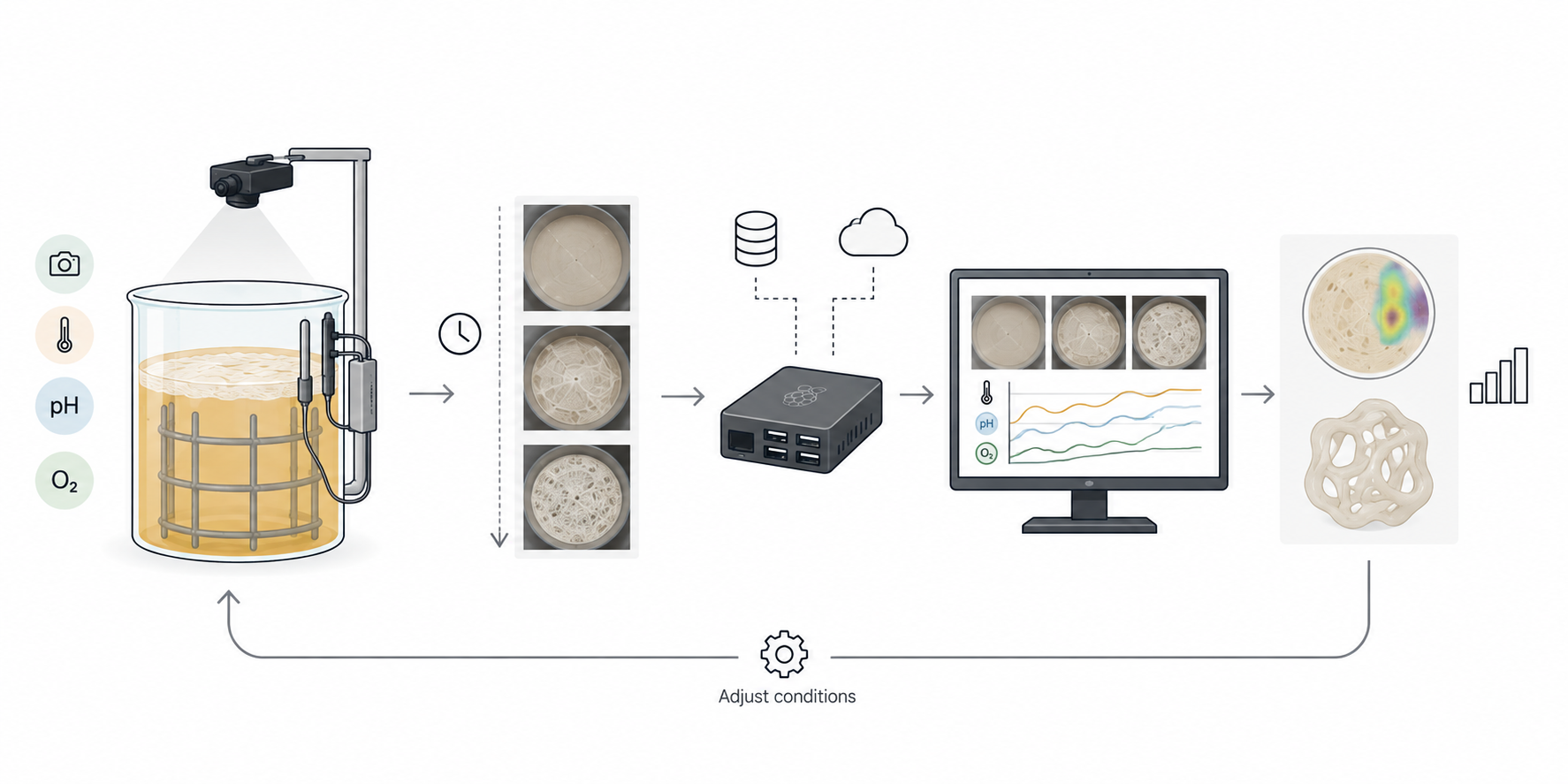
Automation would primarily be used to monitor, document, and compare biological growth over time.
Rather than initially trying to completely automate fabrication, I would use automation as a research instrument.
A camera-based system could periodically capture images of the developing bacterial cellulose.
These images could be used to document changes in:
- surface coverage;
- morphology;
- thickness;
- transparency;
- density;
- spatial distribution.
Environmental sensors could simultaneously record relevant cultivation conditions.
A programmable controller could collect and associate these measurements with the corresponding stages of biological growth.
The resulting dataset could connect:
time + environmental conditions + scaffold configuration + biological morphology
This would make it possible to move beyond simple visual observation toward a more measurable and repeatable experimental process.
Existing bacterial cellulose research demonstrates that automation can also be integrated directly into the cultivation process. Loh et al. (2025), for example, used automated peristaltic pumps to introduce fresh growth medium into their mesh-supported bioreactor, allowing continued growth at the air–liquid interface.
Grown Artifact would extend this logic toward monitoring and adaptive experimentation, rather than only automating nutrient delivery.
Feedback loop
The automation system could eventually support a feedback loop:
biological growth → observation → data → adjustment → new growth condition
For example, if a particular scaffold geometry consistently produces greater cellulose accumulation in a specific region, that information could inform the next scaffold iteration.
The purpose of automation is therefore not to make biology behave like a conventional manufacturing machine.
Instead, it is to make biological variability observable, measurable, and progressively understandable.
This approach is consistent with broader biomanufacturing research emphasizing automation, data collection, process monitoring, and enabling infrastructure as important components of biological production systems.
Prototype versus scale
The automation used during experimentation would likely differ from the system used for larger-scale production.
For the prototype stage, a relatively simple system could be sufficient:
camera + environmental sensors + programmable controller + data logging
The purpose would be to understand the biological process.
At a larger manufacturing scale, automation would likely need to address:
- environmental control;
- monitoring of multiple cultivation systems;
- nutrient delivery;
- sampling;
- data management;
- process consistency;
- parallel production.
This distinction is important because the automation required to learn the process is not necessarily the same as the automation required to manufacture at scale.
4. How much would I need to make, and how long would it take?
(a) How much?
For this project, I define a meaningful scale as one exhibition-scale artifact approximately 1 meter tall and 50–60 cm wide.
The purpose of this calculation is not to determine a final manufacturing specification, but to estimate the approximate quantity of bacterial cellulose involved.
Assume that the biological membrane covers approximately:
1.5 m²
and has an average dry thickness of:
0.12 mm
First, estimate the volume of dry bacterial cellulose:
1.5 m² × 0.12 mm ≈ 180 cm³
For a preliminary mass estimate, I use the dry-density range reported by Loh et al. (2025) for their mesh-supported system:
91.5–156 kg/m³
which corresponds to:
0.0915–0.156 g/cm³
Using this range:
180 cm³ × 0.0915–0.156 g/cm³ ≈ 16.5–28.1 g
Therefore, under this literature-based assumption, the target artifact would contain approximately:
17–28 g of dry bacterial cellulose
This estimate should be treated cautiously because bacterial cellulose density depends on cultivation method, thickness, drying method, and material structure. The values reported by Loh et al. correspond to their specific bioreactor and should not be assumed to represent a universal density for bacterial cellulose.
Culture volume estimate
Avcioglu et al. (2021) reported a bacterial cellulose production value of 18.68 g/L using an optimized kombucha consortium under specific experimental conditions: static cultivation at 30 °C for 10 days with an optimized medium.
Using this value only as a theoretical reference:
17–28 g ÷ 18.68 g/L ≈ 0.9–1.5 L
This suggests that approximately 0.9–1.5 L of culture medium could theoretically produce the estimated dry mass under comparable production conditions.
However, this should not be interpreted as the actual culture volume required for the sculpture.
The proposed artifact is three-dimensional, the biological material would not necessarily grow uniformly, and the relationship between culture volume, scaffold geometry, and usable three-dimensional material has not yet been established.
The calculation is therefore a back-of-the-envelope mass-to-yield comparison, rather than a validated production specification.
The first experimental prototypes would be used to determine the actual relationship between:
culture volume → growth → cellulose accumulation → usable artifact
(b) How long?
The production time of the final artifact cannot currently be established with sufficient confidence.
Published bacterial cellulose studies demonstrate that production rate depends strongly on cultivation configuration and environmental conditions.
Loh et al. (2025) demonstrated continuous growth at approximately 1 mm of thickness per day in their mesh-supported bioreactor, with the system tested over extended cultivation periods. Their 10 L system produced pellicles up to approximately 82 mm thick.
Caro-Astorga et al. (2021), using a different fabrication strategy based on bacterial cellulose spheroids, observed growth and fusion into continuous 3D shapes over approximately 4–10 days.
These results demonstrate that bacterial cellulose can grow at useful rates, but they cannot be directly transferred to the proposed artifact because the geometry, interface configuration, scale, culture conditions, and fabrication strategy are different.
Therefore, the project would first establish an empirical relationship between:
time → cellulose accumulation → thickness → spatial coverage
A hypothetical growth rate can illustrate the calculation.
For example, if a particular region accumulated:
1 mm/day
then producing:
10 mm
in that region would theoretically require:
10 mm ÷ 1 mm/day = 10 days
However, this does not mean that the complete one-meter artifact would require ten days.
Different regions may grow at different rates, and increasing scale may introduce environmental gradients, oxygen limitations, structural issues, and other constraints.
For overall project planning, I would initially allocate approximately:
10–14 weeks
for the complete development process, including:
- scaffold design;
- biological experiments;
- growth;
- monitoring;
- iteration;
- final cultivation;
- drying;
- stabilization;
- documentation.
This is a project-planning estimate, not a demonstrated manufacturing time.
The project would therefore progress from small experimental prototypes toward the final artifact rather than assuming that the final object can simply be scaled proportionally from a small sample.
5. What don’t I know yet?
After considering the proposed biological system, automation, and scale, several major technical uncertainties remain.
1. Can a designed scaffold guide bacterial cellulose into a larger continuous spatial form?
Existing research demonstrates that bacterial cellulose can be produced in three-dimensional configurations, including both mesh-supported pellicles and modular spheroid-based structures.
The remaining question for Grown Artifact is whether a deliberately designed scaffold and interface can guide the growth of a continuous spatial artifact at a larger scale.
The first experiments would therefore need to determine whether scaffold geometry produces measurable differences in cellulose distribution and attachment.
2. Which scaffold properties most strongly influence growth?
The project does not yet establish which properties of the scaffold will have the greatest effect on bacterial cellulose formation.
Potential factors include:
- geometry;
- porosity;
- surface area;
- surface characteristics;
- curvature;
- aperture size;
- orientation;
- distance from the air–liquid interface.
Determining which of these variables produce observable changes would help identify which aspects of the scaffold should be actively designed and which can remain uncontrolled.
3. How predictable can the final morphology become?
The project intentionally allows biological growth to influence the final form.
This introduces variability.
I do not yet know how consistently factors such as:
- temperature;
- pH;
- oxygen availability;
- nutrient concentration;
- scaffold geometry;
- surface area;
- cultivation time
will influence thickness and spatial distribution.
The key challenge is therefore not complete control.
It is finding a useful balance between:
design control ↔ biological variability
The research would need to determine whether this balance is sufficient to produce a coherent artifact while preserving the biological character of the growth process.
4. Can the system be scaled from prototype to a one-meter artifact?
A small prototype and a one-meter artifact cannot necessarily be treated as the same system at different scales.
Increasing scale may introduce challenges related to:
- oxygen availability;
- environmental gradients;
- surface-to-volume ratio;
- structural support;
- contamination;
- uniformity of growth;
- drying;
- cultivation volume.
The transition from experimental biological fabrication toward reproducible and scalable production remains a significant challenge in biomanufacturing.
The prototype would therefore function not only as a visual test, but as a calibration stage for determining whether the biological fabrication process can realistically be scaled.
Expected Contribution
The expected contribution of Grown Artifact is not the invention of bacterial cellulose as a material, nor the claim that biological growth can be completely controlled.
Instead, the project investigates a specific design question:
How can a designer construct the spatial and environmental conditions that allow biological material to participate in the formation of an artifact?
The project proposes a shift from material selection toward material cultivation, and from designing a finished geometry toward designing a system capable of generating geometry.
The research therefore has two interconnected outcomes:
- a biological fabrication process that can be observed, measured, and iterated;
- a final spatial artifact produced through that process.
The final artifact would consequently function simultaneously as:
object + experiment + evidence
The research could contribute to future explorations of:
- biological fabrication;
- computationally guided growth;
- ephemeral spatial artifacts;
- material ecology;
- biofabrication;
- responsive design systems.
Ultimately, Grown Artifact explores a different role for the designer: not solely as the author of a predetermined form, but as the designer of the conditions, interfaces, and feedback systems through which form can emerge.
References
Bacterial Cellulose
Avcioglu, N. H., Birben, M., & Seyis Bilkay, I. (2021). Optimization and physicochemical characterization of enhanced microbial cellulose production with a new Kombucha consortium. Process Biochemistry, 108, 60–68. https://doi.org/10.1016/j.procbio.2021.06.005
Caro-Astorga, J., Walker, K. T., Herrera, N., Lee, K.-Y., & Ellis, T. (2021). Bacterial cellulose spheroids as building blocks for 3D and patterned living materials and for regeneration. Nature Communications, 12, 5027. https://doi.org/10.1038/s41467-021-25350-8
Loh, J., Arnardottir, T., Gilmour, K., Zhang, M., & Dade-Robertson, M. (2025). Enhanced production of bacterial cellulose with a mesh dispenser vessel-based bioreactor. Cellulose, 32, 2209–2226. https://doi.org/10.1007/s10570-024-06367-w
Wang, J., Tavakoli, J., & Tang, Y. (2019). Bacterial cellulose production, properties and applications with different culture methods – A review. Carbohydrate Polymers, 219, 63–76. https://doi.org/10.1016/j.carbpol.2019.05.008
Lee, K.-Y., Buldum, G., Mantalaris, A., & Bismarck, A. (2014). More than meets the eye in bacterial cellulose: Biosynthesis, bioprocessing, and applications in advanced fiber composites. Macromolecular Bioscience, 14(1), 10–32. https://doi.org/10.1002/mabi.201300298
Czaja, W., Krystynowicz, A., Bielecki, S., & Brown, R. M. Jr. (2006). Microbial cellulose—the natural power to heal wounds. Biomaterials, 27(2), 145–151. https://doi.org/10.1016/j.biomaterials.2005.07.035
Biological and Computational Design
Oxman, N. (2015). Templating Design for Biology and Biology for Design. Architectural Design, 85(5), 100–107. https://doi.org/10.1002/ad.1961
Oxman, N., Keel, M., Tsai, L., et al. (2014). Silk Pavilion: A Case Study in Fiber-based Digital Fabrication. Fabricate: Negotiating Design & Making.
Oxman, N. (2010). Material-Based Design Computation. Massachusetts Institute of Technology.
Biomanufacturing and Automation
Asin-Garcia, E., Fawcett, J. D., Batianis, C., & Martins dos Santos, V. A. P. (2025). A snapshot of biomanufacturing and the need for enabling research infrastructure. Trends in Biotechnology, 43(5), 1000–1014. https://doi.org/10.1016/j.tibtech.2024.10.014
Petzold, C. J., & Mukhopadhyay, A. (2025). From bench to biofactory: High-throughput technologies and automated workflows to accelerate biomanufacturing. Current Opinion in Biotechnology, 94, 103320. https://doi.org/10.1016/j.copbio.2025.103320
Zhang, Y.-H. P., Sun, J., & Ma, Y. (2017). Biomanufacturing: History and perspective. Journal of Industrial Microbiology & Biotechnology, 44, 773–784. https://doi.org/10.1007/s10295-016-1863-2
Averesch, N. J. H., Berliner, A. J., Nangle, S. N., et al. (2023). Microbial biomanufacturing for space-exploration—what to take and when to make. Nature Communications, 14, 2311. https://doi.org/10.1038/s41467-023-37910-1
AI Assistance
I used ChatGPT (OpenAI) as a brainstorming and research-support tool during the development of this project.
Selected prompts included:
- “How could bacterial cellulose be used as a biological fabrication system for an ephemeral sculpture?”
- “How can scaffold geometry and controlled growth conditions influence bacterial cellulose morphology?”
- “How can bacterial cellulose be grown using a mesh scaffold at the air–liquid interface?”
- “What would be a realistic back-of-the-envelope calculation for scaling a bacterial cellulose artifact to approximately 1 meter?”
- “How could automation be used to monitor bacterial cellulose growth?”
- “How can this project be framed as a biomanufacturing research question rather than only an art or design project?”
AI-generated information was treated as preliminary and used to identify concepts, technical questions, quantitative assumptions, and potential references. Scientific and quantitative claims were checked against external sources where possible.