Week 03 — Cell-Free Reaction Design
This homework explores the design and optimization of cell-free protein synthesis (CFPS) reactions for three target proteins: superfolder green fluorescent protein (sfGFP), PETase (TfCut2), and Reteplase.
The objective is to reduce the cost per gram of functional protein, while accounting for differences in expression, folding, and activity requirements. A low-cost reaction is not necessarily the best formulation if it produces less active protein.
The designs below combine literature-based reasoning with initial hypotheses developed using the CFPS Reaction Designer. The proposed modifications have not yet been experimentally validated.
A. Compare Cell-Free Reaction Compositions
A1. Why do potassium glutamate and magnesium glutamate concentrations differ between compositions? Which is more sensitive?
Potassium glutamate and magnesium glutamate influence different aspects of the chemical environment required for cell-free protein synthesis. Potassium helps establish the ionic conditions needed for transcription and translation, while magnesium is directly involved in ribosome function and interacts with RNA, nucleotides, and phosphate.
Magnesium availability is particularly sensitive to changes in reaction composition. ATP, other nucleotides, and phosphate can bind or interact with magnesium, so changing the energy system or nucleotide concentrations can alter the amount of magnesium available for biochemical processes. Potassium glutamate also requires optimization, but its effects depend on the ionic environment and the other components in the reaction.
Jewett and Swartz (2004) showed that both potassium glutamate and magnesium glutamate affect protein production in CFPS. They also found that the optimal magnesium concentration differed between the PANOx-SP and Cytomim systems, illustrating that the appropriate concentration depends on the energy-regeneration strategy.
Conclusion: Magnesium glutamate is often a particularly sensitive variable because its effective availability depends on interactions with other reaction components. However, neither salt has a universal optimum; both must be optimized in the context of the complete formulation and the lysate used.
A2. How does a PEP + NTP formulation differ from a ribose + NMP formulation?
PEP + NTP and ribose + NMP formulations use different strategies to supply energy and nucleotide precursors for cell-free protein synthesis.
PEP + NTP
Traditional formulations such as PANOx-SP supply nucleotide triphosphates directly:
- ATP
- CTP
- GTP
- UTP
They also use phosphoenolpyruvate (PEP) as a high-energy substrate that supports ATP regeneration.
A commonly reported PANOx-SP formulation contains 1.2 mM ATP, 0.85 mM each of GTP, UTP, and CTP, and 33 mM PEP. The same formulation includes 170 mM potassium glutamate and 16 mM magnesium glutamate, among other components (Knapp et al., 2007; Jewett & Swartz, 2004).
This approach provides nucleotides in a form that can be used directly for transcription. However, PEP and several nucleotide triphosphates can contribute substantially to reagent costs. PEP metabolism also generates inorganic phosphate, which can affect magnesium availability and the chemical environment over the course of a reaction.
Ribose + NMP
Ribose/NMP-based strategies use nucleotide monophosphates as precursors:
- AMP
- CMP
- GMP
- UMP
The cell lysate contains metabolic pathways that can convert these precursors into the nucleotide triphosphates required for transcription. Ribose can support endogenous metabolism, depending on the formulation and metabolic capacity of the lysate.
Calhoun and Swartz (2005) demonstrated that a glucose/NMP-based CFPS system could maintain protein production while reducing reagent costs by more than 75% under the conditions they studied. This result supports the general principle of using less expensive nucleotide precursors, although the exact performance depends on the formulation.
Olsen et al. (2026) further demonstrated that low-cost CFPS formulations can generate NTPs from less expensive precursors and sustain protein production without relying on a conventional phosphorylated energy substrate such as PEP.
Comparison
| Feature | PEP + NTP | Ribose/NMP-based strategy |
|---|---|---|
| Nucleotide input | NTPs supplied directly | NMPs supplied as precursors |
| Energy strategy | PEP supports ATP regeneration | Depends more on endogenous metabolism and the selected substrates |
| Reagent cost | Can be high because of PEP and NTPs | Potentially lower, depending on the formulation |
| Metabolic dependence | Supplies more nucleotide resources directly | Requires the lysate to convert precursors into usable nucleotides |
| Phosphate balance | PEP metabolism can generate substantial phosphate | Depends on the selected substrates and metabolic pathways |
| Main advantage | Established, direct nucleotide supply | Potential reduction in reagent cost |
| Main challenge | Cost and changing phosphate/Mg²⁺ balance | Performance depends on lysate metabolism and substrate balance |
For this project, I consider a lower-cost nucleotide strategy a useful starting point. However, the objective is not to minimize reagent cost alone. It is to maximize functional protein produced per unit cost.
A3. Compare two cell-free reaction formulations from the literature
I chose PANOx-SP, described by Jewett and Swartz (2004), and RFopt, the optimized low-cost formulation developed by Olsen et al. (2026). These formulations illustrate two different approaches to cell-free protein synthesis: supplying energy and nucleotide resources directly, or relying more heavily on metabolic conversion of less expensive precursors.
PANOx-SP
PANOx-SP is a conventional cell-free protein synthesis (CFPS) formulation that uses phosphoenolpyruvate (PEP) as an energy substrate and supplies nucleotide triphosphates (NTPs) directly. A commonly reported composition includes the following components:
| Component | Reported concentration |
|---|---|
| ATP | 1.2 mM |
| GTP | 0.85 mM |
| UTP | 0.85 mM |
| CTP | 0.85 mM |
| PEP | 33 mM |
| Potassium glutamate | 175 mM |
| Magnesium glutamate | 20 mM |
| Ammonium glutamate | 10 mM |
| Spermidine | 1.5 mM |
| Putrescine | 1.0 mM |
| NAD | 0.33 mM |
| Coenzyme A | 0.26 mM |
| Sodium oxalate | 2.7 mM |
| Amino acids | 2 mM each |
These values correspond to the PANOx-SP formulation reported by Jewett and Swartz (2004). The complete reaction also includes components such as folinic acid, tRNA, DNA template, T7 RNA polymerase, and cell extract. Exact concentrations can vary between protocols and modified versions of the system.
The main advantage of PANOx-SP is that it supplies important substrates directly to the transcription and translation machinery. However, PEP and several nucleotide triphosphates can contribute substantially to reagent costs. PEP consumption and degradation can also lead to phosphate accumulation, affecting the chemical environment during the reaction (Jewett & Swartz, 2004).
RFopt
Olsen et al. (2026) developed RFopt through a systematic optimization campaign involving 1,231 reaction formulations. Their objective was to reduce reagent costs while maintaining high protein production. The optimized formulation uses a smaller set of added components and supports the production of nucleotide triphosphates from nitrogenous bases and ribose
B. Design One Reaction Composition for Each of the Three Proteins
The three reaction designs use the fixed-volume framework provided by the CFPS Reaction Designer. My objective is to reduce the cost per gram of functional protein rather than simply minimize the cost per reaction or maximize total protein expression.
The submitted formulations are initial hypotheses informed by the literature and the reference compositions available in the designer. Their performance has not yet been experimentally validated.
B1. sfGFP: Cost-efficient protein synthesis
For sfGFP, I selected a nucleotide-focused modification within a ribose/NMP-based reference formulation. sfGFP is a useful reporter because its fluorescence provides a practical readout of correctly folded protein.
My submitted composition reduces AMP from 3 to 2.5 mM and reduces CMP, GMP, and UMP from 2.13 to 1.75 mM each. All other reaction settings remain unchanged from the starting composition.
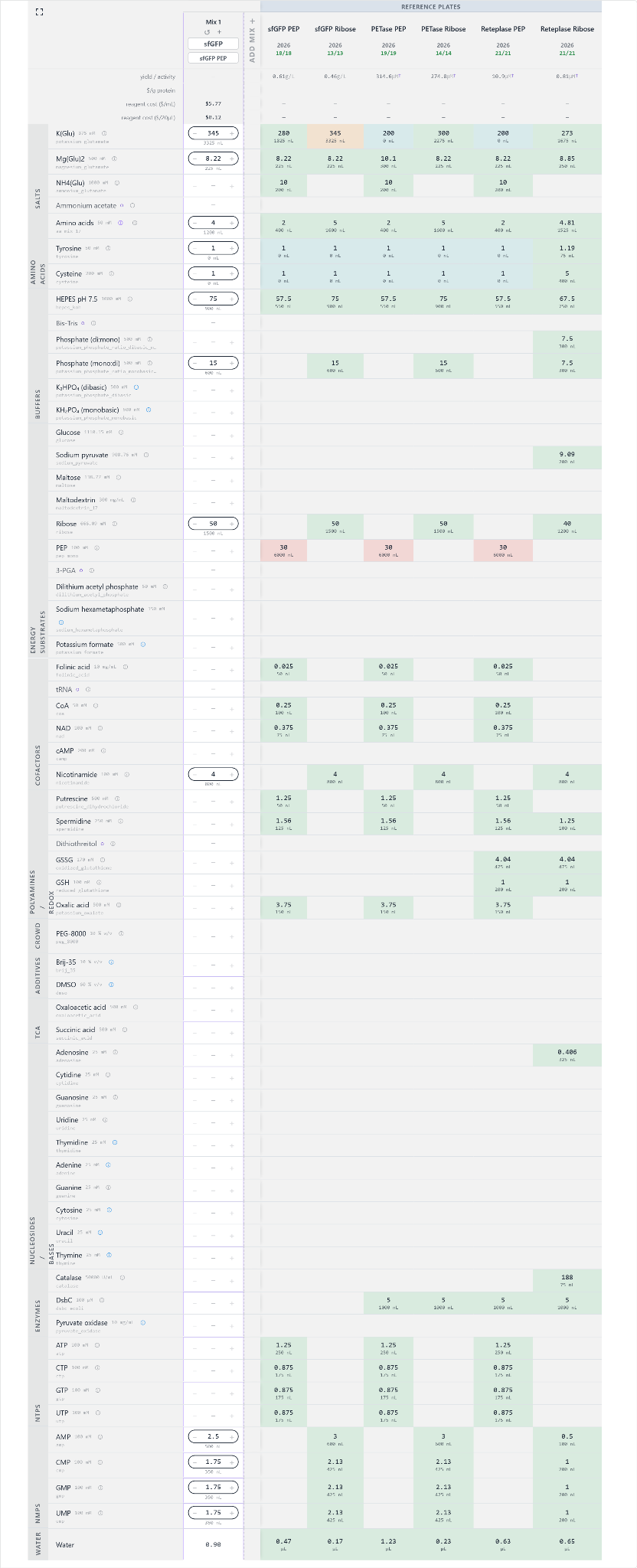
The hypothesis is that reducing the supplied NMP concentrations may lower reagent cost while retaining sufficient nucleotide availability for transcription and translation. However, lowering nucleotide precursor concentrations could also limit protein synthesis. The direction and magnitude of the effect cannot be established without experimental measurements.
Hypothesis: Reducing NMP concentrations may lower reagent cost without substantially reducing sfGFP fluorescence.
Evaluation: Compare fluorescence and reagent cost against the reference formulation. A lower reaction cost alone would not establish an improvement if functional protein output also decreased.
B2. TfCut2/PETase: Functional enzyme production
For TfCut2, I used the ribose/NMP-based PETase reference formulation and increased maltodextrin to 0.75 mg/mL. The other reaction components remain unchanged from the reference formulation.
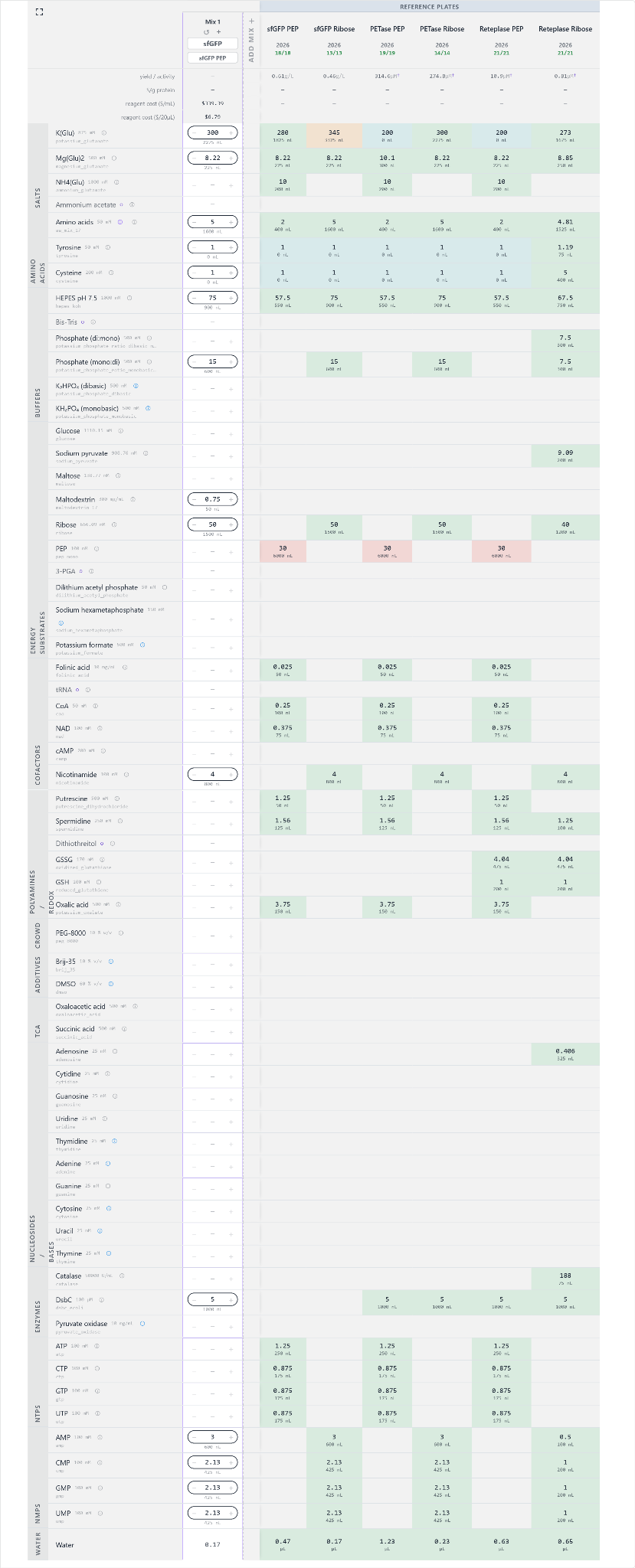
This modification tests whether additional maltodextrin can support the metabolic processes required for protein synthesis and maintain or improve the production of functional enzyme. The rationale is exploratory: the effect depends on the metabolic capacity of the lysate, and adding a carbon source does not necessarily increase protein yield.
Olsen et al. (2026) found that individual additions of several alternative energy substrates, including maltodextrin and ribose, did not improve yield in their initial tests. Therefore, my proposed increase should be treated as a specific hypothesis for this formulation rather than a result established by the literature.
TfCut2 is a cutinase-family enzyme whose function depends on correct folding and catalytic activity. Total protein production alone would not be sufficient to evaluate this design.
Hypothesis: Increasing maltodextrin to 0.75 mg/mL may maintain or improve TfCut2 activity without a disproportionate increase in reagent cost.
Evaluation: I would measure enzyme activity using an appropriate p-nitrophenyl ester substrate and monitor the initial increase in absorbance at 405 nm. The assay should include suitable controls and use the same conditions for the reference and modified reactions. I would compare initial enzyme activity and reagent cost against the reference formulation. The modification would be useful only if the measured functional output justifies its cost.
B3. Reteplase: Functional protein production and oxidative folding
Reteplase presents a folding challenge because its biological activity depends on the formation of the correct disulfide bonds. Producing the polypeptide alone does not guarantee that the resulting protein will be functional.
For this target, I selected the Reteplase Ribose reference formulation and reduced the amino acid concentration from 4.81 to 4 mM. All other reaction settings remain unchanged. The purpose is to investigate whether a moderate reduction in amino acid input can lower reagent costs while maintaining sufficient substrate availability for functional protein production.
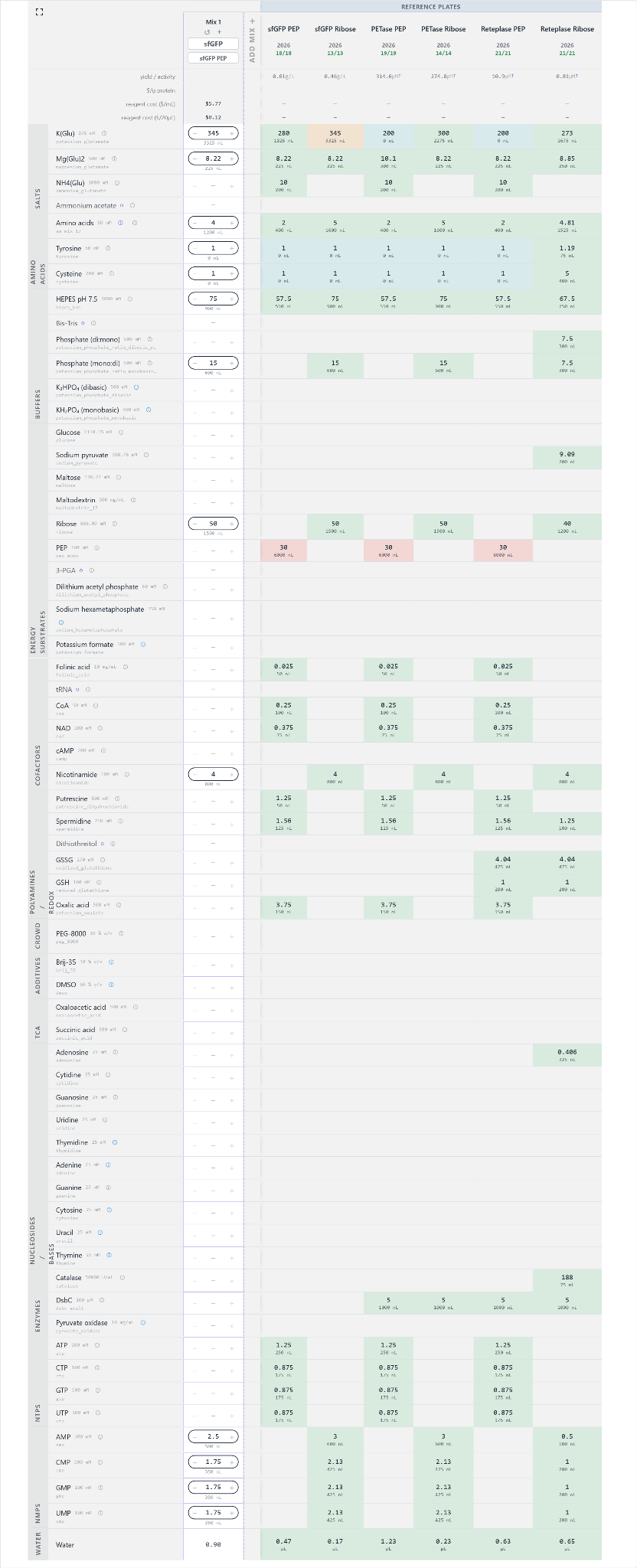
I retained the folding-related components included in the reference formulation: DsbC, GSSG, GSH, and catalase. These components serve different roles in the reaction, and retaining them allows me to focus this initial modification on amino acid concentration rather than changing several variables simultaneously.
Previous research on cell-free synthesis of disulfide-bonded proteins highlights the importance of controlling the redox environment and providing suitable folding conditions (Yin & Swartz, 2004). Groff et al. (2014) investigated folding helpers, including DsbC and FkpA, in a cell-free antibody-expression system. However, those findings do not establish that the same strategy will improve Reteplase production. FkpA is therefore a possible direction for future investigation, not an additional component in my current formulation.
Hypothesis: Reducing the amino acid concentration from 4.81 to 4 mM may lower reagent costs while preserving functional Reteplase production.
Evaluation: I would compare the modified reaction with the reference formulation by measuring Reteplase activity using a validated functional assay. One possible approach is to measure the initial rate of substrate cleavage using IPR-AMC, provided the assay conditions are appropriate for Reteplase and include suitable controls. I would compare functional activity and reagent cost to determine whether the reduction offers a meaningful benefit. If activity decreases substantially, the lower reagent cost may not justify the modification.
Since these reactions have not yet been experimentally evaluated, the effect of reducing amino acid concentration on Reteplase activity remains unknown.
Design limitations and evaluation
These three formulations are initial experimental hypotheses, not validated improvements.
Each reaction must total 20,000 nL, with fixed volumes of lysate, DNA, and base buffer, variable reagent volumes in multiples of 25 nL, and the remaining variable volume filled with nuclease-free water.
The proposed modifications target different potential constraints:
- sfGFP: nucleotide precursor availability and reagent cost.
- TfCut2: the possible contribution of additional maltodextrin to metabolic support and enzyme activity.
- Reteplase: amino acid input while retaining the selected folding-related components.
A successful formulation must balance reagent cost with functional output. The relevant readouts are sfGFP fluorescence, TfCut2 enzymatic activity, and Reteplase enzymatic activity. Until those measurements are available, I cannot conclude that any of the proposed modifications improves protein production or reduces cost per gram of functional protein.
B4. Community Reagent: FkpA
I upvoted FkpA in the Community Reagents section.
FkpA is an Escherichia coli periplasmic protein with chaperone and peptidyl-prolyl isomerase activity. It is a candidate folding helper because it can support protein folding and reduce aggregation in certain contexts.
Groff et al. (2014) identified FkpA and the disulfide isomerase DsbC as positive effectors of immunoglobulin folding and assembly in an open cell-free synthesis system. Their results suggest that these proteins can act synergistically in that particular system.
I consider FkpA a candidate for future investigation in reactions that require substantial folding support. However, FkpA is not a substitute for DsbC’s disulfide-isomerase function, and the published antibody results do not demonstrate that FkpA improves Reteplase activity.
My rationale for upvoting FkpA is that it may expand the available set of folding helpers for future CFPS optimization. Its contribution would need to be evaluated experimentally by comparing functional protein activity and reagent cost with and without the additional component.
Relevant research:
Groff et al. (2014), Engineering toward a bacterial “endoplasmic reticulum” for the rapid expression of immunoglobulin proteins.
https://doi.org/10.4161/mabs.28172
B5. Use of AI
I used ChatGPT (GPT-6) throughout this assignment as a tool to help me understand and compare different cell-free protein synthesis strategies. I focused on how energy substrates, nucleotide precursors, salt concentrations, and folding helpers influence reaction design, and how these choices relate to the cost of producing functional protein.
I also used it to explore possible modifications to the reference formulations for sfGFP, TfCut2, and Reteplase. Rather than changing several components at once, I focused on specific adjustments that could be evaluated individually: reducing nucleotide monophosphate concentrations for sfGFP, increasing maltodextrin for TfCut2, and reducing amino acid concentration for Reteplase while retaining the selected folding-related components.
The main prompts I used during this process included:
Compare PEP/NTP-based and ribose/NMP-based cell-free protein synthesis formulations. Explain their differences in energy regeneration, nucleotide availability, and reagent cost, and identify the main trade-offs when choosing between them.
Explain how potassium glutamate and magnesium glutamate affect cell-free protein synthesis, and why changing their concentrations can influence reaction performance.
Help me compare the PANOx-SP formulation with the RFopt formulation reported in the literature. Separate published experimental results from possible explanations and identify what can reasonably be concluded about protein yield and production cost.
Based on the reference formulations available in the CFPS Reaction Designer, help me identify one specific component to modify for sfGFP, TfCut2, and Reteplase. For each target, explain the rationale, the potential trade-offs, and how I could evaluate the effect without assuming the modification will improve the outcome.
Explain the folding requirements of Reteplase, including the role of disulfide bonds, DsbC, and the redox environment. Could FkpA be a useful additional folding helper, and what are the limitations of applying findings from antibody expression to Reteplase?
Help me define meaningful evaluation criteria for the three reaction designs, considering functional protein activity and reagent cost rather than total protein yield alone.
An important part of this process was distinguishing between what has been demonstrated in published research and what remains an assumption in my own designs. The literature helped inform the rationale behind the proposed changes, but it does not establish that these modifications will improve my reactions. I therefore treated each composition as a hypothesis to be tested, with functional protein activity and reagent cost as the main criteria for evaluating the results.
ChatGPT also helped me examine the potential role of FkpA as a folding helper. This was useful for identifying a possible direction for future investigation, while keeping in mind that results obtained with antibodies cannot be directly assumed to apply to Reteplase.
The final compositions reflect my design decisions informed by the reference formulations, published research, and this AI-assisted analysis. Since the reactions have not yet been experimentally evaluated, their effects on protein activity and cost remain unknown.
The prompts listed above are representative examples of the questions explored during the design process, rather than verbatim transcripts of every interaction.
B6. CFPS Coopetition Forum
I checked access to the CFPS Coopetition forum as part of the assignment. The forum provides a space to discuss reaction design, compare ideas, and exchange feedback related to cell-free protein synthesis.
References
Borkowski, O., et al. (2020). Large scale active-learning-guided exploration for in vitro protein production optimization. Nature Communications, 11, Article 1872. https://doi.org/10.1038/s41467-020-15798-5
Calhoun, K. A., & Swartz, J. R. (2005). An economical method for cell-free protein synthesis using glucose and nucleoside monophosphates. Biotechnology Progress, 21(4), 1146–1153. https://doi.org/10.1021/bp050052y
Groff, D., Armstrong, S., Rivers, P. J., Zhang, J., Yang, J., Green, E., Rozzelle, J., Liang, S., Kittle, J. D., Jr., Steiner, A. R., Baliga, R., Thanos, C. D., Hallam, T. J., Sato, A. K., & Yam, A. Y. (2014). Engineering toward a bacterial “endoplasmic reticulum” for the rapid expression of immunoglobulin proteins. mAbs, 6(3), 671–678. https://doi.org/10.4161/mabs.28172
Jewett, M. C., & Swartz, J. R. (2004). Mimicking the Escherichia coli cytoplasmic environment activates long-lived and efficient cell-free protein synthesis. Biotechnology and Bioengineering, 86(1), 19–26. https://doi.org/10.1002/bit.20026
Knapp, K. G., Goerke, A. R., & Swartz, J. R. (2007). Cell-free synthesis of proteins that require disulfide bonds using glucose as an energy source. Biotechnology and Bioengineering, 97, 901–908. https://doi.org/10.1002/bit.21296
Olsen, M. L., Copeland, C. E., Sundberg, C. A., Aw, R., Shaver, Z. M., Rao, G., Swartz, J. R., Karim, A. S., & Jewett, M. C. (2026). Design-driven optimization of low-cost reagent formulations for reproducible and high-yielding cell-free gene expression. Nature Communications, 17, Article 3478. https://doi.org/10.1038/s41467-026-69605-8
Silverman, A. D., Karim, A. S., & Jewett, M. C. (2020). Cell-free gene expression: An expanded repertoire of applications. Nature Reviews Genetics, 21, 151–170. https://doi.org/10.1038/s41576-019-0186-3
Smith, A. A., et al. (2026). Using a GPT-5-driven autonomous lab to optimize the cost and titer of cell-free protein synthesis. bioRxiv. https://doi.org/10.64898/2026.02.05.703998
Yin, G., & Swartz, J. R. (2004). Enhancing multiple disulfide bonded protein folding in a cell-free system. Biotechnology and Bioengineering, 86(2), 188–195. https://doi.org/10.1002/bit.10827
Silverman, A. D., Karim, A. S., & Jewett, M. C. (2020). Cell-free gene expression: An expanded repertoire of applications. Nature Reviews Genetics, 21, 151–170. https://doi.org/10.1038/s41576-019-0186-3
Smith, A. A., et al. (2026). Using a GPT-5-driven autonomous lab to optimize the cost and titer of cell-free protein synthesis. bioRxiv. https://doi.org/10.64898/2026.02.05.703998
Yin, G., & Swartz, J. R. (2004). Enhancing multiple disulfide bonded protein folding in a cell-free system. Biotechnology and Bioengineering, 86(2), 188–195. https://doi.org/10.1002/bit.10827