Week 1 HW: Final Project Ideas
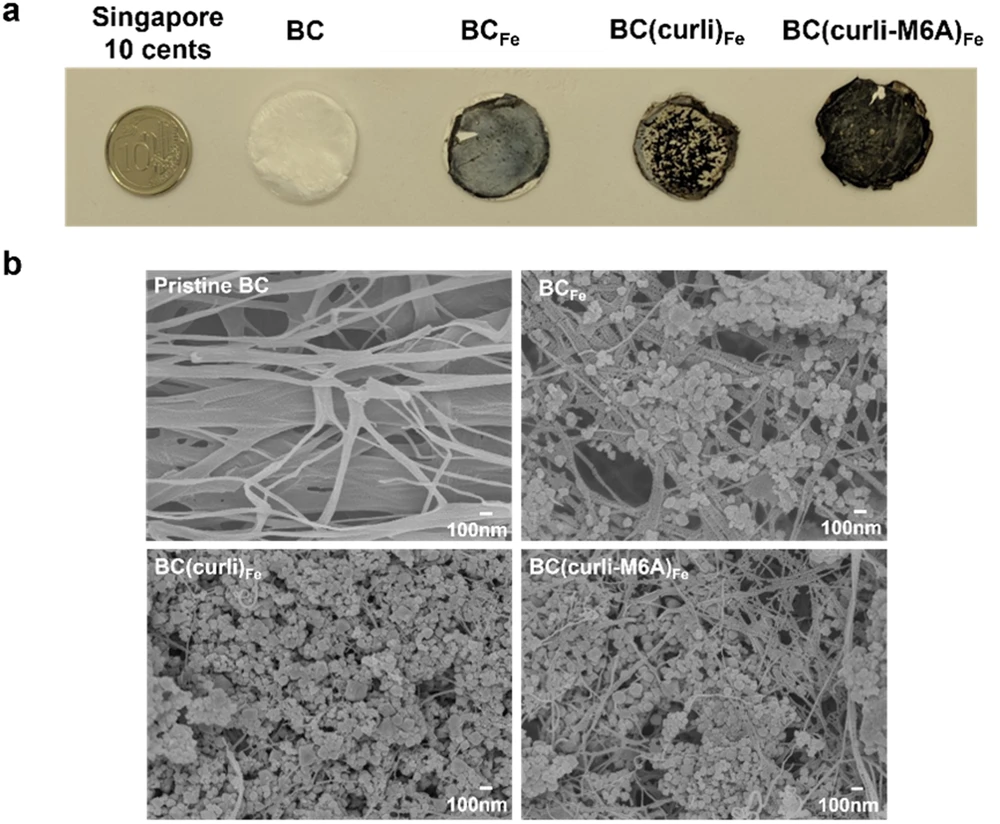
Magnetic bacterial cellulose films and SEM morphologies. Vadanan et al., Communications Materials 5, 242 (2024).
FERRIC MEMORY
Can microorganisms manufacture a medium that stores sound?
1. What would I like to biomanufacture, and why?
I want to explore the biomanufacturing of an analog magnetic sound-recording medium: a flexible material produced and functionalized by microorganisms onto which an audio signal could eventually be magnetically written, stored, and read back.
The long-term target is not necessarily a commercial replacement for magnetic tape. My first goal would be a proof of concept: a biologically manufactured material that can retain a spatial magnetic pattern strongly enough for a simple recorded signal — for example a 1 kHz sine wave — to be written and subsequently detected.
My background and interests combine data science, programming, material-based artistic practice, and experimental sound. I am particularly interested in recording technologies in which the physical medium is not neutral: magnetic tape, damaged media, feedback systems, and other processes in which noise, distortion, saturation, and material imperfections become audible.
This is why I do not want to simply “sonify” biological data. I want the biological material itself to become the recording medium.
The project starts from an existing and very promising result. Vadanan et al. demonstrated a dual-microbial strategy for producing magnetic bacterial cellulose. Komagataeibacter hansenii produces the cellulose scaffold, while engineered E. coli secretes curli fibers fused to an M6A peptide that promotes the nucleation of magnetite nanoparticles inside the cellulose network [1]. Their material reached a saturation magnetization of approximately 40 emu/g.
However, the resulting material was superparamagnetic: it showed little or no coercivity and no conventional hysteresis loop [1]. This is useful for magnetically responsive materials, but it is a major limitation for recording information, because magnetic recording requires a medium that retains magnetization after the external writing field is removed [2].
This gap is the central challenge of my project:
Can a biofabricated magnetic cellulose material be engineered from something that responds to a magnetic field into something that can actually retain and reproduce an audio signal?
The object I ultimately want to manufacture is therefore not simply “magnetic cellulose.” It is an information-bearing biomaterial.
The project is intended first as an experimental material for sound and media art, but I also find the broader question interesting: can biological manufacturing produce functional media for storing information, rather than only structural materials, chemicals, food, or therapeutics?
2. What living system would I use?
My initial manufacturing system would use two microbial chassis sequentially.
Bacterial cellulose scaffold
The first organism would be Komagataeibacter hansenii, a bacterium capable of producing bacterial cellulose.
Given a carbon-rich growth medium, the bacteria secrete cellulose nanofibers that assemble into a dense pellicle at the air-liquid interface. The resulting cellulose is flexible, highly porous at the nanoscale, and can be functionalized to create hybrid materials.
The simplified process is:
carbon source + nutrients → K. hansenii metabolism → extracellular cellulose scaffold
Biological functionalization
A second organism would be engineered Escherichia coli.
The approach demonstrated by Vadanan et al. uses E. coli engineered to produce the amyloid fiber protein CsgA fused to the short peptide M6A. M6A is derived from a protein associated with magnetosome formation in magnetotactic bacteria and can promote iron-oxide nanoparticle nucleation [1].
The bacterial cellulose is first produced and is then exposed to the engineered E. coli. The curli-M6A fibers become integrated into the cellulose matrix. A subsequent mineralization step generates iron-oxide nanoparticles throughout this biologically structured scaffold.
The conceptual manufacturing chain is therefore:
K. hansenii → bacterial cellulose
engineered E. coli → curli-M6A functionalization
iron-containing mineralization step → magnetic cellulose composite
further material optimization → potentially recordable magnetic biomaterial
This is currently a hybrid biological/chemical manufacturing process, rather than a material manufactured entirely inside one organism. For Homework 1, I consider the published dual-microbial system a realistic starting chassis rather than assuming that I already know the optimal biological architecture.
An important later question would be whether more of the magnetic-material manufacturing step could itself become biological. For example, magnetotactic bacteria naturally produce highly organized magnetic nanoparticles inside magnetosomes. I see this as a possible future direction rather than part of my initial system.
3. How would I use automation?
Automation would be especially useful because the project is fundamentally an optimization problem.
The published magnetic bacterial-cellulose system already produces a magnetic material, but not yet one with the magnetic properties required for stable recording. I would therefore want to explore a matrix of manufacturing conditions rather than manually producing one sample at a time.
At the prototype stage, an Opentrons liquid-handling robot or Cloud Lab infrastructure could automate operations such as:
- preparation and dispensing of media;
- preparation of replicate cultures;
- induction conditions for the engineered E. coli;
- controlled variation of iron concentrations and mineralization conditions;
- timing of liquid additions;
- washing and sampling steps where mechanically compatible with the robotic system;
- sample tracking and metadata collection.
For example, an early design-of-experiments could compare approximately 12 manufacturing conditions with 3 replicates each:
12 conditions × 3 replicates = 36 material samples
The variables would initially be chosen from parameters that could plausibly influence nanoparticle density, size, distribution, and therefore magnetic behavior.
Each resulting sample could then be characterized for properties such as:
- saturation magnetization;
- remanent magnetization;
- coercivity;
- hysteresis behavior;
- material thickness and uniformity.
The most interesting longer-term automation strategy would be a closed-loop optimization workflow:
manufacture → measure magnetic properties → analyze results → select next manufacturing conditions → manufacture again
This connects directly to the high-throughput and automated biomanufacturing workflows discussed in the course readings [3].
Because I work in data science, I am particularly interested in this part of the project. If enough experimental data were produced, statistical modelling or Bayesian optimization could eventually search the manufacturing space for conditions that move the material toward a desired magnetic response.
I would not assume at this stage that every physical manipulation of a wet cellulose membrane can be performed by the HTBAA robots. Automation could initially handle the liquid workflows and experimental design while some membrane handling and magnetic characterization remain human-assisted.
4. How much would I need to make, and how long would it take?
What is a meaningful scale?
Because this is an art and experimental-media project, I define meaningful scale as:
enough functional material to store ten minutes of analog audio.
I will use the geometry and speed of Compact Cassette tape as a familiar benchmark, without assuming that the final material must actually fit inside a commercial cassette shell.
A standard Compact Cassette uses approximately:
- tape width = 3.81 mm
- tape speed = 4.76 cm/s
For ten minutes of audio:
10 min × 60 s/min = 600 s
Required length:
0.0476 m/s × 600 s = 28.56 m
So approximately 28.6 metres of tape-width material would be required.
The corresponding material area is:
28.56 m × 0.00381 m = 0.1088 m²
or approximately:
1,088 cm²
This is the theoretical minimum area.
For a first engineering estimate I would add 25% process allowance for trimming, shrinkage, damaged regions, and non-uniform samples:
1,088 cm² × 1.25 ≈ 1,360 cm²
My meaningful-scale target is therefore approximately:
0.136 m² of usable magnetic biomaterial
This calculation describes equivalent material area, not yet a continuous 28.6 m strip. Producing a thin, continuous and mechanically stable tape is itself one of the major technical challenges.
Translating this into cultures
As a simple geometric assumption, consider circular bacterial-cellulose growth surfaces 90 mm in diameter.
Area of one culture surface:
π × (4.5 cm)² ≈ 63.6 cm²
Number of equivalent growth surfaces required:
1,360 cm² / 63.6 cm² ≈ 21.4
So approximately:
22 × 90 mm culture surfaces
would provide the required area, before accounting for any additional losses discovered experimentally.
This is deliberately a back-of-the-envelope calculation. One of the first measurements I would need is the actual dimensional change between wet cellulose production, functionalization, drying, and the final usable material.
How long?
In the published magnetic bacterial-cellulose process [1]:
- bacterial cellulose is grown for approximately 5 days;
- functionalization with engineered E. coli takes approximately 16–20 hours;
- an additional overnight solvent-exchange step precedes nanoparticle formation;
- mineralization, washing, and final material processing add further time.
A reasonable first estimate is therefore approximately:
7 days per batch
assuming the different stages are scheduled efficiently.
If all 22 culture surfaces could be processed in parallel, the biological manufacturing time would remain approximately one week.
If a prototype setup could handle only 6 growth surfaces in parallel:
22 / 6 ≈ 3.7
so approximately 4 batches would be required.
At approximately 7 days per batch:
4 × 7 days ≈ 28 days
This gives a rough production window of one week with highly parallel manufacturing versus approximately four weeks with a six-reactor prototype setup.
This estimate does not include optimization experiments, failed batches, or the development of a continuous-strip manufacturing process.
Automation used for experimental screening would therefore be different from the eventual scale-up system. Small multi-condition samples are appropriate for discovering the material formulation; meaningful-scale manufacturing would probably require larger shallow reactors or some form of continuous or semi-continuous cellulose-production geometry.
5. What don’t I know yet?
I currently see three major technical unknowns.
1. Can the biologically produced magnetic phase actually retain recorded information?
This is the most fundamental unknown.
The material demonstrated by Vadanan et al. is strongly magnetic but superparamagnetic, meaning that it has very low or no coercivity and does not retain a conventional hysteresis loop [1].
Audio recording media require significant remanence and sufficient coercivity so that a magnetic pattern survives after the recording field is removed [2].
I therefore need to determine whether the nanoparticle chemistry, size, shape, density, orientation, or biological nucleation process can be modified to produce stable remanent magnetization.
A first success criterion would not be high-fidelity music reproduction. It would simply be:
Can I magnetically write a known signal, such as a 1 kHz tone, into the material and detect that same periodic signal afterward?
If the M6A/magnetite route cannot reach a suitable magnetic regime, alternative magnetic phases or biological systems such as magnetotactic bacteria may need to be explored.
2. Can bacterial cellulose be manufactured in the geometry required for a recording medium?
A functional tape requires much more than magnetism.
The material must eventually be:
- thin;
- relatively uniform;
- flexible;
- mechanically strong enough to move;
- smooth enough to maintain consistent contact with a recording or playback head.
The current literature demonstrates magnetic films, not tens of metres of thin continuous tape.
I therefore need to measure thickness variation, drying shrinkage, tensile behavior, surface roughness, and the possibility of manufacturing continuous or joined strips.
3. What recording quality is physically achievable?
Even if a stable magnetic pattern can be written, the usable bandwidth may be extremely limited.
Particle distribution, orientation, surface roughness, thickness variation, magnetic noise, and mechanical irregularity could all affect the recovered signal.
From an engineering perspective these may be defects.
From my artistic perspective, however, they are also part of the reason I am interested in the project.
If the material can store sound at all, I want to understand how its biological manufacturing process becomes audible through dropouts, saturation, noise, distortion, frequency loss, and other material signatures.
The scientific question is therefore whether information survives.
The artistic question begins with how it survives.
References
[1] Vadanan, S. V., Pasula, R. R., Joshi, N., & Lim, S. (2024). Bioengineering approach for the design of magnetic bacterial cellulose membranes. Communications Materials, 5, 242. DOI: 10.1038/s43246-024-00562-9.
[2] Jiles, D. (2015). Introduction to Magnetism and Magnetic Materials. 3rd edition. CRC Press. See sections on magnetic recording materials, remanence, coercivity, and particulate magnetic tape.
[3] Petzold, C. J., & Mukhopadhyay, A. (2025). From bench to biofactory: High-throughput technologies and automated workflows to accelerate biomanufacturing. Current Opinion in Biotechnology, 94, 103320. DOI: 10.1016/j.copbio.2025.103320.
[4] IEC 60094-7:1986. Magnetic tape sound recording and reproducing systems — Part 7: Cassette for commercial tape records and domestic use. Compact Cassette geometry is used here only as an engineering benchmark for the scale calculation.
AI use
I used ChatGPT, GPT-5.6 Sol (OpenAI) as a research assistant to help identify relevant artistic and scientific precedents, explore the technical feasibility of the project, compare possible biological and material approaches, and locate literature that I could then examine directly.
Representative prompts included:
“Please provide me with a bibliography of projects and research that combine electroacoustics, sound art, living materials, synthetic biology, and biomanufacturing. Distinguish artistic precedents from scientific and technical precedents.”
“Help me find peer-reviewed articles and technical references on the feasibility of manufacturing magnetic bacterial cellulose, especially approaches combining cellulose-producing bacteria, engineered microorganisms, magnetite nucleation, or other magnetic nanoparticles.”
“What magnetic properties are required for an analog audio recording medium? Compare coercivity, remanent magnetization, saturation magnetization, particle size, magnetic anisotropy, surface uniformity, and mechanical requirements with the properties reported for existing magnetic bacterial cellulose materials.”
“Find scientific approaches that could increase coercivity and remanence in a biologically manufactured cellulose-based magnetic material. Compare magnetite, maghemite, cobalt ferrite, and biologically produced magnetosomes, and identify which routes could realistically connect to biomanufacturing.”
“Find literature on magnetotactic bacteria and magnetosomes that measures hysteresis, coercivity, remanence, particle size, and magnetic stability. Could these biological magnetic structures provide useful design principles for a recordable biomaterial?”
“Help me identify the main technical gap between a magnetically responsive bacterial-cellulose membrane and a material capable of storing an analog audio signal. What experiments would be required to test that transition?”
“Using published bacterial-cellulose production times and the dimensions and transport speed of Compact Cassette tape as a benchmark, estimate the material area and manufacturing time required for ten minutes of audio. Clearly state all assumptions.”
I used the resulting searches as starting points and checked the primary scientific literature cited in this homework before using specific technical claims or numerical values.
I reviewed and edited the proposed project direction myself and used the cited scientific literature to verify the key biological and material assumptions.