Week 1 HW: Final Project Ideas
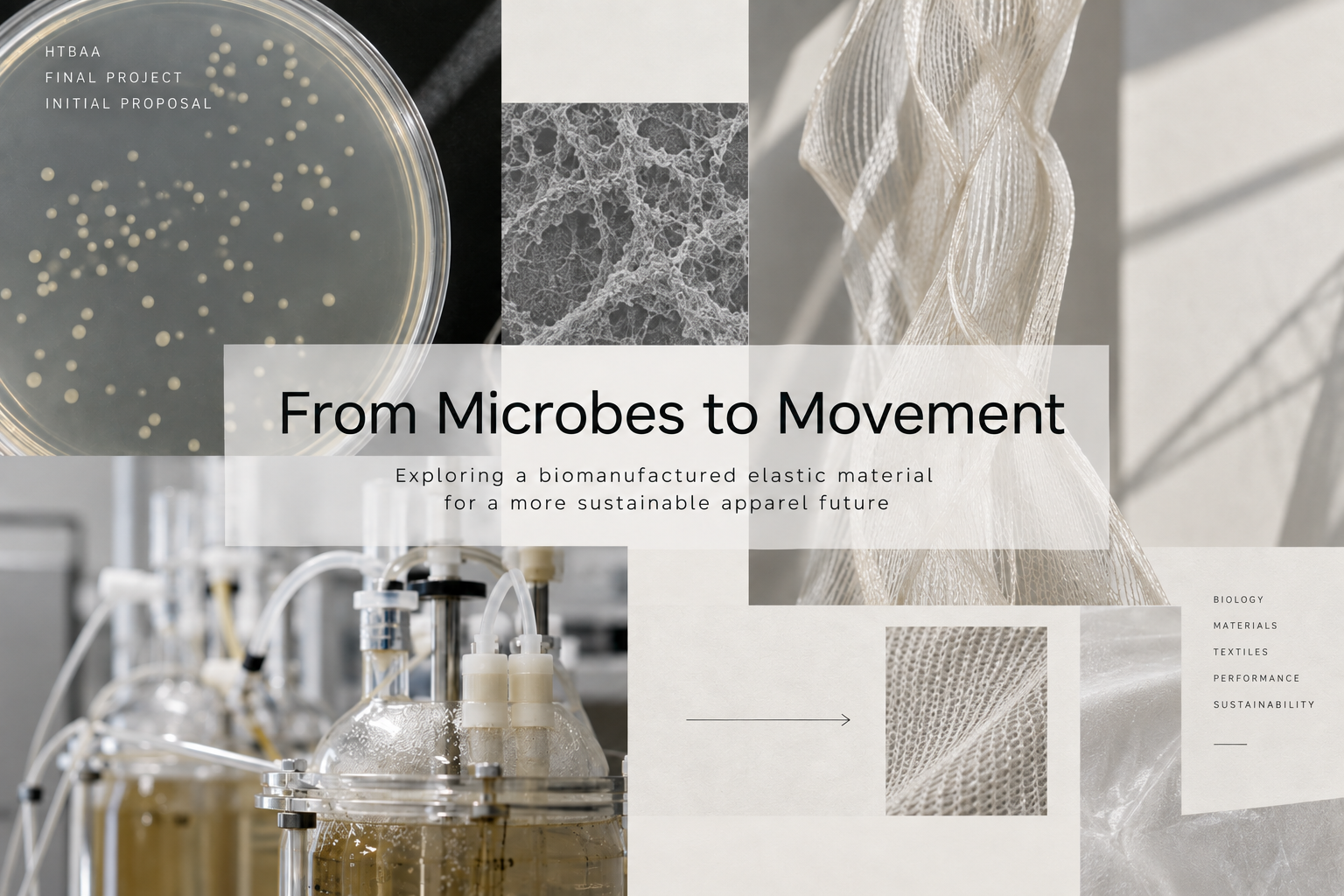
(1) What would you like to biomanufacture and why?
Can we program biology to manufacture a fiber with a specific mechanical function that apparel currently relies on petrochemical elastane to provide?
I would like to explore a biomanufactured elastic material for stretch and performance apparel, with the long-term goal of replacing or reducing conventional elastane (spandex) in products such as leggings and sportswear. I am interested in performance apparel because the challenge is reproducing a very specific mechanical function. Elastane can stretch substantially, return toward its original shape, and repeat this process many times while helping a garment maintain its fit. At the same time, conventional elastane relies on fossil-derived inputs, which motivates me to explore whether its function could be produced through a different manufacturing pathway.
There are already developments that make me think this is an interesting moment to explore a different approach. Spiber’s Brewed Protein™ materials show that proteins produced through microbial fermentation can be processed into fibers and used in commercial garments. However, I would like to push this idea toward a different question: could biology produce a fiber not only because it can become a textile, but because it can provide a specific mechanical function?
At the same time, the elastane industry is beginning to explore renewable alternatives. The LYCRA Company, for example, has been developing bio-derived LYCRA fiber using renewable feedstocks. This reduces reliance on fossil-derived inputs, but it still produces elastane through a version of the existing polymer-manufacturing pathway. I am interested in a different possibility: could the elastic material itself eventually be produced by a living system?
I do not yet know exactly what protein, microorganism, or manufacturing process would be best for making this material. That is part of what I want to explore through this project. This is also different from the way I have previously worked with biomaterials. In experiments with materials such as gelatin, I started with existing ingredients and changed how they were mixed or processed to change the final material. It felt closer to cooking because the ingredients already existed, and I was learning how their different properties interacted. I have never designed a material by working at the level of DNA or engineering cells to produce it. I am interested in learning whether some of the material’s properties could instead come from what a living system is designed to produce.
More broadly, this project connects to a question that has shaped my interest in sustainable materials: can a sustainable material eventually compete with an existing material without asking consumers to accept much lower performance or much higher prices? Performance apparel is an interesting case for me because it still relies heavily on synthetic, petrochemical-derived materials, while also demanding very specific material performance. Elastane captures both sides of this problem: it is conventionally produced from fossil-derived inputs, but it also performs its function extremely well. For this project, I therefore want to ask whether biomanufacturing could eventually offer a different way of producing that elastic function without sacrificing the performance that makes elastane so useful in clothing.
(2) What living system would you use?
I would initially explore a microbial system, such as engineered E. coli or yeast, to produce the elastic protein through fermentation.
The basic idea would be to introduce DNA with instructions for producing the target protein into a microbial host. As the microorganisms grow, they would use those instructions to produce the protein (Zhang et al., 2017). At a high level, the inputs would include the engineered cells, a carbon source such as glucose, nutrients, water, and oxygen if needed.
The process I am imagining is:
Inputs → engineered microbial cells + nutrients → cell growth and protein production → elastic protein → recovery/purification → fiber processing
After fermentation, the protein would need to be separated and purified. It would then enter a separate material-processing stage, where I would explore whether it could be turned into a continuous fiber.
I do not yet know whether E. coli, yeast, or another microbial system would be the best choice. I am starting with microbial fermentation because it provides a relatively simple way for me to think about using living cells as a manufacturing system for proteins. As I learn more, I would need to compare different microbial hosts based on how well they can produce the protein and how easy it is to recover the protein afterward.
I am also making two major assumptions at this stage: first, that a microorganism can produce enough of the selected elastic protein, and second, that the protein can actually be processed into a usable elastic fiber. Both are things I would need to test rather than assume are already possible.
(3) How would you use automation?
I would use an automated liquid-handling and screening platform, potentially through a Cloud Lab, during the early development of the material.
The main reason I would use automation is that I do not expect the first attempt to immediately produce the elastic material I want. There are many things I may need to change, such as the protein design, the microorganism being used, and the conditions in which the cells are grown. Testing all of these possibilities manually would take a long time.
I would therefore use automation to test multiple possibilities in parallel. For example, an automated system could prepare small cultures, add media and other reagents, grow different samples under controlled conditions, and collect samples for measurement. I could then compare which conditions produce more protein and identify promising candidates for further material testing.
At a high level, I imagine the process as:
different protein designs and growth conditions → automated small-scale experiments → sampling and measurement → compare results → choose promising candidates → test again
This is where the Design-Build-Test-Learn (DBTL) cycle discussed in the course becomes useful to me (Petzold & Mukhopadhyay, 2025). Rather than expecting to know the correct biological design from the beginning, I could use each round of experiments to learn what should be changed in the next round.
At this stage, I would mainly use automation for R&D and screening rather than manufacturing the final fiber. I would want to learn two basic things: Can the cells produce enough of the protein? And can that protein eventually give me the material properties I want? A protein that is very elastic but extremely difficult to produce may not be practical, while a protein that is easy to produce but does not provide enough elasticity would also not solve the problem.
If the project eventually moved toward larger-scale manufacturing, the role of automation would change. Instead of testing many small variations, automation could be used to help consistently control and monitor the production of the selected material at a larger scale.
(4) How much would you need to make, and how long would it take?
(a) How much?
For an initial meaningful manufacturing scale, I would estimate the amount of biomanufactured elastic protein fiber required to produce 1,000 pairs of performance leggings.
Commercial leggings commonly blend a primary fiber such as nylon or polyester with an elastic fiber. A study of commercial leggings reported elastic-fiber contents ranging from approximately 13% to 20% by fiber composition (Lee & Do, 2023). For this back-of-the-envelope calculation, I will assume that my biomanufactured protein fiber replaces the elastic component of a conventional legging at 15% by mass.
I will also assume that one pair of leggings weighs approximately 250 g. This is a simplifying assumption for an initial estimate; actual garment weight varies with size, fabric construction, and fabric weight.
Elastic protein required per pair:
250 g leggings × 15% elastic fiber = 37.5 g elastic protein fiber/pair
For 1,000 pairs:
37.5 g/pair × 1,000 pairs = 37,500 g = 37.5 kg
Therefore, an initial manufacturing target would be approximately 37.5 kg of finished elastic protein fiber to supply the elastic component of 1,000 pairs of leggings. This estimate does not yet account for material lost during protein recovery, purification, or fiber processing. In practice, the microbial system would need to produce more than 37.5 kg of protein. Since I do not yet know the recovery efficiency of the proposed process, I will treat 37.5 kg as the minimum target for this initial calculation.
(b) How long?
For this estimate, I will use 4.3 g of recombinant protein per liter of culture as an approximate benchmark. A published study of a related silk-elastin-like protein produced in E. coli reported a production level of 4.3 g/L (Martin et al., 2014). Since the actual production rate of my proposed protein is not yet known, I am using this value only as a benchmark from a related system.
From the previous calculation, my minimum target is 37.5 kg of protein fiber for 1,000 pairs of leggings.
37.5 kg = 37,500 g
37,500 g ÷ 4.3 g/L ≈ 8,721 L
Assuming 1,000-L bioreactors:
8,721 L ÷ 1,000 L/reactor = 8.721 ≈ 9 bioreactors
This gives me a minimum estimate of approximately 8,700 L of microbial culture. The actual volume would likely be higher because some material would be lost during protein recovery, purification, and fiber processing, but I do not yet know what those losses would be.
Estimating the time is more difficult because I do not yet know the actual growth and protein-production rate of the microbial system. For this initial calculation, I will assume that one fermentation cycle takes approximately 2 days. This is a simplifying assumption rather than a known production time for my proposed material. For a simple estimate, I will imagine that the required 8,700 L of culture could be divided across approximately nine 1,000-L bioreactors operating in parallel. If all nine bioreactors could complete fermentation at the same time, the fermentation stage would therefore take approximately 2 days rather than requiring multiple sequential batches.
Additional time would then be required for protein recovery, purification, and fiber processing. I do not yet have enough information to estimate these downstream steps reliably, so the two-day estimate only represents the assumed fermentation stage rather than the complete manufacturing process.
The automation used at this scale would also be different from the automation I proposed for prototyping. During the R&D stage, I would use a Cloud Lab or liquid-handling robot to test many protein designs and growth conditions in small volumes. At manufacturing scale, the goal would instead be to produce a large amount of one selected protein consistently. Automation could therefore shift toward monitoring and controlling the fermentation process, such as temperature, pH, nutrient feeding, and sampling.
This calculation is highly approximate because the actual protein yield, production time, downstream recovery, and fiber-processing efficiency are still unknown. However, it suggests that even producing enough elastic fiber for only 1,000 pairs of leggings could already require fermentation at the scale of thousands of liters.
(5) What don’t you know yet?
After working through this proposal, I realized that several of my calculations depend on things that I do not yet know. In particular, I see three major technical unknowns that would determine whether this idea could actually work.
1. Can a biologically produced protein provide enough elasticity and recovery?
The most fundamental unknown is whether a protein-based material could provide the mechanical behavior needed to replace or reduce elastane. I do not yet know what kind of protein would be appropriate or how close its performance could come to conventional elastane. I would need to test how far candidate materials can stretch, how well they return to their original shape, and what happens after many repeated cycles of stretching.
2. Can a microbial system produce enough of the material?
My scale calculation currently depends on an assumed production yield based on related protein systems, rather than my proposed material itself. I do not yet know whether E. coli, yeast, or another microbial system would be most appropriate, or how much protein it could actually produce. This would need to be measured experimentally because the production yield would directly affect how much fermentation volume, time, and eventually cost would be required.
3. What happens between producing the protein and having an actual textile fiber?
This is probably the part of the process I currently understand the least. Producing a protein does not automatically mean that I have a usable fiber. I still need to understand how the protein could be recovered, processed, and spun into a continuous fiber, and whether it would retain its elasticity after those steps. Eventually, the resulting fiber would also need to be tested for repeated stretching, washing, and compatibility with other textile fibers.
These three questions represent different stages of the same problem: can the material provide the function I want, can biology produce enough of it, and can it actually become a usable textile? Until these questions are tested, the scale and manufacturing-time calculations in this proposal should be understood as initial estimates rather than predictions.
Sources
The LYCRA Company. “Reducing Environmental Impact with Renewable Spandex.”
Martin et al. “High Level Biosynthesis of a Silk-Elastin-Like Protein in E. coli.” 2014.
Petzold, C. J., & Mukhopadhyay, A. “From Bench to Biofactory: High-Throughput Technologies and Automated Workflows to Accelerate Biomanufacturing.” 2025. Course reading.
Zhang, Y. H. P., Sun, J., & Ma, Y. “Biomanufacturing: History and Perspective.” 2017. Course reading.
AI Use
I used ChatGPT (OpenAI) during the development of this assignment to brainstorm and refine the project idea, identify relevant examples and literature, work through the back-of-the-envelope calculations, and edit the writing for clarity. I reviewed and revised the final responses and checked the sources and assumptions used in the assignment.
Representative prompts included:
- “What living system could be used to biomanufacture an elastic protein fiber?”
- “How could automation be used to test different protein designs and growth conditions?”
- “Help me estimate how much elastic fiber would be needed for 1,000 pairs of leggings.”
- “What are the biggest technical unknowns in this proposed biomanufacturing system?”