Homework 2 – DNA Design
Part 0 — Kernel Setup
I created a Kernel repository named yuki-selp-elastic-fiber, with a project folder named selp.
Part 1 — Expression Target
For this project, I am designing an expression system for SELP-59-A—a recombinant silk-elastin-like protein. I chose SELP-59-A as a starting point because my longer-term project asks whether a biologically produced protein could eventually provide some of the elastic function currently provided by elastane in performance textiles. At this stage, I am not assuming that SELP-59-A itself can replace elastane. Instead, I am using an existing and experimentally demonstrated protein as a baseline that I could later modify and test.
The SELP-59-A sequence comes from previously published work by Machado et al. (2013) and Collins et al. (2014). SELP-59-A consists of nine repeats of a monomeric unit containing five repeats of the silk-like sequence GAGAGS and nine repeats of the elastin-like sequence VPAVG. Collins et al. expressed this protein in E. coli BL21(DE3), which is why I selected E. coli as the host for my initial design.
For this first design, I am treating SELP as an intracellular product. The protein would therefore be produced inside the cells and recovered and purified after expression. I am keeping this first construct relatively simple rather than adding a signal peptide before I know whether the basic expression system works.
Part 2 — Genetic Parts
| Part | Choice | Why I chose it |
|---|---|---|
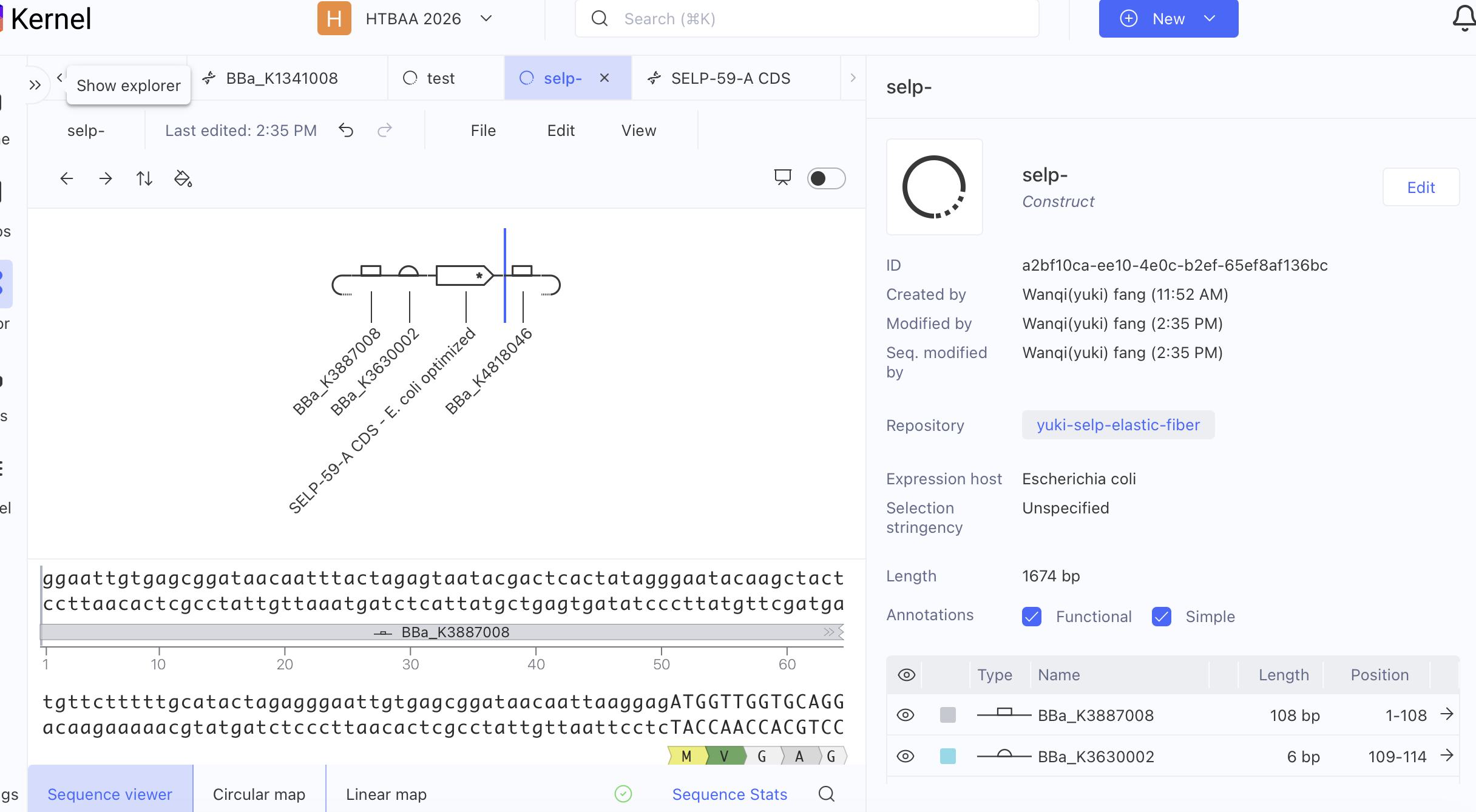
| Promoter | T7 promoter (BBa_K3887008) | T7 provides strong, controllable expression in an E. coli system containing T7 RNA polymerase, consistent with the BL21(DE3)-based expression strategy used in the published SELP work (Collins et al., 2014). |
| RBS | BBa_K3630002 | The ribosome binding site provides the translation-initiation signal needed for E. coli to begin translating the SELP coding sequence. |
| CDS | SELP-59-A CDS | This is the protein I want the cells to produce. The sequence was based on the published SELP-59-A design and entered into Kernel with start and stop codons. |
| Terminator | BBa_K4818046 | The terminator provides a defined end to transcription after the SELP coding sequence. |
| Backbone | modified pET25b(+) | I chose this as the intended expression-vector context because the published SELP-59-A work expressed the protein in E. coli BL21(DE3) using a modified pET25b(+) vector (Collins et al., 2014). |
I assembled the expression cassette itself in Kernel. I specify modified pET25b(+) as the intended vector backbone based on the published SELP-59-A expression system, rather than substituting an unrelated backbone simply because it was available in Kernel.
Part 3 — Construct Assembly
I assembled the final expression cassette in Kernel in the 5′→3′ order: T7 promoter → RBS → E. coli-optimized SELP-59-A CDS → terminator I checked that the SELP-59-A CDS contains the expected start and stop codons and that the parts are in the intended orientation. The expression cassette is intended to be placed in a modified pET25b(+) vector for expression in E. coli BL21(DE3), following the general expression system used in the published SELP-59-A work.
Part 4 — Optimization and Sequence Checks
Codon Optimization
I used Kernel’s codon optimizer to redesign the SELP-59-A coding sequence for expression in E. coli. I used the amino acid sequence as the input and selected Escherichia coli as the expression organism, with TAA as the stop codon. I did not add a signal peptide or additional motif constraints.
The optimization changed the DNA sequence while preserving the SELP-59-A amino acid sequence. This is possible because multiple codons can encode the same amino acid. Different organisms have different patterns of codon usage, so the goal was to generate a DNA sequence better suited to expression in E. coli without changing the protein I am trying to produce.
BLAST
I used NCBI Protein BLAST (blastp) to search the SELP-59-A amino acid sequence against the ClusteredNR database. The search did not return an exact SELP-59-A match. The top result covered 99% of my query and had an E-value of 2e-76, but only 30.89% sequence identity. Other results included repetitive and structural proteins, including collagen-like proteins.
I therefore would not interpret the BLAST result as identifying SELP-59-A as a natural protein. Instead, the result is consistent with the sequence being an engineered repetitive protein whose repeated amino acid patterns share similarity with other repetitive or structural proteins.
Biosecurity Screening
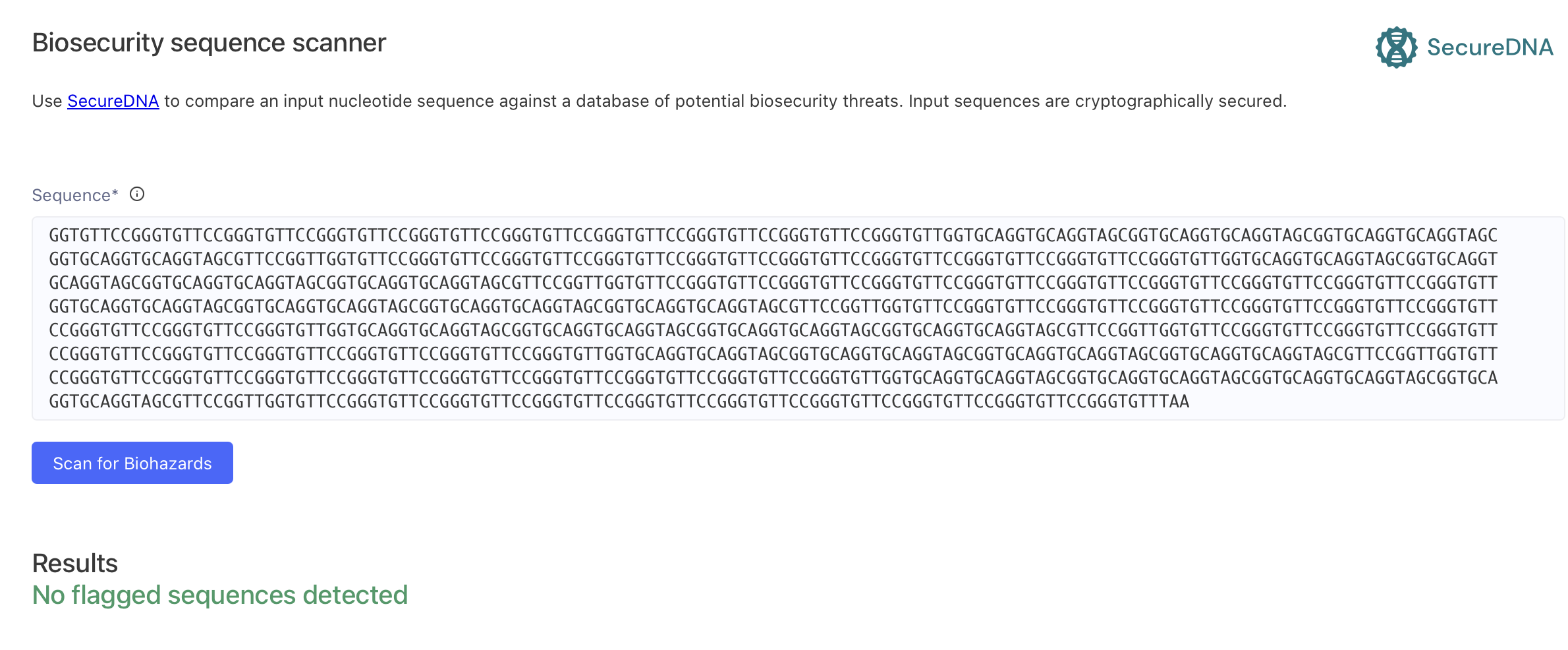
I ran the E. coli-optimized SELP-59-A coding sequence through Kernel’s SecureDNA biosecurity sequence scanner. The tool screens nucleotide sequences for matches associated with potential biosecurity concerns. The result was “No flagged sequences detected.”
I therefore did not identify any biosecurity flags for this sequence through the screening tool. This result only describes what the scanner detected and does not by itself establish that a biological construct is risk-free in every context.
Part 5 — From Digital Sequence to Physical DNA
Building the Construct
For the first prototype, I would order the E. coli-optimized SELP-59-A coding sequence as synthetic DNA rather than synthesizing the entire plasmid myself. Because SELP-59-A is highly repetitive, the sequence could be divided into smaller fragments if synthesizing it as one piece is difficult. I would then use Gibson Assembly to join these fragments with the expression vector. Gibson et al. (2009) showed that DNA fragments with overlapping ends can be joined in a single isothermal reaction. The assembled construct would then be sequence-verified before expression in E. coli.
Synthesis Constraints
The biggest issue for my design is probably repetition rather than length. SELP-59-A contains repeated silk-like and elastin-like motifs, which means large sections of the DNA look very similar. That can create problems during synthesis and assembly because similar sequences may hybridize or assemble incorrectly. Errors can also come from the shorter oligonucleotides used to build synthetic genes, as discussed by Kong et al. (2007). Kosuri et al. (2010) also shows how sequence similarity and increasingly complex oligonucleotide pools can make reliable assembly more difficult.
If synthesizing SELP-59-A as one sequence did not work reliably, I would split the CDS into smaller fragments, assemble them afterward, and sequence-verify the final construct. Error-correction methods could also become more important if I later tested multiple SELP variants. Tian et al. (2004) and Kosuri et al. (2010), for example, show approaches for reducing errors introduced during DNA synthesis.
Prototype versus Scale
At the prototype stage, I would first need to know whether the genetic construct works and whether E. coli can produce the designed SELP protein. But producing the protein is not the final goal of this project. The larger goal is to turn that protein into an elastic material that could eventually perform some of the functions of conventional elastane in textiles.
Moving from laboratory to commercial scale would therefore involve more than increasing fermentation volume. The cells would need to produce SELP reliably at larger scale, but the protein would also need to be recovered, purified, processed into fibers, and tested for properties such as stretch and recovery. At this stage, Homework 2 focuses mainly on designing and building the biological production system. If that system works, the next question would be whether the material itself can still be produced consistently and perform as intended as the manufacturing process scales.
Part 6 — Biggest Unknowns
1. Can the SELP be produced reliably in E. coli?
The first unknown is whether my genetic design will actually produce SELP reliably in E. coli. The previous SELP-59-A study shows that this protein can be produced in E. coli (Collins et al., 2014), but my construct and codon-optimized sequence are not identical to the system used in that study.
I would therefore first test whether the cells express the expected protein and measure how much protein is produced. If expression is low, I could compare different genetic designs, such as different promoters or expression conditions.
2. Will the produced protein have the material properties I actually need?
Even if the protein can be produced successfully, I still do not know whether it can provide the kind of elastic performance I am interested in. Previous work has already shown that another silk-elastin-like protein, SELP-47K, can be wet-spun into fibers with high deformability. Fully hydrated fibers reached strains to failure as high as 700%, and crosslinked hydrated fibers reached tensile strengths up to 20 MPa (Qiu et al., 2009).
However, high strain-to-failure does not necessarily mean the material has the elastic recovery and repeated-cycle performance required of elastane. I would therefore test properties such as stretch, recovery, and repeated loading. If the material does not recover well enough after stretching, I could compare SELP variants with different silk-like and elastin-like motif ratios or sequences.
3. Would scaling this process actually provide an environmental advantage?
A third unknown is whether this material would actually be environmentally preferable once the whole manufacturing process is considered. I do not want to assume that a biologically produced material is automatically more sustainable. Fermentation, temperature control, aeration, water use, feedstocks, purification, and fiber processing can all require resources.
If the project moves beyond the initial biological prototype, I would compare the energy, water, material inputs, and emissions of producing a functional amount of SELP-based elastic fiber with those of conventional petroleum-based elastane. This comparison would help determine under what production conditions, if any, the biological route provides a meaningful environmental advantage.
References
External References
Collins, T., Azevedo-Silva, J., da Costa, A., Branca, F., Machado, R., & Casal, M. (2014). High level biosynthesis of a silk-elastin-like protein in E. coli. Biomacromolecules, 15(7), 2701–2708.
Machado, R., Azevedo-Silva, J., Correia, C., Collins, T., Arias, F. J., Rodríguez-Cabello, J. C., & Casal, M. (2013). High level expression and facile purification of recombinant silk-elastin-like polymers in auto induction shake flask cultures. AMB Express, 3, 11.
Qiu, W., Teng, W., Cappello, J., & Wu, X. (2009). Wet-spinning of recombinant silk-elastin-like protein polymer fibers with high tensile strength and high deformability. Biomacromolecules, 10(3), 602–608.
In-Class Readings
Gibson, D. G., Young, L., Chuang, R. Y., Venter, J. C., Hutchison, C. A., & Smith, H. O. (2009). Enzymatic assembly of DNA molecules up to several hundred kilobases. Nature Methods, 6, 343–345.
Kong, D. S., Carr, P. A., Chen, L., Zhang, S., & Jacobson, J. M. (2007). Parallel gene synthesis in a microfluidic device. Nucleic Acids Research, 35(8), e61.
Kosuri, S., Eroshenko, N., LeProust, E. M., Super, M., Way, J., Li, J. B., & Church, G. M. (2010). Scalable gene synthesis by selective amplification of DNA pools from high-fidelity microchips. Nature Biotechnology, 28, 1295–1299.
Tian, J., Gong, H., Sheng, N., Zhou, X., Gulari, E., Gao, X., & Church, G. M. (2004). Accurate multiplex gene synthesis from programmable DNA microchips. Nature, 432, 1050–1054.
AI Use Notice
I used ChatGPT (OpenAI) as a learning and writing assistant during this assignment. Since I am new to molecular biology and DNA design, I used it mainly to help explain unfamiliar concepts, understand the assigned readings, and clarify the steps of the Kernel workflow. I also used it to help organize and edit my writing for clarity and Markdown formatting.
I used Kernel’s AI assistant while exploring available biological parts and constructing the initial expression system. All final design choices, interpretations, and project decisions were reviewed and made by me.