Week 3 HW: Cell-Free Protocols
 (made with AI)
Designing cell-free protein synthesis reactions for sfGFP, PETase, and Reteplase.
Goal: using the collective intelligence of the HTBAA community and accessible AI systems, design novel CFPS reaction compositions for each of the three target proteins: sfGFP, PETase, and Reteplase to reduce the cost per gram of functional protein. Each design should be compatible with the experimental framework described above and should reflect the distinct expression and folding requirements of that protein. You can learn more about the details of the coopetition (https://docs.google.com/document/d/1E9RKXezEU5pMO5A10kkUHjHrfL5f8segL0QeNHXAs_E/edit?tab=t.0#heading=h.6vlujjk5vhca).
A. ⚗️ COMPARE CELL-FREE REACTION COMPOSITIONS
1. 🧂 Why do potassium glutamate and magnesium glutamate differ between compositions?
Potassium glutamate provides the ionic environment required for transcription and translation. Potassium ions regulate electrostatic interactions between nucleic acids, ribosomes, and proteins.
Magnesium glutamate supplies Mg²⁺, a cofactor for ribosomal structure and function, RNA polymerase activity, and nucleotide-dependent reactions. Mg²⁺ also interacts with NTPs and inorganic phosphate, so its optimal concentration depends on the entire reaction composition.
Which is more sensitive?
Magnesium glutamate is more sensitive to concentration changes. Too little Mg²⁺ impairs transcription and translation, while excess Mg²⁺ can reduce transcription/translation efficiency and fidelity.
In Jewett & Swartz (2004), increasing Mg(Glu) from 20 to 24 mM reduced protein expression to about 73% of maximum, and increasing K(Glu) from 175 to 225 mM maintained about 92% of maximum expression.
2. ⚡ PEP + NTP Vs ribose + NMP formulations
The main difference is how nucleotides are supplied and how metabolic energy is regenerated.
PEP + NTP
- Directly supplies ATP, CTP, GTP, and UTP for transcription.
- Uses phosphoenolpyruvate (PEP) as a high-energy phosphate donor to support ATP regeneration through endogenous lysate metabolism.
- Provides immediately available nucleotide and energy substrates.
- Depends on relatively expensive reagents (PEP and NTPs).
- PEP consumption can contribute to inorganic phosphate accumulation, which may interfere with protein synthesis.
Ribose + NMP
- Supplies AMP, CMP, GMP, and UMP rather than NTPs directly.
- NMPs must be phosphorylated by endogenous lysate pathways to form NTPs.
- Uses ribose, often together with glucose and phosphate, to support endogenous nucleotide metabolism and energy regeneration.
- Reduces dependence on expensive PEP and NTPs.
- Relies more heavily on the metabolic activity of the lysate and can be more sensitive to reaction conditions (oxygen availability).
3. 📊 Comparing two literature formulations
I selected two CFPS formulations:
PANOx-SP : Jewett & Swartz (2004) A PEP/NTP-based formulation.
RFopt : Olsen et al. (2026) A ribose/glucose/NMP-based formulation designed to reduce reagent cost while maintaining high protein yield.
| Reagent | PANOx-SP | RFopt |
|---|---|---|
| K(Glu) | 175 mM | 362 mM |
| Mg (Glu) | 20 mM | 8 mM |
| NH4 (Glu) | 10 mM | Not added |
| Amino acids | 2 mM each | 5 mM each |
| PEP | 33 mM | Not added |
| Ribose | Not added | 50 mM |
| Glucose | Not added | 10 mM |
| ATP | 1.2 mM | Not added |
| CTP, GTP, UTP | 0.85 mM each | Not added |
| AMP | Not added | 3 mM |
| CMP, GMP, UMP | Not added | 2.15 mM each |
| HEPES | Not added | 75 mM |
| Inorganic phosphate | Not added | 15 mM |
| NAD | 0.33 mM | Not added |
| Coenzyme A | 0.26 mM | Not added |
| Nicotinamide | Not added | 4 mM |
| Spermidine | 1.5 mM | Not added |
| Putrescine | 1 mM | Not added |
| Oxalate | 2.7 mM | Not added |
Yellow = RFopt only components
RFopt leverages the endogenous lysate metabolism, uses ribose/glucose and NMPs, contains fewer supplied cofactors, and uses higher K(Gmu) and amino-acid concentrations but lower Mg(Glu) glutamate.
Olsen et al. (2026) reported that RFopt produced 2.4 ± 0.3 g/L sfGFP at the 15 µL scale, corresponding to approximately $60 per gram of protein in reagent cost. Under oxygen-supplemented 4 mL conditions, production reached 3.7 ± 0.2 g/L, with an estimated reagent cost of $39/g.

PANOx-SP versus RFopt reaction-composition comparison.
B. 🧪 Design one reaction composition for each protein
1. Reaction framework
Each reaction has a total volume of 20 µL:
| Fixed component | Volume |
|---|---|
| E. coli lysate | 5,000 nL |
| DNA template | 2,000 nL |
| Base buffer | 2,000 nL |
| Variable reagents + water | 11,000 nL |
| Total | 20,000 nL |
2. ♻️ PETase: low-cost ribose/NMP formulation without added DsbC
PETase (TfCut2) contains one disulfide bond. Although correct folding is important for its catalytic activity, its limited disulfide complexity suggests that extensive disulfide-isomerization supplementation may not always be necessary.
I explored a ribose/NMP formulation without added DsbC, based on the Ginkgo GPT-35 formulation.
PETase hypothesis
A ribose/NMP formulation without DsbC may maintain PETase activity while reducing reaction cost. Because TfCut2 contains only one disulfide bond, correct pairing may be sufficiently supported by the endogenous folding environment of the lysate.
Selected PETase formulation
| Reagent | Volume |
|---|---|
| Ribose | 1,200 nL |
| Glucose | 150 nL |
| Sodium pyruvate | 200 nL |
| AMP | 100 nL |
| CMP | 200 nL |
| GMP | 200 nL |
| UMP | 200 nL |
| Adenosine | 325 nL |
| Potassium glutamate | 1,675 nL |
| Magnesium glutamate | 250 nL |
| HEPES-KOH | 750 nL |
| Potassium phosphate mix 1 | 300 nL |
| Potassium phosphate mix 2 | 300 nL |
| Nicotinamide | 800 nL |
| DsbC | 0 |
| Added GSSG / GSH | 0 |
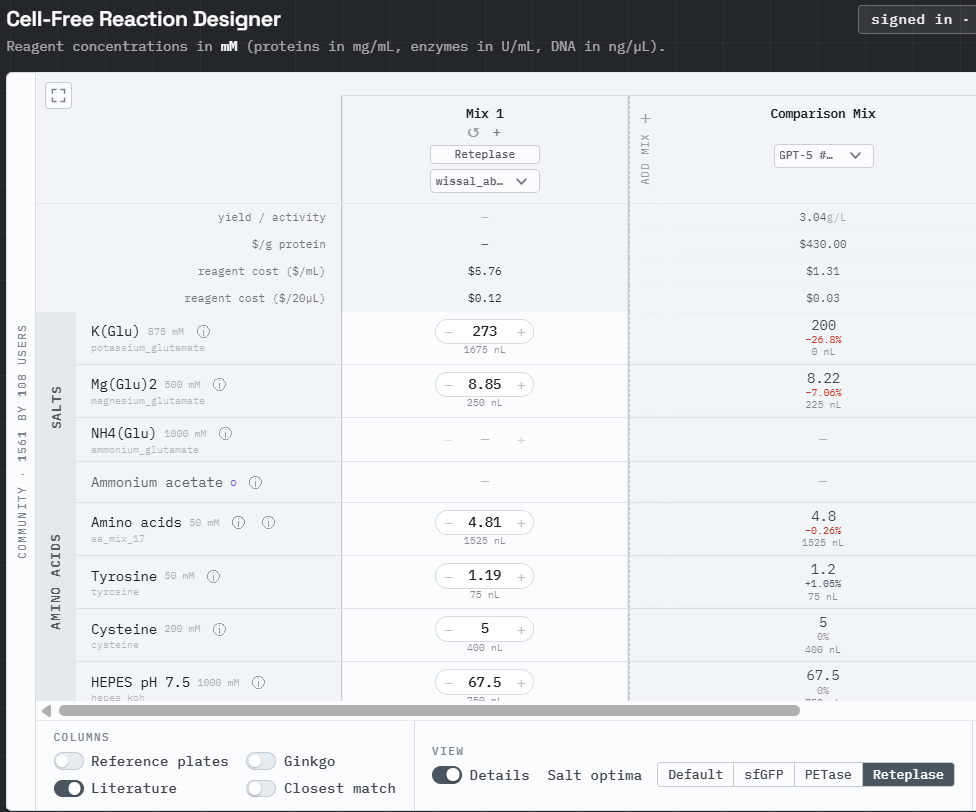
PETase formulation submitted to the CFPS coopetition.
3 . 🧬 Reteplase: tuning the oxidative folding environment
Reteplase presents a more difficult folding challenge because it contains five disulfide bonds that must form correctly for enzymatic activity.
For this initial design, I retained a PEP/NTP-based formulation because the E. coli BL21 Star lysate used has functional glutathione reductase, with DsbC, GSSG, and GSH.
Reteplase hypothesis
Adjusting the concentration of oxidized glutathione (GSSG) may influence the production of functionally active Reteplase by promoting disulfide-bond formation.
My initial condition evaluates:
| Reagent | Concentration |
|---|---|
| Potassium glutamate | 200 mM |
| Magnesium glutamate | 8.22 mM |
| Ammonium glutamate | 10 mM |
| 17 Amino Acid Mix | 2.00 mM |
| Tyrosine | 1.00 mM |
| Cysteine | 1.00 mM |
| HEPES-KOH pH 7.5 | 57.50 mM |
| PEP | 30.00 mM |
| Folinic acid | 0.025 mg/mL |
| CoA | 0.25 mM |
| NAD | 0.375 mM |
| Putrescine | 1.25 mM |
| Spermidine | 1.56 mM |
| GSSG | 2.125 mM |
| GSH | 1.00 mM |
| Oxalic acid | 3.75 mM |
| DsbC | 5 µM |
| ATP | 1.25 mM |
| CTP | 0.875 mM |
| GTP | 0.875 mM |
| UTP | 0.875 mM |
| Water | 0.850 µL |
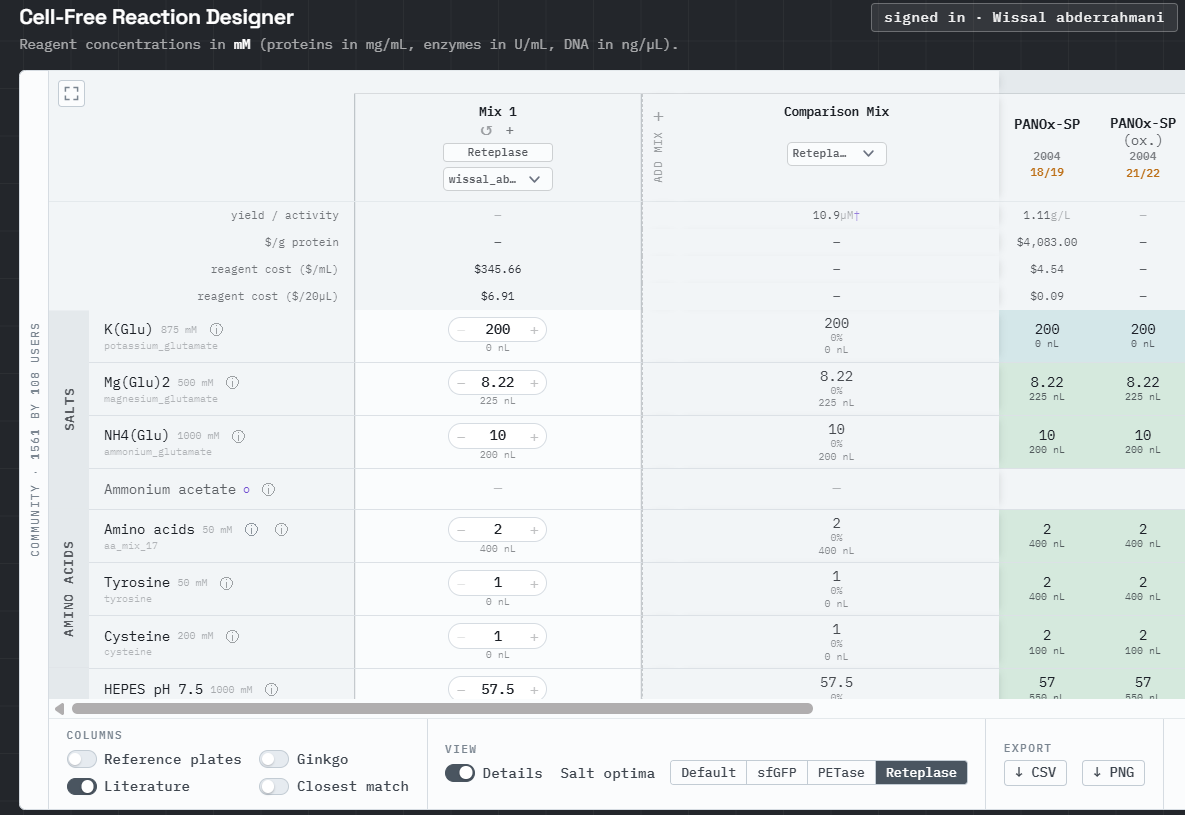
Reteplase formulation submitted to the CFPS coopetition.
- 🟢 sfGFP
sfGFP submission
C. 🔋 Community reagent proposal
Creatine phosphate + creatine kinase as an alternative ATP-regeneration system
I proposed adding creatine phosphate (phosphocreatine) and creatine kinase to the community reagent inventory as an alternative energy-regeneration strategy.
Creatine phosphate serves as a high-energy phosphate donor, while creatine kinase regenerates ATP from ADP.
My motivation came from investigating alternatives to PEP-based energy regeneration, particularly for proteins whose activity depends on an oxidizing environment and correct disulfide formation.
Why could this be useful?
Kim et al. (2007) showed that combining creatine phosphate with glucose could sustain ATP regeneration while slowing inorganic phosphate accumulation.
Oh et al. (2006) used CFPS for recombinant plasminogen activator production with 67 mM creatine phosphate and 3.2 µg/mL creatine kinase for ATP regeneration.
For proteins such as Reteplase, the energy-regeneration pathway may influence not only ATP availability but also the redox environment responsible for oxidative folding.
PEP-based energy regeneration can indirectly influence redox balance. As discussed by Matsuda et al. (2013), PEP metabolism may generate reducing equivalents such as NADH that can contribute to GSSG reduction and weaken the oxidizing environment.
In contrast, creatine phosphate and creatine kinase regenerate ATP without relying on PEP metabolism, potentially reducing this source of redox interference.
The trade-off
Creatine phosphate / creatine kinase does not eliminate all endogenous reducing activity, and the system may increase reagent cost.
Its value therefore has to be judged experimentally by comparing:
functional enzyme activity + protein yield + cost per gram
against established PEP/NTP and ribose/NMP formulations.
The proposed reagent addition expands the range of energy-regeneration strategies available to the CFPS coopetition, particularly for proteins that require oxidative folding.
📚 References
Jewett, M. C. & Swartz, J. R. (2004). Mimicking the Escherichia coli cytoplasmic environment activates long-lived and efficient cell-free protein synthesis. Biotechnology and Bioengineering. https://doi.org/10.1002/bit.20026
Olsen, M. L. et al. (2026). Design-driven optimization of low-cost reagent formulations for reproducible and high-yielding cell-free gene expression. Nature Communications. https://doi.org/10.1038/s41467-026-69605-8
Michel, E. et al. (2012). Cell-free expression of disulfide-containing eukaryotic proteins for structural biology. The FEBS Journal. https://doi.org/10.1111/j.1742-4658.2012.08697.x
Kim, T.-W. et al. (2007). Prolonged cell-free protein synthesis using dual energy sources: Combined use of creatine phosphate and glucose for the efficient supply of ATP and retarded accumulation of phosphate. Biotechnology and Bioengineering. https://doi.org/10.1002/bit.21337
Oh et al. (2006). Providing an oxidizing environment for the cell-free expression of disulfide-containing proteins by exhausting the reducing activity of Escherichia coli S30 extract https://doi.org/10.1021/bp060051l
Matsuda et al. (2013).Cell-free synthesis system suitable for disulfide-containing proteins https://doi.org/10.1016/j.bbrc.2012.12.107