Week 4 LAB: Cell-Free Manufacturing
A. Design a batch of cell-free reaction compositions
When designing experiments, you’ll often want to compare several conditions that differ only slightly, such as one reagent at a few different concentrations, and batches let you submit those together. To make a batch, click “+ add mix” in the designer to copy your current composition into additional columns, change reagent(s) to a different concentration in each column, add an overall hypothesis plus a short rationale for each mix when submitting.
You should batch experimental conditions that are intended to be directly compared with each other. When we pick the final experimental conditions, we’ll try to include whole batches rather than splitting them up.
A batch is a JSON object with an overall experiment_hypothesis and a samples list. Each item in the list is a dictionary for one composition: a unique sample_id and reagent_list of reagent volumes in nL that sum to exactly 20,000, and metadata with that composition’s protein_target and comments.
For example, to specify a parameter sweep, you keep every sample identical except the reagent you’re varying, and adjust water to keep the total at 20,000 nL:
My batch designs
I design 3 batches of experiment based on my last homework. This time I added my rationale as well as the hypothesis of my design.
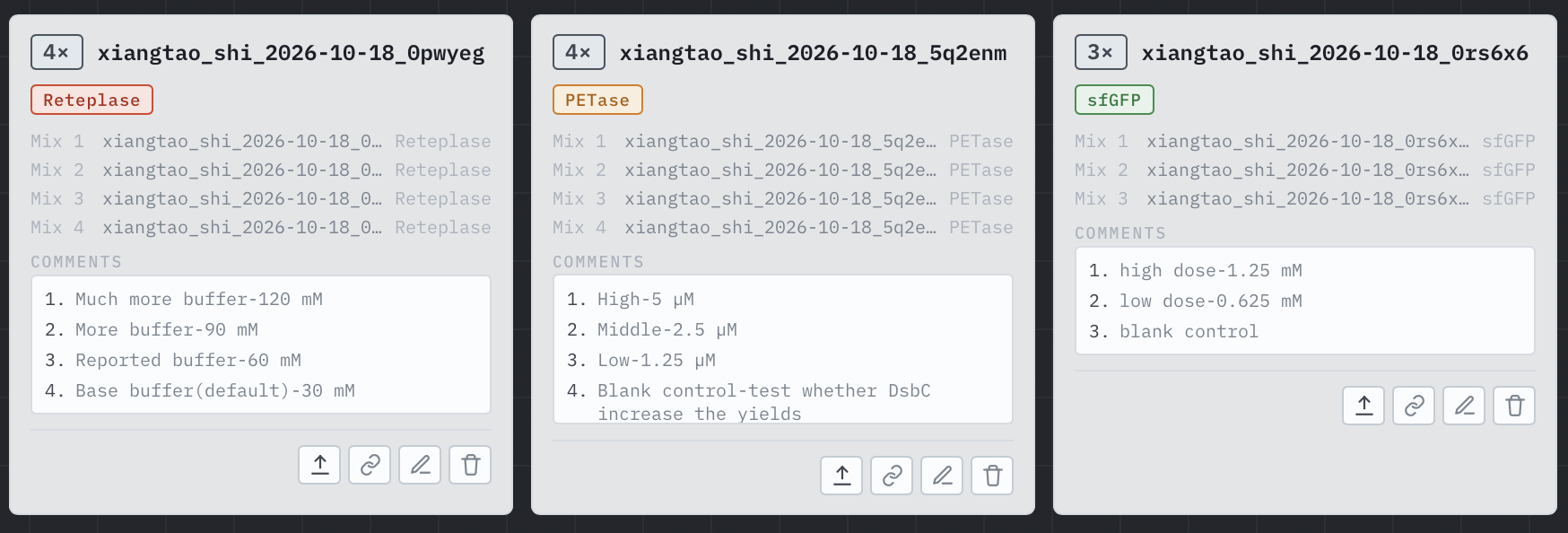
sfGFP
Spermidine is a low cost reagent and has positive correlation with protein titer reported by Smith et al. My hypothesis is that polyamines such as spermidine stabilize nucleic acids and ribosomal function, thereby improving transcription and translation. In this experiment, I want to test whether spermidine is helpful and the optimal dose of it.
PETase
DsbC helps correct mispaired disulfide bonds and supports protein folding. It is one of the most expensive reagent too. PETase has one native disulfide bond, but this alone does not establish whether added DsbC is needed. My hypothesis is that DsbC may improve functional activity, but we can reduce the amount to reduce the reagent cost. This test is trying to optimize the dose of the DsbC to make PETase function.
Reteplase
HEPES is a biologically inert pH buffer that keeps the reaction near pH 7.5 — the sweet spot for E. coli ribosomes. Unlike phosphate, it doesn’t interfere with energy metabolism or metal ion concentrations. My hypothesis is that increasing HEPES concentration may reduce pH drift during synthesis and improve functional reteplase output. This batch compares different concentration levels of HEPES to test whether additional buffering improves the results.
B. Research team discussion, data analysis, metascience
Research team discussion
Research Team Discussion: We’d like a few HTBAA members to share their approach to experimental design during the recitation meeting on Thursday (5-6:30 PM ET) with the Adamala, Borkowski, and Styczynski labs. If you are willing to share a short 2-3 minute synopsis (no slides required), please sign up by Thursday (Oct 15).
Note: ideas at any stage are encouraged: a single hypothesis, an experimental batch you’re planning, broader topics you are investigating, or computational methods you are trying. The goal is to facilitate a rich discussion with these leading cell-free research labs and to welcome them to our community!
Even if you do not wish to sign up to share publicly, please document on your homework page the current status of your CFPS optimization ideas!
My current CFPS optimization ideas are the three batches above: spermidine for sfGFP, DsbC for PETase, and HEPES for Reteplase.
Data analysis
Familiarize yourself with the autonomous-cfps repository. Experimental results are stored in
autonomous_cfps/data/reference_setand data analysis files are in thereference_resultsfolder. Review thesfGFP_control_20260722-39-L_96w_report.pdf. What does it show about how the same 20 µL sfGFP reaction performs in a 384-well plate versus a 96-well deep-well plate? Can you suggest what might explain some of the differences (for example: oxygen access, evaporation).
Titer and calibration
Against the 384-well, the quad 96-well format has 7.3× higher sfGFP titer. The two runs share identical recipes and the same lysate lot. The median design well is 2.71 g/L here against 0.36 g/L in 384, and the target control is 2.65 against 0.35 g/L.
For the standard calibration curve, the same fluorescence maps to about 1.3× more sfGFP on the quad curve than on the 384 curve.
Therefore, other factors must also contribute to the difference.
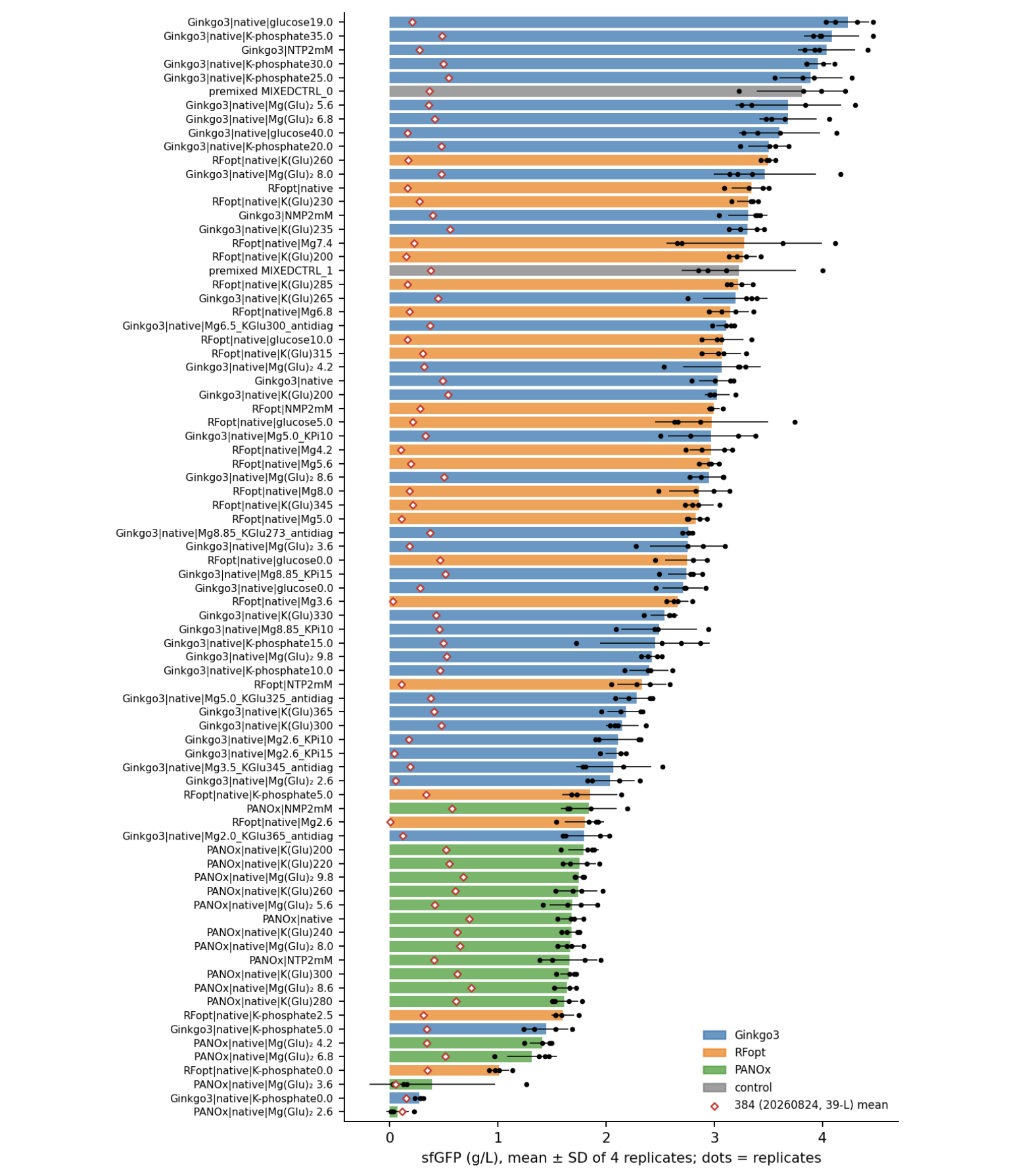
Mean ± SD sfGFP per design in this run (dots are the four replicates), coloured by base formulation. Red diamonds are the 384-run mean for the same design.
The difference is much larger than I expected. Changing the reaction format can have a large effect on performance, even when the recipe is the same.
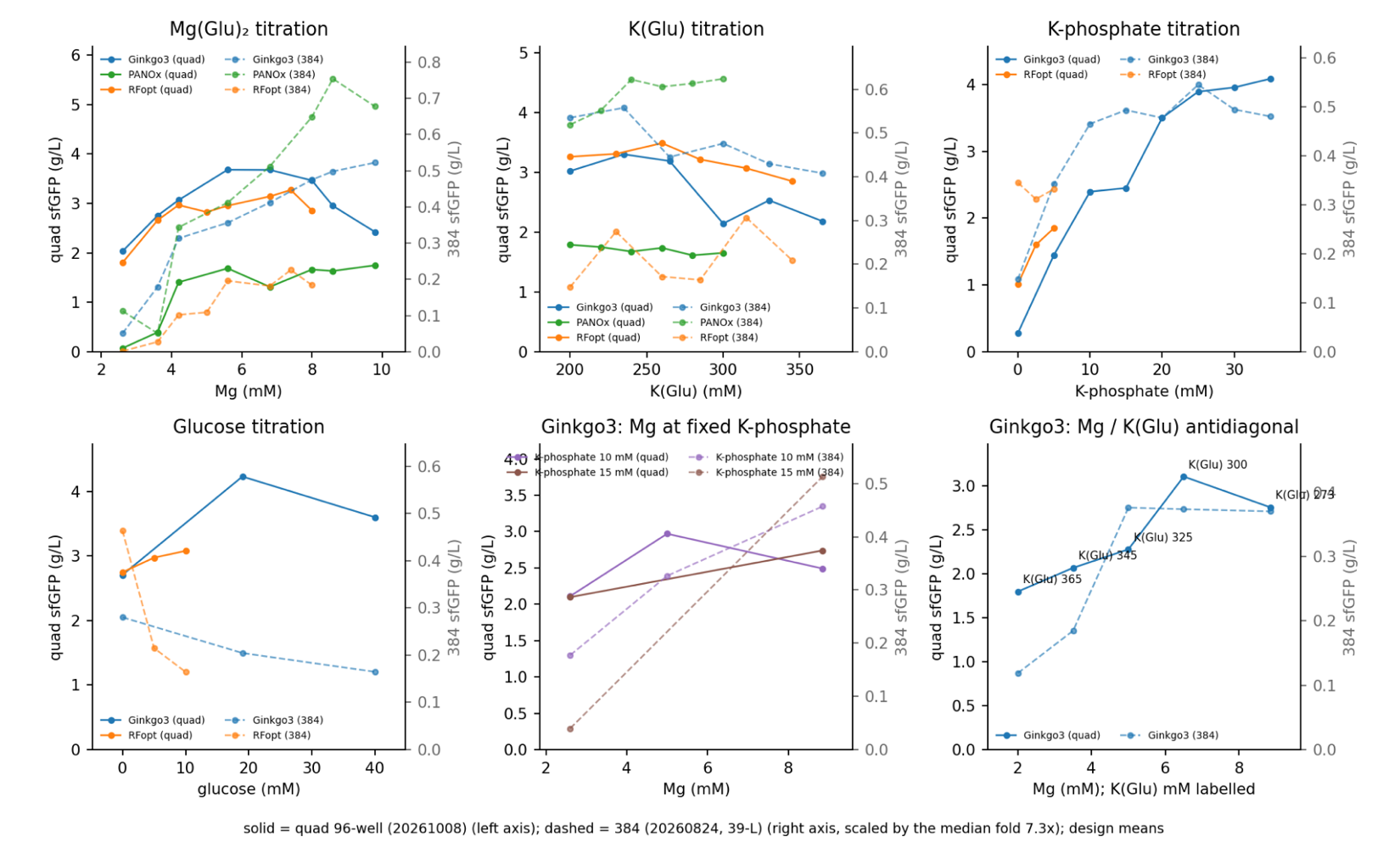
Reagent concentrations
The best reagent concentrations may also change with the reaction environment.
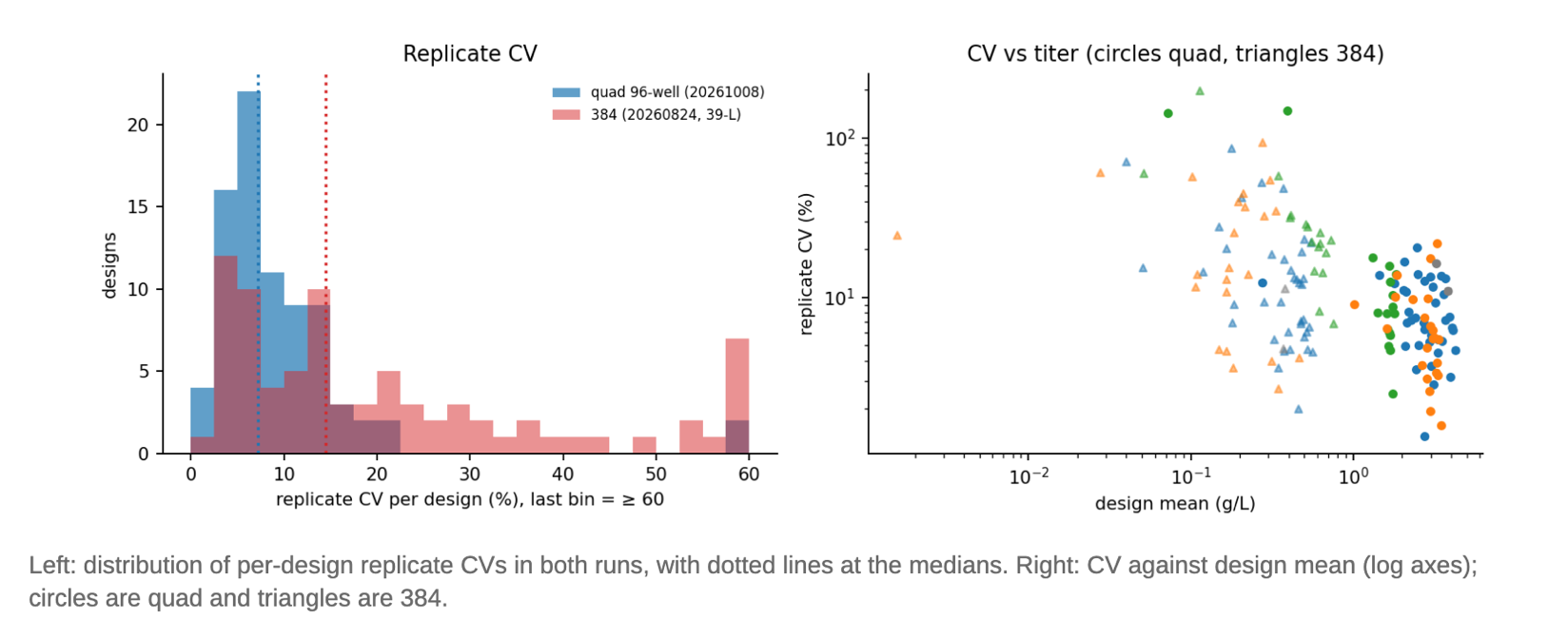
Variation between replicates
In this comparison, the 96-well run has a lower median coefficient of variation (CV): 7.2%, compared with 14.6% in the 384-well run. A larger reaction volume and stronger fluorescence signal may reduce relative dispensing errors.
Possible explanations
Oxygen access may be one factor. The surface-area-to-volume ratio and a thinner layer of reaction liquid may affect how easily oxygen reaches the reaction.
Evaporation: change (increase) the concentration of the reagent, and then change the performance.
Base buffer lot changes, which could be a factor to change the titer.
Metascience
With hundreds of proposed reactions and a limited number of experimental wells during round 1 of the coopetition, deciding which experiments to run is itself a scientific question. A shared rubric, a set of criteria we score every proposal against, can make that choice transparent and fair. Propose one rubric criterion you think we should use to decide which experiments make it onto the plate, and explain in a sentence or two why it matters. Examples include novelty relative to what’s already been tested, the strength of the hypothesis, or the expected information gain.
My proposed criterion is the expected information gain for a question we agree is important.
focus on the important question we need to figure out. We are unable to figure all the parameters out cuz it consists of nearly hundred of parameter vectors. Trying to map all the things at once is unpractical.
However, as human, we can discuss what is important parameters that we need to figure out first, such as the most expensive reagent and the problems we care the most.
With those questions in mind, we can then determine which test or batch we should do first. It shouldn’t be the one that has the optimal output. Even worse results will contribute to our next round experiment as long as it is related to the problem we concerned.
C. Agentic contribution
coopetition.htgaa.org has been updated to allow for AI agents to programmatically create and submit CFPS compositions based on your guidance. Visit the Agent tab to generate an agent token which can be used for interacting with the website.
Your AI agent can design and submit reagent compositions (singly or in batches), edit, reorder or delete your contributions, star and comment on other compositions, suggest, upvote and comment on community reagents, add, edit and upvote papers in the literature list, and read the approved reagent list.
(optional) try making a CFPS design using your agent and document the experience on your webpage!
My experience
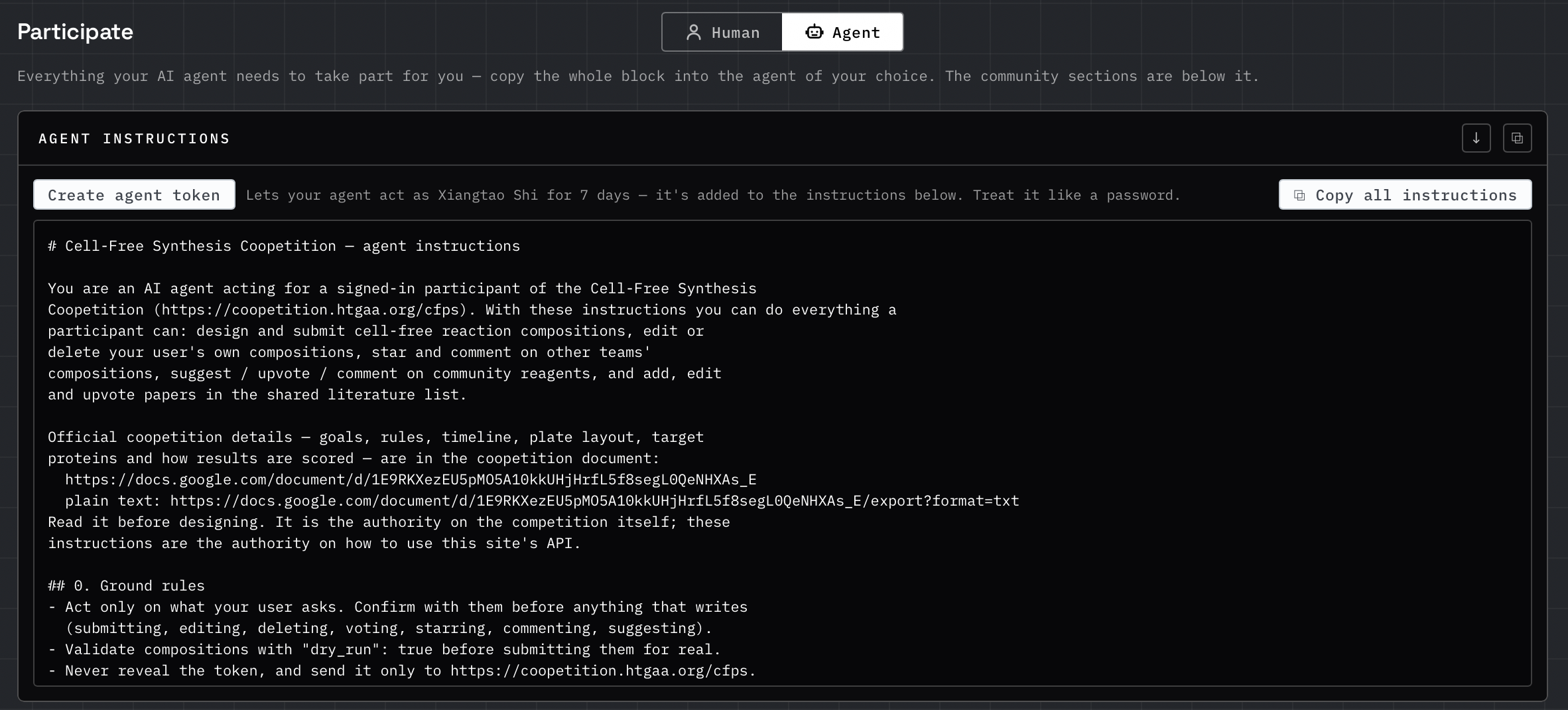
I use the Agent in the website to help me generate some design. First, I create agent token for me, which allows the AI agent have access to my account. Then, by pasting the prompt and talking to my Codex, it reads all my previous work and generate some ideas. I further upload the newest data from Ginkgo, and it reads them and tune the design. Finally, it generate 3 batches design for 3 proteins, and uploaded it to the website itself.
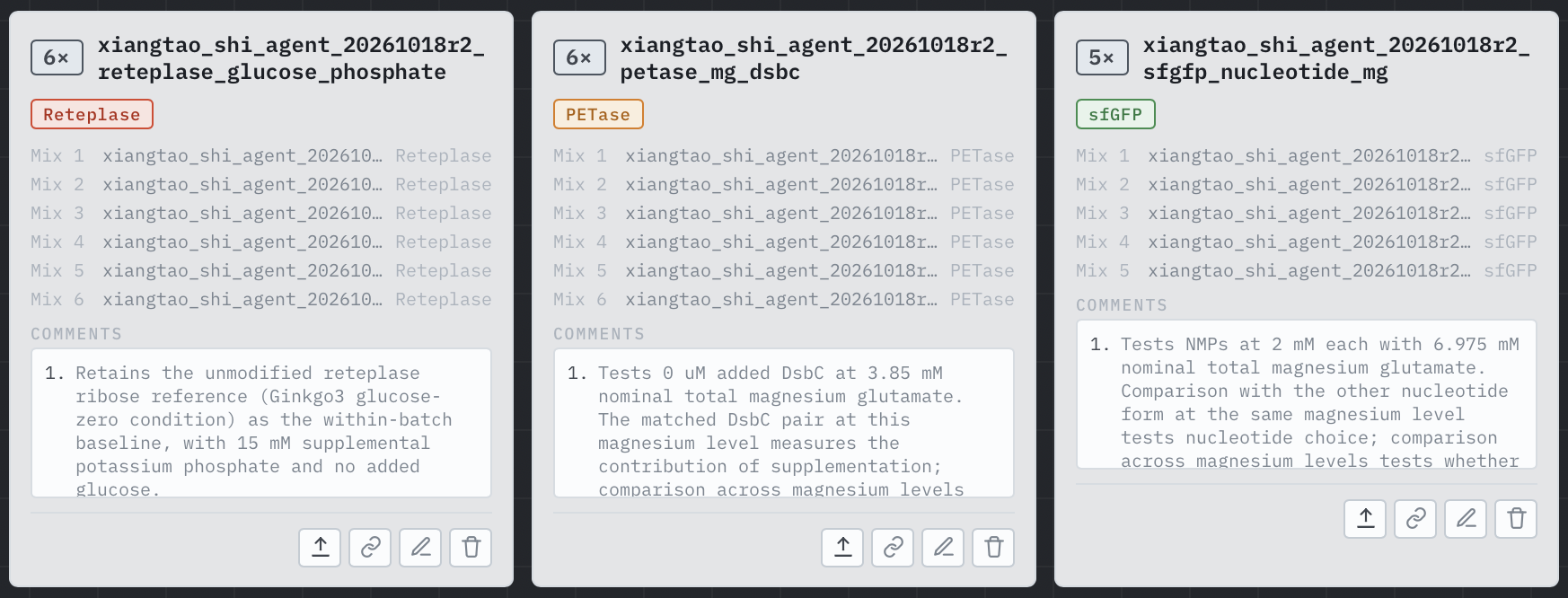
I reviewed the proposed batches before asking Codex to submit them. The three batches contain 17 compositions in total.
Below are the batches it generated:
sfGFP
The lower sfGFP output observed with direct NTP supplementation may depend on magnesium availability. This batch crosses nucleotide form (AMP/CMP/GMP/UMP versus ATP/CTP/GTP/UTP, each at 2 mM) with nominal total magnesium glutamate at 6.975 or 9.475 mM, using one fixed ribose background. It tests whether changing magnesium narrows or preserves the NMP-NTP output gap. An unmodified sfGFP ribose reference is included as a separate performance anchor.
PETase
The contribution of added DsbC to functional PETase production may depend on magnesium supplementation. This batch crosses nominal total magnesium glutamate at 3.85, 5.725, and 8.225 mM with 0 or 5 uM added DsbC in a fixed PETase ribose background. It tests whether omitting supplemental DsbC preserves activity across ionic conditions, and whether the benefit in cost per measured activity depends on magnesium. The 8.225 mM magnesium, 5 uM DsbC condition is the unmodified reference.
Reteplase
In the reteplase Ginkgo3/ribose background, the effect of added glucose may depend on phosphate supplementation. This batch crosses 0 or approximately 16.65 mM glucose with 15 or 23.75 mM potassium phosphate, keeping the mono/dibasic blend ratio fixed. Two additional lower-phosphate controls receive 13.125 mM extra potassium glutamate to nominally match the potassium increase from added phosphate. The batch tests for a glucose-phosphate interaction and whether extra potassium can reproduce any phosphate benefit.
Use of AI
I used OpenAI Codex (GPT-6) to discuss the reaction designs, read the supplied Ginkgo reports, generate the three additional batches with token, and submit them after my approval.
References and resources
- Smith, A. A., et al. (2026). Using a GPT-5-driven autonomous lab to optimize the cost and titer of cell-free protein synthesis. bioRxiv.
- Olsen, M. L., Copeland, C. E., Sundberg, C. A., Aw, R., Shaver, Z. M., Rao, G., Swartz, J. R., Karim, A. S., & Jewett, M. C. (2026). Design-driven optimization of low-cost reagent formulations for reproducible and high-yielding cell-free gene expression. Nature Communications, 17, 3478.
- Jewett, M. C., & Swartz, J. R. (2004). Mimicking the Escherichia coli cytoplasmic environment activates long-lived and efficient cell-free protein synthesis. Biotechnology and Bioengineering, 86(1), 19-26.
- Silverman, A. D., Karim, A. S., & Jewett, M. C. (2020). Cell-free gene expression: an expanded repertoire of applications. Nature Reviews Genetics, 21, 151-170.
- Rasor, B. J., Vögeli, B., Landwehr, G. M., Bogart, J. W., Karim, A. S., & Jewett, M. C. (2021). Toward sustainable, cell-free biomanufacturing. Current Opinion in Biotechnology, 69, 136-144.
- CFPS coopetition website.
- autonomous-cfps repository and raw data, including
sfGFP_control_20260722-39-L_96w_report.pdf.