Week 2 HW: DNA Design
Designing an MMP-13 mRNA Template for Cardiac Scar Remodeling
Project overview: from Homework 1 to Homework 2
In Homework 1, I proposed investigating whether the collagen-rich scar that forms after a myocardial infarction (heart attack) could be remodeled in a controlled way to make the damaged heart more receptive to future regenerative treatments, including approaches using stem-cell-derived cardiomyocytes. This idea is related to the broader field of cardiac regeneration, including work associated with Dr. Charles (Chuck) Murry.
Scar tissue is not simply a problem to remove: early after an infarction, it helps hold the injured heart wall together. My question is whether carefully timed and localized remodeling of an established scar could be useful without compromising its mechanical integrity. The literature on myocardial fibrosis and matrix metalloproteinases makes this a biologically plausible question, but also highlights important risks (MMPs in MI and heart failure; myocardial fibrosis pathways).
My proposed manufacturing route is cell-free in vitro transcription (IVT) to make mRNA, followed conceptually by lipid nanoparticle (LNP) delivery to mammalian cells. In Homework 2, I focused on designing the DNA template that could be used to make that mRNA. I am still learning the underlying molecular biology, so this is a first design.
Concept: DNA template → cell-free IVT → MMP13 mRNA → proposed LNP delivery → mammalian cell → MMP-13 protein → possible extracellular-matrix remodeling.
Part 0: Setup in Kernel
I created a Kernel repository for this project: Nam-mmp13-cardiac-scar. I used Kernel to collect genetic parts, assemble a construct, generate a codon-optimized coding sequence, and run a sequence-level biosecurity screen. I also used NCBI BLAST for sequence identification.
Part 1: Expression target
Molecule. I selected human matrix metalloproteinase-13 (MMP-13), also called collagenase-3. It is an enzyme involved in extracellular matrix (ECM) turnover. I considered other MMPs, including MMP-14, but chose secreted MMP-13 as a working model for extracellular collagen remodeling.
Sequence and source. The target is the human MMP13 gene (NCBI Gene ID 4322), with reference mRNA NM_002427.4, reference protein NP_002418.1, and UniProt protein P45452 (MMP13_HUMAN). The reference protein is 471 amino acids long. My Kernel coding sequence was generated from the reference protein sequence rather than copied unchanged from the natural human nucleotide sequence (NCBI MMP13; RefSeq NM_002427.4; [UniProt P45452]
(https://www.uniprot.org/uniprotkb/P45452/entry)).
Host/chassis. The immediate manufacturing system is a cell-free T7 IVT reaction: it transcribes a DNA template into mRNA. The later translation host would be a mammalian target cell, which would use the delivered mRNA to make MMP-13 protein. These are two different stages, which is why I used a human translation context for codon optimization.
Destination. The mRNA would need to reach the inside of mammalian cells. The resulting MMP-13 protein would need to be processed and secreted to reach the extracellular collagen matrix. The native MMP-13 precursor contains N-terminal secretion-related information. Whether the protein would be secreted and activated appropriately remains to be tested.
Part 2: Genetic parts
| Genetic part | Choice in my Kernel design | Why I chose it / source |
|---|---|---|
| Promoter | T7 promoter, 23 bp | Intended to initiate transcription by T7 RNA polymerase in a cell-free IVT system. Source: T7 promoter part available in Kernel; see also iGEM Registry. |
| 5′ untranslated region | HBA1 5′ UTR, 37 bp | A mammalian untranslated region upstream of the CDS. Source: Kernel part. Its performance in this particular construct has not been experimentally validated. |
| Coding sequence (CDS) | Human-optimized MMP13 CDS, 1,416 bp | Encodes the intended human MMP-13 protein. Generated in Kernel from UniProt P45452. |
| Secretion / targeting | Native MMP-13 N-terminal sequence, within CDS | The reference MMP-13 protein includes secretion-related information; I did not add a separate signal-peptide part. Actual secretion still requires experimental testing. |
| 3′ untranslated region | HBB 3′ UTR, 132 bp | Provides a mammalian 3′ UTR element. Source: Kernel part. |
| Poly(A) element | Unspecified poly(A) tail, 30 bp | A prototype 3′ poly(A) element available in Kernel; I am not assuming 30 bases is optimal for therapeutic mRNA. |
| Vector / backbone | Not yet selected or validated | The design is a sequence-level IVT cassette. A physical DNA template format and backbone still need to be decided for a laboratory build. |
Important design distinction: A T7 promoter is for making the RNA in vitro, while the mammalian UTRs and CDS are intended to support what happens after that RNA enters a mammalian cell. The assembled parts do not by themselves establish correct RNA end processing, capping, translation efficiency, or clinical suitability.
Part 3: Assemble the construct
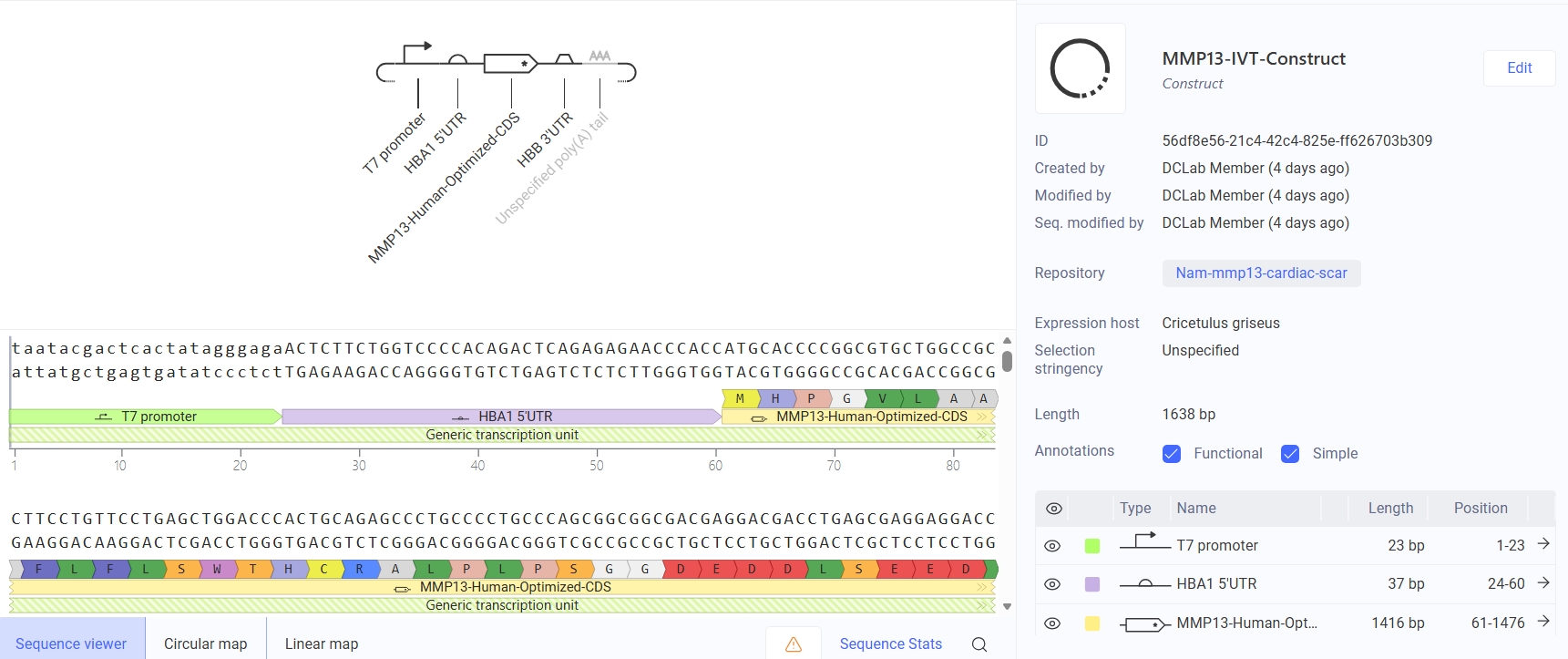
In Kernel, I assembled a construct named MMP13-IVT-Construct in the following 5′→3′ order:
T7 promoter → HBA1 5′ UTR → MMP13-Human-Optimized-CDS → HBB 3′ UTR → poly(A) tail
Kernel displayed a total length of 1,638 bp. The individual lengths were 23 bp, 37 bp, 1,416 bp, 132 bp, and 30 bp, respectively. I inspected the part order and orientation in the construct map. The optimized CDS starts with ATG, and the optimizer settings specified a TAA stop codon. Kernel showed a translated coding region; a complete independent frame and junction verification would still be prudent before synthesis.
In particular, the displayed construct has no selected backbone, and the suitability of the 5′/3′ ends and poly(A) design still needs to be evaluated.
Figure 1. MMP13-IVT construct assembled in Kernel.
Part 4: Optimize and quality-check
4.1 Codon optimization
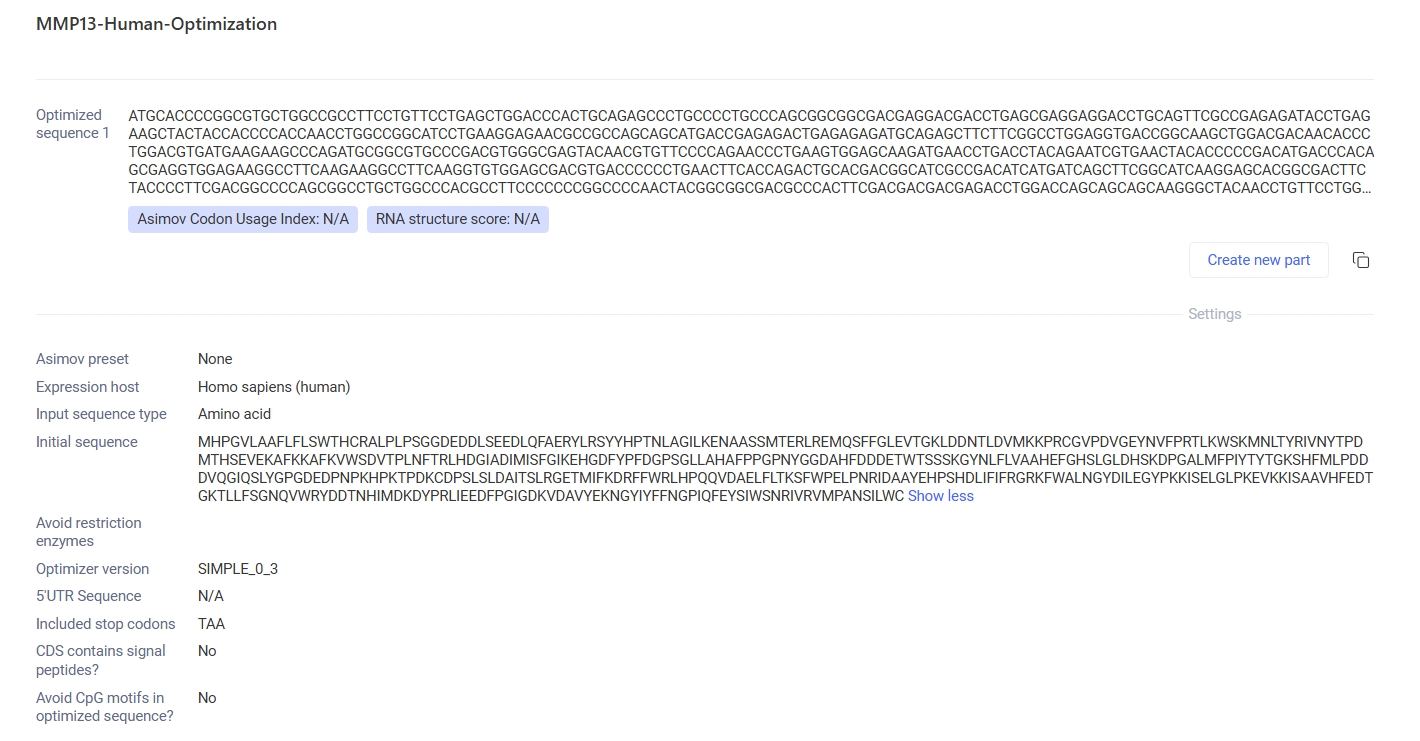
I used Kernel’s Coding Sequence Optimization tool with the human MMP-13 amino-acid sequence from UniProt P45452 as input. I selected Homo sapiens as the expression host and Kernel’s SIMPLE_0_3 optimizer. The tool generated a 1,416-bp DNA CDS with a TAA stop codon. I did not specify restriction-site avoidance or CpG avoidance.
Codon optimization selects DNA codons for an intended translation context while aiming to preserve the protein’s amino-acid sequence. I chose a human host because mammalian cells would translate the delivered mRNA; the cell-free T7 IVT stage only makes the RNA.
Figure 2. MMP13 codon optimization results in Kernel.
4.2 Sequence search / BLAST
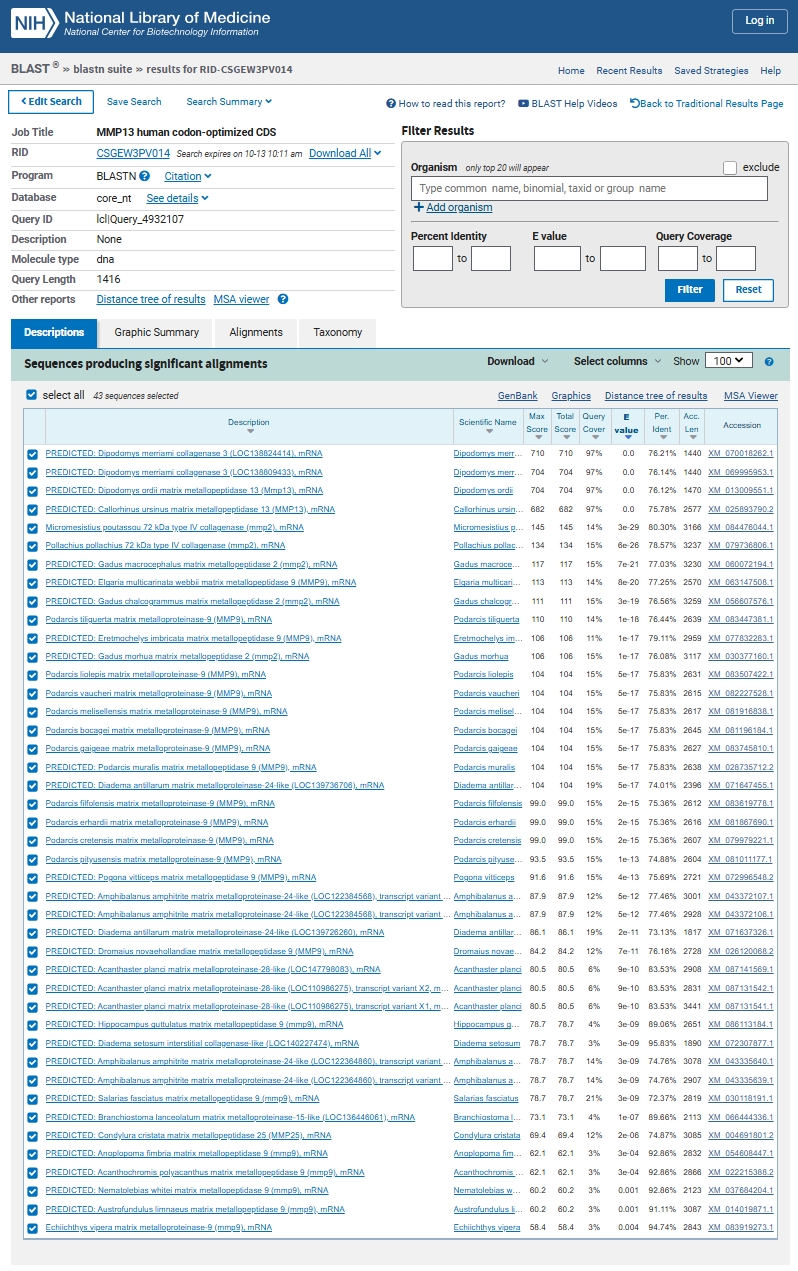
I submitted the 1,416-bp optimized CDS to NCBI BLASTN against the core nucleotide database (core_nt) (NCBI BLAST). The results included human MMP13 / collagenase-3 sequences, including the reference mRNA NM_002427.4. The human reference match shown in my results had 100% query coverage, an E-value of 0.0, and approximately 75.85% nucleotide identity.
Figure 3. NCBI BLASTN results for the codon-optimized MMP13 sequence.
4.3 Biosecurity sequence screening
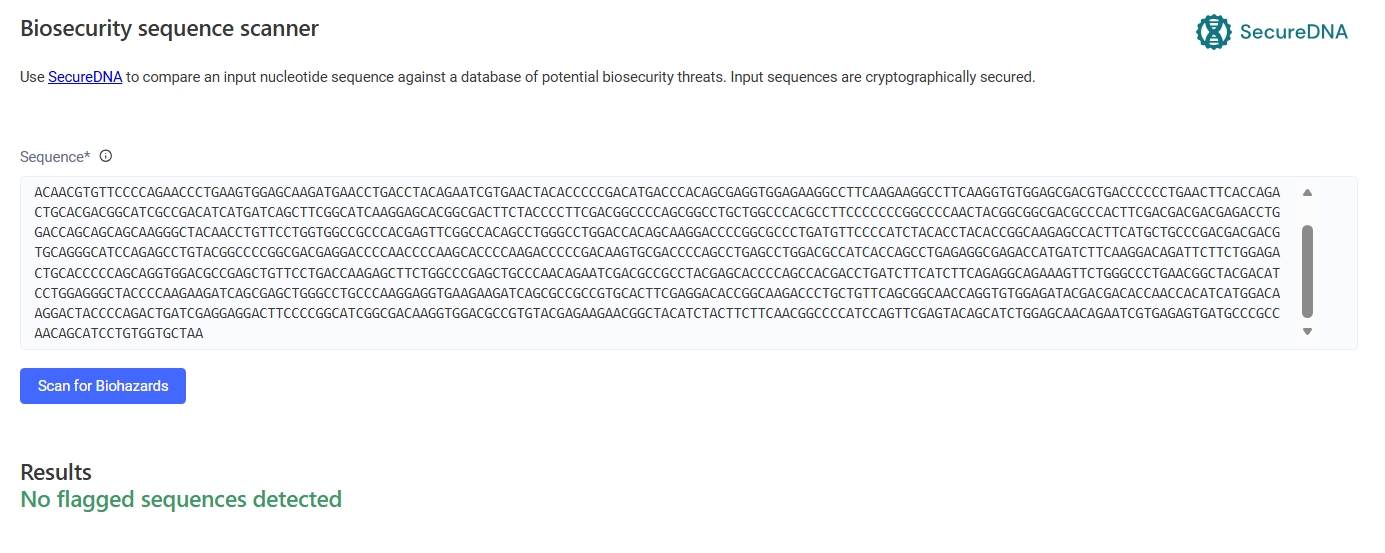
I used Kernel’s Biosecurity Sequence Scanner, powered by SecureDNA, on the optimized MMP13 CDS. It reported: “No flagged sequences detected.” This means the submitted sequence did not trigger that screening tool’s biosecurity flags. Also, this result was obtained for the CDS, not necessarily a separate scan of the entire 1,638-bp construct.
Figure 4. Kernel SecureDNA biosecurity screening results.
Part 5: From design to build
How I would build it. For an initial prototype, I would propose ordering the approximately 1.64-kb designed cassette as commercially synthesized DNA, subject to a provider’s sequence review. Because the cassette is relatively short and has only a few parts, this seems simpler than generating it from a large pool of chip-synthesized oligonucleotides. If synthesizing the complete cassette proved difficult, I would consider separate verified fragments and an assembly strategy such as the one demonstrated by Gibson et al. (2009). Kosuri et al. (2010) is more relevant to parallel synthesis of many designs, which could become useful if I later compared many UTR or coding-sequence variants.
Synthesis constraints. A digital sequence is not guaranteed to be reproduced perfectly as physical DNA. Carr et al. (2004) describe error correction in de novo DNA synthesis, emphasizing why sequence fidelity matters. I have not yet completed a provider-level assessment of GC content, repeats, or difficult sequence features, so I cannot claim that my cassette is trouble-free to synthesize. I would require sequence verification of the delivered DNA and reconsider a fragment-based design if the provider flagged difficult regions.
Prototype versus scale. For proof of concept, the priority would be a small amount of verified DNA template and evidence that it yields the intended RNA. At scale, my proposed product would be mRNA, not the DNA itself: the main manufacturing challenge would shift toward reproducible template quality and IVT-derived RNA quality. This distinction follows my Homework 1 concept, but neither the DNA production process nor the mRNA manufacturing process has been experimentally validated here.
Part 6: What I do not know yet
1. Will the mRNA yield properly processed and secreted MMP-13? Kernel can show a plausible CDS but cannot establish successful expression, folding, secretion, activation, or activity. A future mammalian-cell study would compare mRNA abundance, MMP-13 protein production, secretion into the extracellular medium, and relevant matrix-degrading activity. A lack of secretion or activity would mean the expression design needs revision.
2. Could MMP-13 weaken the heart scar? The scar is structurally important, especially during early healing. Too much or poorly timed collagen breakdown might increase damage rather than improve regeneration. Future work would need to evaluate ECM remodeling alongside tissue integrity and cardiac function, rather than treating greater collagen degradation as automatically beneficial. This is the central safety uncertainty in the project (MMPs in MI and heart failure).
3. Would mRNA delivery reach the intended cardiac cells? A successful DNA and RNA sequence would not guarantee targeted delivery. Future research would compare distribution and cellular uptake of candidate delivery systems, including off-target exposure. I would need to establish where the RNA and protein go before making any claim of therapeutic efficacy.
AI use disclosure
I used ChatGPT (OpenAI) as a learning and writing assistant to explain basic molecular-biology concepts, help translate my Homework 1 proposal into a Kernel design, organize my observed Kernel and BLAST results, and structure this write-up. I reviewed the screenshots and supplied the experimental-tool outputs reported above. AI assistance does not substitute for sequence verification or experimental validation.
References and background resources
Genetic design and DNA synthesis (assigned readings)
- Carr, P. A., et al. (2004). “Protein-mediated error correction for de novo DNA synthesis.” Nucleic Acids Research, 32, e162. https://doi.org/10.1093/nar/gnh160
- Gibson, D. G., et al. (2009). “Enzymatic assembly of DNA molecules up to several hundred kilobases.” Nature Methods, 6, 343–345. https://doi.org/10.1038/nmeth.1318
- Kosuri, S., et al. (2010). “Scalable gene synthesis by selective amplification of DNA pools from high-fidelity microchips.” Nature Biotechnology, 28, 1295–1299. https://doi.org/10.1038/nbt.1716
Sequence and software resources
- NCBI Gene: Human MMP13 (Gene ID 4322)
- NCBI RefSeq: NM_002427.4
- UniProt: MMP13_HUMAN (P45452)
- NCBI BLAST
- SecureDNA
Heart attack, fibrosis, and regenerative-medicine background
The following are background links I collected for this project. Not all were used to support a specific claim above, and their relevance should be checked before using them as formal scholarly citations.
- Khan Academy — Healing after a heart attack (myocardial infarction)
- Cellular mechanisms of tissue fibrosis: contributory pathways leading to myocardial fibrosis
- Matrix Metalloproteinases in Myocardial Infarction and Heart Failure
- PMC article: PMC11090942
- PMC article: PMC3050537
- PMC article: PMC13026035
- PMC article: PMC12439134
- Stanford News — Cardiac fibrosis research (April 2025)
- PMC article: PMC8063206
- PMC article: PMC8355135