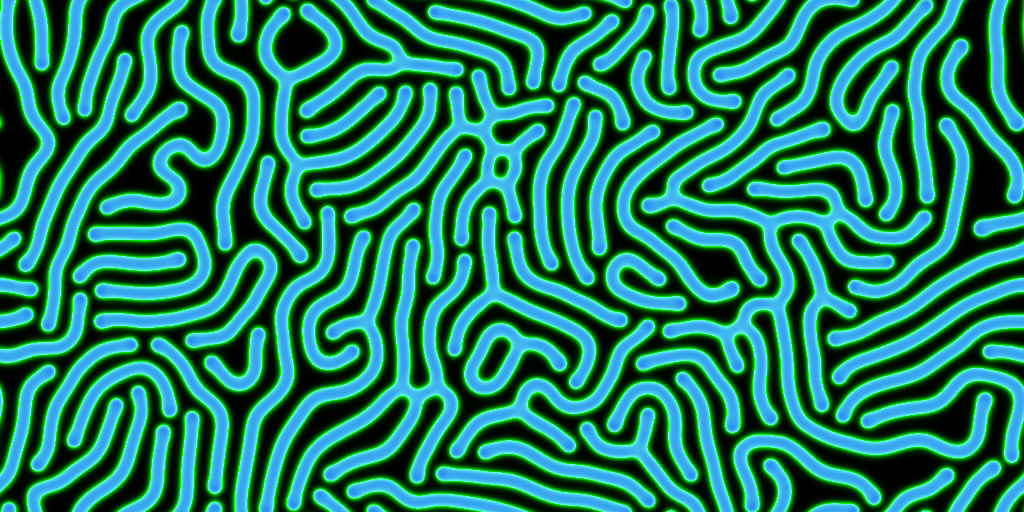
Seeming to model phenomena found frequently in the natural world, the Reaction-Diffusion equations give rise to an endless assortment of intriguing behaviours. I created the one above courtesy of @pmneila via Reaction-Diffusion System (Grey-Scott model).
About me
Hey there, I’m Zander!
I’m a recent industrial design graduate and current engineering student with a growing fascination in how synthetic biology may be harnessed as a novel manufacturing technique. Since completing a minor in biotechnology and subsequently participating in HTGAA 2026 as a committed listener, my fascination with the domain of synthetic biology has only continued to deepen.
I am interested in unconventional materialities, and believe deeply that synthetic biology will be central in the approach to unlocking true circularity in product design and beyond. Besides biology, my core interests include art, manufacturing, and recently electronics. I’m thrilled to be participating with you all, and cannot wait to learn how to biomanufacture almost anything!
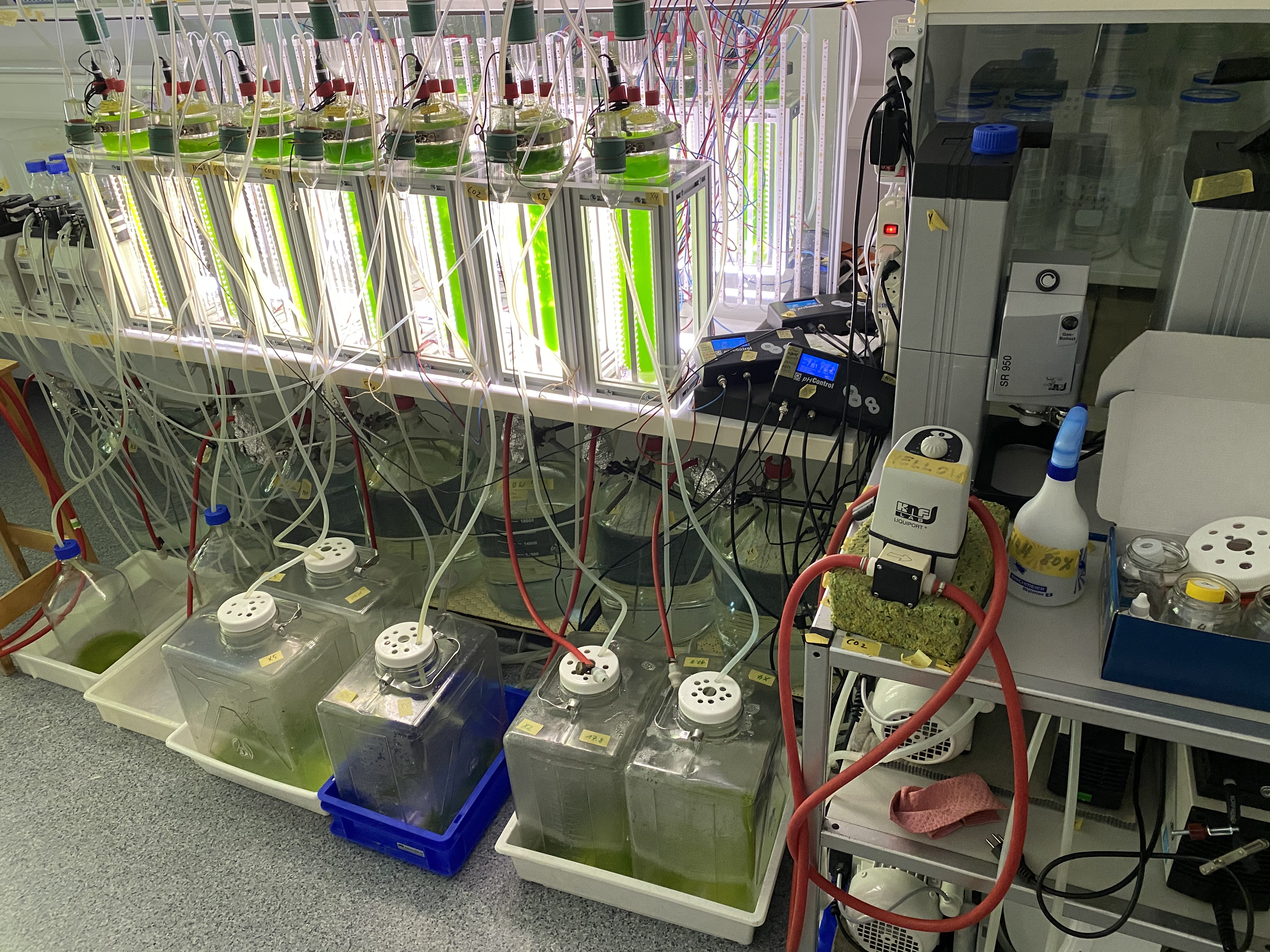
A chemostat is a device used to batch produce microbial cultures. The rate of parameters such as nutrient inflow and waste outflow can be tuned to control the rate, and phase, of culture growth. The chemostat array above is used to grow the green algae Tetradesmus obliquus. (University Of Basel, Department of Environmental Sciences, 2026. source)
1. What you would like to biomanufacture, and why?
A large portion of manufacturing techniques may be described by three categories: formative, additive and subtractive. Formative manufacturing revolves around the production of an object by guiding its elementary material into a specified mould: injection moulding and casting are two such examples. Additive techniques ‘build’ a product through a series of procedural layers (3D printing). Conversely, subtractive techniques remove material from a ‘blank’ section of stock, whether that be a 3m^2 tungsten cube or a banana, to reach a desired form. Each of these approaches share similar design and circularity limitations, and must often be used in conjunction to achieve a desirable outcome.
I would love to explore how biology may be used to design and manufacture 3D forms in a fashion dissimilar to conventional approaches. Designed biomineralisation would be especially exciting; being able to control the precise deposition and structural characteristics of a durable material with high circularity potential would provide a highly feasible alternative to conventional petroleum-based polymers in consumer products.
For the scope of HTBAA, I’d like to investigate material deposition via guided biomineralization or biofilm formation, either across a planar surface or object submerged within a chemostat-like environment. This concept would require a method to provide controlled concentrations of a ligand to different spatial regions for an extended duration. As it is likely very difficult to control growth spatially in 3D, the approach would centre on the use of a 2D plate (or other surface) populated with a grid of pores: by controlling the rate and location at which the ligands are provided (or lack thereof), I would like to investigate if it is possible to design the shape and depth of the resulting biofilm formation.
2. What living system would you use?
A microbial chassis appears the most feasible candidate. A species with well-described quorum-sensing capabilities is likely to provide the fastest-foothold, as it may be possible to leverage these pre-existing pathways to synthetically induce biofilm formation to varied intensities in response to localised variation in ligand concentration.
3. How would you use automation?
I would seek to utilise some form of automated chemostat. The primary aim is to support the growth and processes of the microbial chassis for an extended duration; it may take up to four days for cellular matter to accumulate within a biofilm for it to become visible to the naked eye. I speculate if this is feasible at small scale with a microfluidic, whereby a low-volume prototype could help tune the parameters (control ligand and nutrient concentration, waste removal) required to observe genuinely structured growth patterns.
4. How much would you need to make, and how long would it take?
Although this concept is mainly an exercise in exploring the control of a microbial population as a means of material deposition, identifying the rough accumulation of the chassis required before being perceptible by the naked eye is crucial.
For our setup, we will assume a cylindrical 100mm x 150mm chemostat contains a flat, 60mm x 80 mm plate. Bacillus subtilis is selected as the chassis, with target biofilm formation of 0.1 mm in depth across the entire plate.
Chemostat volume:
V=(pi) x (radius)^2
V = 1,178,097 mm3 or 1.18 L
Plate area:
A = (length) x (width)
A = 4,800 mm^2
Volume of biofilm required:
V = (plate area) x (target depth)
V = 480 mm^3 or 0.48 mL
A single B. Subtilis cell has an approximate volume of 1.13 um^3 during exponential growth. We will assume are biofilm contains a cellular volume of 30%, we can approximate the number of required cells as follows:
(req) = (percent cells) x (biofilm required)
V (req) = 0.144 mL -> 1.44 x 10¹¹ um3
V (B. Subtillis) = 1.13 um^3
N (cells) = V (req) / V (B. Subtillis)
N (cells) = 1.27 x 10^11 cells
The general solution for continuous exponential growth can be used to approximate the time required to culture the quantity required. We solve for t, and assume a doubling time of 30 min and initial quantity of 10^8 cells:
t = (doubling time) x log2( (final cell qty.) / (initial cell qty.))
t = 309 min or 5.2 hours
5. What don’t you know yet?
The largest limitation lies within the use and control of quorum-sensing pathways, while adhesion and longevity also pose significant challenges. In an ideal system, the biofilm would produce some hardened product / residue with attractive ‘structural’ properties (i.e rigidity, toughness, density) which may be separated intact from the growth plate: an approach to achieving this remains unclear.