Week 1 HW: Final Project Ideas
![cover image]()
![cover image]()
HTBAA Homework #1
Due: Tuesday September 22, by 2:30p ET
For your first homework, propose and describe one idea for something you would like to biomanufacture. This could be medicine, material, food, energy, an art, design, or architectural artifact, or beyond. Draw from your own background and interests for inspiration.
The goal of this assignment is not to develop a complete or technically optimized manufacturing process. Instead, we want you to begin connecting four fundamental questions:
What do you want to make? →
What living system could make it? →
How could automation help you make it? →
What would it take to make it at a meaningful scale?
Include in detail:
(1) What you would like to biomanufacture and why?
Describe the target product or output you would like to make.
I propose to biomanufacture an engineered trifunctional recombinant biocatalyst, a single-chain fusion protein combining:
- Monomeric Family II Inorganic Pyrophosphatase (mPPase): An engineered monomeric pyrophosphatase domain (derived from Bacillus subtilis Family II / ppaC architecture) that scavenges inhibitory pyrophosphate without forcing high-order oligomerization.
- Engineered Reductant-Tolerant Terminal Deoxynucleotidyl Transferase (TdT Core): An active- site-expanded, thermostable mutant engineered for rapid single-nucleotide incorporation of 3′-O-blocked reversible terminators and stability against mild cyclic reducing agents.
- Immobilization & Purification Tag: A C-terminal SpyTag003 handle for bio-orthogonal, covalent isopeptide crosslinking to SpyCatcher-functionalized solid supports, preceded by a deca-histidine (10 × His) tag.
- Linker Architecture: Inter-domain connections consist of rigid, protease-resistant α-helical (EAAAK)₃ linkers, establishing a precise 25–30 Å spatial separation between domains to eliminate active-site steric shielding.
The final formulated product is an aseptic, lyophilized white cake packaged in Type I borosilicate glass vials, classified and certified as a Biocatalytic Critical Raw Material (CRM) / Ancillary Material under USP <1043> and ISO 20387 for use in automated clinical enzymatic oligo synthesis hardware.
[N-Terminus] ── [mPPase Domain] ── (EAAAK)3 ── [TdT Core] ── (EAAAK)3 ── [His10-SpyTag003] ── [C-Terminus]
(~24 kDa) (~54 kDa) (~4 kDa) Total Monomeric Fusion Mass: ~82 kDa
Why are you interested in making it? Your motivation might be utilitarian—for example, addressing a problem in health, sustainability, food, energy, or manufacturing—but it does not need to be. Your project might instead have a social, cultural, artistic, or personal motivation.
Modern personalized medicine (such as personalized neoantigen mRNA cancer vaccines, individualized CRISPR cell therapies, and rapid pandemic countermeasures) is severely bottlenecked by how we synthesize nucleic acids:
• The Chemical Bottleneck: Classical phosphoramidite chemistry relies on hazardous organic solvents (acetonitrile, pyridine, toluene), generates toxic halogenated waste, and suffers from cumulative yield decay (99.0–99.5% step efficiency), practically capping error-free synthesis at ~150–200 nucleotides.
• The Biological Bottleneck: Because chemical synthesis cannot make full-length genes directly, mRNA manufacturing depends on bacterial plasmid DNA fermentation in E. coli, which requires 6 to 10 weeks to clone, sequence-verify, bank, ferment, and rigorously purify from live-cell bacterial endotoxins and adventitious agents.
• The Enzymatic Bottleneck: Existing cell-free enzymatic synthesis approaches face two core vulnerabilities:
- Pyrophosphate Poisoning: Enzymatic cleavage of incoming dNTPs generates inorganic pyrophosphate (PPi). In the presence of free magnesium, PPi rapidly forms insoluble magnesium pyrophosphate (Mg₂P₂O₇) micro-precipitates that foul microfluidic channels and drive the reverse pyrophosphorolysis reaction.
- Reagent Denaturation & Fluidic Leaching: Standard polymerases degrade when exposed to cyclic wash conditions and deblocking reagents, while physically adsorbed enzymes leach into the product stream.
Clearly articulate what you want to make, who or what it is for, and why you think it is interesting or important.
This biological product is an enabling upstream critical raw material supplied to biopharmaceutical CDMOs, hardware synthesis OEMs (e.g., DNA Script, Molecular Assemblies, Telesis Bio platforms), and automated clinical genomic foundries. By combining pyrophosphate scavenging, solvent tolerance, and covalent surface immobilizability into a single molecule, this biocatalyst enables continuous, cell- free synthesis of long, high-fidelity DNA templates in hours rather than months, using clean aqueous buffers with zero live-cell endotoxin exposure.
(2) What living system would you use?
Propose at least one living-system manufacturing chassis that could produce your target—for example, a microbial, mammalian, or cell-free system.
The production chassis is a high-expression microbial host: recombinant Escherichia coli strain BL21(DE3) carrying a pET-derived, kanamycin-selectable expression vector controlled by an IPTG-inducible T7-lac promoter.
At a high level, describe how the system would make your target product. What goes into the system? What biological process or processes occur? What comes out?
- Inputs: A chemically defined mineral salts medium (potassium phosphate buffers, ammonium sulfate, magnesium sulfate, citric acid, and trace metal solution) supplemented with USP-grade glycerol as the non-repressing primary carbon source. Dissolved oxygen (DO ≥ 30%) is controlled via automatic air/pure-O₂ enrichment and cascade agitation; pH is closed-loop regulated at 6.90 ± 0.05 via concentrated ammonium hydroxide (NH₄OH) titration, providing supplemental nitrogen.
- Biological Process:
• Biomass Growth Phase (0–18 h): Cells propagate exponentially at 37°C, assimilating glycerol through the glycerol-3-phosphate pathway to build biomass without recombinant gene expression (basal transcription tightly suppressed by lacIq).
• Temperature Downshift & Chaperone Priming (18–20 h): Upon achieving target biomass density (OD₆₀₀ ≈ 60), the vessel is rapidly cooled to 18°C. This downshift reduces translation velocity and enhances ribosome coupling with endogenous molecular chaperones (GroEL-GroES and DnaK-DnaJ-GrpE).
• Induction & Controlled Synthesis (20–40 h): Addition of 0.2 mM IPTG releases the lac repressor from the T7 promoter. The single-chain ~82 kDa transcript is translated under low-temperature conditions that prevent kinetic entrapment in inclusion bodies, allowing independent tertiary folding of the mPPase and TdT catalytic domains.
- Outputs: The intact 82 kDa monomeric biocatalyst accumulates as a fully soluble protein within the bacterial cytoplasm (~15% of total soluble cytoplasmic protein).
You do not need to design the complete biological system yet. Make reasonable assumptions where necessary and identify them.
• Monomeric Quaternary Autonomy: The use of a Family II monomeric PPase prevents the self-assembly of the fusion into massive ~500 kDa homohexameric aggregates, preserving solubility and preventing active-site occlusion.
• Proteolytic Resistance: The (EAAAK)₃ linkers adopt rigid, salt-bridge-stabilized α-helices that prevent linker cleavage by endogenous host endoproteases in the lon/ompT-deficient cytoplasm.
• Non-Toxicity of Constitutive Scavenging: Intracellular scavenging of endogenous pyrophosphate by mPPase during the induction phase does not starve the cell of phosphate or arrest vital translation machinery prior to harvest.
(3) How would you use automation?
Identify at least one automation technology that you would combine with your living system.
This could include a large-scale Cloud Lab, a desktop liquid-handling robot such as an Opentrons, a programmable microfluidics platform such as Nuclera’s, or another automation technology.
Automation is implemented across three domains: high- throughput strain & enzyme engineering (R&D), commercial process-analytical production (PAT), and continuous solid-phase flow reactor synthesis. To interface directly with my living system (recombinant Escherichia coli BL21(DE3)), I would integrate a desktop liquid-handling platform: the Opentrons Flex Automated Workstation, configured with:
- A 96-Channel Pipetting Head (5–1, 000 μL range).
- An on-deck Orbital Heater-Shaker Module (up to 3,000 RPM, 37°C–105°C).
- A Magnetic Block Module (high-strength neodymium permanent magnet array).
- An on-deck Temperature Module (4°C–95°C for reagent chilling and heat inactivation).
Describe what part of the biomanufacturing workflow you would automate and why. For example, you might automate liquid handling, culturing, assembly, screening, sampling, measurement, optimization, or another step.
• Eliminating Time-Drift in Fast Enzyme Kinetics: In manual screening, pipetting across a 96-well plate takes 3 to 5 minutes. Because TdT incorporates nucleotides in < 60 seconds, well A1 would be completely reacted before well H12 even receives substrate. The Opentrons 96-channel head fires all 96 reactions in less than 1 second, enabling precise, side-by-side comparison of catalytic rates (kₚₒₗ).
• Throughput for Protein Engineering: Accommodating bulky reversible terminators in the TdT active site requires testing dozens of site-saturation mutagenesis (SSM) variants. Doing cell lysis, centrifugation, gravity-column purification, and assay setup by hand caps throughput at ~16 samples per day per researcher. The Opentrons Flex processes 96 variants in under 2 hours with < 2% volumetric coefficient of variation (CV).
• Open-Source Reproducibility: The Opentrons uses open-source Python APIs (opentrons. protocol_api), allowing protocols to be version- controlled in Git, parameterized, and shared across distributed academic biofoundries.
(4) How much would you need to make, and how long would it take?
Perform a back-of-the-envelope calculation estimating what it would take to manufacture your target at a meaningful scale.
(a) How much?
Define a scale relevant to your project and calculate approximately how much of your target product you would need to manufacture.
For example, if you are producing a medicine, you might estimate the amount required to treat 1,000 people, everyone in Massachusetts, or everyone in the world. If you are producing a building material, you might calculate the amount required for one structure or an entire neighborhood. If you are producing an art or design artifact, define an appropriate scale yourself.
Clearly show your calculation, including units, assumptions, and sources for important numbers.
Supply the annual enzyme requirements for the global personalized neoantigen mRNA cancer vaccine market across active clinical pipelines and specialized cancer centers.
• Patient Population: 25,000 patients annually receiving individualized neoantigen mRNA vaccines.
• Dosage Requirements: 10 clinical doses of 100 μg mRNA per patient ≈ 1.0 mg of personalized mRNA API per patient.
• Total Global Therapeutic mRNA Required: 25, 000 patients × 1.0 mg = 25, 000 mg = 25.0 g of purified therapeutic mRNA API
• Linear DNA Template Demand: In vitro transcription (IVT) using T7 RNA polymerase yields ≥ 250 μg of mRNA per 1 μg of linearized DNA template. 25.0 g mRNA Total DNA Template / 250ug Required = 0.10 g = 𝟏𝟎𝟎 mg of high-fidelity linear DNA templates
• Biocatalytic Consumption & Column Lifetime:
• One immobilized microbore synthesis column contains 25 mg of the chimeric biocatalyst.
• Covalently immobilized via SpyTag-SpyCatcher linkages, the enzyme column operates with a validated lifetime of ≥ 350 hours, synthesizing 50 individual patient-specific DNA templates before bed turnover.
• Columns required globally: 25, 000 templates/50 templates/column = 500 columns. • Total Biocatalyst Demand: 500 columns × 25 mg/column = 12, 500 mg = 𝟏𝟐.𝟓 g of pure active biocatalyst
Annual Production Target = 𝟐𝟓.𝟎 grams of pure formulated CRM (1,000 vials @ 25 mg/vial).
(b) How long?
Using your proposed living system and automation technology, estimate how long it would take to manufacture that amount.
Consider quantities such as production rate, yield, volume, number of parallel experiments or reactors, automation throughput, or whatever parameters are most appropriate for your system.
You may discover that the automation technology you would use to prototype your system is very different from what you would use to manufacture at scale. If so, describe both.
Again, we are looking for a reasonable engineering estimate. Show your assumptions and calculations.
The production throughput is rooted in a first- principles mass balance that converts a single pilot- scale fermentation into an entire year’s worth of global enzyme supply. Operating a standard 50 L stirred-tank bioreactor at a 35 L working volume, high- density fed-batch E. coli reaches a cell density of 135 g/L wet cell weight, generating approximately 4.725 kg of cell paste. Because the soluble 82 kDa fusion protein constitutes ~15% of the host’s soluble cytoplasmic protein pool, the crude lysate yields 70.8 g of raw target enzyme. The downstream purification train—consisting of high-pressure lysis with Benzonase endonuclease treatment (85% recovery), IMAC affinity capture (80%), Capto Q anion-exchange polishing for endotoxin removal (80%), and ultrafiltration/diafiltration with controlled Co²⁺/Mg²⁺ cation reconstitution (90%)—operates at a cumulative process yield of 49.0%. This yields 34.7 grams of pure, formulated biocatalyst from a single run, directly exceeding the global annual clinical demand of 25.0 grams (1,000 vials @ 25 mg/vial) in just one manufacturing campaign.
The physical execution of this single batch requires an 8-day end-to-end operational schedule, transitioning sequentially from upstream culture to final fill- finish. Days 1 through 3 cover upstream processing: establishing the shake-flask seed train, ramping up cell biomass under closed-loop dissolved oxygen control at 37°C, and chilling the culture to 18°C for a 20-hour IPTG induction to ensure soluble folding without inclusion body formation. Days 4 through 6 manage downstream recovery and purification: harvesting via disc-stack centrifugation, microfluidic cell rupture, automated tandem chromatography (IMAC and Capto Q), and TFF diafiltration to strip high imidazole and restore catalytic metal cofactors. Finally, Days 7 and 8 complete the cycle with automated aseptic vial dispensing and a 44-hour lyophilization run to produce a shelf-stable cake under nitrogen stoppering. Including an additional 14 days for standard analytical lot release testing (USP <71> sterility, USP <85> endotoxin, and LC-MS mass confirmation), the global clinical supply is fully fulfilled in less than four weeks of total facility campaign time.
(5) What don’t you know yet?
After completing your analysis, identify the 2–3 biggest technical unknowns, bottlenecks, or assumptions in your proposed biomanufacturing system.
What would you need to learn, measure, or experimentally determine to know whether your idea could actually work?
- Active-Site Steric Accommodation vs. Incorporation Velocity: • The Unknown: Does expanding the active-site pocket of the TdT core to accommodate bulky 3′-O- azidomethyl reversible blocking groups compromise catalytic velocity (kₚₒₗ) or fidelity across stubborn homo-polymeric runs?
• Mitigation & Test: Perform pre-steady-state quench-flow kinetic measurements to confirm that single-nucleotide incorporation proceeds within < 45 seconds per base with an error rate < 1 in 1, 000 bases.
- Scavenging Dynamics of Monomeric Family II PPase: • The Unknown: While monomeric Family II PPase avoids hexameric aggregation, does its catalytic velocity (Vₘₐₓ) in high-velocity microchannels keep pace with rapid local PPi production to fully suppress magnesium pyrophosphate precipitation?
• Mitigation & Test: Couple a dynamic microfluidic column to an in-line ion chromatography detector to measure residual [PPi] in the flow effluent across flow rates ranging from 10 to 250 μL/min.
- Covalent Solid-Phase Retention & Redox Resistance: • The Unknown: Although the SpyTag-SpyCatcher isopeptide linkage is covalent and mechanically robust, will exposure to cyclic neutral aqueous reducing agent (2 mM TCEP) or fluid shear stress induce progressive active-site unfolding over its intended 350-hour lifetime?
• Mitigation & Test: Run automated stress-testing across 100 continuous synthesis cycles; monitor effluent via high-sensitivity sandwich ELISA to quantify enzyme leaching, and run differential scanning fluorimetry (DSF) on recovered beads to measure shifts in melting temperature (Tₘ).
- Cation Stoichiometric Reconstitution Post-IMAC: • The Unknown: Does high-concentration imidazole stripping during affinity capture leave a fraction of the enzyme in an inactive apo-conformation that fails to properly coordinate divalent cofactors during diafiltration?
• Mitigation & Test: Use Inductively Coupled Plasma Mass Spectrometry (ICP-MS) to quantify the exact molar ratio of bound Co²⁺/Mg²⁺ to enzyme monomer in the final vialed cake, establishing a validated Cation Reconstitution Index as a lot-release parameter.
AI
Feel free to use AI and our learning tools to be shared in recitation to assist you, but remember that you will present in class, so make sure you have a solid understanding of your responses.
Please also cite your AI client and prompts.
Gemini
Prompts:
Act as an expert bioprocess engineer, structural biochemist, and biotechnology executive.
I need a rigorous, industry-grade biomanufacturing project proposal for an engineered recombinant biocatalyst that solves the primary mechanical and economic bottlenecks in continuous cell-free enzymatic DNA/RNA synthesis.
Address the following prompt requirements systematically with high technical depth, concrete quantitative mass balances, and professional biopharma terminology:
- Product Definition & Motivation (What & Why):
- Propose a single-chain chimeric fusion protein (~82 kDa) combining:
(a) A Monomeric Family II Inorganic Pyrophosphatase (mPPase, e.g., derived from Bacillus subtilis ppaC) to scavenge inhibitory PPi in situ and eliminate magnesium pyrophosphate (Mg2P2O7) precipitate fouling.
(b) An active-site-expanded, reductant-tolerant Terminal Deoxynucleotidyl Transferase (TdT core) engineered to incorporate bulky 3′-O-blocked reversible terminators (such as 3′-O-azidomethyl-dNTPs) with >=99.7% fidelity under aqueous reducing conditions (e.g., mild TCEP).
(c) A C-terminal SpyTag003 and deca-histidine (10xHis) handle for site-directed, irreversible covalent isopeptide coupling to solid-phase microfluidic flow reactors.
(d) Rigid, protease-resistant alpha-helical (EAAAK)3 linkers (~25–30 Å spatial separation) preventing inter-domain steric clash and active-site occlusion.
- Classify the target product as a Critical Raw Material (CRM) / Ancillary Material under USP <1043> / ISO 20387.
- Contrast this biological solution against the limitations of conventional phosphoramidite chemistry (organic solvent waste, yield decay at >150 nt) and bacterial plasmid fermentation (6–10 week lead times, endotoxin/pyrogen contamination risk).
- Production Chassis & Biology (Living System):
- Select recombinant Escherichia coli BL21(DE3) deficient in lon and ompT proteases, utilizing an IPTG-inducible T7-lac system.
- Detail the fed-batch fermentation process using a defined mineral salts medium with glycerol as the primary non-repressing carbon source.
- Explain the physiological rationale for a temperature downshift to 18°C post-induction (slowing translation velocity to engage GroEL-GroES / DnaK-DnaJ-GrpE chaperones and avoid inclusion bodies).
- Address critical assumptions regarding monomeric stability, avoidance of hexameric aggregation, and non-toxicity of intracellular pyrophosphate scavenging.
- Automation Integration:
- Define automation across three distinct operational tiers:
(a) Prototyping/Screening: Opentrons Flex liquid handler for automated 96-well magnetic bead-based micro-IMAC purification and stopped-flow/fluorescence-quench catalytic kinetic screening.
(b) Commercial Production: Closed-loop Process Analytical Technology (PAT) via DeltaV/Siemens PLC running an automated Dissolved Oxygen (DO)-spike glycerol feed cascade and dual-wavelength in-line A280/A260 UV switching valves for automated chromatography diversion.
(c) Downstream Flow Application: Continuous solid-phase microfluidic column management utilizing cyclic 3-step delivery (incorporation, aqueous wash, mild 2 mM aqueous TCEP deblocking).
- Scaled Quantitative Demand, Yield & Operational Schedule (How Much & How Long):
- Scale Scenario: Annual enzyme supply for the global personalized neoantigen mRNA cancer vaccine market (25,000 patients/year; 10 doses @ 100 µg mRNA = 1.0 mg mRNA/patient = 25.0 g mRNA API).
- Provide a first-principles stoichiometric derivation:
- Linear DNA template required assuming an IVT amplification yield of >=250 µg mRNA per 1 µg DNA.
- Column consumption rate assuming 25 mg enzyme per column and an operational column half-life >=350 hours (50 patient runs per column).
- Apply a 2x safety/QC release factor to establish the net annual target in grams and 25 mg vials.
- Fermentation & Purification Mass Balance:
- Model a 50 L stirred-tank bioreactor (35 L working volume) achieving 45 g DCW/L (~135 g/L WCW).
- Detail step-by-step recovery yields across high-pressure homogenization, IMAC capture, Capto Q anion-exchange polishing, and 30 kDa TFF diafiltration/re-metallation.
- Prove mathematically that a single 35 L batch fulfills the entire global annual quota.
- Create an 8-day operational batch execution timeline from Day 1 (seed propagation) to Days 7–8 (lyophilization and nitrogen stoppering), plus a complete Techno-Economic Analysis (TEA) detailing Cost of Goods Sold (COGS) per vial and per patient course.
- Critical Technical Unknowns & Mitigation Plan:
- Identify 3–4 specific failure modes (e.g., active-site steric clash lowering k_pol, monomeric PPase scavenging kinetics under microfluidic flow velocities, enzyme redox denaturation under cyclic TCEP washes, divalent cation Co2+/Mg2+ stripping during IMAC).
- Pair each unknown with concrete analytical assays (quench-flow kinetics, in-line ion chromatography, 100-cycle stress testing with ELISA/DSF, and ICP-MS metal stoichiometry quantification).
Readings:
Asin-Garcia, E., Fawcett, J. D., Batianis, C., & Martins dos Santos, V. A. P. (2025). A snapshot of biomanufacturing and the need for enabling research infrastructure. Trends in Biotechnology, 43(5), 1000–1014. https://doi.org/10.1016/j.tibtech.2024.10.014
Averesch, N. J. H., Berliner, A. J., Nangle, S. N., Zezulka, S., Vengerova, G. L., Ho, D., Casale, C. A., Lehner, B. A. E., Snyder, J. E., Clark, K. B., Dartnell, L. R., Criddle, C. S., & Arkin, A. P. (2023). Microbial biomanufacturing for space-exploration—what to take and when to make. Nature Communications, 14, 2311. https://doi.org/10.1038/s41467-023-37910-1
Karim, A. S. & Jewett, M. C. (2021). “Toward sustainable, cell-free biomanufacturing.” Current Opinion in Biotechnology 69, 136–144. DOI: 10.1016/j.copbio.2020.12.012.
Petzold, C. J., & Mukhopadhyay, A. (2025). From bench to biofactory: High-throughput technologies and automated workflows to accelerate biomanufacturing. Current Opinion in Biotechnology, 94, 103320. https://doi.org/10.1016/j.copbio.2025.103320
Yap, W. S., Choudhury, D., & Suntornnond, R. (2023). Towards biomanufacturing of cultured meat. Trends in Biotechnology, 41(3), 292–294. https://doi.org/10.1016/j.tibtech.2023.01.014
Ye, J.-W., Lin, Y.-N., Yi, X.-Q., Yu, Z.-X., Liu, X., & Chen, G.-Q. (2023). Synthetic biology of extremophiles: A new wave of biomanufacturing. Trends in Biotechnology, 41(3), 342–357. https://doi.org/10.1016/j.tibtech.2022.11.010
Zhang, Y.-H. P., Sun, J., & Ma, Y. (2017). Biomanufacturing: History and perspective. Journal of Industrial Microbiology & Biotechnology, 44, 773–784. https://doi.org/10.1007/s10295-016-1863-2
Readings Folder:
https://drive.google.com/drive/folders/1wX9w_MaJ3TFwHMyPp51b2vJ4mxkUNibf?usp=sharing
Week 3 HW: Cell-Free Protocols
Goal: using the collective intelligence of the HTBAA community and accessible AI systems, design novel CFPS
reaction compositions for each of the three target proteins: sfGFP, PETase, and Reteplase to reduce the cost
per gram of functional protein. Each design should be compatible with the experimental framework described
above and should reflect the distinct expression and folding requirements of that protein. You can learn more
about the details of the coopetition here.
A. COMPARE CELL-FREE REACTION COMPOSITIONS (20 minutes)
- Why does the concentration of potassium glutamate and magnesium glutamate differ between
compositions? Which is more sensitive?
- The concentrations of potassium glutamate and magnesium glutamate differ dramatically due to their distinct biological roles within the transcription-translation machinery. Potassium glutamate is typically added at high concentrations ranging from 100 to 250 mM to provide the necessary bulk ionic strength and macromolecular crowding that mimics the natural intracellular environment of E. coli. In contrast, magnesium glutamate is added at much lower concentrations, typically between 2 and 16 mM, because divalent magnesium ions act as essential catalytic cofactors required for stabilizing ribosome architecture, tRNA charging, and enzymatic function. Between the two, the cell-free reaction is markedly sensitive to magnesium concentration. Even a minor fluctuation of 1 to 2 mM in $Mg^{2+}$ can critically disrupt protein synthesis, causing ribosome dissociation at low levels or non-specific RNA precipitation and structural misfolding at high levels.
- Explain how a PEP+NTP reaction formulation is different from a Ribose+NMP reaction formulation.
- The primary difference between a PEP plus NTP reaction formulation and a Ribose plus NMP formulation lies in their energy and nucleotide regeneration strategies, which dictate reaction kinetics and lifespan. A PEP plus NTP formulation uses phosphoenolpyruvate as a high-energy metabolic fuel paired with pre-made nucleoside triphosphates, allowing endogenous pyruvate kinase to rapidly phosphorylate ADP into ATP for fast, high-yield bursts of protein synthesis that typically complete within an hour. Conversely, a Ribose plus NMP formulation relies on cheaper, unphosphorylated raw starting materials like nucleoside monophosphates coupled with sugars, forcing the cell lysate’s metabolic network to slowly build its own energy pool from scratch. This alternative approach results in a prolonged, sustained marathon reaction that can run smoothly for up to 20 hours at a fraction of the cost.
- Choose two cell-free reaction compositions from the literature, compare and contrast the choice of
reagents and the concentration of reagents.
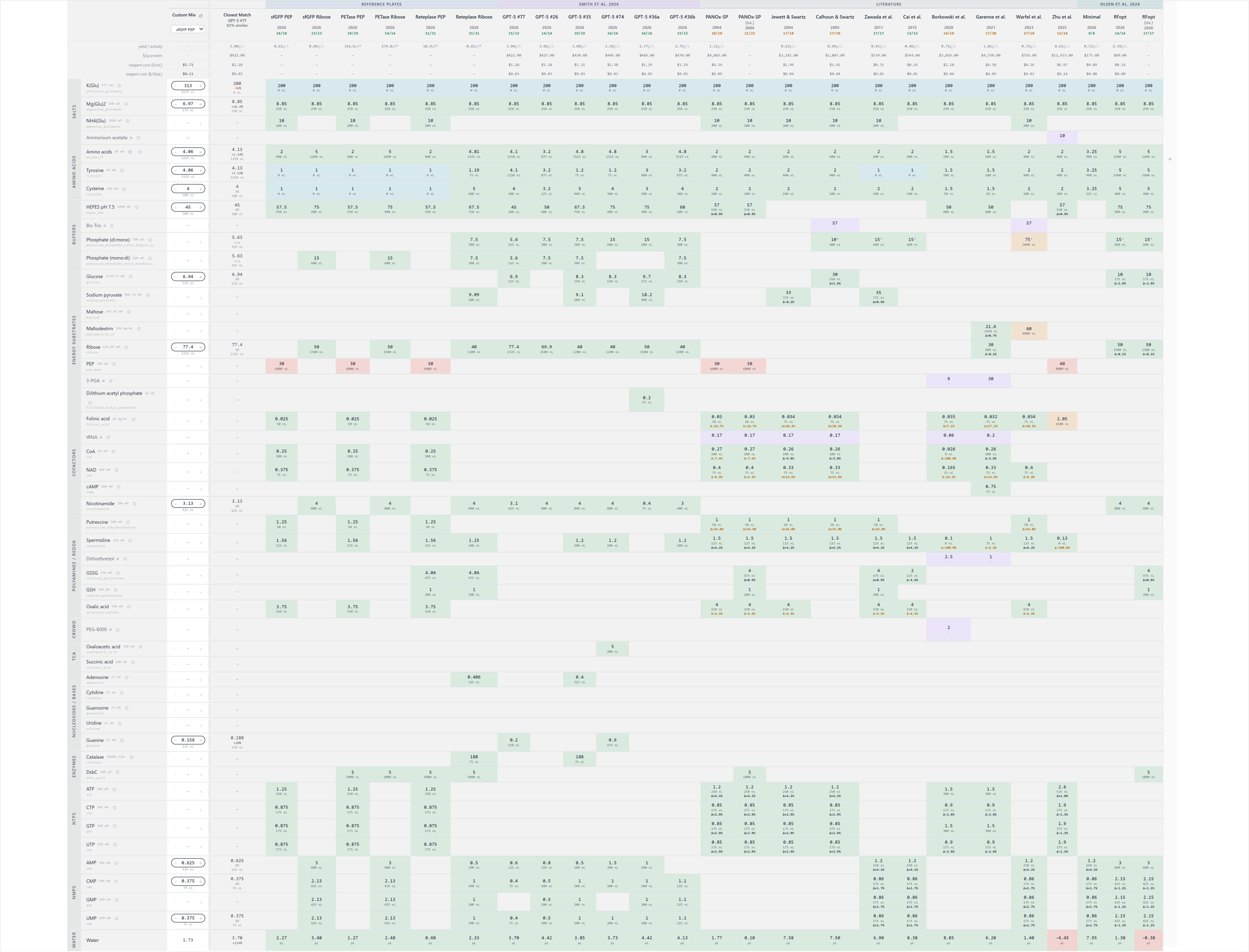
- Comparing the classical cell-free protein synthesis (CFPS) composition established by Jewett and Swartz (2004) with the modernized, cost-optimized formulations developed by Olsen, Jewett, Smith, and colleagues (2026) reveals a fundamental shift from manual, mechanism-driven optimization to automated, multi-variable formulation design. In their 2004 study, Jewett and Swartz introduced the PANOxSP system, which strategically chose high-purity reagents like phosphoenolpyruvate (PEP) as an energy source, pre-made nucleoside triphosphates (NTPs), specific concentrations of potassium glutamate (typically ~160 mM) for ionic strength, and tightly controlled magnesium glutamate (~8 to 10 mM) to mimic the native E. coli cytoplasmic environment. These precise, manually tuned reagent choices successfully prolonged high-level protein synthesis, but they relied heavily on expensive starting materials that limited economic viability for large-scale biomanufacturing. In contrast, the recent 2026 studies by Olsen, Smith, Jewett, and their collaborators leverage autonomous robotic platforms and advanced machine learning models (such as GPT-5-driven cloud laboratories) to systematically re-evaluate and contrast these classical reagent choices. Rather than relying solely on high-cost NTPs and PEP, the modern automated workflow explores vast, multi-dimensional combinatorial spaces involving alternative energy substrates, lower-cost raw building blocks, and shifted salt concentrations. By contrasting thousands of parallel variations in reagent concentrations, the 2026 frameworks successfully drop expensive components or substitute them with economical alternatives while simultaneously adjusting magnesium and potassium glutamate balances. Consequently, while the 2004 composition relied on a rational, mechanism-first design to maximize titer through premium reagents, the 2026 compositions demonstrate that iterative, design-driven optimization can drastically alter reagent concentrations and choice of inputs to achieve a remarkable reduction in cost per gram of protein without sacrificing—and often improving overall volumetric titers.
Note: A recommended starting point would be to review a least one published formulation, such as PANOx-SP
(Jewett & Swartz 2004), a cost-optimized formulation from Olsen et al. (2026), and/or an AI-designed
formulation from Smith et al. (2026).
B. DESIGN ONE REACTION COMPOSITION FOR EACH OF THE THREE PROTEINS (40 minutes)
- Sign in to coopetition.htgaa.org and publish your first unique 20 μL CFPS reaction composition for each
of the following (don’t worry, you can resubmit later):
Potassium Glutamate 312.66 mM
Ribose 77.43 mM
HEPES-KOH pH 7.5 45.00 mM
Magnesium Glutamate 6.97 mM
Glucose 6.94 mM
17 Amino Acid Mix 4.06 mM
Tyrosine pH 12 4.06 mM
Cysteine 4.00 mM
Nicotinamide 3.13 mM
AMP 625.00 uM
CMP 375.00 uM
UMP 375.00 uM
Guanine 156.25 uM
Water 1.725 uL
.png)
.png)
Note: if you’re unable to login with your HTGAA keycloak account, please post in Zulip so that you can
participate in the coopetition!
For each composition, specify the reagents you would adjust from the relevant categories, including
salts, energy sources, building blocks, cofactors, and redox components.
- As a HTBAA research team, we will have the opportunity to suggest new reagents to add to the
cell-free reagent inventory. Contribute (or upvote) at least one reagent to the “Community Reagents”
section of the website and provide a short rationale. Include in your homework documentation how you
decided on that specific reagent and provide links to any relevant research.
- I chose maltodextrin because traditional cell-free protein synthesis systems heavily rely on expensive high-energy phosphate molecules like phosphoenolpyruvate or purified nucleoside triphosphates, which create a significant cost barrier for scalable and sustainable biomanufacturing. Maltodextrin acts as an economical, slow-release polysaccharide carbon source that efficiently fuels endogenous glycolysis and ATP regeneration pathways within cell extracts, thereby driving down reagent expenses without sacrificing overall protein yield or reaction lifespan. My decision to prioritize this specific reagent was directly inspired by foundational metabolic engineering studies from the Jewett laboratory demonstrating how slowly-metabolized carbohydrates can power robust cell-free protein synthesis at a fraction of the traditional cost, as documented in key literature on low-cost cell-free platforms
- Visit the cfps-coopetition forum page to ensure you will be able to take part in the discussion. Bonus:
send a note in the channel about a CFPS optimization idea that you have! If you would like clarification
on aspects of the project, please message in this dedicated channel.
C. ASIMOV KERNAL (OPTIONAL)
4. Build T7 compatible plasmids for cell-free expression using the amino acid coding sequences below:
sfGFP
MSKGEELFTGVVPILVELDGDVNGHKFSVRGEGEGDATIGKLTLKFICTTGKLPVPWPTLVTTLTYGVQCFSRYPDHMKRHDFFKSAMPEGYVQER
TISFKDDGKYKTRAVVKFEGDTLVNRIELKGTDFKEDGNILGHKLEYNFNSHNVYITADKQKNGIKANFTVRHNVEDGSVQLADHYQQNTPIGDGP
VLLPDNHYLSTQTVLSKDPNEKGTRDHMVLHEYVNAAGITWSHPQFEK
PETase
MEKKIWSHPQFEKGGSGENLYFQSGGASPAGGGANPYERGPNPTDALLEASSGPFSVSEENVSRLSASGFGGGTIYYPRENNTYGAVAISPGYTGT
EASIAWLGERIASHGFVVITIDTITTLDQPDSRAEQLNAALNHMINRASSTVRSRIDSSRLAVMGHSMGGGGTLRLASQRPDLKAAIPLTPWHLNK
NWSSVTVPTLIIGADLDTIAPVATHAKPFYNSLPSSISKAYLELDGATHFAPNIPNKIIGKYSVAWLKRFVDNDTRYTQFLCPGPRDGLFGEVEEY
RSTCPFGGSGVSGWRLFKKIS
Reteplase
MEKKIWSHPQFEKGGSGENLYFQSGGASPAGGGNSDCYFGNGSAYRGTHSLTESGASCLPWNSMILIGKVYTAQNPSAQALGLGKHNYCRNPDGDA
KPWCHVLKNRRLTWEYCDVPSCSTCGLRQYSQPQFRIKGGLFADIASHPWQAAIFAKHRRSPGERFLCGGILISSCWILSAAHCFQERFPPHHLTV
ILGRTYRVVPGEEEQKFEVEKYIVHKEFDDDTYDNDIALLQLKSDSSRCAQESSVVRTVCLPPADLQLPDWTECELSGYGKHEALSPFYSERLKEA
HVRLYPSSRCTSQHLLNRTVTDNMLCAGDTRSGGPQANLHDACQGDSGGPLVCLNDGRMTLVGIISWGLGCGQKDVPGVYTKVTNYLDWIRDNMRP
GGSGVSGWRLFKKIS
- Bonus question: design a T7 helper plasmid that you could add to the cell-free reaction to improve the
yield of functional reteplase (general chaperones, disulfide-bond machinery, etc).
Use of AI
You are encouraged to use AI and online tools for this assignment to assist your reagent composition
development process. As you will present your work during recitation, you must be able to explain and justify
the reasoning behind your design.
If you use AI, ensure that you cite the AI client and your prompts used.