Week 3 HW: Cell-Free Protocols
Goal: using the collective intelligence of the HTBAA community and accessible AI systems, design novel CFPS reaction compositions for each of the three target proteins: sfGFP, PETase, and Reteplase to reduce the cost per gram of functional protein. Each design should be compatible with the experimental framework described above and should reflect the distinct expression and folding requirements of that protein. You can learn more about the details of the coopetition here.
A. COMPARE CELL-FREE REACTION COMPOSITIONS (20 minutes)
- Why does the concentration of potassium glutamate and magnesium glutamate differ between compositions? Which is more sensitive?
- The concentrations of potassium glutamate and magnesium glutamate differ dramatically due to their distinct biological roles within the transcription-translation machinery. Potassium glutamate is typically added at high concentrations ranging from 100 to 250 mM to provide the necessary bulk ionic strength and macromolecular crowding that mimics the natural intracellular environment of E. coli. In contrast, magnesium glutamate is added at much lower concentrations, typically between 2 and 16 mM, because divalent magnesium ions act as essential catalytic cofactors required for stabilizing ribosome architecture, tRNA charging, and enzymatic function. Between the two, the cell-free reaction is markedly sensitive to magnesium concentration. Even a minor fluctuation of 1 to 2 mM in $Mg^{2+}$ can critically disrupt protein synthesis, causing ribosome dissociation at low levels or non-specific RNA precipitation and structural misfolding at high levels.
- Explain how a PEP+NTP reaction formulation is different from a Ribose+NMP reaction formulation.
- The primary difference between a PEP plus NTP reaction formulation and a Ribose plus NMP formulation lies in their energy and nucleotide regeneration strategies, which dictate reaction kinetics and lifespan. A PEP plus NTP formulation uses phosphoenolpyruvate as a high-energy metabolic fuel paired with pre-made nucleoside triphosphates, allowing endogenous pyruvate kinase to rapidly phosphorylate ADP into ATP for fast, high-yield bursts of protein synthesis that typically complete within an hour. Conversely, a Ribose plus NMP formulation relies on cheaper, unphosphorylated raw starting materials like nucleoside monophosphates coupled with sugars, forcing the cell lysate’s metabolic network to slowly build its own energy pool from scratch. This alternative approach results in a prolonged, sustained marathon reaction that can run smoothly for up to 20 hours at a fraction of the cost.
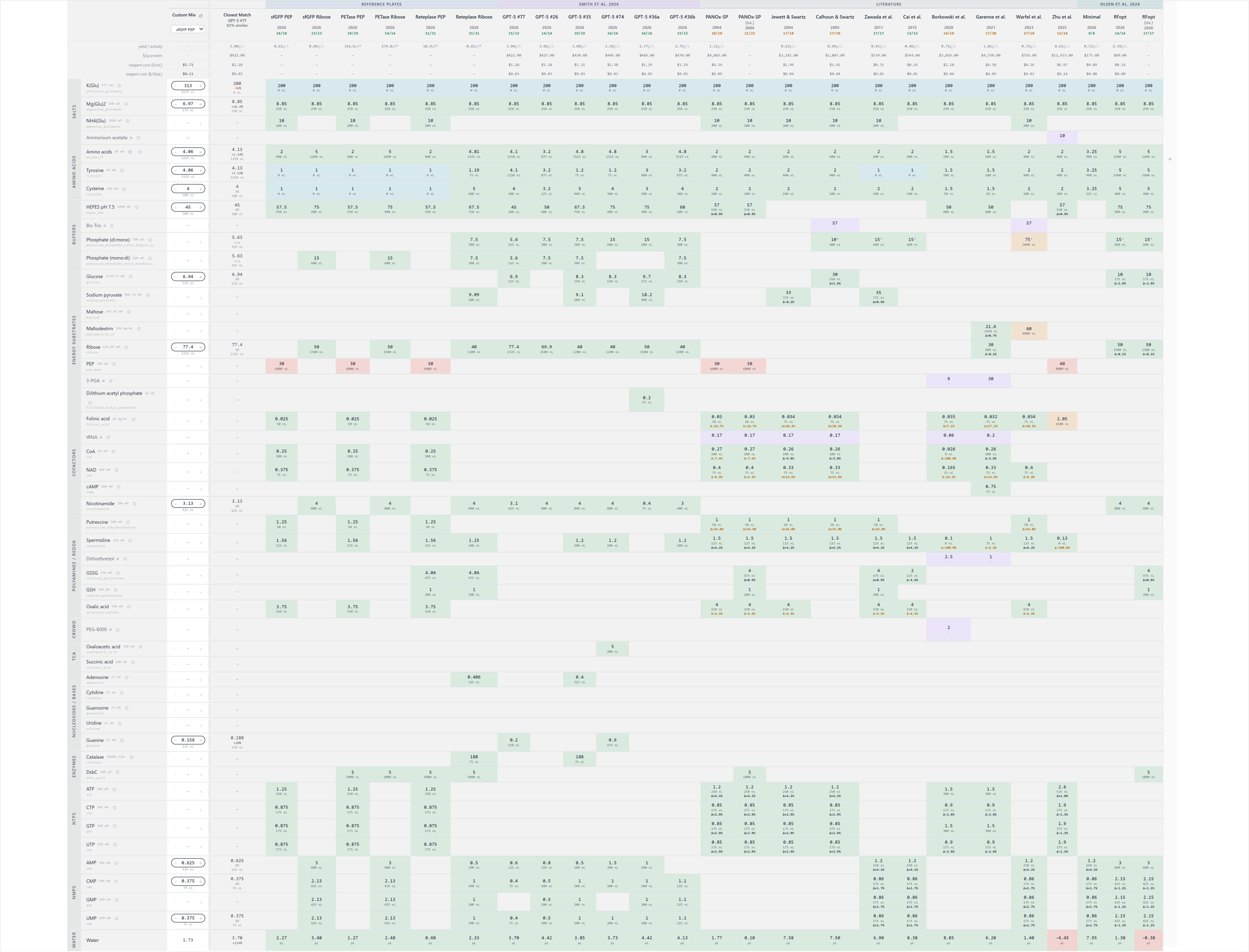
- Choose two cell-free reaction compositions from the literature, compare and contrast the choice of reagents and the concentration of reagents.
- Comparing the classical cell-free protein synthesis (CFPS) composition established by Jewett and Swartz (2004) with the modernized, cost-optimized formulations developed by Olsen, Jewett, Smith, and colleagues (2026) reveals a fundamental shift from manual, mechanism-driven optimization to automated, multi-variable formulation design. In their 2004 study, Jewett and Swartz introduced the PANOxSP system, which strategically chose high-purity reagents like phosphoenolpyruvate (PEP) as an energy source, pre-made nucleoside triphosphates (NTPs), specific concentrations of potassium glutamate (typically ~160 mM) for ionic strength, and tightly controlled magnesium glutamate (~8 to 10 mM) to mimic the native E. coli cytoplasmic environment. These precise, manually tuned reagent choices successfully prolonged high-level protein synthesis, but they relied heavily on expensive starting materials that limited economic viability for large-scale biomanufacturing. In contrast, the recent 2026 studies by Olsen, Smith, Jewett, and their collaborators leverage autonomous robotic platforms and advanced machine learning models (such as GPT-5-driven cloud laboratories) to systematically re-evaluate and contrast these classical reagent choices. Rather than relying solely on high-cost NTPs and PEP, the modern automated workflow explores vast, multi-dimensional combinatorial spaces involving alternative energy substrates, lower-cost raw building blocks, and shifted salt concentrations. By contrasting thousands of parallel variations in reagent concentrations, the 2026 frameworks successfully drop expensive components or substitute them with economical alternatives while simultaneously adjusting magnesium and potassium glutamate balances. Consequently, while the 2004 composition relied on a rational, mechanism-first design to maximize titer through premium reagents, the 2026 compositions demonstrate that iterative, design-driven optimization can drastically alter reagent concentrations and choice of inputs to achieve a remarkable reduction in cost per gram of protein without sacrificing—and often improving overall volumetric titers.
Note: A recommended starting point would be to review a least one published formulation, such as PANOx-SP (Jewett & Swartz 2004), a cost-optimized formulation from Olsen et al. (2026), and/or an AI-designed formulation from Smith et al. (2026). B. DESIGN ONE REACTION COMPOSITION FOR EACH OF THE THREE PROTEINS (40 minutes)
- Sign in to coopetition.htgaa.org and publish your first unique 20 μL CFPS reaction composition for each of the following (don’t worry, you can resubmit later):
Potassium Glutamate 312.66 mM Ribose 77.43 mM HEPES-KOH pH 7.5 45.00 mM Magnesium Glutamate 6.97 mM Glucose 6.94 mM 17 Amino Acid Mix 4.06 mM Tyrosine pH 12 4.06 mM Cysteine 4.00 mM Nicotinamide 3.13 mM AMP 625.00 uM CMP 375.00 uM UMP 375.00 uM Guanine 156.25 uM Water 1.725 uL
- sfGFP
- PETase
.png)
- Reteplase
.png)
Note: if you’re unable to login with your HTGAA keycloak account, please post in Zulip so that you can participate in the coopetition! For each composition, specify the reagents you would adjust from the relevant categories, including salts, energy sources, building blocks, cofactors, and redox components.
- As a HTBAA research team, we will have the opportunity to suggest new reagents to add to the cell-free reagent inventory. Contribute (or upvote) at least one reagent to the “Community Reagents” section of the website and provide a short rationale. Include in your homework documentation how you decided on that specific reagent and provide links to any relevant research.
- I chose maltodextrin because traditional cell-free protein synthesis systems heavily rely on expensive high-energy phosphate molecules like phosphoenolpyruvate or purified nucleoside triphosphates, which create a significant cost barrier for scalable and sustainable biomanufacturing. Maltodextrin acts as an economical, slow-release polysaccharide carbon source that efficiently fuels endogenous glycolysis and ATP regeneration pathways within cell extracts, thereby driving down reagent expenses without sacrificing overall protein yield or reaction lifespan. My decision to prioritize this specific reagent was directly inspired by foundational metabolic engineering studies from the Jewett laboratory demonstrating how slowly-metabolized carbohydrates can power robust cell-free protein synthesis at a fraction of the traditional cost, as documented in key literature on low-cost cell-free platforms
- Visit the cfps-coopetition forum page to ensure you will be able to take part in the discussion. Bonus: send a note in the channel about a CFPS optimization idea that you have! If you would like clarification on aspects of the project, please message in this dedicated channel.
C. ASIMOV KERNAL (OPTIONAL) 4. Build T7 compatible plasmids for cell-free expression using the amino acid coding sequences below:
sfGFP
MSKGEELFTGVVPILVELDGDVNGHKFSVRGEGEGDATIGKLTLKFICTTGKLPVPWPTLVTTLTYGVQCFSRYPDHMKRHDFFKSAMPEGYVQER TISFKDDGKYKTRAVVKFEGDTLVNRIELKGTDFKEDGNILGHKLEYNFNSHNVYITADKQKNGIKANFTVRHNVEDGSVQLADHYQQNTPIGDGP VLLPDNHYLSTQTVLSKDPNEKGTRDHMVLHEYVNAAGITWSHPQFEK
PETase
MEKKIWSHPQFEKGGSGENLYFQSGGASPAGGGANPYERGPNPTDALLEASSGPFSVSEENVSRLSASGFGGGTIYYPRENNTYGAVAISPGYTGT EASIAWLGERIASHGFVVITIDTITTLDQPDSRAEQLNAALNHMINRASSTVRSRIDSSRLAVMGHSMGGGGTLRLASQRPDLKAAIPLTPWHLNK NWSSVTVPTLIIGADLDTIAPVATHAKPFYNSLPSSISKAYLELDGATHFAPNIPNKIIGKYSVAWLKRFVDNDTRYTQFLCPGPRDGLFGEVEEY RSTCPFGGSGVSGWRLFKKIS
Reteplase
MEKKIWSHPQFEKGGSGENLYFQSGGASPAGGGNSDCYFGNGSAYRGTHSLTESGASCLPWNSMILIGKVYTAQNPSAQALGLGKHNYCRNPDGDA KPWCHVLKNRRLTWEYCDVPSCSTCGLRQYSQPQFRIKGGLFADIASHPWQAAIFAKHRRSPGERFLCGGILISSCWILSAAHCFQERFPPHHLTV ILGRTYRVVPGEEEQKFEVEKYIVHKEFDDDTYDNDIALLQLKSDSSRCAQESSVVRTVCLPPADLQLPDWTECELSGYGKHEALSPFYSERLKEA HVRLYPSSRCTSQHLLNRTVTDNMLCAGDTRSGGPQANLHDACQGDSGGPLVCLNDGRMTLVGIISWGLGCGQKDVPGVYTKVTNYLDWIRDNMRP GGSGVSGWRLFKKIS
- Bonus question: design a T7 helper plasmid that you could add to the cell-free reaction to improve the yield of functional reteplase (general chaperones, disulfide-bond machinery, etc).
Use of AI You are encouraged to use AI and online tools for this assignment to assist your reagent composition development process. As you will present your work during recitation, you must be able to explain and justify the reasoning behind your design. If you use AI, ensure that you cite the AI client and your prompts used.