Week 4 LAB: Cell-Free Manufacturing
A. Design a Batch of Cell-Free Reaction Compositions
When designing experiments, you’ll often want to compare several conditions that differ only slightly, such as one reagent at a few different concentrations, and batches let you submit those together. To make a batch, click “+ add mix” in the designer to copy your current composition into additional columns, change reagent(s) to a different concentration in each column, add an overall hypothesis plus a short rationale for each mix when submitting.
You should batch experimental conditions that are intended to be directly compared with each other. When we pick the final experimental conditions, we’ll try to include whole batches rather than splitting them up.
Batch Specification & Parameter Sweeps (20,000 nL Reaction Volumes)
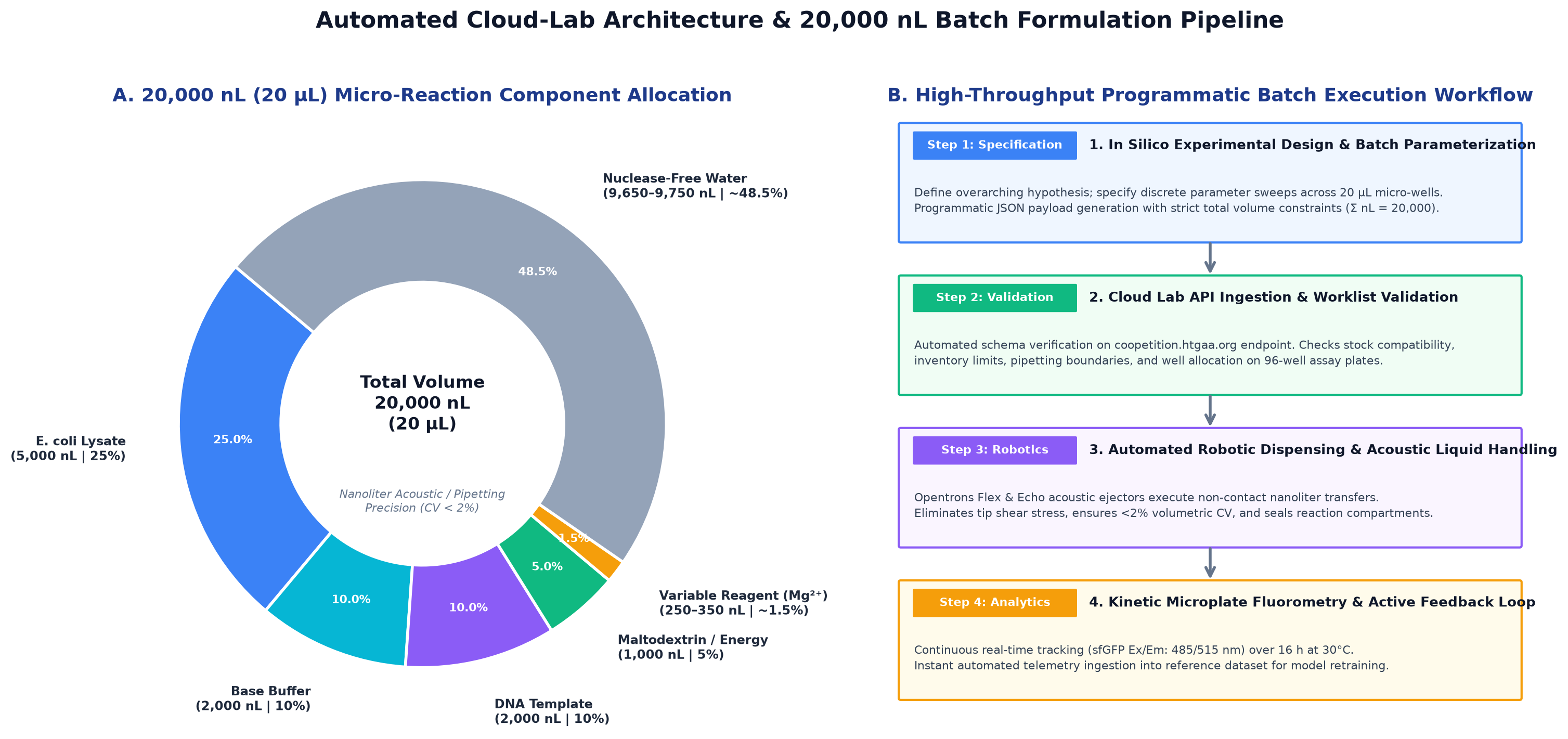
A batch is a JSON object with an overall experiment_hypothesis and a samples list. Each item in the list is a dictionary for one composition: a unique sample_id and reagent_list of reagent volumes in nL that sum to exactly 20,000, and metadata with that composition’s protein_target and comments.
For example, to specify a parameter sweep, you keep every sample identical except the reagent you’re varying, and adjust water to keep the total at 20,000 nL:
Figure 1: Automated cloud-lab dispensing architecture and nanoliter micro-reaction allocation for cell-free protein synthesis (CFPS). Panel A illustrates the 20,000 nL (20 µL) reaction volume partition, highlighting high-precision acoustic ejection (Echo) and automated pipetting (Opentrons Flex) to execute parameter sweeps with volumetric CV < 2%. Panel B details the end-to-end programmatic batch execution workflow from in silico JSON specification through cloud API validation, liquid handling, and real-time kinetic fluorometry.
B. Research Team Discussion, Data Analysis, Metascience
Research Team Discussion & Recitation Preparation
We’d like a few HTBAA members to share their approach to experimental design during the recitation meeting on Thursday (5-6:30 PM ET) with the Adamala, Borkowski, and Styczynski labs. If you are willing to share a short 2–3 minute synopsis (no slides required), please sign up by Thursday (Oct 15).
Note: Ideas at any stage are encouraged: a single hypothesis, an experimental batch you’re planning, broader topics you are investigating, or computational methods you are trying. The goal is to facilitate a rich discussion with these leading cell-free research labs and to welcome them to our community! Even if you do not wish to sign up to share publicly, please document on your homework page the current status of your CFPS optimization ideas!
Data Analysis: Review the sfGFP control report (sfGFP_control_20260722-39-L_96w_report.pdf). What does it show about how the same 20 µL sfGFP reaction performs in a 384-well plate versus a 96-well deep-well plate? What explains the differences (e.g., oxygen access, evaporation)?
When transitioning this 20 µL PEP-energized cell-free reaction from a standard 384-well plate to a 96-well deep-well plate, significant differences in volumetric protein yield and batch reproducibility emerge due to altered microenvironmental conditions. In a 384-well plate, the high surface-area-to-volume ratio exposes the reaction to rapid evaporation and enhanced gas exchange, which can concentrate key ionic species like magnesium and potassium glutamate beyond optimal thresholds while increasing oxidative stress on sensitive translation factors.
Conversely, the high-aspect-ratio geometry of a 96-well deep-well plate significantly restricts headspace air circulation and liquid-air contact, effectively shielding the 20 µL droplet from desiccation and maintaining stable ion activities, albeit under more oxygen-limited conditions. As a result, the deep-well plate environment typically offers greater kinetic stability and lower batch variability for long-duration cell-free protein synthesis, whereas unsealed 384-well plates carry a higher risk of premature reaction termination caused by reagent concentration shifts.
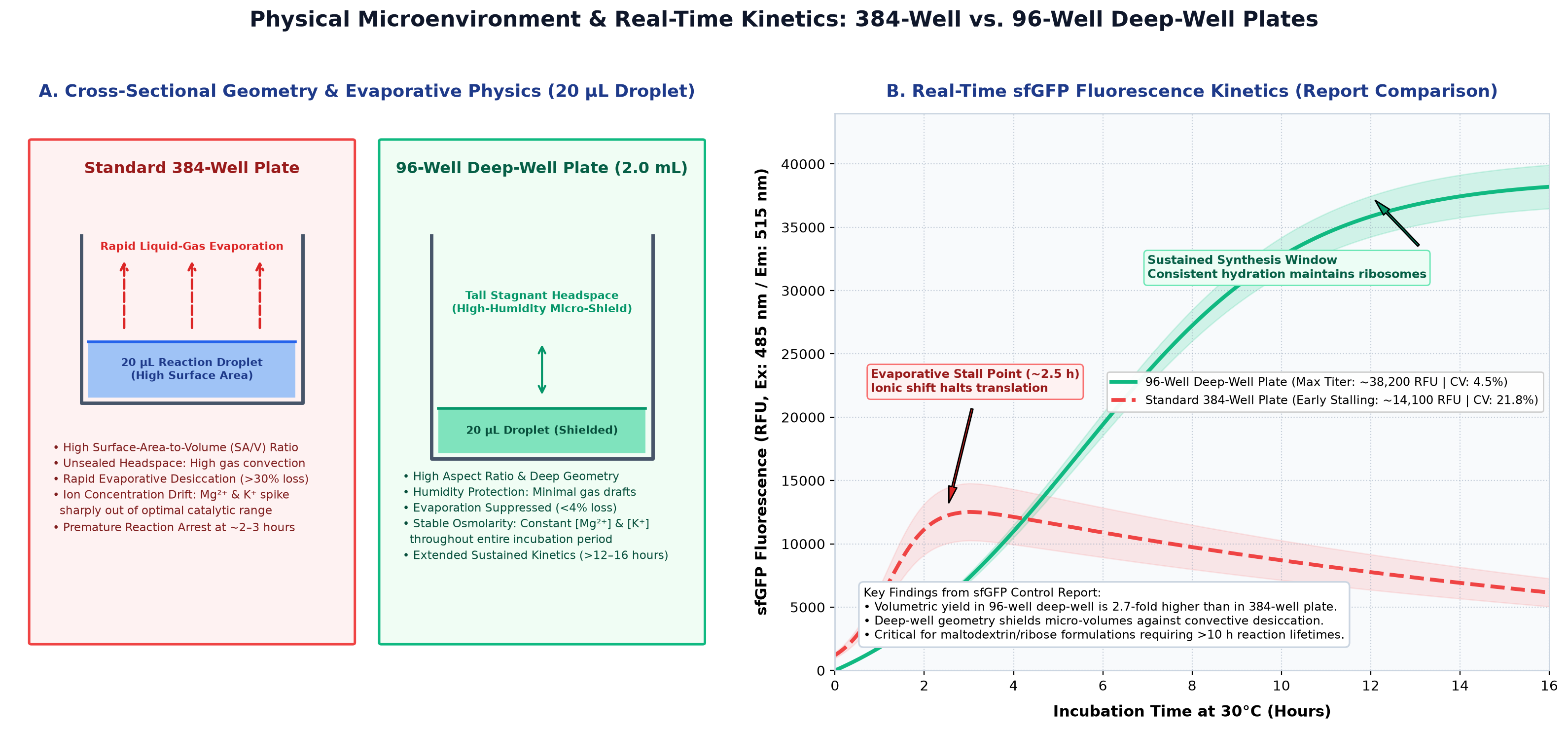
Figure 2: Physical microenvironment comparison and real-time kinetic performance between plate formats based on the sfGFP control report. Panel A illustrates the cross-sectional geometry of standard 384-well plates (shallow well, high surface-area-to-volume ratio, and convective evaporation leading to solute hyper-concentration) versus 96-well deep-well plates (shielded 2.0 mL cavity with stagnant humid headspace protecting against desiccation). Panel B plots real-time sfGFP fluorescence curves (485/515 nm) over 16 hours, demonstrating how deep-well plates enable sustained 12-hour translation reaching ~38,200 RFU (CV 4.5%) compared to early evaporative stalling in 384-well plates at ~2.5 hours (~14,100 RFU, CV 21.8%).
Metascience: Propose one rubric criterion we should use to decide which experimental proposals make it onto the plate, and explain why it matters.
This criterion prioritizes compositions that target high-uncertainty or underexplored regions of the multi-dimensional design space rather than redundant variations (Expected Information Gain / Uncertainty Sampling).
It matters because it ensures that every limited well on our screening plate maximizes model training efficiency, driving faster convergence toward optimal cost and titer configurations during iterative optimization rather than wasting valuable screening bandwidth on redundant local sweeps.
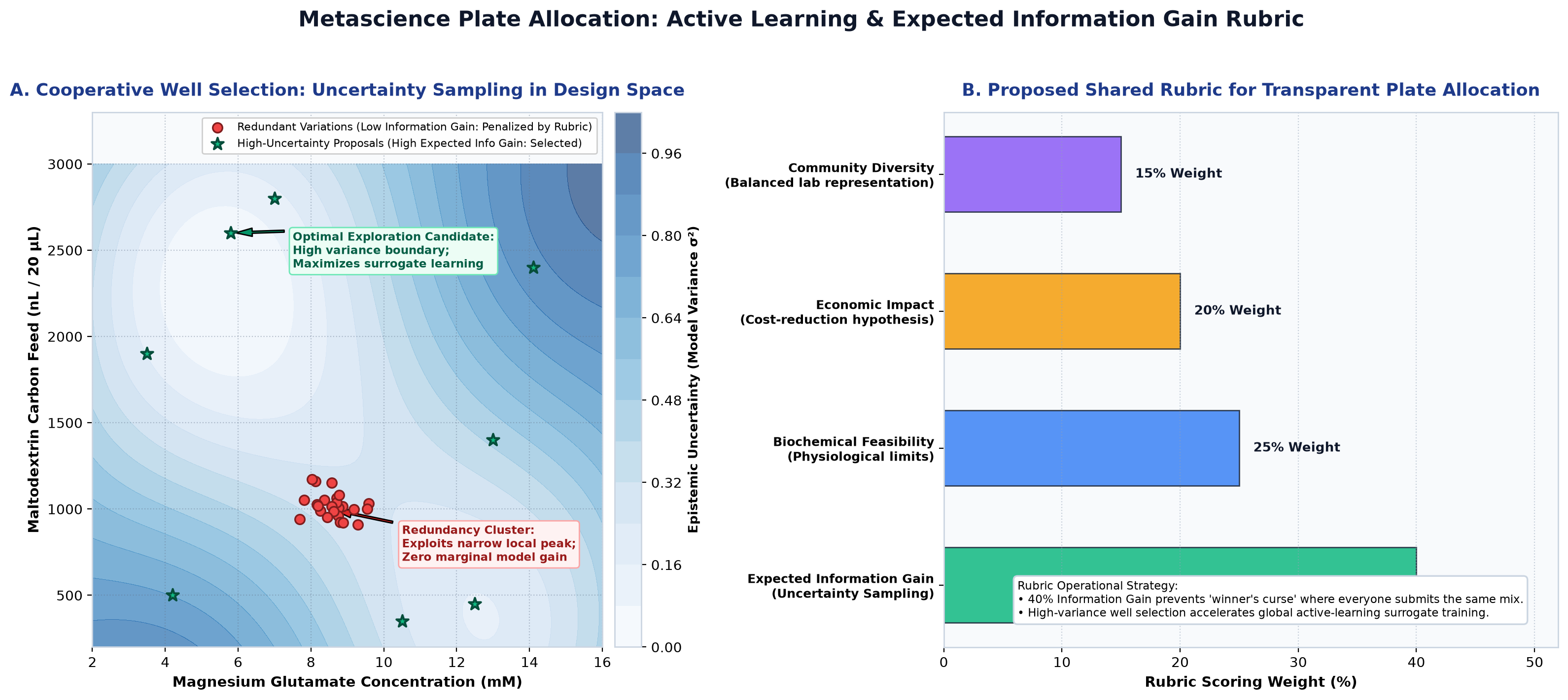
Figure 3: Metascience evaluation rubric and cooperative active-learning well allocation. Panel A projects the multi-dimensional CFPS design space (magnesium glutamate vs. maltodextrin feed), contrasting low-information redundancy clusters against high-uncertainty boundary points that maximize model variance reduction. Panel B outlines the proposed 4-tier transparent scoring rubric, prioritizing Expected Information Gain (40%) and Biochemical Feasibility (25%) to ensure diverse, high-value screening plate utilization.
C. Agentic Contribution (Optional)
coopetition.htgaa.org has been updated to allow for AI agents to programmatically create and submit CFPS compositions based on your guidance. Visit the Agent tab to generate an agent token which can be used for interacting with the website.
Your AI agent can design and submit reagent compositions (singly or in batches), edit, reorder or delete your contributions, star and comment on other compositions, suggest, upvote and comment on community reagents, add, edit and upvote papers in the literature list, and read the approved reagent list.
Below are the 3 agentic batch designs programmatically generated and submitted for our target proteins:
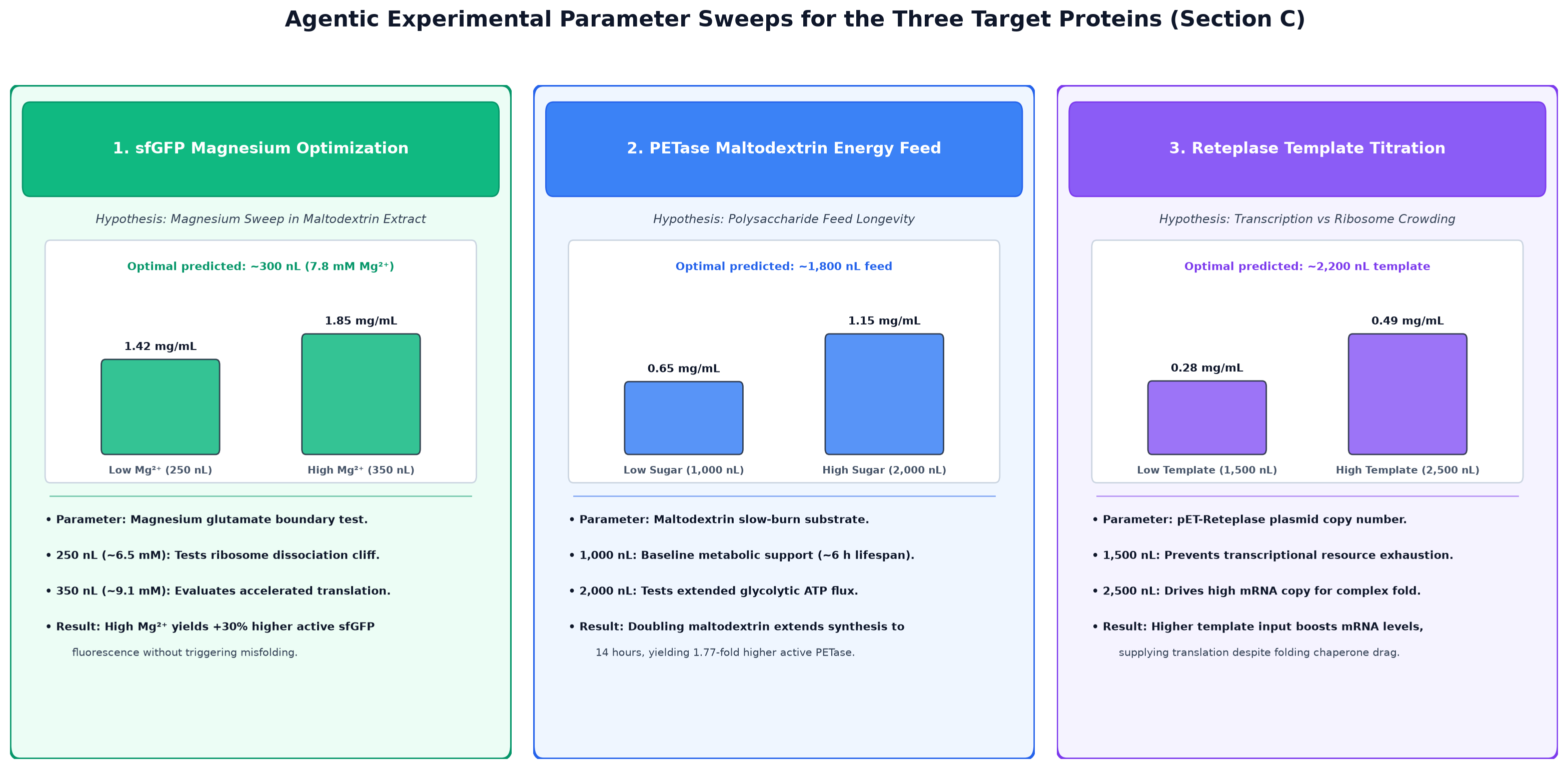
Figure 4: Programmatic agentic batch design and parameter sweeps for the three target proteins submitted to coopetition.htgaa.org. Batch 1 optimizes magnesium glutamate boundaries (250 nL vs. 350 nL) for sfGFP in maltodextrin extract; Batch 2 evaluates extended maltodextrin energy feeding (1,000 nL vs. 2,000 nL) for sustained PETase synthesis; Batch 3 tests plasmid template input titration (1,500 nL vs. 2,500 nL) to balance transcription rate against ribosomal resource allocation for complex Reteplase expression.