Week 1 HW: Final Project Ideas

Predictive Biomanufacturing of Functional Mycelium–Nanoparticle Materials

Why this matters: Mycelium-based materials offer a renewable and biodegradable platform for functional materials, but their performance depends strongly on the biological state of the fungus and the conditions used to process it. My project explores whether Ganoderma lucidum can act not only as the material itself, but also as a living manufacturing system that helps form antimicrobial silver nanostructures within the mycelial network. I want to combine this biological system with automated cultivation and characterization to understand how process conditions influence nanoparticle formation, structure, and function. In the longer term, the goal is to move from small-scale experiments toward a scalable, data-driven and predictive biomanufacturing platform where desired material properties can guide how the biological process is designed and controlled.

                    WHY THIS MATTERS
                    ----------------

                 Mycelium-based materials
                 ------------------------
              +---------------------------+
              | Renewable & biodegradable |
              | material platform         |
              +-------------+-------------+
                            |
                            v
              +---------------------------+
              | Can be vulnerable to      |
              | microbial growth and      |
              | degradation               |
              +-------------+-------------+
                            |
                            v
               Need antimicrobial function
                            |
             +--------------+--------------+
             |                             |
             v                             v

    CONVENTIONAL APPROACH              IN-SITU APPROACH
    ---------------------              ----------------

+---------------------------+      +---------------------------+
| Synthesize antimicrobial |      | Use the living fungal     |
| agent separately         |      | system as part of the     |
| e.g. silver nanoparticles|      | manufacturing process     |
+-------------+-------------+      +-------------+-------------+
              |                                  |
              v                                  v
+---------------------------+      +---------------------------+
| Chemical synthesis may   |      | Fungal-associated        |
| require reductants,      |      | biomolecules interact    |
| stabilizers and energy   |      | with silver ions         |
+-------------+-------------+      +-------------+-------------+
              |                                  |
              v                                  v
+---------------------------+      +---------------------------+
| Purify / stabilize the   |      | In-situ formation of     |
| antimicrobial agent      |      | silver nanostructures    |
+-------------+-------------+      | within the mycelium      |
              |                    +-------------+-------------+
              v                                  |
+---------------------------+                    v
| Incorporate into the     |      +---------------------------+
| material                 |      | Nanoparticle formation    |
|                          |      | and material formation    |
| • Coating                |      | become more integrated    |
| • Impregnation           |      +-------------+-------------+
+-------------+-------------+                    |
              |                                  v
              v                    +---------------------------+
+---------------------------+      | Functional mycelium      |
| Possible limitations     |      | nanocomposite             |
|                          |      |                           |
| • Additional processing |      | Antimicrobial function   |
| • Additional energy use |      | integrated within the    |
| • Possible uneven       |      | material structure       |
|   distribution          |      +-------------+-------------+
| • Possible leaching or  |                    |
|   weak integration      |                    v
+---------------------------+      +---------------------------+
                                   | Streamlined              |
                                   | biomanufacturing         |
                                   +-------------+-------------+
                                                 |
                                                 v
                                   +---------------------------+
                                   | Fewer separate           |
                                   | manufacturing steps      |
                                   | and better opportunity   |
                                   | for structural           |
                                   | integration              |
                                   +-------------+-------------+
                                                 |
                                                 v
                                   +---------------------------+
                                   | Antimicrobial bio-based  |
                                   | functional material      |
                                   +---------------------------+

Where I want to take this:

Fungal physiological state + Process conditions
                      |
                      v
            Nanoparticle formation
                      |
                      v
             Structure + Function
                      |
                      v
        Automation + Systematic Data
                      |
                      v
              Predictive Model
                      |
                      v
      Scalable & Controllable Biomanufacturing         

1. What would I like to biomanufacture and why?

I would like to biomanufacture a mycelium-based antimicrobial material containing in-situ synthesized silver nanoparticles (AgNPs). My interest comes from my current research on Ganoderma lucidum, where I study how fungal biomass can participate in nanoparticle formation rather than acting only as a passive scaffold.
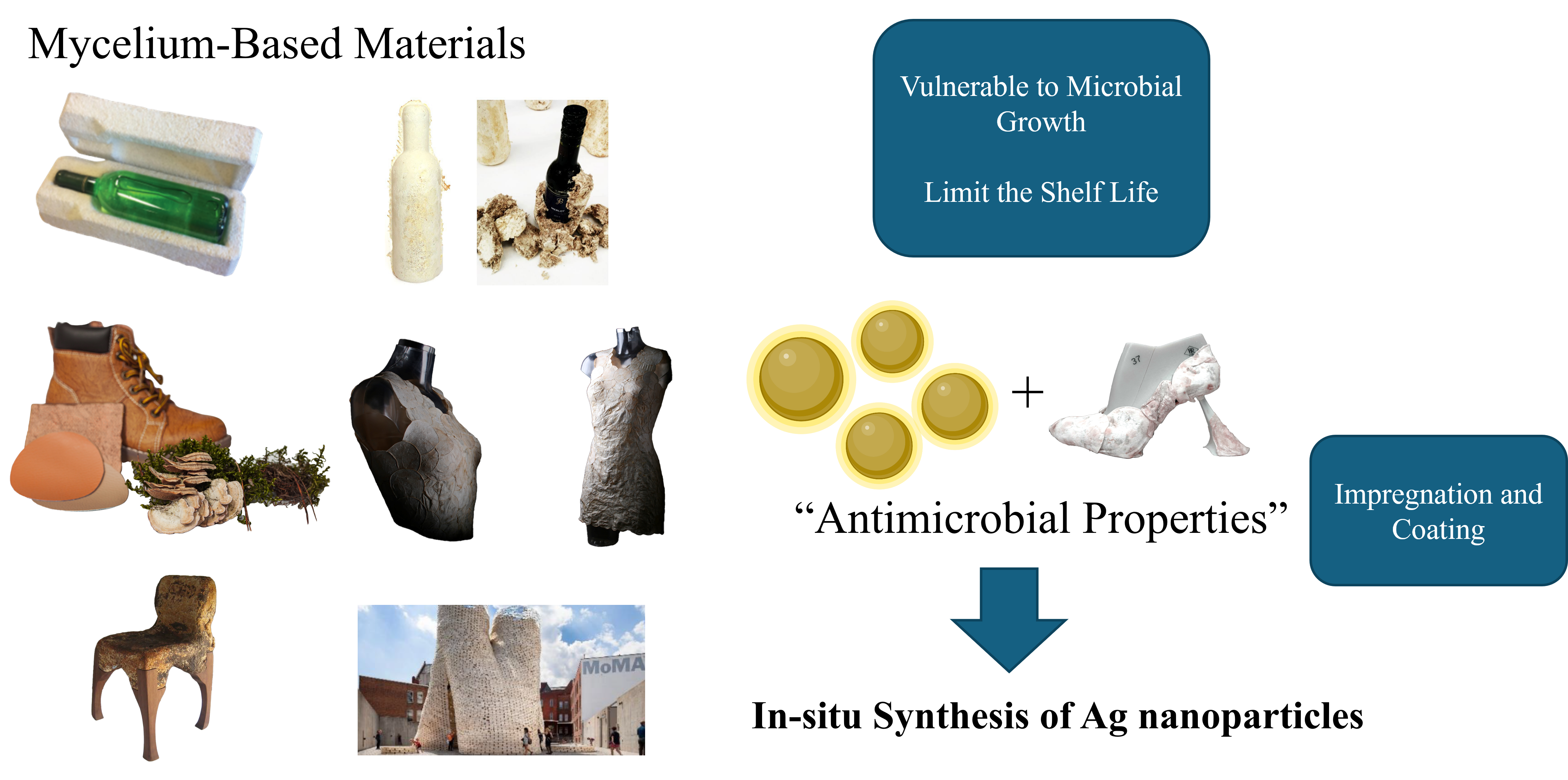
Mycelium antimicrobial concept

The conventional route is usually to synthesize an antimicrobial agent separately and then incorporate it into a material through methods such as coating or impregnation. This can require additional chemicals, purification, processing steps, and energy, while the antimicrobial agent may also be less uniformly distributed within the final material. My idea is to explore whether these steps can be streamlined through in-situ synthesis, where the fungal system itself helps form silver nanostructures directly within the mycelial network.

The target is therefore not simply a mycelium material with silver added to it, but a bio-integrated functional material in which the living system contributes to both material formation and antimicrobial function. Possible applications include biodegradable protective packaging and other temporary materials where microbial control is useful.

What interests me most is understanding how fungal physiological state, processing conditions, nanostructure, and final function are connected. In the long term, I would like to move from trial-and-error fabrication toward a process where the desired material properties can be predicted and controlled.

2. What living system would I use?

I would use the filamentous fungus Ganoderma lucidum as the living manufacturing chassis. Its mycelium forms an interconnected network and provides a biologically active environment containing biomolecules that can interact with metal ions. In my proposed system, the fungus would first be grown to produce active mycelial biomass. The biomass would then interact with a silver precursor, allowing fungal-associated biomolecules to participate in silver-ion transformation and nanoparticle formation. The resulting output would be functionalized mycelium containing biologically formed silver nanostructures, which could later become part of a larger bio-based material.

Why Ganoderma lucidum?
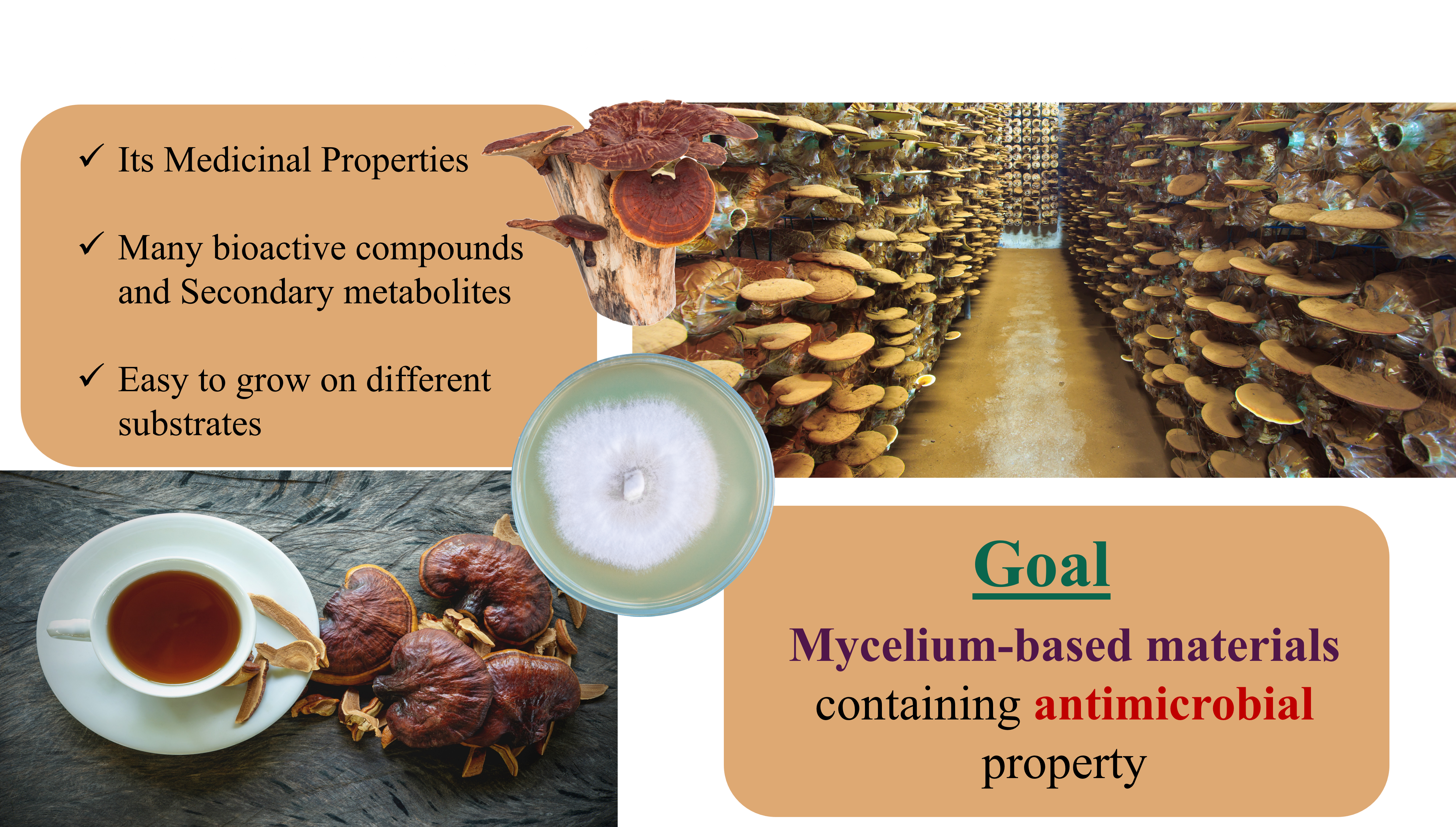
Why Ganoderma lucidum Why Ganoderma lucidum

Where does mycelium fit in the fungal life cycle?
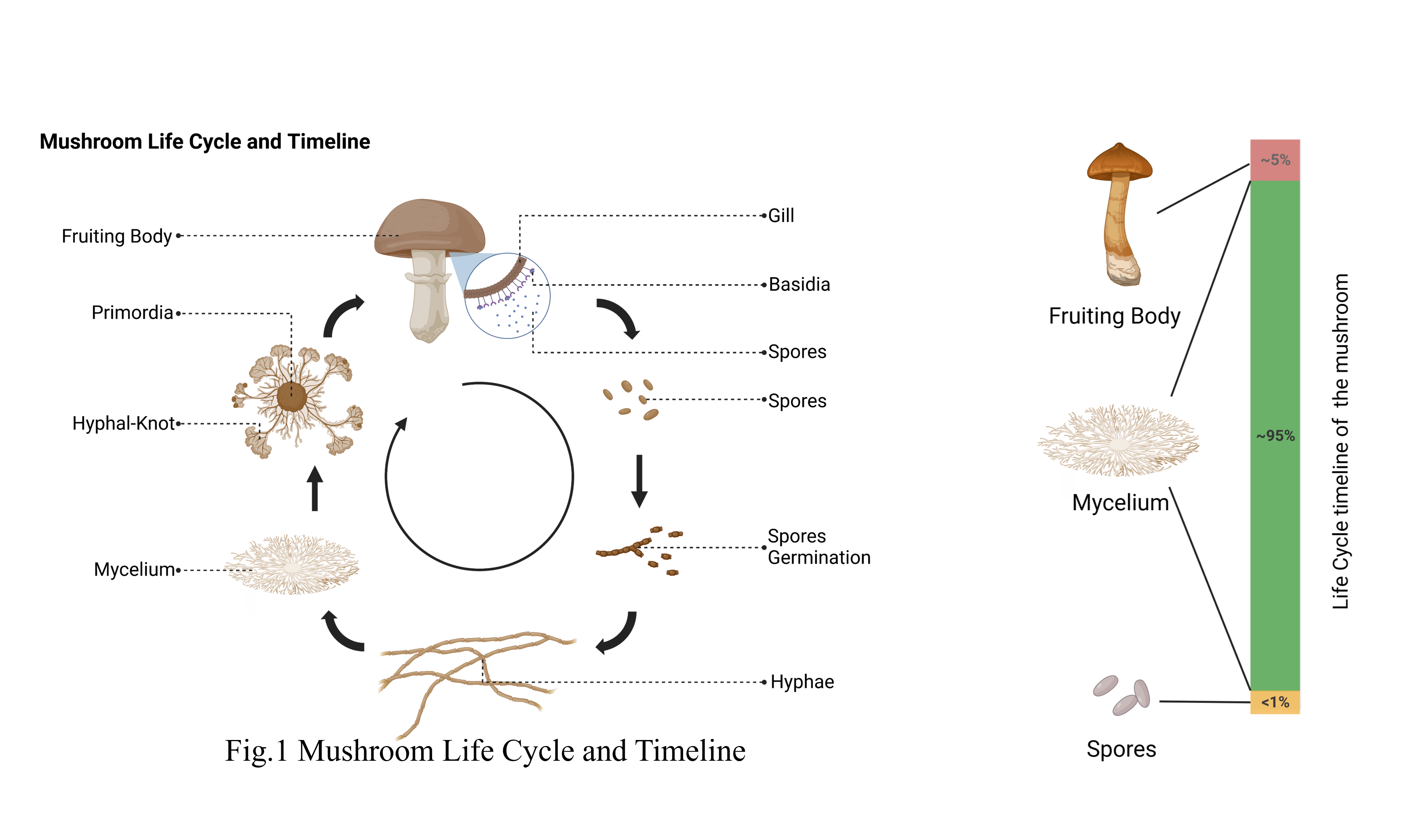
Ganoderma lucidum life cycle Ganoderma lucidum life cycle

My focus is the mycelial network, rather than the fruiting body. In this system, the mycelium serves both as a living manufacturing environment and as part of the material scaffold.

The main assumptions are that sufficient fungal viability can be retained for subsequent material formation and that nanoparticle loading and distribution can eventually be controlled reproducibly.

3. How would I use automation?

I would use automated cultivation, sampling, characterization, and data analysis to make the biomanufacturing workflow more reproducible and data-rich. The main goal would be to run multiple fungal conditions in parallel, collect samples at defined time points, and connect biological state and process conditions with nanoparticle formation and final material performance.

Automation could be used for liquid handling, parallel culturing, scheduled sampling, UV–Vis measurements, SEM/EDX image analysis, and antimicrobial testing. A parallel microbioreactor platform such as the Ambr 15 could be one example for small-scale process development, but the broader idea is to build an automated workflow rather than depend on one specific instrument.

Automated workflow

Experimental design
        |
        v
Parallel fungal cultivation
        |
        v
Controlled process conditions
        |
        v
Scheduled sampling
        |
        v
+-----------------------------+
| Characterization            |
|                             |
| Ag+ depletion               |
| UV-Vis                      |
| SEM / EDX                   |
| Image analysis              |
| Antimicrobial testing       |
+-------------+---------------+
              |
              v
      Structured dataset
              |
              v
 Mechanistic + statistical
      modelling
              |
              v
   Predictive biomanufacturing

4. How much would I need to make, and how long would it take?

For a first meaningful scale, I would target a pilot demonstration of 1,000 antimicrobial protective-packaging inserts. The values below are preliminary engineering assumptions for this homework rather than measured production parameters.

                     PILOT-SCALE TARGET
                     ------------------

              +---------------------------+
              |      1,000 usable        |
              |    packaging inserts      |
              +-------------+-------------+
                            |
                            v
              +---------------------------+
              |   ~50 g material / piece  |
              +-------------+-------------+
                            |
                            v
              +---------------------------+
              | 1,000 × 50 g = 50 kg     |
              | finished material         |
              +-------------+-------------+
                            |
                            v
              +---------------------------+
              | Allow ~10% manufacturing |
              | loss / rejection          |
              +-------------+-------------+
                            |
                            v
              +---------------------------+
              | ~1,111 pieces required    |
              | ~56 kg material           |
              +-------------+-------------+
                            |
                            v
              +---------------------------+
              | 12 parallel modules       |
              | × 100 pieces / module     |
              +-------------+-------------+
                            |
                            v
              +---------------------------+
              | ~1,200 pieces / batch     |
              +-------------+-------------+
                            |
                            v
        +-----------------------------------------+
        |          ESTIMATED PRODUCTION TIME      |
        |                                         |
        | Material growth / formation   ~5 days   |
        | Drying / stabilization        ~2 days   |
        | Handling + quality control    ~1 day    |
        |                               --------  |
        | Total                         ~8 days   |
        +--------------------+--------------------+
                             |
                             v
              +---------------------------+
              | ~1,000 usable products    |
              | every ~8-day pilot batch  |
              +---------------------------+


         PROTOTYPING                    MANUFACTURING
         ------------                   -------------

 Automated small-scale                 Larger biomass
 cultivation & testing                 production
          |                                  |
          v                                  v
 Identify reproducible       --->    Parallel material-
 process conditions                  forming units
                                             |
                                             v
                                    Drying + Quality Control

Estimated pilot target: ~56 kg of material → 1,000 usable products → ~8 days per production cycle

Actual manufacturing capacity would need to be determined experimentally from biomass yield, material density, growth time, drying time, production capacity, and rejection rate.

5. What do I still need to understand?

The main challenge is not simply whether the fungus can form silver nanoparticles, but whether the process can become predictable, reproducible, and scalable. I see three major unknowns that need to be solved before this could become a reliable biomanufacturing process.

                KEY UNKNOWNS
                ------------

+----------------------------------+
| 1. Biological variability       |
|                                  |
| Which aspects of fungal          |
| physiological state most strongly|
| control nanoparticle formation?  |
+----------------+-----------------+
                 |
                 v
+----------------------------------+
| 2. Process → Structure → Function|
|                                  |
| How do processing conditions     |
| affect nanoparticle formation,   |
| distribution, and antimicrobial  |
| performance?                     |
+----------------+-----------------+
                 |
                 v
+----------------------------------+
| 3. Scale-up                      |
|                                  |
| Will relationships observed at   |
| small scale remain predictable   |
| in larger manufacturing systems? |
+----------------------------------+

5.1 What do I still need to understand and learn?

My current background gives me experience in materials science, biomaterials, fungal cultivation, nanoparticle synthesis, and materials characterization. Through my current research, I have learned how to grow mycelium, investigate biologically mediated silver nanoparticle formation, use techniques such as UV–Vis and SEM/EDX, perform antimicrobial testing, and design experiments to compare processing conditions.

However, moving from an experimental material to a predictable biomanufacturing process requires skills that go beyond what I currently know. One reason I am interested in HTBAA is to begin connecting my existing materials research with automation, bioprocessing, and scalable manufacturing.

             WHAT I ALREADY KNOW
             -------------------

        Materials Science
               |
               v
     Biomaterials + Mycelium
               |
               v
     Nanoparticle Formation
               |
               v
   Materials Characterization
      UV-Vis | SEM | EDX
               |
               v
     Antimicrobial Testing
               |
               v
       Experimental Data


                    ↓
            WHAT I NEED TO BUILD
                    ↓


      Bioprocess Engineering
               |
     +---------+---------+
     |                   |
     v                   v
Bioreactor control    Scale-up
and monitoring        principles
     |
     v
Lab + Process Automation
     |
     +--> Automated liquid handling
     +--> Sensors and process monitoring
     +--> Automated sampling
     +--> Reproducible workflows
     |
     v
Data Integration
     |
     +--> Experimental design
     +--> Reaction kinetics
     +--> Statistics
     +--> Automated image analysis
     +--> Programming / data pipelines
     |
     v
Predictive Modelling
     |
     +--> Machine learning
     +--> Process prediction
     +--> Optimization
     |
     v
Scalable & Controllable
Biomanufacturing

What I hope to develop through HTBAA

For me, HTBAA is an opportunity to begin filling the gap between making a functional biomaterial in the laboratory and engineering a reproducible biomanufacturing system. I particularly want to develop practical skills in laboratory automation, automated experimental workflows, bioprocess design, process monitoring, data integration, and scale-up thinking. I also want to become more comfortable connecting hardware, biological experiments, and computational tools within the same workflow.

Some areas, especially advanced fungal physiology, detailed kinetic modelling, and machine learning, will require continued training beyond a single course. However, HTBAA can help me build the biomanufacturing and automation foundation needed to connect these areas together.

The direction I want to move toward

WHAT I CAN DO NOW

Biology + Materials + Characterization
                 |
                 v
         Observe what happens

                 +

WHAT I WANT TO LEARN

Automation + Bioprocessing + Data + Modelling
                 |
                 v
       Understand why it happens
                 |
                 v
       Predict what will happen
                 |
                 v
        Control how it happens

Ultimately, I want to move from observing nanoparticle formation in a biological material toward being able to measure, model, predict, and eventually control the process.

6. How do I use AI in my research workflow?

I use ChatGPT (GPT-5.6 Sol) as a research-support tool, not as a replacement for experiments, scientific judgement, or my own interpretation of the data. I mainly use it to help organize ideas, explore possible experimental approaches, clarify concepts, improve scientific writing, perform preliminary calculations, troubleshoot analysis workflows, and connect different parts of my research more clearly.

              MY AI-ASSISTED WORKFLOW
              -----------------------

Research question / Experimental problem
                 |
                 v
        Discuss with ChatGPT
                 |
        +--------+---------+
        |                  |
        v                  v
 Clarify concepts      Explore options
 Generate questions    Compare approaches
        |                  |
        +--------+---------+
                 |
                 v
      Design / refine experiment
                 |
                 v
           Analyze data
                 |
                 v
      Interpret the results
                 |
                 v
   Improve communication and
     planning for next steps

What I use ChatGPT for

  • Experimental thinking — discussing controls, possible sources of error, alternative methods, and questions that should be tested.
  • Data analysis — checking calculations, statistical approaches, visualization ideas, and analysis workflows.
  • Scientific communication — improving the structure and clarity of reports, presentations, webpages, and research explanations.
  • Learning — helping me understand unfamiliar topics in biology, bioprocessing, automation, modelling, and programming.
  • Research planning — helping me connect my current experiments with longer-term questions in mechanistic understanding, automation, and predictive biomanufacturing.

For this HTBAA project, I also used ChatGPT to help me organize the project concept, simplify diagrams, develop back-of-the-envelope calculations, and translate my research direction into a biomanufacturing framework, while keeping unpublished experimental details out of the public webpage.

Ultimately, I use AI as a thinking and communication assistant, while experimental decisions, interpretation, and scientific conclusions remain my responsibility.

References

  1. Osorio-Echavarría J, Ossa-Orozco CP, Gómez-Vanegas NA. Synthesis of silver nanoparticles using white-rot fungus Anamorphous Bjerkandera sp. R1: influence of silver nitrate concentration and fungus growth time. Scientific Reports. 2021;11(1):3842. doi:10.1038/s41598-021-82514-8.

  2. Mukherjee P, Ahmad A, Mandal D, Senapati S, Sainkar SR, Khan MI, Parishcha R, Ajaykumar PV, Alam M, Kumar R, Sastry M. Fungus-mediated synthesis of silver nanoparticles and their immobilization in the mycelial matrix: a novel biological approach to nanoparticle synthesis. Nano Letters. 2001;1(10):515–519. doi:10.1021/nl0155274.

  3. Karwa A, Gaikwad S, Rai MK. Mycosynthesis of silver nanoparticles using Lingzhi or Reishi medicinal mushroom, Ganoderma lucidum (W. Curt.:Fr.) P. Karst. and their role as antimicrobials and antibiotic activity enhancers. International Journal of Medicinal Mushrooms. 2011;13(5):483–491. doi:10.1615/IntJMedMushr.v13.i5.80.

  4. Ahmed S, Ahmad M, Swami BL, Ikram S. A review on plants extract mediated synthesis of silver nanoparticles for antimicrobial applications: a green expertise. Journal of Advanced Research. 2016;7(1):17–28.

  5. Stamets P. Mycelium Running: How Mushrooms Can Help Save the World. Ten Speed Press; 2005.

  6. Stamets P. Earth’s natural internet. Whole Earth Review. 1999;Fall:74–77.

  7. Pramila K, Sushil K. Microbes mediated synthesis of metal nanoparticles: current status and future prospects. International Journal of Nanomaterials and Biostructures. 2016;6(1):1–24.

  8. Wong-Pinto LS, Menzies A, Ordóñez JI. Bionanomining: biotechnological synthesis of metal nanoparticles from mining waste—opportunity for sustainable management of mining environmental liabilities. Applied Microbiology and Biotechnology. 2020;104:1859–1869. doi:10.1007/s00253-020-10353-0.

  9. Bahrulolum H, Nooraei S, Javanshir N, et al. Green synthesis of metal nanoparticles using microorganisms and their application in the agrifood sector. Journal of Nanobiotechnology. 2021;19:86. doi:10.1186/s12951-021-00834-3.