Week 6 LAB: Microfluidic Manufacturing
Part 1: Explore Non-Model Organisms
1. Target Organism and Relevance
Target Product & Project Introduction: My final project focuses on the predictive biomanufacturing of a mycelium-based antimicrobial material containing in-situ synthesized silver nanoparticles (AgNPs). Conventionally, antimicrobial agents are synthesized separately and then applied to materials via coating or impregnation—a process requiring additional chemicals, energy, and processing steps that can result in uneven distribution. My project aims to streamline this by using a living fungal system not just as a passive material scaffold, but as an active manufacturing environment. By combining automated cultivation with data modeling, I intend to control the organism’s physiological state to biologically form silver nanostructures directly within the material, moving toward a predictable and scalable biomanufacturing platform for products like protective packaging.
Chosen Non-model Organism: The filamentous fungus Ganoderma lucidum.
Justification/Relevance: G. lucidum is highly relevant for this project because its growing mycelial network provides a biologically active environment capable of interacting with metal ions. The fungus naturally produces redox-active enzymes (such as nitrate reductase) and a variety of secondary metabolites that can biochemically reduce silver ions (Ag+) into silver nanoparticles (Ag0). This dual capability allows the living fungus to serve simultaneously as the biochemical manufacturing system that synthesizes the antimicrobial agent, and as the physical, biodegradable scaffold for the final functional material.
Method of Identification: I identified and selected G. lucidum based on my current, ongoing research in materials science and biomaterials. As outlined in my final project proposal, I targeted this specific non-model organism because of its well-documented medicinal properties, rich profile of bioactive compounds and secondary metabolites, and its robust ability to be easily cultivated on diverse substrates. These characteristics make it a highly tractable and promising candidate for integrating biological growth with in-situ nanomaterial synthesis.
2. Navigation to the organism’s page on the Cultivarium Portal.
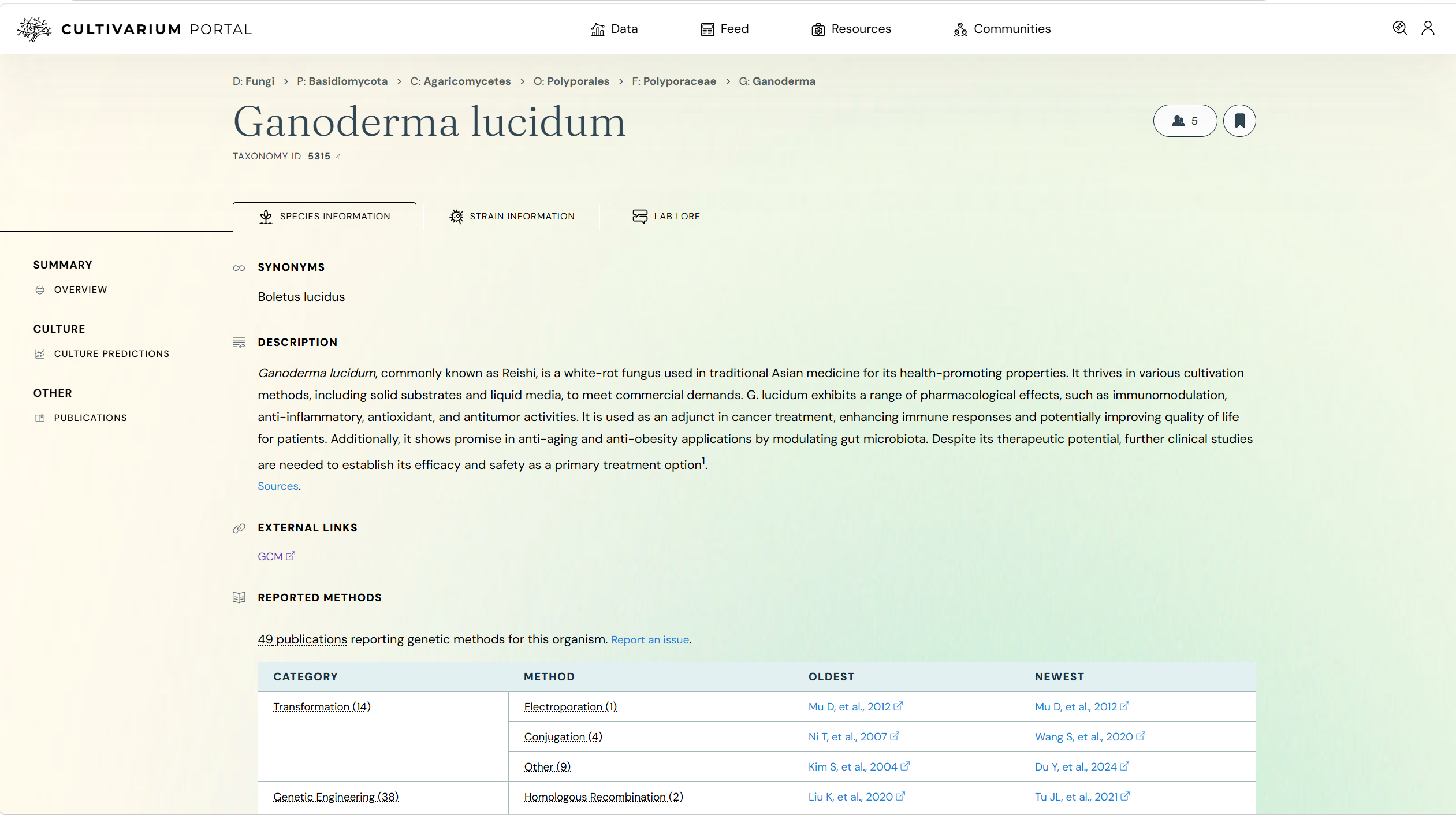
| Category | Data |
|---|---|
| Species Name | Ganoderma lucidum |
| Strain Name | Ganoderma lucidum NTU G001 |
| Link | Cultivarium Portal Link |
| Growth Media and Temperature | MALT EXTRACT PEPTONE AGAR , 24°C |
| Susceptible antibiotics, and MIC90 | |
| Functional ORIs | |
| Genome size | (~43-45 Mb) |
| Number of publications listed | 6 |
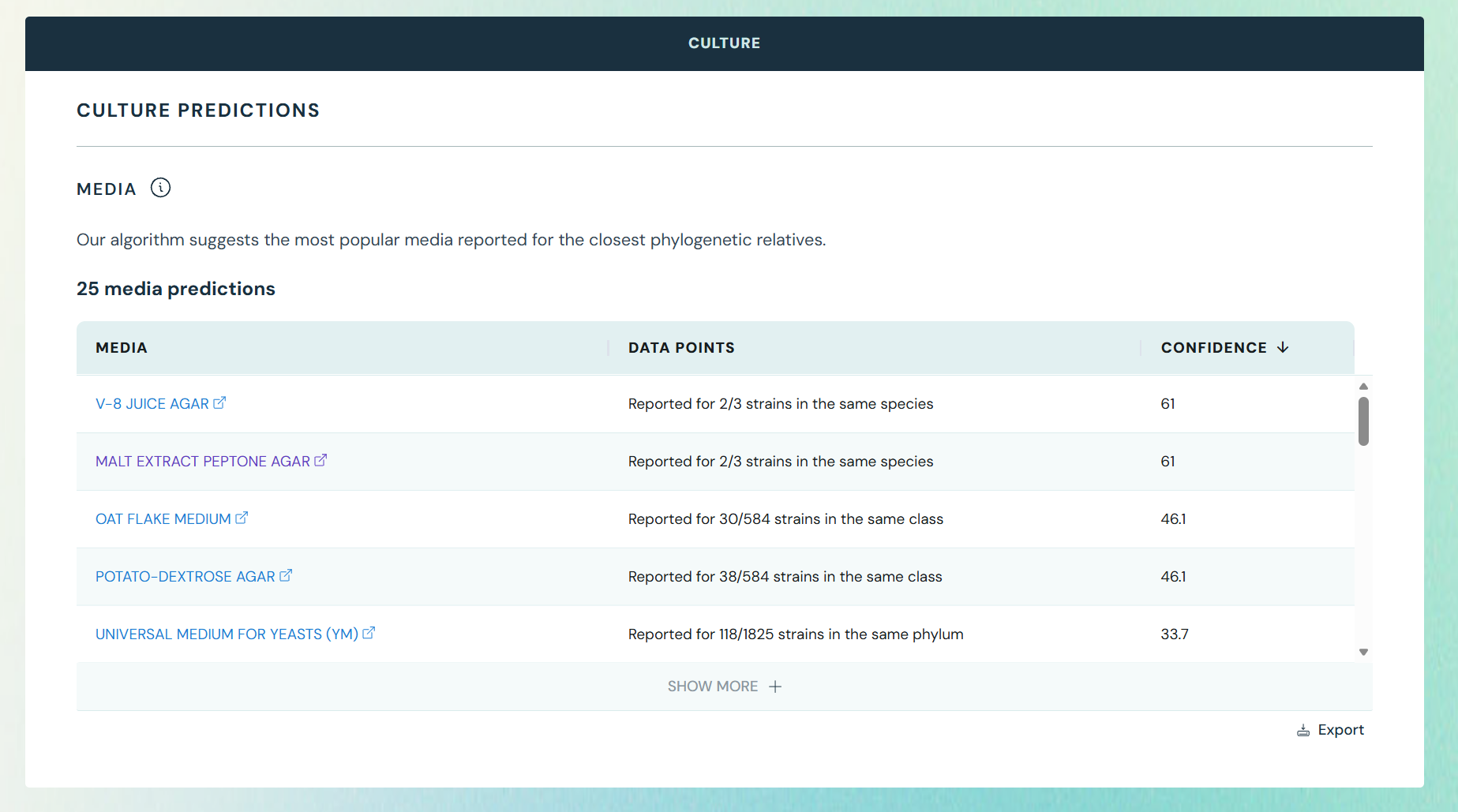
Analysis of Strain Information: With the information available, I can establish the baseline cultivation conditions (Malt Extract Peptone Agar at 24°C) necessary to grow the initial mycelial biomass for my biomanufacturing experiments. However, critical genetic engineering parameters are missing, specifically the susceptible antibiotics (MIC90), functional origins of replication (ORIs), and a precise genome sequence/size. I need the antibiotic susceptibility data to confirm whether the cbxR (carboxin-resistance) selection marker I designed in my expression cassette will be effective, or if this strain possesses innate resistance. The functional ORIs are required to ensure that my pJW-EXP-derived plasmid backbone can actually replicate within this specific isolate. Finally, without an exact sequenced genome for the NTU G001 strain, I cannot verify if the candidate nitrate-responsive promoter (Pnr) and nitrate reductase coding sequence (MG601724.1) I am targeting are completely homologous to this strain’s native genome.
3. Deliverable: Genetic Methods
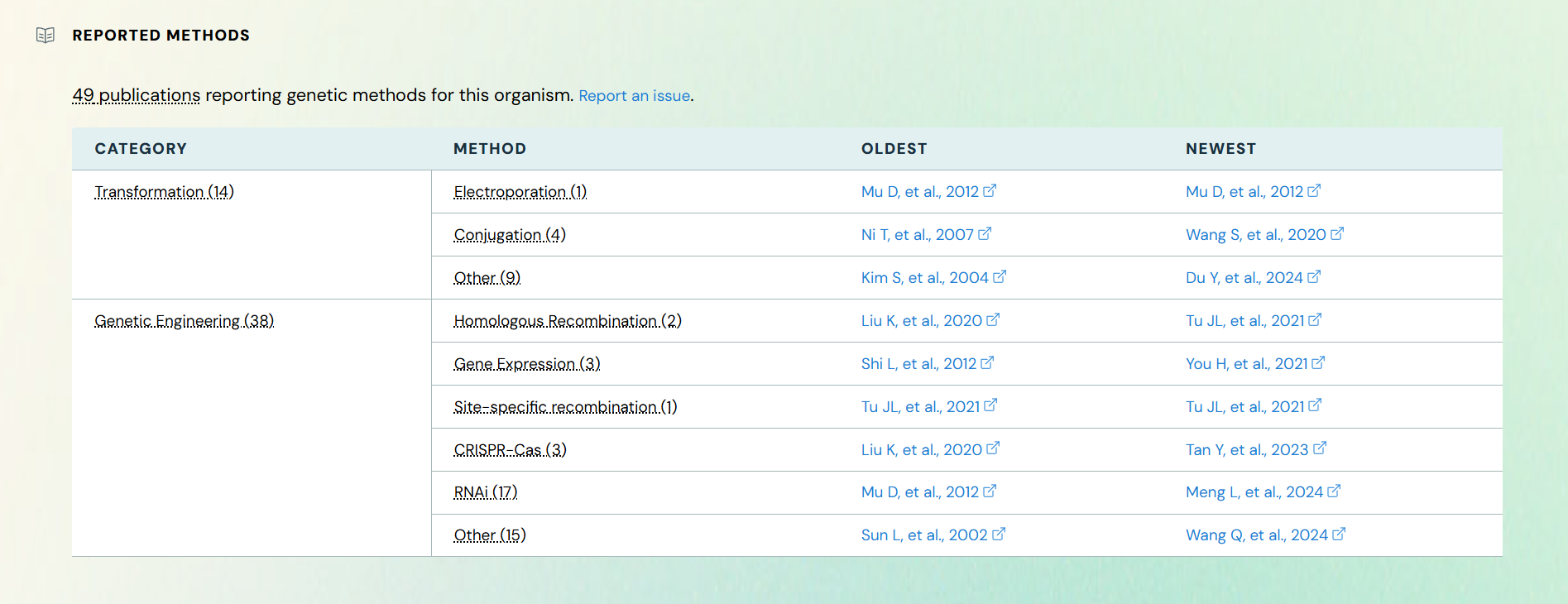
Based on the Cultivarium Portal “species information” tab, here are the reported genetic methods for Ganoderma lucidum:
List of Available Genetic Methods: The portal lists 9 distinct method categories divided into two main groups:
- Transformation (14 total publications):
- Electroporation (1)
- Conjugation (4)
- Other (9)
- Genetic Engineering (38 total publications):
- Homologous Recombination (2)
- Gene Expression (3)
- Site-specific recombination (1)
- CRISPR-Cas (3)
- RNAi (17)
- Other (15)
Total Number of Methods/Publications: There are 49 publications reporting genetic methods for this organism, covering 9 specific method categories.
Range of Years: The genetic research for G. lucidum spans a 22-year range. The oldest reported method is from 2002 (Sun L, et al., categorized under Genetic Engineering - Other), and the newest methods are from 2024 (e.g., Du Y, et al.; Meng L, et al.; Wang Q, et al.).
(Note: Because there is abundant genetic method data available for this species, a “next closest organism” is not required for this section.)
Part 2: Explore Neighbor Strains
Search Methodology & Results: To identify a suitable neighbor strain, I used the Cultivarium Taxonomy Browser to search within the same genus (Ganoderma). However, I was unable to find any closely related species that contained the required strain-level data. To resolve this, I broadened my search by traversing up the phylogenetic tree to the family level, Polyporaceae.
Since many species within this family lack detailed strain records, I optimized my search methodology by exclusively filtering for and reviewing species that possessed documented strain information. Despite a manual search through the Polyporaceae family (focusing only on species with strain data), I was unable to locate a neighbor strain that provided the specific missing data points required from Part 1 (Susceptible antibiotics/MIC90 and Functional ORIs).
Because the required comparative data was unavailable across the family level within the portal, the data table for this section has been intentionally skipped.
Part 3: From Information to Delivery - What don’t you know yet?
Review of Gathered Data & Confidence Level: From the Cultivarium Portal, I know that Ganoderma lucidum is genetically tractable, with 49 publications detailing methods like CRISPR-Cas, RNAi, and homologous recombination. I also confirmed its baseline growth media (Malt Extract Peptone Agar at 24°C). However, I am still missing critical molecular parameters: functional origins of replication (ORIs) and baseline antibiotic susceptibility (MIC90). Because even neighbor strains within the Polyporaceae family lacked this specific data in the portal, my confidence in designing an experiment is moderate. While the theoretical DNA design (from HW2) is sound, the lack of standardized, strain-specific parameters means I must conduct empirical baseline testing before full implementation.
The 3 Biggest Unknowns and Experimental Plans:
1. Unknown: Baseline Sensitivity for Selection (MIC90)
- The Risk: My HW2 design relies on an sdhB-based carboxin-resistance marker (cbxR) to select for successful transformants. Because the portal lacked MIC90 data for G. lucidum, I do not know the natural resistance level of my specific commercial strain.
- Next Experiment: Conduct a kill-curve (MIC) assay. I will plate wild-type G. lucidum on MEA plates containing a gradient of carboxin concentrations.
- Readouts: Measure mycelial radial growth (cm) or dry biomass after 7-14 days.
- What it tells me: The exact Minimum Inhibitory Concentration (MIC90) required to reliably kill non-transformed cells, ensuring I avoid false-positive colonies during genetic transformation.
2. Unknown: Functional Plasmid ORIs and Maintenance
- The Risk: I do not know which plasmid origins of replication (ORIs) are functionally stable in this specific strain, meaning my engineered plasmid (pJW-EXP-derived) might not be maintained as the mycelium grows and divides.
- Next Experiment: Transform the fungus with a simple reporter plasmid (e.g., GFP) containing the proposed backbone. Subculture the transformed mycelium repeatedly on non-selective media, then switch it back to selective media.
- Readouts: Track fluorescence via microscopy and compare growth rates on selective vs. non-selective plates over multiple generations.
- What it tells me: Whether the plasmid is maintained episomally (and is stable without constant selective pressure), whether it integrates into the genome, or if it is rapidly lost.
3. Unknown: Inducible Promoter Functionality in a Commercial Strain
- The Risk: My design utilizes a candidate nitrate-responsive promoter (Pnr) sourced from a reference genome to control the expression of nitrate reductase (NR) for nanoparticle biosynthesis. It is unknown if this reference promoter will activate predictably in my unsequenced commercial strain.
- Next Experiment: Transform the strain with the Pnr construct, grow the mycelium to maturity, and then introduce nitrate to the media to induce expression.
- Readouts: Perform RT-qPCR to measure NR transcript levels and conduct an NR enzyme activity assay before and after nitrate induction.
- What it tells me: Whether the genetic circuit successfully “turns on” as designed in this specific biological chassis before I attempt the full silver nanoparticle (AgNP) synthesis experiment.
Part 4: Final Project
Reflection on Project Proposal & Living System Design: My final project, “Predictive Biomanufacturing of Functional Mycelium-Nanoparticle Materials,” seeks to move Ganoderma lucidum from a trial-and-error organism to an automated, scalable manufacturing chassis. As highlighted in my Week 1 proposal, a major hurdle in this transition is biological variability—specifically, understanding how the fungal physiological state dictates in-situ silver nanoparticle (AgNP) formation. The Cultivarium resources (Portal, Vault, PRISM) directly address this bottleneck by attempting to provide standardized empirical data, which is essential for transitioning a non-model organism into a predictable living system suitable for automated scale-up.
Specific Tools and Intended Use:
The Cultivarium Portal & Data Vault: My current DNA design (from Week 2) relies on an sdhB-based (cbxR) selection marker and a pJW-EXP-derived vector. Because precise baseline parameters (like MIC90 and functional ORIs) are missing for my specific commercial G. lucidum isolate, my initial intention was to use the Data Vault to cross-reference validated transformation protocols and genetic parts. If comprehensive fungal data becomes available, bypassing weeks of empirical trial-and-error will allow me to transition much faster into the automated cultivation and parameter screening phase (e.g., using an Ambr 15 microbioreactor system).
PRISM: If my current nitrate reductase (NR) overexpression strategy proves inefficient at altering cellular reducing capacity, I intend to use PRISM to computationally explore alternative redox enzymes, metabolic pathways, or stronger native promoters that are conserved across neighbor strains.
Cultivarium AI Agent & Vault AI Evaluation: Throughout this assignment, I utilized both the Portal and the Data Vault AI to attempt to fill in the missing parameters for G. lucidum (CVM639). Staying critical of the tool, here is my evaluation:
Where it was helpful (Transparency & Scoping): The Vault AI was highly transparent about its own data constraints. When asked what the package contained, it clearly outlined the 13 CSV tables (covering cultivation, genetic tractability, genomes, and strain identity). It successfully identified Ganoderma lucidum in the catalog (CVM639) and correctly explained why it couldn’t answer my queries—explicitly stating that tables like
cvm_mic_analysis.csvandcvm_ori_screen.csvcontained zero rows for my target organism. It also correctly refused to hallucinate a “nearest neighbor” substitution from a bacterial strain, maintaining scientific integrity.Where it fell short (Data Scarcity for Fungi): The AI and the underlying Vault data package fell short due to a severe lack of data for non-model fungi. As the AI confirmed, the dataset heavily skews toward bacterial isolates (~200 strains). Consequently, it could not provide MIC90, functional ORIs, or genome size for G. lucidum or its closest phylogenetic neighbor in the snapshot (Coprinopsis cinerea). Furthermore, when I asked the AI to generate a plot for growth kinetics over various media, or to explain the relationship between MALT EXTRACT PEPTONE AGAR and PDA, it could not fulfill the request because fungal media screening data was completely absent from the snapshot. This demonstrates that while the AI is an excellent querying tool for the data it possesses, it cannot overcome the fundamental experimental data gaps that currently exist for Basidiomycota in the database.