Week 2 HW: DNA Design
This design advances my Week 1 proposal for structurally coloured cellulose films. I want a black, melanin-containing bacterial-cellulose backing to deepen the contrast of a separate colour-producing layer. For this assignment, I assembled a Tyr1 tyrosinase expression cassette in Kernel. The digital construct is a proposed component for a future prototype; I have not built or tested a pigmented film (Baig, 2026; Walker et al., 2025).
Kernel workspace
I used the HTGAA 2026 workspace and the baig-growingcolours repository. The saved construct is named J23104-B0034-tyr1-B0015 melanin cassette. Figure 1 shows it in Kernel (Asimov, 2026).
1. Expression target
The target is Tyr1, a 297-amino-acid tyrosinase derived from Bacillus megaterium. Tyr1 catalyses oxidation of L-tyrosine toward melanin formation. I would use the dark pigment as the backing to the cellulose-based colour layer (National Center for Biotechnology Information [NCBI], n.d.; Walker et al., 2025).
The proposed chassis is Komagataeibacter rhaeticus. This bacterial-cellulose producer was part of my Week 1 proposal and has been studied as a host for engineered cellulose and melanin production (Baig, 2026; Florea et al., 2016; Walker et al., 2025).
2. Parts and vector context
| Layer and Kernel part | Source and length | Reason for choice |
|---|---|---|
| Promoter: J23104 | iGEM BBa_J23104; 35 bp | Constitutive transcription. I would measure its strength with Tyr1 in K. rhaeticus (Florea et al., 2016; iGEM Registry of Standard Biological Parts, n.d.-c). |
| RBS: B0034 plus spacer | iGEM BBa_B0034, 12 bp; designed TACTAG spacer, 6 bp | Bacterial translation initiation (iGEM Registry of Standard Biological Parts, n.d.-b). |
| CDS: Tyr1 | GenBank MT346028, positions 2277–3170; 894 bp | Tyrosinase associated with melanin production (NCBI, n.d.; Walker et al., 2025). |
| Terminator: B0015 | iGEM BBa_B0015; 129 bp | Double terminator after the Tyr1 stop codon (iGEM Registry of Standard Biological Parts, n.d.-a). |
| Target backbone: pSEVA331Bb | Addgene plasmid #78269; approximately 2,893 bp | Proposed plasmid context for a K. rhaeticus prototype (Addgene, n.d.; Florea et al., 2016). |
The 1,076 bp Kernel construct contains the expression cassette. The selected pSEVA331Bb backbone is a proposed build target and is not part of the saved Kernel cassette.
3. Assembled cassette and reading frame
| Region | Kernel coordinates | Orientation and check |
|---|---|---|
| J23104 promoter | 1–35 | Forward |
| B0034 plus spacer | 36–53 | Forward; Tyr1 starts immediately after the spacer |
| Tyr1 CDS | 54–947 | Forward; ATG at 54–56 and TGA at 945–947 |
| B0015 terminator | 948–1076 | Forward; follows the Tyr1 stop codon |
The CDS has 297 sense codons followed by one stop codon. Kernel displayed a construct length of 1,076 bp. Figures 1 and 2 document the saved cassette; the schematic export does not label its individual parts, so the table above supplies their positions (Asimov, 2026).
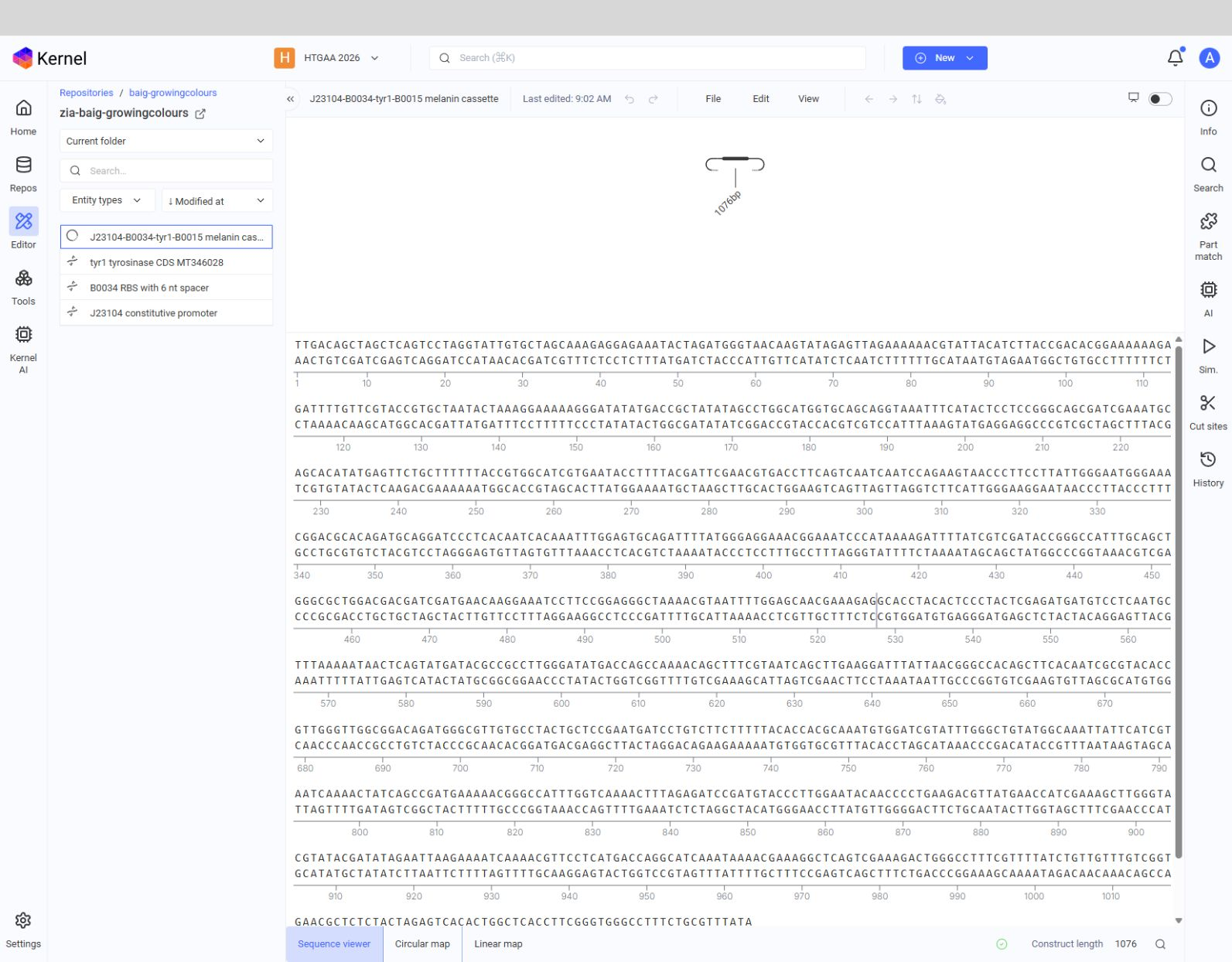
Figure 1. Kernel editor showing the saved cassette in baig-growingcolours (Asimov, 2026).

Figure 2. Schematic exported by Kernel. The export lacks individual part labels; the table above supplies the coordinates (Asimov, 2026).
4. Optimization and sequence checks
Kernel codon optimizer
I submitted the native 894 bp Tyr1 CDS to Kernel SIMPLE_0_3 with Escherichia coli as the expression host because K. rhaeticus was absent from its four available hosts. The result is 897 bp, with 172 substitutions across the 891 sense-coding bases. GC content changed from 43.85% to 44.93%, and the output added a TAA after the native TGA. Local translation confirmed the same 297 amino acids. I used this E. coli variant only as a comparison; I did not substitute it into the K. rhaeticus construct (Asimov, 2026).
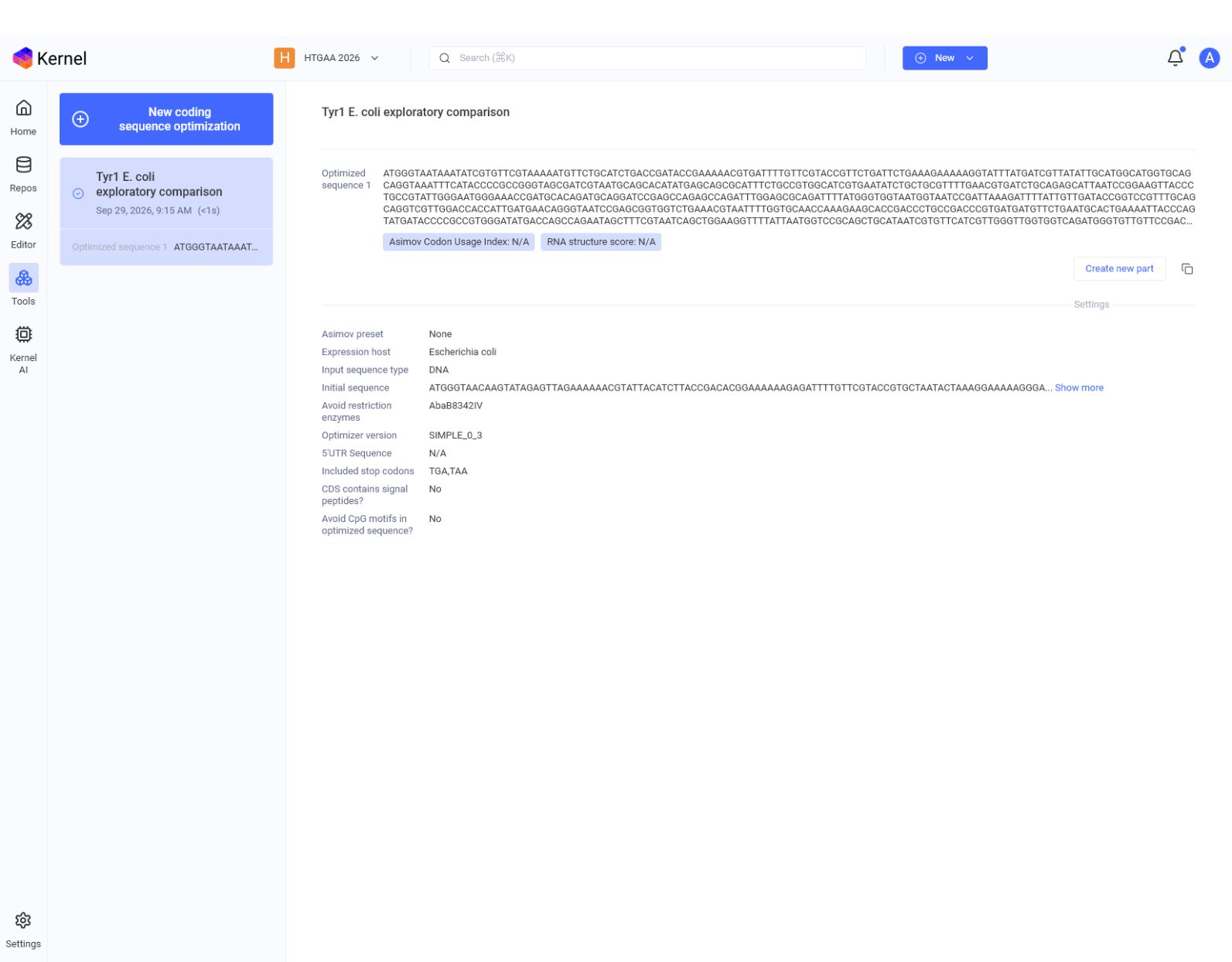
Figure 3. Kernel optimizer output and recorded run settings (Asimov, 2026).
Sequence identity
I compared the saved CDS base for base with the published MT346028 Tyr1 region used to create it: all 894 positions match, and the translated protein matches QLI61466.1 (NCBI, n.d.). This is a comparison with the selected reference sequence, not a broad similarity search. The revised document reports no biosecurity scan result.
5. From digital design to DNA
For one prototype, I would order an insert covering the 1,076 bp cassette and place it in the verified pSEVA331Bb multiple cloning site using overlap-based assembly. I would then sequence the full insert and both vector junctions in an isolated clone before testing pigment formation. Overlap-based assembly has been demonstrated for joining DNA fragments, and sequence verification is important because synthesized DNA can contain errors (Carr et al., 2004; Gibson et al., 2009; Kosuri et al., 2010).
I believe one verified clone is enough to begin promoter and pigment tests. The assembly, sequencing and pigment tests remain proposed work.
6. Main unknowns and next tests
| Uncertainty | Test and decision |
|---|---|
| Tyr1 expression may be too weak or burdensome | Compare weaker promoter variants with the same Tyr1 CDS; measure transcript or protein level, growth and cellulose yield. Keep the lowest expression that gives adequate colour. |
| Active tyrosinase and pigment placement are unproven in this host | Measure Tyr1 activity, melanin accumulation, copper dependence and pigment distribution; test variants if the initial design underperforms. |
| A dark backing may not improve the final optical film enough | Test layers with and without pigmented cellulose; compare contrast and colour. |
References
Addgene. (n.d.). pSEVA331Bb (Plasmid #78269). https://www.addgene.org/78269/
Asimov. (2026). Kernel [Software]. https://www.asimov.com/kernel
Baig, Z. (2026). Week 1 HW: Final project ideas. HTGAA Pages. https://pages.htgaa.org/2026b/zia-baig/week-01-hw-project-ideas/
Carr, P. A., Park, J. S., Lee, Y.-J., Yu, T., Zhang, S., & Jacobson, J. M. (2004). Protein-mediated error correction for de novo DNA synthesis. Nucleic Acids Research, 32(20), e162. https://doi.org/10.1093/nar/gnh160
Florea, M., Hagemann, H., Santosa, G., Abbott, J., Micklem, C. N., Spencer-Milnes, X., de Arroyo Garcia, L., Paschou, D., Lazenbatt, C., Kong, D., Chughtai, H., Jensen, K., Freemont, P. S., Kitney, R., Reeve, B., & Ellis, T. (2016). Engineering control of bacterial cellulose production using a genetic toolkit and a new cellulose-producing strain. Proceedings of the National Academy of Sciences, 113(24), E3431–E3440. https://doi.org/10.1073/pnas.1522985113
Gibson, D. G., Young, L., Chuang, R.-Y., Venter, J. C., Hutchison, C. A., III, & Smith, H. O. (2009). Enzymatic assembly of DNA molecules up to several hundred kilobases. Nature Methods, 6, 343–345. https://doi.org/10.1038/nmeth.1318
iGEM Registry of Standard Biological Parts. (n.d.-a). BBa_B0015. https://registry.igem.org/parts/BBa_B0015
iGEM Registry of Standard Biological Parts. (n.d.-b). BBa_B0034. https://registry.igem.org/parts/BBa_B0034
iGEM Registry of Standard Biological Parts. (n.d.-c). BBa_J23104. https://registry.igem.org/parts/BBa_J23104
Kosuri, S., Eroshenko, N., LeProust, E. M., Super, M., Way, J., Li, J. B., & Church, G. M. (2010). Scalable gene synthesis by selective amplification of DNA pools from high-fidelity microchips. Nature Biotechnology, 28, 1295–1299. https://doi.org/10.1038/nbt.1716
National Center for Biotechnology Information. (n.d.). Cloning vector pJV298-Tyr1, complete sequence (GenBank accession MT346028) [GenBank record]. https://www.ncbi.nlm.nih.gov/nuccore/MT346028
Walker, K. T., Li, I. S., Keane, J., Goosens, V. J., Song, W., Lee, K.-Y., & Ellis, T. (2025). Self-pigmenting textiles grown from cellulose-producing bacteria with engineered tyrosinase expression. Nature Biotechnology, 43(3), 345–354. https://doi.org/10.1038/s41587-024-02194-3