Week 2 HW: DNA Design
Project scope and AI assistance
My HW1 project, Glumen, aims to produce a gluten-binding protein for a gluten detector. For HW2, I used an existing computational protein candidate to explore how to move from a protein sequence to a DNA expression design while the gluten-binder work continues.
Much of this write-up was written by OpenAI Codex as an AI-assisted exploration of the topic. Codex also did substantial technical work: retrieving the candidate, generating and checking sequence files, helping inspect the design in VectorBee, and capturing screenshots. This is a learning exercise, not a claim that I independently designed or validated every element. I am still developing my understanding of the terminology and design choices.
We did not have access to Kernel. We used VectorBee to inspect the constructs, with Biopython and DNA Chisel for local sequence generation, optimization, and checks. No Kernel repository was created and no Kernel tools were run. Database similarity searching and biosecurity screening remain incomplete, so this draft does not claim that every assignment requirement has been fulfilled.
The practice candidate was designed to bind human transglutaminase 2 (TG2). It is not a gluten binder, and its binding has not been experimentally validated. Using it gave us a concrete sequence for exploring the DNA-design workflow.
Part 0 — Workspace and tools
The local workspace is HTBAA/HW2/practice-v1. It contains source sequences, an annotated construct, a saved VectorBee workspace, screenshots, and a detailed step-by-step walkthrough. (The data files linked below are published with this page; the full walkthrough is kept in that local workspace.)
The original backbone and modified construct were opened in VectorBee to inspect their maps and sequence annotations. The local folder serves as the homework workspace; it is not a substitute for a findable Kernel repository.
Part 1 — Define the expression target
The intended product is a small protein binder. For this exercise, we used the 90-amino-acid candidate rf_9_dldesign_0, generated in my earlier RFdiffusion and ProteinMPNN work against TG2.
The original candidate sequence is:
Its identity and original source are recorded in the candidate provenance file.
The proposed expression host is E. coli BL21(DE3). The design uses a T7 promoter, so the host must supply T7 RNA polymerase. The protein would remain inside the cell, in the cytoplasm, followed by extraction and purification.
The proposed product is one joined protein:
Start methionine (M) → purification handle (HHHHHH) → short spacer (GSG) → 90-amino-acid candidate
The six histidines, called a His6 tag, provide a handle for affinity purification. The GSG spacer is three amino acids—glycine, serine, glycine—connecting that handle to the candidate. Together with the starting methionine, these additions give a 100-amino-acid protein. The candidate itself is unchanged.
No secretion signal or dedicated tag-cleavage site is included. The proposed purified protein would retain its tag; whether the tag affects binding remains an experimental question.
Part 2 — Start with an existing plasmid and replace one section
I used the pET-28a(+) backbone based on the sequence from SnapGene’s sequence resource, and replaced the original tag and cloning region with the candidate coding sequence.
A plasmid is a circular piece of DNA. Its backbone is the reusable supporting DNA: it lets bacteria maintain the plasmid and provides controls for reading the protein instructions.
The before-and-after comparison is:
| Section | Original plasmid | Our design |
|---|---|---|
| Controls for reading the protein instructions | T7 promoter, lac operator, and ribosome binding site | Kept unchanged |
| Protein-coding and insertion region | Original tags and cloning region: 163 DNA bases | Replaced with 303 bases encoding our tagged candidate and its stop codon |
| Signal to stop copying the instructions into RNA | T7 terminator | Kept unchanged |
| Supporting DNA elsewhere around the circle | Replication, selection, and regulation features | Kept unchanged |
We removed the original tag-and-cloning section and supplied our own defined version. We did not add a second set of tags on top of the existing ones. The replacement corresponds to bases 88–250 in the locally oriented source record; those coordinates refer to that record, not necessarily other displays of the same circular plasmid.
| Part | Source | Plain-English role and reason for including it |
|---|---|---|
| T7 promoter and lac operator | Existing backbone | Control when the protein instructions are copied into an RNA message. |
| Ribosome binding site (RBS) | Existing backbone | Provide a landing site on that message for the protein-making machinery; retain its original spacing to the start codon. |
| Tagged candidate coding sequence (CDS) | Earlier protein design; DNA generated locally | Encode the complete proposed protein, including its purification handle and spacer, with start and stop instructions. |
| His6 tag and GSG spacer | Added in this design | Provide a purification handle and a short flexible connection to the binder. These are already included within the CDS, not separate proteins. |
| T7 terminator | Existing backbone | Signal the end of copying DNA into the RNA message. |
| Origin of replication | Existing backbone | Allow bacteria to copy and maintain the plasmid. |
| Kanamycin-resistance marker | Existing backbone | Allow selection of bacteria carrying the plasmid. |
| lacI and its promoter | Existing backbone | Provide the repressor that helps control expression. |
The exact sequences, coordinates, and sources are recorded in the parts table.
Part 3 — Assemble and inspect the construct
The expression region follows this order:
Reading controls → ribosome landing site → instructions for our tagged protein → stop-copying signal
In the terminology used on the map:
T7 promoter / lac operator → RBS → tagged candidate CDS → T7 terminator
The final circular plasmid is 5,509 base pairs: 5,369 original bases − 163 removed bases + 303 inserted bases. The 303-base CDS contains 300 bases encoding the 100-amino-acid protein and three bases forming the stop codon.
The annotated sequence was generated locally and inspected in VectorBee. Saved computational checks confirm that:
- The CDS translates into the intended tagged protein.
- There are no internal stop codons.
- Backbone DNA outside the intended replacement is unchanged.
- The proposed assembly fragments reconstruct the final circular sequence.
These checks establish consistency of the sequence design. They do not establish expression, folding, or binding.
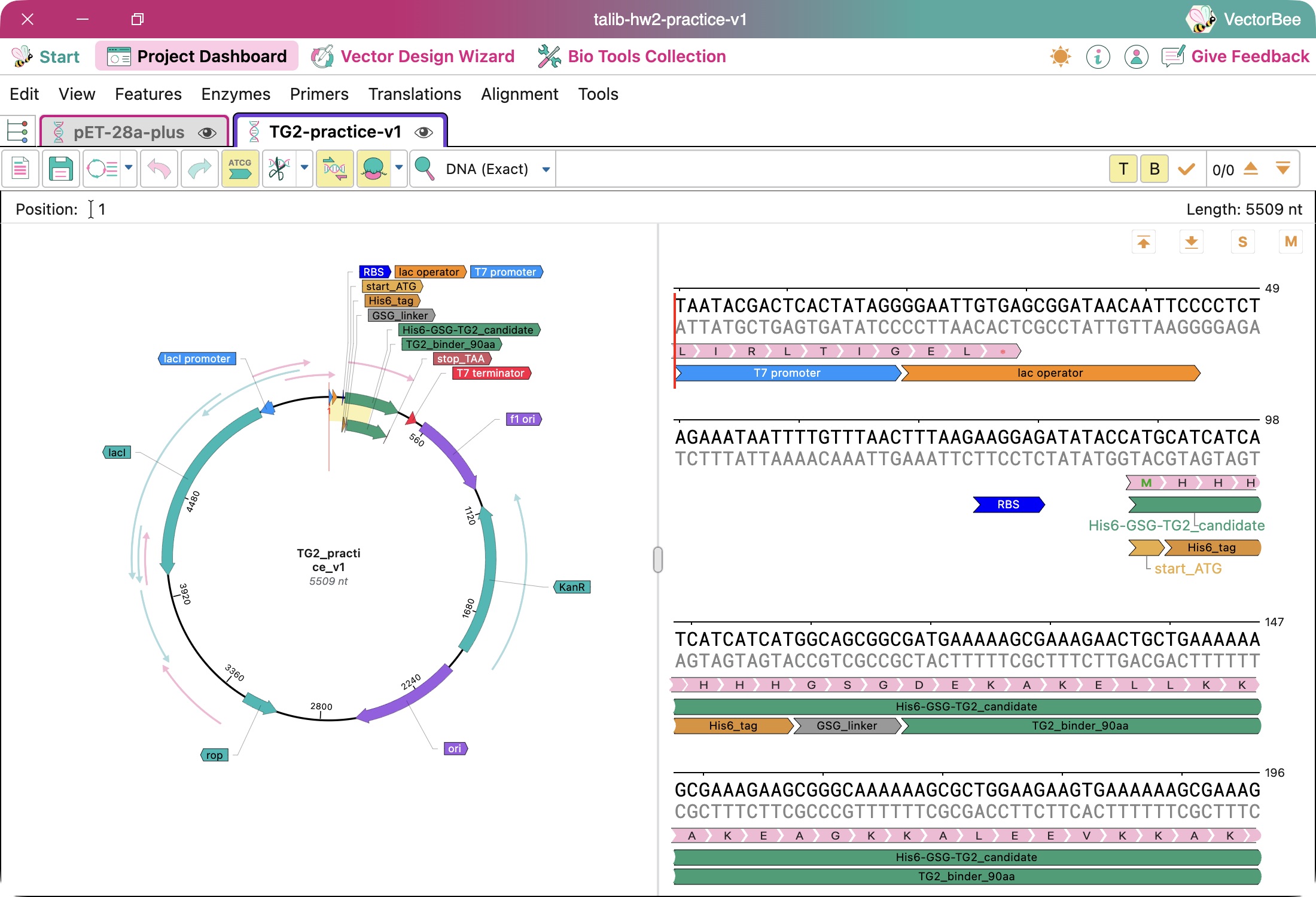
Figure 1. The final plasmid in VectorBee, showing the candidate CDS and retained backbone features.
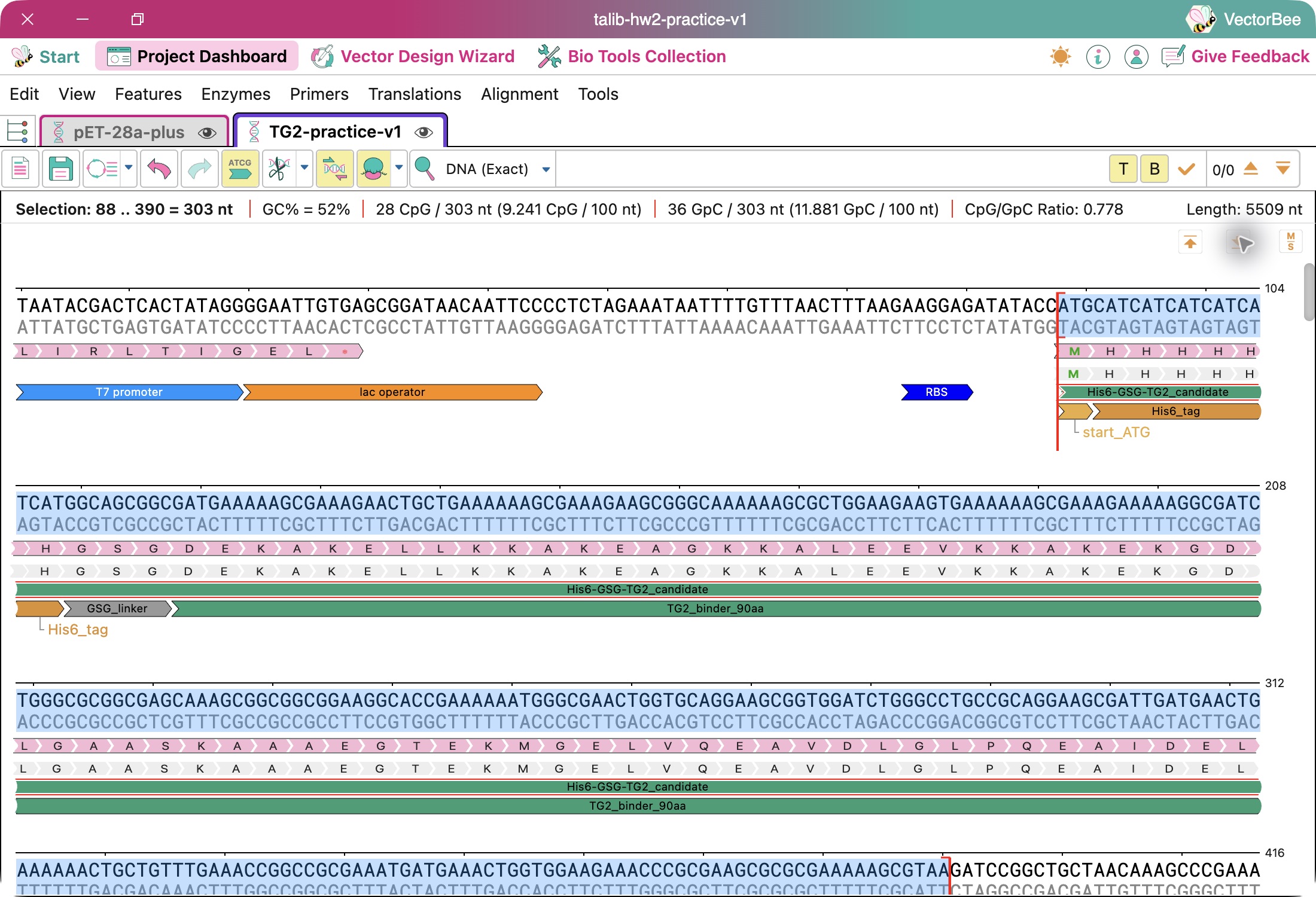
Figure 2. The selected 303-base CDS, with the start codon, His6 tag, GSG spacer, and candidate translation. Overlapping annotations and translation rows describe the same sequence; they are not additional protein copies.
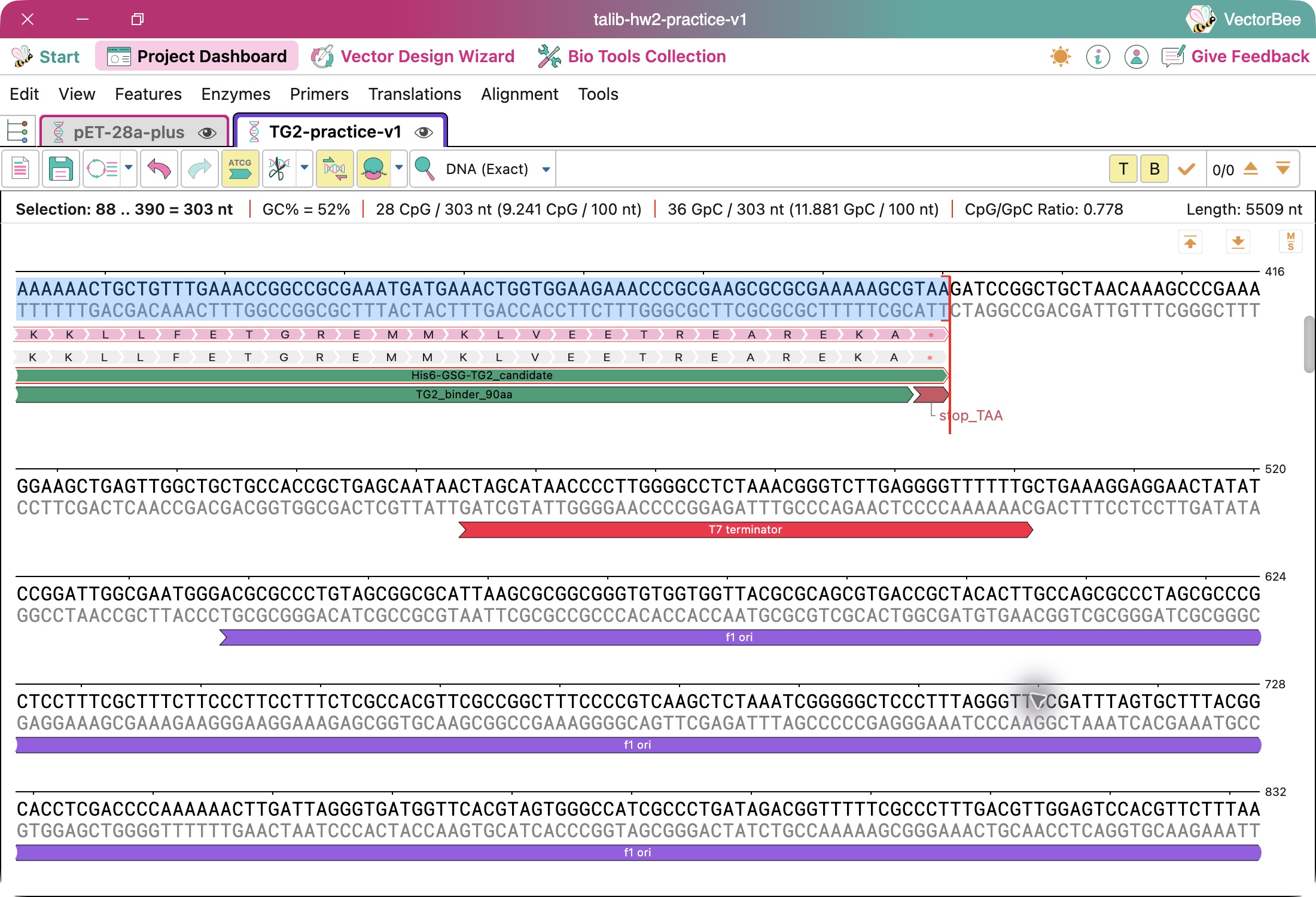
Figure 3. The TAA stop codon tells the cell to stop making this protein. The separate downstream T7 terminator signals the end of copying DNA into RNA.
The annotated GenBank file, saved VectorBee workspace, and check results are retained with the design.
Part 4 — Optimize and quality-check
Codon optimization — completed locally
Because this is a de novo protein candidate, there was no natural gene sequence to use as the starting DNA. We generated a synthetic baseline and used the open-source tool DNA Chisel to optimize codon usage for E. coli while preserving the protein sequence.
A codon is a group of three DNA letters that specifies an amino acid or a stop. Different codons can specify the same amino acid, allowing the DNA to change without changing the protein.
| Metric | Before | After |
|---|---|---|
| GC content, excluding the stop codon | 50.33% | 52.33% |
| Codon adaptation index against the saved usage table | 0.5828 | 1.0000 |
| Intended protein sequence | 100 amino acids | Unchanged |
GC content is the percentage of DNA letters that are G or C. Roughly half the letters are G or C in both versions. We tracked it as a sequence-design constraint; higher is not automatically better.
Of the 100 amino-acid-encoding codons, 62 changed, involving 67 nucleotide substitutions. Constraints included limits on overall and local GC content, avoiding long single-base repeats, and excluding selected restriction sites from the coding region.
A codon adaptation index of 1.0 means the selected codons maximize the score against this particular usage table. It does not mean perfect expression. RNA structure, protein folding, and other biological factors remain relevant. The before-and-after codon comparison records the changes.
Sequence similarity search — incomplete
We verified that the designed DNA encodes the intended candidate, but have not searched it against a database of known sequences. I therefore cannot report a closest natural match or conclude that the sequence is novel.
A later step would be to search both the untagged protein and designed CDS, recording the database, settings, closest matches, identity, coverage, and E-values.
Safety screening — incomplete
We did not have access to Kernel’s screening tool and have not run an equivalent biosecurity screen. The local checks address sequence integrity and selected design constraints; they do not substitute for screening against defined biological hazards.
No screening pass or absence of flags is claimed.
Part 5 — From design to physical DNA
For a first prototype, my proposed approach is to obtain a synthetic insert and assemble it with the retained backbone. The saved design specifies a 363-base insert including overlap regions and a 5,206-base retained backbone. The overlapping ends allow the two pieces to join; those shared bases are not counted twice in the final plasmid.
This approach reuses most of the existing vector and introduces only the new coding region. Gibson et al. describe joining DNA fragments through overlapping ends, supporting this proposed assembly strategy. Fragment joining has been checked computationally; no physical assembly has been performed. Gibson et al., 2009
The coding sequence is short and has moderate GC content, but repeated codons and other local features could still affect synthesis. A supplier has not assessed or accepted the design. Primer design and laboratory conditions also remain outside the completed work.
Carr et al. describe error correction for synthetic DNA. The practical lesson for this construct is that synthesis can introduce errors. I would verify the resulting sequence and assembly junctions before interpreting protein experiments; error correction during synthesis would not replace final verification. Carr et al., 2004
For repeated production of the same protein, the goal would be to retain a verified production clone and scale expression and purification. The gene would not need to be chemically resynthesized for every batch. Producing many different binder candidates would require a separate strategy for DNA synthesis, assembly, and identification.
Part 6 — What remains uncertain?
| Unknown | How I would investigate it |
|---|---|
| Will the construct produce enough protein without excessive burden on the cells? | Compare induced and uninduced expression, cell growth, and protein abundance. |
| Will the protein be soluble and suitable for further testing? | Compare soluble and insoluble fractions, then assess recovered yield, purity, and aggregation. |
| Will the candidate bind TG2 specifically, and does the tag affect binding? | Measure concentration-dependent binding with unrelated-protein controls; compare a tag variant if needed. |
Even a positive result against TG2 would not establish gluten binding. Moving back to Glumen would require an actual gluten-binder candidate, an updated construct, and appropriate binding and selectivity tests.
Open-source follow-up to explore later
We have already used open-source tools for sequence generation, optimization, and checking. If time permits, the next priorities are:
| Follow-up | Possible tool | Intended result |
|---|---|---|
| Search for related known sequences | NCBI BLAST+, using downloaded databases | A documented similarity-search result without submitting the candidate to a public search service. |
| Investigate an alternative biosecurity screen | SecureDNA’s open-source tools and screening infrastructure | Establish access requirements and, if available, obtain an actual screening report. |
NCBI documents local BLAST+ searching. SecureDNA provides open-source components and screening documentation. We still need to establish the appropriate access and setup, and should not assume its screening scope is identical to Kernel’s.
These are proposed follow-ups, not completed results.
AI use and prompts
OpenAI Codex wrote much of this document and performed substantial portions of the computational workflow. My role included providing the project context, requesting the exploration, reviewing the explanations, and asking for clarification of concepts such as the tag, spacer, coding sequence, and GC content. The document is an account of AI-assisted exploration rather than independent experimental work. No DNA was ordered and no expression or binding experiment was performed as part of this exercise.
The original design-work prompt, as recorded in the walkthrough, was:
“ok if you were going to go ahead and help with this assignemtn can you get th binder sequence or a sample one? maybe we can start with one we have and then we can improve it . make it later? and contuie with the rest of the steps . make sure each step is super clear what you do what happend and that I can follow - take screenshots if need be. I want to follow step by step and see the full restults”
For this write-up, I asked:
“ok can you suggest good answers here - that I can review - say we didnt have Kernel but show the parts we did do and what we could do with open source if we have time (which we shoudl look at later)”
I also requested VectorBee screenshots and a plain-English explanation of the original plasmid and the section replaced. For finalization, I asked:
“lets go ahead and finalize this draft Md - and acknwoledge much of this was written by Ai as an exploration of this topci and didnt have access to Kernel”