Homeworks
Homeworks
HTBAA 2026 homework documentation.
HTBAA 2026 homework documentation.
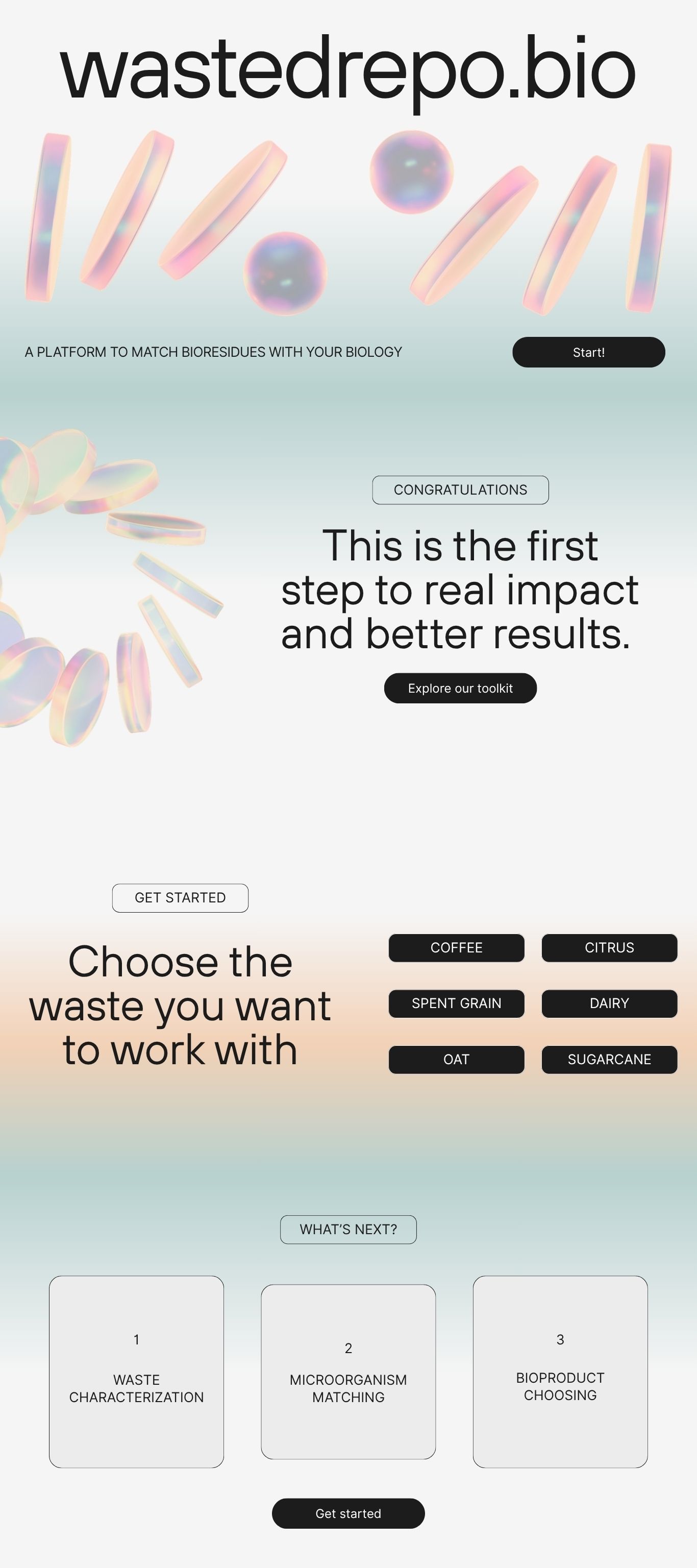 made with Canva using a template
I want to build a platform that matches bioresidues with microorganisms that can metabolize them as well as the bioproducts that can be biomanufactured with them. The platform generates the research process desing by providing experimental steps for the user. It is connected to an automated biolab which is in charge of media preparation, inoculation, sampling and incubation. The results feed the platform by using automated analysis of samples and updates its repository accordingly.
The living system that could make it probably is me :) as this is a platform.
Automation could be in charge of performing continuos experiments in order to update the repository. Along with other features such as the research process and experiment design being provided on the platform.
Creating this platform at a meaningful scale would require a lot of time and resources, as it relies on building a library continuosly updating itself. Yet it should be started at some point. I therefore have determined 10 residues I can tackle and match with microorganisms as well as possible bioproducts that could be obtained.
Since my project idea is a platform for matching bioresidues to microorganisms that could metabolize them and produce products using them, I decided to tackle a certain type of waste (coffee waste) and design a system that would break it down to its simpler carbohydrates and produce PHB out of it.
Goal: using the collective intelligence of the HTBAA community and accessible AI systems, design novel CFPS reaction compositions for each of the three target proteins: sfGFP, PETase, and Reteplase to reduce the cost per gram of functional protein. Each design should be compatible with the experimental framework described above and should reflect the distinct expression and folding requirements of that protein. You can learn more about the details of the coopetition here.
A. COMPARE CELL-FREE REACTION COMPOSITIONS (20 minutes)
Why does the concentration of potassium glutamate and magnesium glutamate differ between compositions? Which is more sensitive?
Explain how a PEP+NTP reaction formulation is different from a Ribose+NMP reaction formulation.
Choose two cell-free reaction compositions from the literature, compare and contrast the choice of reagents and the concentration of reagents.
Note: A recommended starting point would be to review a least one published formulation, such as PANOx-SP (Jewett & Swartz 2004), a cost-optimized formulation from Olsen et al. (2026), and/or an AI-designed formulation from Smith et al. (2026).
B. DESIGN ONE REACTION COMPOSITION FOR EACH OF THE THREE PROTEINS (40 minutes)
Sign in to coopetition.htgaa.org and publish your first unique 20 µL CFPS reaction composition for each of the following (don’t worry, you can resubmit later): sfGFP PETase Reteplase
Note: if you’re unable to login with your HTGAA keycloak account, please post in Zulip so that you can participate in the coopetition!
For each composition, specify the reagents you would adjust from the relevant categories, including salts, energy sources, building blocks, cofactors, and redox components.
As a HTBAA research team, we will have the opportunity to suggest new reagents to add to the cell-free reagent inventory. Contribute (or upvote) at least one reagent to the “Community Reagents” section of the website and provide a short rationale. Include in your homework documentation how you decided on that specific reagent and provide links to any relevant research.
Visit the cfps-coopetition forum page to ensure you will be able to take part in the discussion. Bonus: send a note in the channel about a CFPS optimization idea that you have! If you would like clarification on aspects of the project, please message in this dedicated channel.